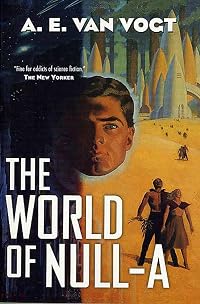
On This Page
Description
A classic novel of non-Aristotelian logic and the coming race of supermen.Tags
Recommendations













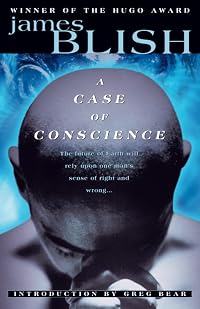
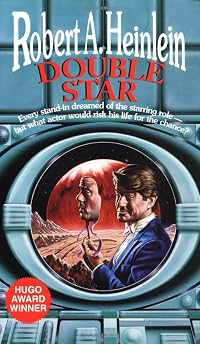

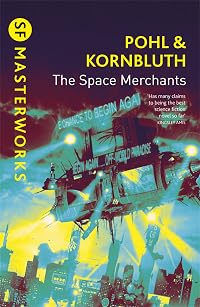

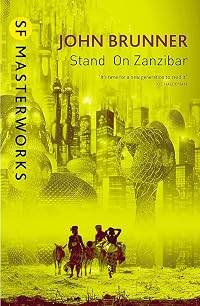




Member Recommendations


Member Reviews
This was a reread, although I forget when I originally read it, probably in the late 1970s or early 1980s. I’d always wanted to finish the trilogy – of which this is the first book – and last year stumbled across copies of The World of Null-A and The Players of Null-A at Fantasticon in Copenhagen and bought them (they were very very cheap, very very very cheap). I have all three books – in the nice NEL editions from the 1970s – and have had them for many years, but they’re in storage at present. Having found cheap copies of the first two, I thought it worth giving them a go. That was a mistake. I mean, I know what van Vogt’s fiction is like. I have, after all, read enough of it. Admittedly, that was back in the late 1970s show more and early 1980s, when I was a teenager. But every book I’ve read by him since I turned, say, thirty, has been awful – except perhaps rereads of the handful of his books I continue to think are not absolutely awful, such as The Undercover Aliens. Gilbert Gosseyn is in the city to take part in the Games, in which thousands participate, all overseen by a giant computer brain. Players are given jobs depending on how far they reach in the Games. But it turns out Gosseyn’s life is a complete lie – someone has implanted memories in him that are simply not true. And given that on the night before the Games start all laws in the city are temporarily rescinded and people lock themselves away in groups for safety… but Gosseyn’s identity can’t be established so he’s forced out onto the streets, where he meets a young woman and the two look out for each other… But it turns out she’s the daughter of the president, and it’s all a plot as the president is trying to destroy the giant computer brain, because there’s some secret galactic empire that wants to invade the earth… And Gosseyn was more or less grown to order to foil the secret galactic empire’s plans because… he has two brains! Or is it minds? I forget. And all this is wrapped around some guff about non-Aristotelian, or “null-A”, logic, which seems to be basically non-binary logic, or fuzzy logic. But, of course, binary logic is for computers, not people, so it’s not entirely clear what van Vogt is going on about. But then, that’s true of a lot of Golden Age science fiction: it’s complete bollocks, written by people who had no idea what the fuck they were wittering on about, but it managed to impress the shit out of poorly-socialised thirteen year old boys. And from such was a genre born. The really scary part of all this is not that the writers actually believed the shit they were peddling, or even that some were quite cynical about it – hello Elron and that evil “religion” you invented! – but that many adult fans were just as impressionable as those thirteen year olds. Van Vogt famously based his writing on the advice given by a how to write book – and there’s another genre entirely dependent on gullibility – chief among which was that scenes should be 800 words long and end on a cliff-hanger. Van Vogt took this advice, well, literally. And reading his books is like watching a magician pull a series of increasingly unlikely series of creatures out of a hat when you actually turned up to see a drag queen lipsynch the hits of Rihanna. I connected with a few of van Vogt’s novels as a young teenager, which mistakenly led me to believe he was an author whose oeuvre I should explore. And during the 1970s and 1980s, I bought and read his books. They were readily available in WH Smith during that period. But reading his books now, nearly forty years later… I’m slightly embarrassed at having been taken in all those years ago. He was an appalling writer, and the level of his success is mystifying. That people continue to champion him tells you more about them than, well, you really want to know. He’s a lot like Asimov in that respect. The World of Null-A is typical van Vogt and really quite bad. This is not surprising. One for fans of van Vogt, I suspect. And if you’re a fan of van Vogt, I can only ask… why? show less
I remember having either this book or its sequel, The Players of Null-A, on my shelf when I was much younger, but I never got around to reading it. Having just gotten hold of the eBook version, I was expecting a fairly entertaining, if dated, novel, but was disappointed. I was, in fact, completely underwhelmed. Gilbert Gosseyn lives in 2560 AD, an era in which mastery of the mental disciplines of Non-Aristotelian logic gives superior intelligence, emotional control, and even athleticism to its adepts. As the story opens, he is about to begin a month of testing by the Machine, success in which is the gateway to a better job, or even residence among the elite on Venus. We are then presented with a rapid succession of ideas, none of which show more are ever adequately developed. It quickly emerges that Gosseyn's memories of his past life are false. He soon discovers that the government of Earth has been taken over by subversives who are allied to a Galactic Empire. He is then killed. and shortly resurrects in another body, which is a surprise to himself as well as his adversaries. An invasion of both Earth and Venus by the galactics follows. These ideas could have made for an intriguing book if well presented; but the ideas alone do not make up a coherent, engaging novel.
What I found annoying about The World of Null-A is that Van Vogt constantly introduces concepts, characters, events, and plot elements by merely mentioning them in passing, without ever developing or explaining them. In my opinion, this practice – which is pervasive throughout the book – really destroys the story. The titular concept, Null-A, is depicted as almost miraculous in allowing humans to realize their potential, but it's never explained in any way that makes it remotely credible. The great Galactic Empire consists of human beings, evidently not of Earth origin, but their actual origin is never explained. Parallel evolution? Is Earth a lost colony? No one even speculates. When Van Vogt describes a device or technology, it is completely unconvincing. Granted, this is science fiction, and one doesn't expect accurate science in any but "hard" SF, but the depiction of science and technology must cohere at least to the point that the reader can maintain “willing suspension of disbelief”. Yet when Van Vogt introduces a device called the “Distorter”, it is at one point a device that dampens computing power and neurological activity, and is later revealed to also serve as a teleporter. The pseudoscience with which the distorter is described is, even by the standards of 1948, sheer gobbledegook, effectively making the device a “Deus ex machina”. My objections to this novel are well summed up in Damon Knight's 1970 review “Cosmic Jerrybuilder”. To quote: "The World of null-A abounds in contradictions, misleading clues and irrelevant action...It is [van Vogt's] habit to introduce a monster, or a gadget, or an extra-terrestrial culture, simply by naming it, without any explanation of its nature...By this means, and by means of his writing style, which is discursive and hard to follow, van Vogt also obscures his plot to such an extent that when it falls to pieces at the end, the event passes without remark." The only addition I would make is that I think the plot falls apart long before the end of the novel.
Respects to all who ranked The World of Null-A higher than I did, and I'm glad you enjoyed it. show less
What I found annoying about The World of Null-A is that Van Vogt constantly introduces concepts, characters, events, and plot elements by merely mentioning them in passing, without ever developing or explaining them. In my opinion, this practice – which is pervasive throughout the book – really destroys the story. The titular concept, Null-A, is depicted as almost miraculous in allowing humans to realize their potential, but it's never explained in any way that makes it remotely credible. The great Galactic Empire consists of human beings, evidently not of Earth origin, but their actual origin is never explained. Parallel evolution? Is Earth a lost colony? No one even speculates. When Van Vogt describes a device or technology, it is completely unconvincing. Granted, this is science fiction, and one doesn't expect accurate science in any but "hard" SF, but the depiction of science and technology must cohere at least to the point that the reader can maintain “willing suspension of disbelief”. Yet when Van Vogt introduces a device called the “Distorter”, it is at one point a device that dampens computing power and neurological activity, and is later revealed to also serve as a teleporter. The pseudoscience with which the distorter is described is, even by the standards of 1948, sheer gobbledegook, effectively making the device a “Deus ex machina”. My objections to this novel are well summed up in Damon Knight's 1970 review “Cosmic Jerrybuilder”. To quote: "The World of null-A abounds in contradictions, misleading clues and irrelevant action...It is [van Vogt's] habit to introduce a monster, or a gadget, or an extra-terrestrial culture, simply by naming it, without any explanation of its nature...By this means, and by means of his writing style, which is discursive and hard to follow, van Vogt also obscures his plot to such an extent that when it falls to pieces at the end, the event passes without remark." The only addition I would make is that I think the plot falls apart long before the end of the novel.
Respects to all who ranked The World of Null-A higher than I did, and I'm glad you enjoyed it. show less
This isn't a novel, this is a novelization of an author's concept notebooks. The author reinvents his setting, characters, and/or plot every three chapters or so. If you finish this book and find yourself wondering what happened, don't worry. If you finish this book and find that you followed it perfectly and don't have any objections to its decisions or style, you may want to get psychiatric help...
(But, as generations of subsequent SF authors have proven by demonstration, it's a really good collection of concepts to mine for a work of one's own. Where else can you find the Matrix, the Ewoks, and the Foundation Trilogy within four chapters of each other?)
(But, as generations of subsequent SF authors have proven by demonstration, it's a really good collection of concepts to mine for a work of one's own. Where else can you find the Matrix, the Ewoks, and the Foundation Trilogy within four chapters of each other?)
This is an ambitious idea, but the muddled presentation of Aristotelian vs non-Aristotelian thought is such a mess that it kills anything special about the book. Our null-A protagonist just becomes a superman working his way through the mysterious information that the author has hidden from us. Oh, and accidentally uncovering multiple, complicated layers of treachery.
I enjoy a good golden age SF book, but this isn't one of them.
I enjoy a good golden age SF book, but this isn't one of them.
"Reader in your hands you hold one of the most controversial - and successful - novels in the whole of science fiction literature" claims Van Vogt in his introduction to the 1970 edition. His introduction then lists some of the successes; all of which sound underwhelming to me; for example "It was listed by the New York library association among the hundred best novels of 1948". He then goes on to explain his theory of General Semantics which is apparently essential for understanding the novel before answering the criticisms of [[Damon Knight]] which stung him when they were first written in 1948 and were obviously still much on his mind 1n 1970.
The world of Null-a was serialised in 1945 in the Astounding Science Fiction magazine and show more its original idea and inventive storyline certainly turned heads at the time. It is set in the year 2560 when a benevolent machine effectively governs earth and each year a competition is held to establish people most suited to be transported to Venus where a democratic society live in a glorious world of logical thought and action described as non- Aristotelian. Gosseyn a highly intelligent man takes part in the competition expecting to do well only to discover that the machine rejects his entry out of hand because he is not who he claims to be. The problem is that he has an additional brain and he spends the rest of the novel trying to ascertain who he really is and how he got the extra brain. There is a plot to destroy the machine hatched by a gang controlled by alien minds and they capture Gosseyn, thinking he is an important player, they then let him go, recapture him again, kill him, but he is reincarnated in another body on Venus and so it goes on..........
Damon Knight criticised the novel under four main headings; Plot, Characterisations, Background and Prose. He claimed the plot was "muddled and self-contradictory" and this is self evident from any reading of it today. Van Vogt attempted to close some of the loop holes for the 1970 edition, but only succeeded in interrupting any original flow the novel might have had. Knight said that the characters were "inconsistent"; I would say that they were interchangeable and of the most absurdly cardboard variety. It was never clear who or why characters were taking action, which at times was reduced to people coming into a room and either capturing Gosseyn, or trying to kill him or giving him clues as to how to proceed. I suppose Van Vogt might claim he was trying to represent the confused state of Gosseyn's mind, but you can't do this if there is no mind to confuse. Knight said that the background to the story was "haphazardly and perfunctorily developed" and while there is no attempt at detailed world building, I think there is enough here to make the novel work, but this is the problem. Once the story gets started then the background is filled in as the plot dictates and there are some glorious inconsistences: as it is a stretch of the imagination to believe that characters in 2560 with video technology would rely on written notes and telephone calls as preferred methods of communication. Knight said that the prose was "fumbling and insensitive". I think insensitive goes with the territory in 1945 science fiction and there are times when the prose is reduced to 'he did that and then he did this' kind of simplicity. There are however some good passages, the book starts off with an imaginative scenario and a real sense of mystery. there are some good atmospheric descriptions of the terraformed Venus and the destruction of the machine has it's moments, but they are too few and far between some acres of pedestrian writing.
The world of Null-a no longer appears amongst the acknowledged classics of science fiction. Although it has not aged particularly well, this was not the whole problem, I felt it was a botched attempt to put an original idea and storyline into practice. The book needed characters, it needed more coherence and above all it needed better writing. The 1970 edition is a case where the authors introduction is more entertaining than the novel. An inglorious two stars. show less
The world of Null-a was serialised in 1945 in the Astounding Science Fiction magazine and show more its original idea and inventive storyline certainly turned heads at the time. It is set in the year 2560 when a benevolent machine effectively governs earth and each year a competition is held to establish people most suited to be transported to Venus where a democratic society live in a glorious world of logical thought and action described as non- Aristotelian. Gosseyn a highly intelligent man takes part in the competition expecting to do well only to discover that the machine rejects his entry out of hand because he is not who he claims to be. The problem is that he has an additional brain and he spends the rest of the novel trying to ascertain who he really is and how he got the extra brain. There is a plot to destroy the machine hatched by a gang controlled by alien minds and they capture Gosseyn, thinking he is an important player, they then let him go, recapture him again, kill him, but he is reincarnated in another body on Venus and so it goes on..........
Damon Knight criticised the novel under four main headings; Plot, Characterisations, Background and Prose. He claimed the plot was "muddled and self-contradictory" and this is self evident from any reading of it today. Van Vogt attempted to close some of the loop holes for the 1970 edition, but only succeeded in interrupting any original flow the novel might have had. Knight said that the characters were "inconsistent"; I would say that they were interchangeable and of the most absurdly cardboard variety. It was never clear who or why characters were taking action, which at times was reduced to people coming into a room and either capturing Gosseyn, or trying to kill him or giving him clues as to how to proceed. I suppose Van Vogt might claim he was trying to represent the confused state of Gosseyn's mind, but you can't do this if there is no mind to confuse. Knight said that the background to the story was "haphazardly and perfunctorily developed" and while there is no attempt at detailed world building, I think there is enough here to make the novel work, but this is the problem. Once the story gets started then the background is filled in as the plot dictates and there are some glorious inconsistences: as it is a stretch of the imagination to believe that characters in 2560 with video technology would rely on written notes and telephone calls as preferred methods of communication. Knight said that the prose was "fumbling and insensitive". I think insensitive goes with the territory in 1945 science fiction and there are times when the prose is reduced to 'he did that and then he did this' kind of simplicity. There are however some good passages, the book starts off with an imaginative scenario and a real sense of mystery. there are some good atmospheric descriptions of the terraformed Venus and the destruction of the machine has it's moments, but they are too few and far between some acres of pedestrian writing.
The world of Null-a no longer appears amongst the acknowledged classics of science fiction. Although it has not aged particularly well, this was not the whole problem, I felt it was a botched attempt to put an original idea and storyline into practice. The book needed characters, it needed more coherence and above all it needed better writing. The 1970 edition is a case where the authors introduction is more entertaining than the novel. An inglorious two stars. show less
van Vogt, A. E. The World of Null-A. 1948. Revised. Berkley, 1970.
The persistence of a writer’s ego cannot be overestimated. Twenty-five years after the World of Null-A’s original magazine publication, A. E. van Vogt was still bothered enough by a review in a long-gone fanzine that he revised the novel. The revision inspired by the early review from Damon Knight, at the time an unknown critic, substantially shortened the novel. Cutting the fat from an already famous work is not the usual course. What director’s cut of a movie ever made a film shorter? The revision also gave van Vogt an opportunity to explain and defend the novel’s theme, which I am sure was opaque to many readers. In a reasonably distant future, a man named show more Gosseyn (pronounced “go sane,” says Wikipedia) awakens with amnesia and false memories. The answer to all this involves interacting with a machine intelligence that today we would call a strong AI, cloning, memory implants, non-Aristotelian logic, and the semantic theories of Alfred Korzybski. Korzybski’s subjectivist theories of perception and his distrust of positive assertions based on experience were claimed to be a scientific refutation of Aristotelian logic. The key to it all, van Vogt explains, is that self-identity is defined by the continuity of memory. In the end, it is not as simple as that, and how all the thematic pieces fit together remains nebulous. Korzybski’s ideas just aren’t as valuable as van Vogt seems to think they are. File them in the back of the mental drawer where you keep Dianetics and the philosophy of Ayn Rand. 4 stars as a museum exhibit. show less
The persistence of a writer’s ego cannot be overestimated. Twenty-five years after the World of Null-A’s original magazine publication, A. E. van Vogt was still bothered enough by a review in a long-gone fanzine that he revised the novel. The revision inspired by the early review from Damon Knight, at the time an unknown critic, substantially shortened the novel. Cutting the fat from an already famous work is not the usual course. What director’s cut of a movie ever made a film shorter? The revision also gave van Vogt an opportunity to explain and defend the novel’s theme, which I am sure was opaque to many readers. In a reasonably distant future, a man named show more Gosseyn (pronounced “go sane,” says Wikipedia) awakens with amnesia and false memories. The answer to all this involves interacting with a machine intelligence that today we would call a strong AI, cloning, memory implants, non-Aristotelian logic, and the semantic theories of Alfred Korzybski. Korzybski’s subjectivist theories of perception and his distrust of positive assertions based on experience were claimed to be a scientific refutation of Aristotelian logic. The key to it all, van Vogt explains, is that self-identity is defined by the continuity of memory. In the end, it is not as simple as that, and how all the thematic pieces fit together remains nebulous. Korzybski’s ideas just aren’t as valuable as van Vogt seems to think they are. File them in the back of the mental drawer where you keep Dianetics and the philosophy of Ayn Rand. 4 stars as a museum exhibit. show less
I can tell how this guy was a big influence on Philip K. Dick, but the bizareness of his ideas is upstaged by the lack of his skill in storytelling.
Members
- Recently Added By
Lists

The 5 Parsec Shelf
50 works; 7 members

Best Science Fiction Novels
816 works; 430 members

Les 100 principaux titres de la science-fiction (1981)
126 works; 3 members
Author Information

338+ Works 22,616 Members
A. E. Van Vogt was born on April 26, 1912 in Manitoba, Canada. He graduated from the University of Ottawa in 1928. His first story sales were to true story confession magazines in the early 1930s while he was working as a census clerk and representative of Maclean Trade Papers. He wrote plays for Canadian radio and in 1939, he began submitting show more stories and serials to Astounding Science Fiction. He wrote more than 35 novels during his lifetime including Slan, The Weapon Shops of Isher, The World of Null-A, The Pawns of Null-A, The Weapons Makers, The Violent Man, The Silkie, The Battle of Forever, and The House That Stood Still. He died on January 26, 2000 at the age of 87. (Bowker Author Biography) show less
Some Editions
Awards and Honors
Awards
Distinctions
Notable Lists
Series

Belongs to Publisher Series
Work Relationships
Common Knowledge
- Canonical title*
- Die Welt der Null-A
- Original title
- World of Null-A
- Alternate titles
- The World of Ā
- Original publication date
- 1945 (serialised) (serialised); 1948; 1970 (revised) (revised)
- People/Characters*
- Gilbert Gosseyn; Nordegg; Patricia Hardie; Jim Thorson; Michael Hardie; "X" Lavoisseur (show all 13); Eldred Crang; John Prescott; Amelia Prescott; Blayney; Dr. Lauren Kair; Dan Lyttle; Enro
- Important places*
- Erde; Venus
- Epigraph
- Common sense, do what it will, cannot avoid being surprised occasionally. The object of science is to spare it this emotion and, create mental habits which shall be in such close accord with the habits of the world as to secu... (show all)re that nothing shall be unexpected.
B. R. - First words
- “. . . THE OCCUPANTS of each floor of the hotel must as usual during the games form their own protective groups. . .”
- Quotations*
- Das negative Urteil ist die höchste Geisteshaltung.
- Last words
- (Click to show. Warning: May contain spoilers.)The face was his own.
- Publisher's editor*
- Jeschke, Wolfgang
- Blurbers
- Campbell, John W.; Conklin, Groff
- Original language*
- Englisch
*Some information comes from Common Knowledge in other languages. Click "Edit" for more information.
Classifications
Statistics
- Members
- 1,421
- Popularity
- 16,711
- Reviews
- 29
- Rating
- (3.28)
- Languages
- 13 — Dutch, English, French, German, Greek, Hungarian, Italian, Japanese, Portuguese, Romanian, Spanish, Swedish, Turkish
- Media
- Paper, Audiobook, Ebook
- ISBNs
- 28
- ASINs
- 39