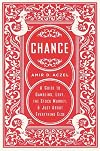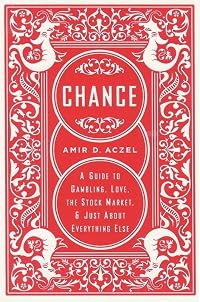
Chance: A Guide to Gambling, Love, the Stock Market, and Just About Everything Else
by Amir D. Aczel
On This Page
Description
Chance defines our life. Will you get the job, the lover, the money? Now Amir Aczel, in this slim book modeled on his very successful Fermat's Last Theorem, gives readers the tools to minimize, or maximize, chance's effect on their lives. Chance marks Aczel's return to his preferred field: the popularization of mathematics. Here, Aczel explores probability theory and its daily, practical applications, while along the way relating stories of inveterate gamblers who also happen to be show more mathematical geniuses. With the clarity of the statistician he once was, Aczel analyzes what is commonly known as luck. Alongside chapters on Surprising Birthday Problem, Coincidences, and How to Make Great Decisions are a history of probability theory and anecdotes of its daily applications. show lessTags
Recommendations


Member Reviews
Chance by Amir D Aczel is quite the gem. This slim volume on probability is packed with information and applications. The book makes for a great primer to the subject, mainly due to its focus on practical applications rather than some ivory tower pure mathematics.
Pros and cons of the book are as follows;
The book is very short.
Despite that, the book is packed with information.
While it has few equations, it does not detract from the enjoyment.
The book contains a lot of gambling and gaming advice.
The end of the book contains workable problems with solutions.
-Some typos still exist in this book, mainly misspellings.
-Some of the advice is silly.
When I took this out from the Library I was not sure if I had read it before, but that does show more not seem to be the case. If you can find it out there, this book might be worth your time. show less
Pros and cons of the book are as follows;
The book is very short.
Despite that, the book is packed with information.
While it has few equations, it does not detract from the enjoyment.
The book contains a lot of gambling and gaming advice.
The end of the book contains workable problems with solutions.
-Some typos still exist in this book, mainly misspellings.
-Some of the advice is silly.
When I took this out from the Library I was not sure if I had read it before, but that does show more not seem to be the case. If you can find it out there, this book might be worth your time. show less
Slender volume, good in parts, but patchy and not very well edited. The substitution of "match" for "natch" (short for naturally) really jumps out at the reader.
The nineteen chapters are quite short. I'ld say that the chapter 1 through 11 are all quite good. The remaining chapters are inferior for several reasons. The formulas are exceedingly poorly typeset, so as to be nearly incomprehensible. Sometimes, several reductions are required to arrive at a simplified or numeric solution; these reductions are even less readable than the individual formulas. Some of the applications of probability are unconvincing or stupid. As the claims get larger the amount of supporting mathematics presented is simply not enough to back them up, so they show more seem vacuous. The problems are fun, and the von Neumann device introduced in one problem is clever and pleasing.
The frequent mention of Persi Diaconis reminds me of the one time when he was a guest lecturer at the UW-Madison when I was a graduate student. As math lectures go his was memorable. show less
The nineteen chapters are quite short. I'ld say that the chapter 1 through 11 are all quite good. The remaining chapters are inferior for several reasons. The formulas are exceedingly poorly typeset, so as to be nearly incomprehensible. Sometimes, several reductions are required to arrive at a simplified or numeric solution; these reductions are even less readable than the individual formulas. Some of the applications of probability are unconvincing or stupid. As the claims get larger the amount of supporting mathematics presented is simply not enough to back them up, so they show more seem vacuous. The problems are fun, and the von Neumann device introduced in one problem is clever and pleasing.
The frequent mention of Persi Diaconis reminds me of the one time when he was a guest lecturer at the UW-Madison when I was a graduate student. As math lectures go his was memorable. show less
Ratings
Members
- Recently Added By
Lists

Books Read in 2017
4,249 works; 130 members
Author Information

25 Works 5,276 Members
Amir D. Aczel was born in Haifa, Israel on November 6, 1950. He received bachelor's and master's degrees in mathematics from the University of California, Berkeley and a doctorate in decision sciences from the business school at the University of Oregon. He taught at several universities during his lifetime including the University of Alaska and show more Bentley College. His first book, Complete Business Statistics, was published in 1989 and went through eight editions. His other books include How to Beat the I.R.S. at Its Own Game: Strategies to Avoid - and Fight - an Audit; Fermat's Last Theorem: Unlocking the Secret of an Ancient Mathematical Problem; The Mystery of the Aleph: Mathematics, the Kabbalah, and the Search for Infinity; The Riddle of the Compass: The Invention That Changed the World; Entanglement: The Greatest Mystery in Physics; and Finding Zero: A Mathematician's Odyssey to Uncover the Origins of Numbers. He died from cancer on November 26, 2015 at the age of 65. (Bowker Author Biography) show less
Common Knowledge
- Original publication date
- 2004
Classifications
Statistics
- Members
- 300
- Popularity
- 107,450
- Reviews
- 2
- Rating
- (3.15)
- Languages
- 5 — Czech, English, Italian, Japanese, Portuguese
- Media
- Paper, Ebook
- ISBNs
- 13
- ASINs
- 5