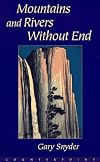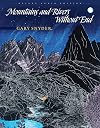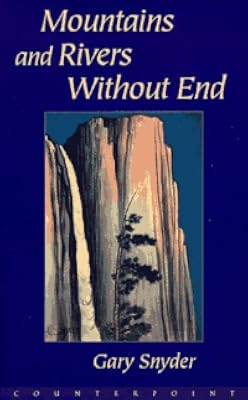
Mountains and Rivers Without End
by Gary Snyder
On This Page
Description
Mountains and Rivers is an epic of geology, prehistory, and planetary mythologies. It is a poem about land and its processes, a book about wisdom, compassion, and myth, and a narrative work that is not quite like anything else.Tags
Recommendations












Member Reviews
This long poem is all at once complex, simple, deep, worth reading slowly, worth dipping into any part of it in any sequence.
Mountains and Rivers Without End records some of Gary Snyder's journeys, from about 1956, until publication of the whole poem in book form in 1996.
It is about travels through geography, through time, and through his spiritual experiences within Zen Buddhism and other religious traditions. The poem is full of references to Snyder’s many lifelong interests, including back country hiking, poetry itself, environmentalism, the spirit, scholarship, and others.
The Bubbs Creek Haircut section begins and ends in a San Francisco barber shop, Snyder getting shorn "close as it will go" as he prepares for a hike to Bubbs show more Creek. His barber tells him the way, "Well I been up there, I built the cabin / up at Cedar Grove. In nineteen five." Snyder talks of this trek and other hitchhiking, walking, and camping experiences, mixing pasts and present in fascinating ways. His journey is folded inside the barber shop preparation for it, where all moments are the present moment and all things are one.
The Night Song of the Los Angeles Basin section is about an urban civilization that is surrounded by and suffused with nature. "The calligraphy of lights on the night / freeways of Los Angeles / will long be remembered. / Owl / calls; / late-rising moon." The owl and the moon get the last word.
By the nineties, the time when Snyder is telling this story, he has mellowed but he is still searching out "—the wildness, the / foolish loving spaces / full of heart." show less
Mountains and Rivers Without End records some of Gary Snyder's journeys, from about 1956, until publication of the whole poem in book form in 1996.
It is about travels through geography, through time, and through his spiritual experiences within Zen Buddhism and other religious traditions. The poem is full of references to Snyder’s many lifelong interests, including back country hiking, poetry itself, environmentalism, the spirit, scholarship, and others.
The Bubbs Creek Haircut section begins and ends in a San Francisco barber shop, Snyder getting shorn "close as it will go" as he prepares for a hike to Bubbs show more Creek. His barber tells him the way, "Well I been up there, I built the cabin / up at Cedar Grove. In nineteen five." Snyder talks of this trek and other hitchhiking, walking, and camping experiences, mixing pasts and present in fascinating ways. His journey is folded inside the barber shop preparation for it, where all moments are the present moment and all things are one.
The Night Song of the Los Angeles Basin section is about an urban civilization that is surrounded by and suffused with nature. "The calligraphy of lights on the night / freeways of Los Angeles / will long be remembered. / Owl / calls; / late-rising moon." The owl and the moon get the last word.
By the nineties, the time when Snyder is telling this story, he has mellowed but he is still searching out "—the wildness, the / foolish loving spaces / full of heart." show less
Apparently this isn't a common experience for everyone, but when I was in middle school, we studied the Beat Generation. I wouldn't be taking too much poetic license to claim that I was raised by Hippies, so to learn about the Beat Generation was like discovering a long-lost branch of my family. I still have a copy of "The Rolling Stones Book of the Beats." I wouldn't say that I am in love with the art produced by the Beat Generation, nor that I personally relate with it, but I do hold in high regard as an ancestral cultural well.
Gary Snyder is an animist, as am I. So when I learned of Snyder, I was immediately intrigued—an animist Beatnik.
Although I've been hearing about Snyder for a few years now, I haven't read much of his show more material. "Mountains and Rivers Without End" is Snyder's Magnum Opus, so I thought I might as well start there. Some had advised against this, but I would say—if you're willing to put in the time, you won't regret it!
The following is a book review of both "Mountains and Rivers Without End" and "A Sense of the Whole."
Gary Snyder spent forty years writing "Mountains and Rivers Without End"—from 1956 to 1996. For the '97-'98 academic year, Gonnerman hosted a seminar at Stanford on "Mountains and Rivers Without End." A broad community of intellectuals, artists, and spiritual leaders contributed to this corpus, which eventually lead to the publication of "A Sense of the Whole" in 2015 (I'm not entirely sure what led to the seventeen year delay). Snyder himself says that working with "Mountains and Rivers Without End" is a treacherous journey, and therefore recommends taking on the endeavor in community. This points to some of the ways in which Snyder's work harkens back to oral traditions. The copy I have includes an audio edition, and I appreciated being able to hear the work in Snyder's own voice (I wasn't able to track down a digital edition of the work).
If you're contemplating engaging with this work, I would encourage you to put together a reading plan. In my case, I read the poem from end to end first, then read the entirety of the companion volume, then listened to the audio edition of the poem. Throughout this time I was taking notes and having discussion with friends—both those familiar and unfamiliar with the text.
I read much less poetry than prose, so I will comment that whereas with prose, I generally read a book once, I can certainly see a work like this being something I come back to multiple or numerous times, as poems have a dynamic, ever-changing quality to them.
The poem is divided into four parts, following the structure of a Noh play.
My first reading of the piece wasn't particularly rapturous, although, as I was anticipating this, I stuck with it. Things really took off once I picked up the companion text. The corpus of the poem is a talisman. There might be a line that appears unremarkable, commonplace. But then once you place the line in context—the context of Chinese landscape art, Zen Buddhism, animism, geology, yogic mythology, or any of a numerous set of relationships—the line transports you to a web of relationship.
I also happen to be reading John McPhee's "From Annals of the Former World," a Pulitzer-winning book on the geology of the United States. I can certainly recommend this as one lens to deepen into Snyders work, although there are many others as well.
You might notice, I have yet to say really anything on the subject of what the poem is "about." Like any spiritual text, an meaning we derive from the material has as much to do with our own practice with the work as it does with some kind of objective set of takeaways. For this reason, I'll continue to marinade on the poetry, and hopefully this has given you enough reason to pick up the material for yourself. show less
Gary Snyder is an animist, as am I. So when I learned of Snyder, I was immediately intrigued—an animist Beatnik.
Although I've been hearing about Snyder for a few years now, I haven't read much of his show more material. "Mountains and Rivers Without End" is Snyder's Magnum Opus, so I thought I might as well start there. Some had advised against this, but I would say—if you're willing to put in the time, you won't regret it!
The following is a book review of both "Mountains and Rivers Without End" and "A Sense of the Whole."
Gary Snyder spent forty years writing "Mountains and Rivers Without End"—from 1956 to 1996. For the '97-'98 academic year, Gonnerman hosted a seminar at Stanford on "Mountains and Rivers Without End." A broad community of intellectuals, artists, and spiritual leaders contributed to this corpus, which eventually lead to the publication of "A Sense of the Whole" in 2015 (I'm not entirely sure what led to the seventeen year delay). Snyder himself says that working with "Mountains and Rivers Without End" is a treacherous journey, and therefore recommends taking on the endeavor in community. This points to some of the ways in which Snyder's work harkens back to oral traditions. The copy I have includes an audio edition, and I appreciated being able to hear the work in Snyder's own voice (I wasn't able to track down a digital edition of the work).
If you're contemplating engaging with this work, I would encourage you to put together a reading plan. In my case, I read the poem from end to end first, then read the entirety of the companion volume, then listened to the audio edition of the poem. Throughout this time I was taking notes and having discussion with friends—both those familiar and unfamiliar with the text.
I read much less poetry than prose, so I will comment that whereas with prose, I generally read a book once, I can certainly see a work like this being something I come back to multiple or numerous times, as poems have a dynamic, ever-changing quality to them.
The poem is divided into four parts, following the structure of a Noh play.
My first reading of the piece wasn't particularly rapturous, although, as I was anticipating this, I stuck with it. Things really took off once I picked up the companion text. The corpus of the poem is a talisman. There might be a line that appears unremarkable, commonplace. But then once you place the line in context—the context of Chinese landscape art, Zen Buddhism, animism, geology, yogic mythology, or any of a numerous set of relationships—the line transports you to a web of relationship.
I also happen to be reading John McPhee's "From Annals of the Former World," a Pulitzer-winning book on the geology of the United States. I can certainly recommend this as one lens to deepen into Snyders work, although there are many others as well.
You might notice, I have yet to say really anything on the subject of what the poem is "about." Like any spiritual text, an meaning we derive from the material has as much to do with our own practice with the work as it does with some kind of objective set of takeaways. For this reason, I'll continue to marinade on the poetry, and hopefully this has given you enough reason to pick up the material for yourself. show less
Gary Snyder is one of my touchstone writers, not so much for the poetry as for the essays, which enlightened me as to how a modern person could hold on to his primordial essence. In this book, however, I took to heart Tara's vow, written by Snyder thus: "Those who wish to attain supreme enlightenment in a man's body are many ... therefore may I, until this world is emptied out, serve the needs of beings with my body of a woman."
This is a treasure, a folio-sized edition that allows for copies of the wonderful landscapes that helped launch the work. I spent several hours listening to Snyder read his poems, and was amazed to read in the notes that they were recorded over only two days! The man is obviously comfortable around his own old friends, chanting over the well-trod wilderness on the page.
Revisited for a drive to La Push and back when Mom was here for a visit, listening to the conclusion during a snowstorm between Forks and Port Angeles. (12/21)
Revisited for a drive to La Push and back when Mom was here for a visit, listening to the conclusion during a snowstorm between Forks and Port Angeles. (12/21)
Interesting - but didn't capture my imagination.
Ratings
Members
- Recently Added By
Author Information

150+ Works 6,233 Members
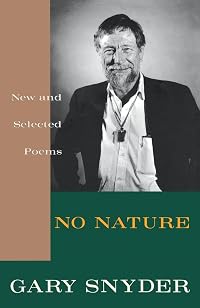
Gary Snyder was born in San Francisco, California on May 8, 1930. He received a B.A. in anthropology at Reed College in 1951. Between working as a logger, a trail-crew member, and a seaman on a Pacific tanker, he was associated with Beat poets such as Allen Ginsberg and Gregory Corso and studied in a Zen monastery in Japan. He wrote numerous books show more of poetry and prose including Danger on Peaks, Mountains and Rivers Without End, No Nature: New and Selected Poems, The Practice of the Wild, Regarding Wave, and Myths and Texts. He received an American Book Award for Axe Handles and the Pulitzer Prize for poetry for Turtle Island. He has also received an American Academy of Arts and Letters award, the Bollingen Prize, the Bess Hokin Prize, the Levinson Prize from Poetry, the Ruth Lilly Poetry Prize, and the Shelley Memorial Award. In 2012, he received the Wallace Stevens Award for lifetime achievement by the Academy of American Poets. (Bowker Author Biography) show less
Awards and Honors
Awards
Common Knowledge
- Canonical title
- Mountains and Rivers Without End
- Original publication date
- 1996
- Important places
- California, USA
- Epigraph
- The notion of Emptiness engenders Compassion -- Milarepa
An ancient Buddha said "A painted rice cake does not satisfy hunger." Dogen comments: "There are few who have even seen this 'painting of a rice cake' and none of them has thoroughly understood it. The paints for painting ri... (show all)ce-cakes are the same as those used for painting mountains and waters. If you say the painting is not real, then the material phenomenal world is not real, the Dharma is not real. Unsurpassed enlightenment is a painting. The entire phenomenal universe and the empty sky are nothing but a painting. Since this is so, there is no remedy for satisfying hunger other than a painted rice cake. Without painted hunger you never become a true person." -- Dogen - Dedication
- This book is for Gen, Kai, Mika, Kyung-jin
- First words
- Clearing the mind and sliding in to that created space, a web of waters streaming over rocks, air mistly but not raining, seeing this land from a boat on a lake or a broad slow river, coasting by.
- Last words
- (Click to show. Warning: May contain spoilers.)But the wet black brush tip drawn to a point, lifts away.
Classifications
Statistics
- Members
- 426
- Popularity
- 72,827
- Reviews
- 5
- Rating
- (4.21)
- Languages
- English, Finnish, French
- Media
- Paper, Ebook
- ISBNs
- 8
- ASINs
- 6