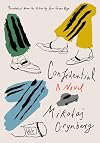
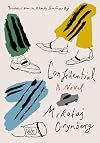
Confidential
by Mikołaj Grynberg
On This Page
Description
"The darkly comic tale of three generations of a Jewish family in today's Poland"--Tags
Recommendations






Member Reviews
A spare, concise collection of short vignettes that illuminate the legacy passed down through the generations of a family descended from Holocaust survivors in Poland. The repercussions of the war echo through each generation, from the grandfather who becomes a womanizer, the father who avoids academic conferences in Germany, to the grandson who ponders whether the weight of his family’s past is a burden or a source of strength. Fear, mistrust, and loss are passed down along with a stamp collection, hand tremors, a Parker 51 fountain pen. But there are also moments of wry humor and scenes that illustrate how family members care for one another. The author, a psychologist, unsurprisingly shows great insight into the complex show more emotions—love, resentment, anger—that we can feel toward our family members.
Each chapter is a small episode in the life of one of the family members, who are never named. It is never clear at first whose point of view is presented or what moment in time, as chapters are not chronologically ordered. There was a sense of dislocation at the start of each chapter, but the search for clues about the speaker and when the events were taking place reinforced the sense that “The past is never dead. It's not even past.” show less
Each chapter is a small episode in the life of one of the family members, who are never named. It is never clear at first whose point of view is presented or what moment in time, as chapters are not chronologically ordered. There was a sense of dislocation at the start of each chapter, but the search for clues about the speaker and when the events were taking place reinforced the sense that “The past is never dead. It's not even past.” show less
 This review was written for LibraryThing Early Reviewers.
The chapters in "Confidential" about different moments in a family's life are little glimpses into different family members at different times in their lives that ultimately read more like short stories than one cohesive plot. Every character is referred to by a pronoun or a title - never a name - and only as each story-within-a-chapter unfolds does the reader piece together the idea that the boy in one chapter becomes the professor in another, and that he is is Grandfather in still another one, etc. The pieces, once put together, illuminate the full circle of life.
There is no real sense of a particular character or narrator's voice as no names are ever mentioned and each chapter is from a different point of view. It's only through the show more characters' revelations in subsequent sketches that you go, "Oh! Because he is the boy, only grown now!" or "Yes, she's remembering a similar experience she endured as a child," etc. And there is no world-building or sense of place beyond the vaguest hint of it being set in a European country on a macro level, and on the micro level, the immediate setting of the action: an apartment, a street, a movie theater, in the rain, a hospital, and so on. So it's very difficult to use typical fiction measures such as likeability or consistency of character or chemistry or sense of immersion in a particular place or its culture or personality rendered with clarity, etc. It's more like dropping in to spy on members of the same family at different points in time, and witnessing little incidents that, together, make up the whole of a life. Or lives.
I can't quite decide if this unconventional approach appeals to me or not. I appreciate the novelty of writing a life story this way, and give full credit to the author's deft hand to be able to string together these little moments with enough dexterity to tell such a complete story when each piece, each chapter, is anything but complete. It's almost like putting together a jigsaw puzzle when you have no idea what the completed picture is supposed to look like: eventually, you figure it out, but until you are most of the way finished, you have no idea what's going on; e.g., the white blob could be clouds, cake frosting, or a lab coat but you wont' know until you get more pieces to the puzzle.
The tone of the work, as a whole, has an air of wry melancholy and gravitas that resonated with me, but also left me feeling vaguely nostalgic (for what, I don't know) and maybe a little sad. However, I also found myself repeatedly nodding my head to acknowledge some unnamed but universal truths, thinking, "Yes! Life IS like that!"
The pacing is even despite there being large gaps of time in between the events of the different chapter-stories, and kudos to the translator for making the book accessible from its original Polish to English speakers. I just can't decide if I like this book or not, despite there not being anything really "wrong" with it, which is the only reason I can't give it a full 5-star review.
I do, however, have the feeling that "Confidential" will stay with me for a long time, even if my final opinion is somewhat ambiguous. I definitely think people should read it, even if for no other reason than to experience how "less becomes more" in the hands (or pen) of a skillful craftsman. But if you like your fiction to be obvious, light-hearted, or laugh-out-loud funny, then this book is not for you.
Based on this book alone, though, I would definitely read more works by the author. show less
There is no real sense of a particular character or narrator's voice as no names are ever mentioned and each chapter is from a different point of view. It's only through the show more characters' revelations in subsequent sketches that you go, "Oh! Because he is the boy, only grown now!" or "Yes, she's remembering a similar experience she endured as a child," etc. And there is no world-building or sense of place beyond the vaguest hint of it being set in a European country on a macro level, and on the micro level, the immediate setting of the action: an apartment, a street, a movie theater, in the rain, a hospital, and so on. So it's very difficult to use typical fiction measures such as likeability or consistency of character or chemistry or sense of immersion in a particular place or its culture or personality rendered with clarity, etc. It's more like dropping in to spy on members of the same family at different points in time, and witnessing little incidents that, together, make up the whole of a life. Or lives.
I can't quite decide if this unconventional approach appeals to me or not. I appreciate the novelty of writing a life story this way, and give full credit to the author's deft hand to be able to string together these little moments with enough dexterity to tell such a complete story when each piece, each chapter, is anything but complete. It's almost like putting together a jigsaw puzzle when you have no idea what the completed picture is supposed to look like: eventually, you figure it out, but until you are most of the way finished, you have no idea what's going on; e.g., the white blob could be clouds, cake frosting, or a lab coat but you wont' know until you get more pieces to the puzzle.
The tone of the work, as a whole, has an air of wry melancholy and gravitas that resonated with me, but also left me feeling vaguely nostalgic (for what, I don't know) and maybe a little sad. However, I also found myself repeatedly nodding my head to acknowledge some unnamed but universal truths, thinking, "Yes! Life IS like that!"
The pacing is even despite there being large gaps of time in between the events of the different chapter-stories, and kudos to the translator for making the book accessible from its original Polish to English speakers. I just can't decide if I like this book or not, despite there not being anything really "wrong" with it, which is the only reason I can't give it a full 5-star review.
I do, however, have the feeling that "Confidential" will stay with me for a long time, even if my final opinion is somewhat ambiguous. I definitely think people should read it, even if for no other reason than to experience how "less becomes more" in the hands (or pen) of a skillful craftsman. But if you like your fiction to be obvious, light-hearted, or laugh-out-loud funny, then this book is not for you.
Based on this book alone, though, I would definitely read more works by the author. show less
This review was written for LibraryThing Early Reviewers.Grynberg is a Polish photographer and psychologist who writes both fiction and non-fiction. This novel is a series of cryptic multi-generational vignettes from the life of a Jewish family in Poland, from pre-war years and through the immediate aftermath of the war, though the war and the Holocaust or mostly only touched on peripherally.
No one is named; the characters are only referred to as mother, father, grandfather, grandson, etc. Or sometimes by their work -- doctor, professor, etc.
Since these snippets are also constantly shifting backward and forward in time, it is often not easy to understand which family members are involved and what their relationships are. Or perhaps that is part of the intention: the same themes, patterns, show more idiosyncrasies, neuroses, obsessions, re-emerge across time.
Black humor there certainly is ... the husband who sits at restaurant tables specially selected so he can listen in on the chats of couples at an adjacent table just meeting each other through online apps. And recording them too. The grandmother who is interested in learning how to use her phone so she can write and submit obituaries. The mother who habitually attends the funerals of strangers so she can learn how to cry. The 13-year-old boy who skips school to take his girlfriend to a movie, and is dragged out of the theatre by his mother (though he never sees the girl again, he later finds out that she has written a book about her experience, which was one of the transformative events shaping her life.
There are dark hints of antisemitism around corners and in the shadows, though they rarely emerge full-blown into the light. There is much illness, and death, and suffering, and separation and loss.
The fact that each of these little scenes is no more than a few pages makes it -- to me, anyway -- a but difficult to enter into the characters, especially since much of the time I found myself wondering who was who.
Still, the overall impression is of richness and sensitivity: the mixture of love and strife, anguish and bitterness and seized moments of joy across generations, makes this very real and deeply felt. show less
No one is named; the characters are only referred to as mother, father, grandfather, grandson, etc. Or sometimes by their work -- doctor, professor, etc.
Since these snippets are also constantly shifting backward and forward in time, it is often not easy to understand which family members are involved and what their relationships are. Or perhaps that is part of the intention: the same themes, patterns, show more idiosyncrasies, neuroses, obsessions, re-emerge across time.
Black humor there certainly is ... the husband who sits at restaurant tables specially selected so he can listen in on the chats of couples at an adjacent table just meeting each other through online apps. And recording them too. The grandmother who is interested in learning how to use her phone so she can write and submit obituaries. The mother who habitually attends the funerals of strangers so she can learn how to cry. The 13-year-old boy who skips school to take his girlfriend to a movie, and is dragged out of the theatre by his mother (though he never sees the girl again, he later finds out that she has written a book about her experience, which was one of the transformative events shaping her life.
There are dark hints of antisemitism around corners and in the shadows, though they rarely emerge full-blown into the light. There is much illness, and death, and suffering, and separation and loss.
The fact that each of these little scenes is no more than a few pages makes it -- to me, anyway -- a but difficult to enter into the characters, especially since much of the time I found myself wondering who was who.
Still, the overall impression is of richness and sensitivity: the mixture of love and strife, anguish and bitterness and seized moments of joy across generations, makes this very real and deeply felt. show less
This review was written for LibraryThing Early Reviewers.“Confidential” shares snippets of life and captured moments through the eyes and minds of several people from one Jewish family. From this family’s stories the reader shares in portraits of grief, loss, humor, and quirky life entanglements. The stories span through several decades from the holocaust through to present day Poland giving a wide array of topics covered. I was quite fond of several of these stories as they were told through interesting perspectives. I also quite enjoyed the characters, however, I did have trouble sorting out who was narrating in the beginning half of book. I believe difficulty came in the form of none of the characters having names. I’ve never encountered this particular style of writing but it was show more different. After a while it didn’t matter that the characters didn’t have names because the connections, relationships, and human characteristics stood out above anything else. One final note, I found this to be one of the better translated books that I have read. Final rating 3.5 stars. show less
This review was written for LibraryThing Early Reviewers.I obtained this novella as a Library thing Giveaway.
As a Jew whose entire family were already established in the US before WW2, this book was important to me.
The author's format and style was difficult to navigate. However, it successfully was able to explore generations of one family. From the aftermath of the Holocaust to modern day.
Except the vignettes follow no pattern of time, nor give names. It is the old man, such and such son, a wife. It was hard to connect with the characters.
But I suspect this is the authors intent. To explore an anonymous family forever affected by their family WW2 history. Because there were millions of families affected, all forgotten or ignored because there was no biography or memoir written.
Format and show more and style was hard for this author, but drove in the point we all still need to never forget but to also continue forward to survive. show less
As a Jew whose entire family were already established in the US before WW2, this book was important to me.
The author's format and style was difficult to navigate. However, it successfully was able to explore generations of one family. From the aftermath of the Holocaust to modern day.
Except the vignettes follow no pattern of time, nor give names. It is the old man, such and such son, a wife. It was hard to connect with the characters.
But I suspect this is the authors intent. To explore an anonymous family forever affected by their family WW2 history. Because there were millions of families affected, all forgotten or ignored because there was no biography or memoir written.
Format and show more and style was hard for this author, but drove in the point we all still need to never forget but to also continue forward to survive. show less
This review was written for LibraryThing Early Reviewers.I received a free copy of this book in LibraryThing's Early Reviewers program, in exchange for an honest review.
I've frankly been putting off my review of this book, because I've been see-sawing in my feelings about it. I enjoyed the writing, and I had the impression that the translation was done exceedingly well. The structure of the book, however, left so much unstated (which character is this, how much time has passed, etc.) that I struggled with my impressions of it as a cohesive narrative. It is written and presented more as a selection of short stories involving members of the same family. But the perspectives kept changing, and it was sometimes difficult to track through the changing voices. It can be an effective mechanism, show more especially in showing family members relating (or not) to one another, and highlighting differing perspectives on one another.
So it was an entertaining and worthwhile read, but hard for me to categorize. show less
I've frankly been putting off my review of this book, because I've been see-sawing in my feelings about it. I enjoyed the writing, and I had the impression that the translation was done exceedingly well. The structure of the book, however, left so much unstated (which character is this, how much time has passed, etc.) that I struggled with my impressions of it as a cohesive narrative. It is written and presented more as a selection of short stories involving members of the same family. But the perspectives kept changing, and it was sometimes difficult to track through the changing voices. It can be an effective mechanism, show more especially in showing family members relating (or not) to one another, and highlighting differing perspectives on one another.
So it was an entertaining and worthwhile read, but hard for me to categorize. show less
This review was written for LibraryThing Early Reviewers.Confidential A Novel by Mikolaj Grynberg is a compelling read, consisting of 154 pages. The very short chapters make for an enjoyable reading experience. This novella tells the poignant story of a Jewish family in modern-day Poland, struggling to express their affection for each other amidst a past that refuses to be forgotten.
This review was written for LibraryThing Early Reviewers.Members
- Recently Added By
Lists

Judaism & Israel
104 works; 2 members

Books We Discovered On LibraryThing
530 works; 130 members
Author Information
13 Works 98 Members
Some Editions
Awards and Honors
Common Knowledge
- Canonical title
- Confidential
Classifications
- Genres
- General Fiction, Fiction and Literature, Historical Fiction
- DDC/MDS
- 891.8 — Literature & rhetoric Literatures of other languages East Indo-European and Celtic literatures West and South Slavic languages (Bulgarian, Slovene, Polish, Czech, Slovak, Serbo-Croatian, and Macedonian)
- LCC
- PG7207 .R96 .P6813 — Language and Literature Slavic languages and literatures. Baltic languages. Albanian language Slavic. Baltic. Albanian Slavic Polish
- BISAC
Statistics
- Members
- 35
- Popularity
- 819,627
- Reviews
- 11
- Rating
- (3.25)
- Languages
- English
- Media
- Paper, Ebook
- ISBNs
- 2
- ASINs
- 1