How to Read Better and Faster
by Norman Lewis
On This Page
Description
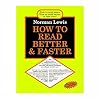
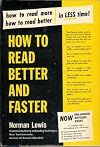
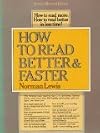
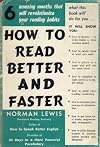
"This famous book, used by the U.S. Air Force, Marine Corps, and more than 100 leading universities and colleges, can show you : how to get more out of books, magazines and newspapers ; how to retain more of what you read ; how to glance at a page and absorb the main ideas ; how to complete a light novel in a single sitting ; how to build your reading vocabulary ; how to increase your powers of concentration ; how to knife through masses of reading matter quickly and efficiently ; how to show more double - or even triple - your reading speed."--Cover. show lessTags
Recommendations














Member Reviews
I must say this was, to me, an extremely useful book. Much more than anticipated. I thought I was a quick reader before, but thanks to the excercises in this book, I managed to increase my speed by another 20% on average.
Yes, it is lengthy, but it really takes you step by step, giving good guidance and excercises. And even though it was originally written in 1944 (I read the 1958 completly revised 3rd edition), it is far from antiquated. In fact, apart from the obviously dated selection of articles for the reading excercises, the whole was fairly modern.
e.g. p 348 At the beginning of the section about reading critically, the author states that every writer wants to convince the reader of his philosophy, attitude, POV. Even in fiction, a show more writer is a "special pleader." He continues:
"And, of course, it is almost impossible to pick up a magazine or newspaper today without being bombarded by special pleading. As you turn the pages, almost every writer is saying to you, directly or by implication, "This si what I think; or, This is how I feel; or, This is how I interpret a situation; or, These are the conclusions I draw from the (selected) facts; This is how I solve a problem; or, This is how to do the job; or, This is how I react to what has happened; or, This is how you should react; or, this is the furniture, clothing, perfume, cereal, book, soap, cigarette, automobile, or liquor you should buy, the transportation you should use, the play or motion picture you should see, the vacation you should take, or the charity you should contribute to"; and so on and on, in endless, infinite variety."
And this was written way before the social media age.
Yes, the author uses lengthy sentences at times (and here it serves its purpose), but it is worth the effort.
I also appreciated the author´s thoughts about why to read (both for furthering education, as well as entertainment), and in the chapter about skipping and skimming (which in my opinion is sacrilige), he made an appealing case, and argued that these techniques should be used sparsely, if at all.
So, all in all, yes, these almost 400 pages take a while to get through (ironically), it is worth the effort, in my opinion. show less
Yes, it is lengthy, but it really takes you step by step, giving good guidance and excercises. And even though it was originally written in 1944 (I read the 1958 completly revised 3rd edition), it is far from antiquated. In fact, apart from the obviously dated selection of articles for the reading excercises, the whole was fairly modern.
e.g. p 348 At the beginning of the section about reading critically, the author states that every writer wants to convince the reader of his philosophy, attitude, POV. Even in fiction, a show more writer is a "special pleader." He continues:
"And, of course, it is almost impossible to pick up a magazine or newspaper today without being bombarded by special pleading. As you turn the pages, almost every writer is saying to you, directly or by implication, "This si what I think; or, This is how I feel; or, This is how I interpret a situation; or, These are the conclusions I draw from the (selected) facts; This is how I solve a problem; or, This is how to do the job; or, This is how I react to what has happened; or, This is how you should react; or, this is the furniture, clothing, perfume, cereal, book, soap, cigarette, automobile, or liquor you should buy, the transportation you should use, the play or motion picture you should see, the vacation you should take, or the charity you should contribute to"; and so on and on, in endless, infinite variety."
And this was written way before the social media age.
Yes, the author uses lengthy sentences at times (and here it serves its purpose), but it is worth the effort.
I also appreciated the author´s thoughts about why to read (both for furthering education, as well as entertainment), and in the chapter about skipping and skimming (which in my opinion is sacrilige), he made an appealing case, and argued that these techniques should be used sparsely, if at all.
So, all in all, yes, these almost 400 pages take a while to get through (ironically), it is worth the effort, in my opinion. show less
It's a simple message. Read more. Read widely. Be alert. Set a goal. I only read the suggestions. It was nothing new. If you want to be good at it, you just have to practice. That means reading a lot in many different areas.
Ratings
Members
- Recently Added By
Author Information
33 Works 3,539 Members
Common Knowledge
- Original publication date
- 1944
- Dedication
- To Mary, Margie, and Debbie
- First words
- How to Read Better and Faster is a step-by-step, day-by-day training manual in the techniques of rapid and skillful reading. (Preface to the Third Edition)
If you are the average untrained reader, there is one central fact you must face at the outset. (Chapter 1) - Last words
- (Click to show. Warning: May contain spoilers.)Continue your investment and the dividends will continue to build up.
Classifications
Statistics
- Members
- 252
- Popularity
- 129,263
- Reviews
- 2
- Rating
- (4.05)
- Languages
- English, Russian
- Media
- Paper
- ISBNs
- 5
- ASINs
- 15