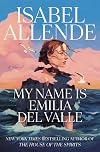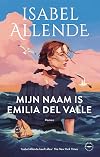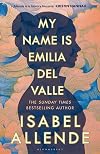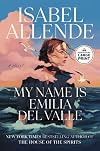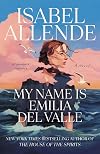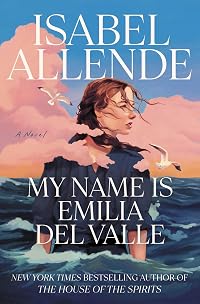
My Name Is Emilia del Valle
by Isabel Allende
On This Page
Description
"In San Francisco in 1866, an Irish nun, abandoned following a torrid relationship with a Chilean aristocrat, gives birth to a daughter named Emilia del Valle. Raised by a loving stepfather, Emilia grows into an independent thinker and a self-sufficient young woman. To pursue her passion for writing, she is willing to defy societal norms. At the age of seventeen, she begins to publish pulp fiction using a man's pen name. When these fictional worlds can no longer satisfy her sense of show more adventure, she turns to journalism, convincing an editor at The Daily Examiner to hire her. There she is paired with another talented reporter, Eric Whelan. As she proves herself, her restlessness returns, until an opportunity arises to cover a brewing civil war in Chile. She seizes it, as does Eric, and while there, she meets her estranged father and delves into the violent confrontation in the country where her roots lie. As she and Eric discover love, the war escalates and Emilia finds herself in extreme danger, fearing for her life and questioning her identity and her destiny." -- show lessTags
Recommendations





Member Reviews
I’ll admit I wasn’t sure I was going to like this novel when I first started reading it, but something about Emilia’s voice drew me in like a moth to a flame. I love the authentic feel to this novel, which is something that felt like home to me. There is much that tethered me to Emilia and her story. The inclusions of various articles written by Emilia made this narrative feel even more unique, not to mention the fact that this novel is written more like a memoir.
I read through this novel a lot quicker than I was expecting. The flow was exquisite, and I drank it all in. There were a few scenes I didn’t care for and felt were unnecessary to include, but these moments paled in comparison to the overall narrative. I felt the show more horrors of war as seen through innocent eyes. I feel like I witnessed them myself.
This is a literary triumph with such realism that I am still not convinced that this isn’t based on a true story. The ending, while coming full circle, was bittersweet for me. This story felt so raw and real that I was expecting an author’s note talking about the truth on these pages, yet there was none. It almost felt like there was a piece of the story missing. Such a gripping story that felt so real.
*I have voluntarily reviewed a copy of this book which I received from the author/publisher. All views and opinions expressed are completely honest, and my own. show less
I read through this novel a lot quicker than I was expecting. The flow was exquisite, and I drank it all in. There were a few scenes I didn’t care for and felt were unnecessary to include, but these moments paled in comparison to the overall narrative. I felt the show more horrors of war as seen through innocent eyes. I feel like I witnessed them myself.
This is a literary triumph with such realism that I am still not convinced that this isn’t based on a true story. The ending, while coming full circle, was bittersweet for me. This story felt so raw and real that I was expecting an author’s note talking about the truth on these pages, yet there was none. It almost felt like there was a piece of the story missing. Such a gripping story that felt so real.
*I have voluntarily reviewed a copy of this book which I received from the author/publisher. All views and opinions expressed are completely honest, and my own. show less
If you asked me to describe MY NAME IS EMILIA DEL VALLE in three words, I might pick adventure, violence, with a bit of romance. But these words don’t really do justice to this novel. Reading this book gave me a chance to meet a determined woman who flaunts the rules and winds up living through exceptional experiences, both good and bad. Awarded four stars but if I could I would go to 4.5.
Written in the style of an autobiography, MY NAME IS EMILIA DEL VALLE is Emilia’s first person account of her life through her mid twenties. (Might there be a sequel?) In Chile in the early 1890s she is a fiercely independent woman, bucking all the social conventions at a time when the only acceptable roles for women in this deeply Catholic society show more were marriage and motherhood.
But after an intellectually rigorous upbringing, courtesy of a loving stepfather, Emilia aspires to earn her own living as a writer — unheard of for a woman at this time. After finding success writing 10-cent novels using a male pseudonym, Emilia becomes a journalist, where she hopes to be able to report using her own name. One of her early assignments is to cover the feature side of Chile’s increasing political tension, partnered with a more experienced journalist who will cover the news side.
Aside from Emilia’s ambition and commitment to lead a non-traditional life, the novel tells a second story of the South American country of Chile itself. It’s a story of European Colonialism and the Chilean Civil War of 1891 -- a fight for power between the President of Chile, José Manuel Balmaceda and the country's legislative congress. Wealthy European settlers generally support Balmaceda while impoverished and indigenous people side with Congress. Like the American Civil War, this was a savage conflict.
As with all her books, Isabel Allende’s language is beautiful. (Credit certainly also goes to translator Frances Riddle.) The passages describing battles that Emilia witnesses are so vivid that they are painful to read and I occasionally found the need to take a break. Likewise, descriptions of wild and remote areas in the Andes Mountains are equally powerful and you will long to visit what must have been a true paradise.
The only reason I did not award five stars to MY NAME IS EMILIA DEL VALLE is because I found the start of the book dragged a bit. But by midway, I was frantically turning pages, both eager and nervous to find out what would happen next. Highly recommended. show less
Written in the style of an autobiography, MY NAME IS EMILIA DEL VALLE is Emilia’s first person account of her life through her mid twenties. (Might there be a sequel?) In Chile in the early 1890s she is a fiercely independent woman, bucking all the social conventions at a time when the only acceptable roles for women in this deeply Catholic society show more were marriage and motherhood.
But after an intellectually rigorous upbringing, courtesy of a loving stepfather, Emilia aspires to earn her own living as a writer — unheard of for a woman at this time. After finding success writing 10-cent novels using a male pseudonym, Emilia becomes a journalist, where she hopes to be able to report using her own name. One of her early assignments is to cover the feature side of Chile’s increasing political tension, partnered with a more experienced journalist who will cover the news side.
Aside from Emilia’s ambition and commitment to lead a non-traditional life, the novel tells a second story of the South American country of Chile itself. It’s a story of European Colonialism and the Chilean Civil War of 1891 -- a fight for power between the President of Chile, José Manuel Balmaceda and the country's legislative congress. Wealthy European settlers generally support Balmaceda while impoverished and indigenous people side with Congress. Like the American Civil War, this was a savage conflict.
As with all her books, Isabel Allende’s language is beautiful. (Credit certainly also goes to translator Frances Riddle.) The passages describing battles that Emilia witnesses are so vivid that they are painful to read and I occasionally found the need to take a break. Likewise, descriptions of wild and remote areas in the Andes Mountains are equally powerful and you will long to visit what must have been a true paradise.
The only reason I did not award five stars to MY NAME IS EMILIA DEL VALLE is because I found the start of the book dragged a bit. But by midway, I was frantically turning pages, both eager and nervous to find out what would happen next. Highly recommended. show less
If you asked me to describe MY NAME IS EMILIA DEL VALLE in three words, I might pick adventure, violence, with a bit of romance. But these words don’t really do justice to this novel. Reading this book gave me a chance to meet a determined woman who flaunts the rules and winds up living through exceptional experiences, both good and bad. Awarded four stars but if I could I would go to 4.5.
Written in the style of an autobiography, MY NAME IS EMILIA DEL VALLE is Emilia’s first person account of her life through her mid twenties. (Might there be a sequel?) In Chile in the early 1890s she is a fiercely independent woman, bucking all the social conventions at a time when the only acceptable roles for women in this deeply Catholic society show more were marriage and motherhood.
But after an intellectually rigorous upbringing, courtesy of a loving stepfather, Emilia aspires to earn her own living as a writer — unheard of for a woman at this time. After finding success writing 10-cent novels using a male pseudonym, Emilia becomes a journalist, where she hopes to be able to report using her own name. One of her early assignments is to cover the feature side of Chile’s increasing political tension, partnered with a more experienced journalist who will cover the news side.
Aside from Emilia’s ambition and commitment to lead a non-traditional life, the novel tells a second story of the South American country of Chile itself. It’s a story of European Colonialism and the Chilean Civil War of 1891 -- a fight for power between the President of Chile, José Manuel Balmaceda and the country's legislative congress. Wealthy European settlers generally support Balmaceda while impoverished and indigenous people side with Congress. Like the American Civil War, this was a savage conflict.
As with all her books, Isabel Allende’s language is beautiful. (Credit certainly also goes to translator Frances Riddle.) The passages describing battles that Emilia witnesses are so vivid that they are painful to read and I occasionally found the need to take a break. Likewise, descriptions of wild and remote areas in the Andes Mountains are equally powerful and you will long to visit what must have been a true paradise.
The only reason I did not award five stars to MY NAME IS EMILIA DEL VALLE is because I found the start of the book dragged a bit. But by midway, I was frantically turning pages, both eager and nervous to find out what would happen next. Highly recommended. show less
Written in the style of an autobiography, MY NAME IS EMILIA DEL VALLE is Emilia’s first person account of her life through her mid twenties. (Might there be a sequel?) In Chile in the early 1890s she is a fiercely independent woman, bucking all the social conventions at a time when the only acceptable roles for women in this deeply Catholic society show more were marriage and motherhood.
But after an intellectually rigorous upbringing, courtesy of a loving stepfather, Emilia aspires to earn her own living as a writer — unheard of for a woman at this time. After finding success writing 10-cent novels using a male pseudonym, Emilia becomes a journalist, where she hopes to be able to report using her own name. One of her early assignments is to cover the feature side of Chile’s increasing political tension, partnered with a more experienced journalist who will cover the news side.
Aside from Emilia’s ambition and commitment to lead a non-traditional life, the novel tells a second story of the South American country of Chile itself. It’s a story of European Colonialism and the Chilean Civil War of 1891 -- a fight for power between the President of Chile, José Manuel Balmaceda and the country's legislative congress. Wealthy European settlers generally support Balmaceda while impoverished and indigenous people side with Congress. Like the American Civil War, this was a savage conflict.
As with all her books, Isabel Allende’s language is beautiful. (Credit certainly also goes to translator Frances Riddle.) The passages describing battles that Emilia witnesses are so vivid that they are painful to read and I occasionally found the need to take a break. Likewise, descriptions of wild and remote areas in the Andes Mountains are equally powerful and you will long to visit what must have been a true paradise.
The only reason I did not award five stars to MY NAME IS EMILIA DEL VALLE is because I found the start of the book dragged a bit. But by midway, I was frantically turning pages, both eager and nervous to find out what would happen next. Highly recommended. show less
Translated from the Spanish by Frances Riddle.
Isabel Allende presents us with a stirring adventure story in 2025’s My Name is Emilia del Valle. She conjures up an old fashioned hero for her first-person protagonist, an adventurous, iconoclastic young woman from 19th Century San Francisco. The product of a tryst between her novice nun mother and a mysterious progenitor who immediately leaves, she lucks out with doting, freethinking Papo, a stepdad who engenders in her a confident, not to say fearless, outlook. This brash worldview gets her into some extremely deadly jeopardy when she ends up on the losing side in the the Chilean civil war. It’s vivid, captivating, enthralling work.
As Emilia’s mother prepares to take a nun’s vows show more she’s swept up in a random tryst and immediately abandoned by a wastrel Chilean aristocrat. Emilia’s mother, Molly, earns the sobriquet “Saint Molly” for the good work she does teaching the children of impoverished Spanish-speaking denizens of the S.F. Mission District and for providing free bread to the neighborhood every day. Her marriage of convenience to don Pancho is a stroke of pure luck for Molly and especially for Emilia.
Emilia grows tall and strong and bilingual, and her Papo encourages her impulse to write down her thoughts and impressions. Grown into womanhood, she takes a male nom de plume and publishes dime novels in the 1880s, adding to the family coffers. This leads to journalism, working for the Hearst newspaper, the Examiner, where she meets reporter Eric Whelan and begins a reporting/column-writing partnership. The two partners travel to Chile to cover its civil war of 1891, and the adventure shifts into high gear.
Allende writes adventure with pace, realism, and an unblinking eye toward human nature in all its wartime butchery. Our hero suffers physically and emotionally: she is beaten, starved, imprisoned. She must decide at length whether to investigate the spurious inheritance her biological father left her — it’s impossibly remote in southern Chile.
You must read this faced-paced, gritty tale of a young woman’s determination and pluck, to find out. I heartily recommend this careening adventure tale, from a storyteller who proves her worth over and over.
https://bassoprofundo1.blogspot.com/2026/01/my-name-is-emilia-del-valle-by-isabe... show less
Isabel Allende presents us with a stirring adventure story in 2025’s My Name is Emilia del Valle. She conjures up an old fashioned hero for her first-person protagonist, an adventurous, iconoclastic young woman from 19th Century San Francisco. The product of a tryst between her novice nun mother and a mysterious progenitor who immediately leaves, she lucks out with doting, freethinking Papo, a stepdad who engenders in her a confident, not to say fearless, outlook. This brash worldview gets her into some extremely deadly jeopardy when she ends up on the losing side in the the Chilean civil war. It’s vivid, captivating, enthralling work.
As Emilia’s mother prepares to take a nun’s vows show more she’s swept up in a random tryst and immediately abandoned by a wastrel Chilean aristocrat. Emilia’s mother, Molly, earns the sobriquet “Saint Molly” for the good work she does teaching the children of impoverished Spanish-speaking denizens of the S.F. Mission District and for providing free bread to the neighborhood every day. Her marriage of convenience to don Pancho is a stroke of pure luck for Molly and especially for Emilia.
Emilia grows tall and strong and bilingual, and her Papo encourages her impulse to write down her thoughts and impressions. Grown into womanhood, she takes a male nom de plume and publishes dime novels in the 1880s, adding to the family coffers. This leads to journalism, working for the Hearst newspaper, the Examiner, where she meets reporter Eric Whelan and begins a reporting/column-writing partnership. The two partners travel to Chile to cover its civil war of 1891, and the adventure shifts into high gear.
Allende writes adventure with pace, realism, and an unblinking eye toward human nature in all its wartime butchery. Our hero suffers physically and emotionally: she is beaten, starved, imprisoned. She must decide at length whether to investigate the spurious inheritance her biological father left her — it’s impossibly remote in southern Chile.
You must read this faced-paced, gritty tale of a young woman’s determination and pluck, to find out. I heartily recommend this careening adventure tale, from a storyteller who proves her worth over and over.
https://bassoprofundo1.blogspot.com/2026/01/my-name-is-emilia-del-valle-by-isabe... show less
In mid-19th century San Francisco Emilia is born from a love affair between a novice nun and a Chilean aristocrat. Her mother marries a teacher and Emilia is guided to adulthood by her loving step-father. As a teen-ager she is successful writing "dime novels" (published under a male pen name) to help support the family. Meanwhile she is encouraged to go to Chile to find her biological father and "claim her fortune". This appeals to her strong character and she finds her way to Chile during the civil war of 1891 as a newspaper reporter. While Emilia is definitely a fictional character the descriptions of the war seem to be historically accurate. The result is a gripping story with a feminist theme. My only criticism is with the ending show more which seems a bit weak but the bulk of the book is interesting, informative and a darned good read show less
Interesting historical context — the 1891 civil war in Chile. I learned a lot. But overall, the novel seemed a bit didactic, as if IA’s entire purpose was to write about the history rather than tell a compelling story.
Isabel Allende es un tesoro literario. Su última novela, Mi Nombre es Emilia del Valle, es un retrato brillantemente escrito de una mujer encontrando la madurez y su propia voz en medio de la guerra civil chilena. En esta historia de amor, guerra, traición y redención, Allende nos transporta completamente al siglo XIX, una época donde las decisiones de las mujeres se veían limitadas y sus ambiciones, frustradas.
Members
- Recently Added By
Lists

LoanStars | Adult List: May 2025
10 works; 1 member
Author Information

88+ Works 84,737 Members
Isabel Allende was born in 1942 in Lima, Peru, the daughter of a Chilean diplomat. When her parents separated, young Isabel moved with her mother to Chile, where she spent the rest of her childhood. She married at the age of 19 and had two children, Paula and Nicolas. Her uncle was Salvador Allende, the president of Chile. When he was overthrown show more in the coup of 1973, she fled Chile, moving to Caracas, Venezuela. While living in Venezuela, Allende began writing her novels, many of them exploring the close family bonds between women. Her first novel, The House of the Spirits, has been translated into 27 languages, and was later made into a film. She then wrote Of Love and Shadows, Eva Luna, and The Stories of Eva Luna, all set in Latin America. The Infinite Plan was her first novel to take place in the United States. She explores the issues of human rights and the plight of immigrants and refugees in her novel, In The Midst of Winter. In Paula, Allende wrote her memoirs in connection with her daughter's illness and death. She delved into the erotic connections between food and love in Aphrodite: A Memoir of the Senses. In addition to writing books, Allende has worked as a TV interviewer, magazine writer, school administrator, and a secretary at a U.N. office in Chile. She received the 1996 Harold Washington Literacy Award. She lives in California. Her title Maya's Notebook made The New York Times Best Seller List in 2013. (Bowker Author Biography) show less
Awards and Honors
Awards
Distinctions
Notable Lists
Common Knowledge
- Canonical title
- My Name Is Emilia del Valle
- Original title
- Mi nombre es Emilia del Valle
- People/Characters
- Emilia del Valle; Eric Whelan
- Important places
- Chile; San Fransisco, California, USA
- Original language*
- Spanisch
*Some information comes from Common Knowledge in other languages. Click "Edit" for more information.
Classifications
- Genres
- Historical Fiction, General Fiction, Fiction and Literature, Romance
- DDC/MDS
- 863.64 — Literature & rhetoric Spanish Literature Spanish fiction 20th Century 1945-2000
- LCC
- PQ8098.1 .L54 .M513 — Language and Literature French, Italian, Spanish and Portuguese literatures Spanish literature Provincial, local, colonial, etc. Spanish America
- BISAC
Statistics
- Members
- 414
- Popularity
- 74,765
- Reviews
- 27
- Rating
- (3.68)
- Languages
- 8 — Dutch, English, German, Italian, Norwegian, Portuguese, Romanian, Spanish
- Media
- Paper, Audiobook, Ebook
- ISBNs
- 28
- ASINs
- 12