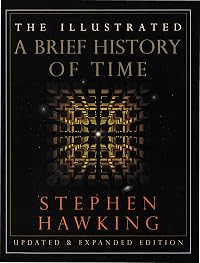
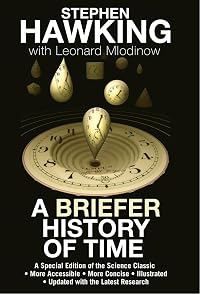
The Illustrated Brief History of Time, Updated and Expanded Edition
by Stephen Hawking
On This Page
Description
The book was on the cutting edge of what was then known about the nature of the universe, but since that time there have been extraordinary advances in the technology of observing both the micro- and the macrocosmic worlds. These observations have confirmed many of Professor Hawking's theoretical predictions in the first edition of his book, including the recent discoveries of the Cosmic Background Explorer satellite (COBE), which probed back in time to within 300,000 years of the universe's show more beginning and revealed wrinkles in the fabric of space-time that he had projected. Eager to bring his original text the new knowledge revealed by these many observations, as well as his most recent research, for this expanded edition Professor Hawking has prepared a new introduction to the book, written an entirely new chapter on the fascinating subject of wormholes and time travel, and updated the original chapters. This edition is enhanced throughout with more than 240 full-color illustrations, including satellite images, photographs made possible by spectacular technological advances such as the Hubble Space Telescope, and computer-generated images of three and four dimensional realities. show lessTags
Recommendations








Member Recommendations
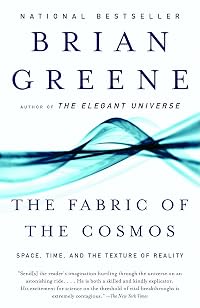
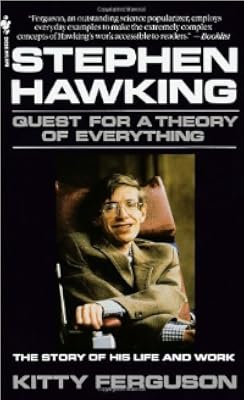
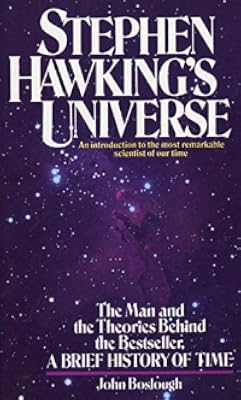
The Hunt for Vulcan: . . . And How Albert Einstein Destroyed a Planet, Discovered Relativity, and Deciphered the Universe by Thomas Levenson
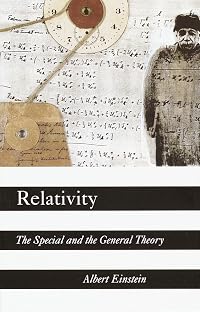
themulhern In the very first chapter of "A Brief History of Time", Hawking mentions the problem of the orbit of the planet Mercury and how Einstein's general theory of relativity predicted its motion better than Newton's laws of gravitation. In "The Hunt of Vulcan", Levenson tells a much expanded story.
Member Reviews
My first exposure to "A Brief History of Time" was audio tapes narrated by Michael Jackson, not the singer, but an Englishman with a beautiful English accent. The clear wording that flowed so easily made me think the tapes contained a special rewording of the book. Discovering that the words on the tapes were identical with those in the book surprised me.
This new illustrated version adds beautiful diagrams and photographs that make Hawkin's easily understood book even more easily understood. Teen-age readers will be able to follow the main lines of reasoning in this book. Hawkin does not get into math and minute detail. He presents a history of theories about the universe and what discoveries prompted refinement of existing theories or show more development of new theories. Hawkin organizes his book to describe how modern astronomers understand time. Like length, breadth, and width, time is the fourth dimension of the universe.
The universe began when all matter in the universe exploded out of an infinitely small amount of space: the "big bang." Before the big bang, time did not exist; hence, the title "A Brief History of Time." Hawkin describes how time started when the universe started and how the universe has changed with time. Scientists believe the universe has been expanding ever since the big bang. Hawkin also describes current projections of what will happen in the future. Will the universe continue to expand? Will it stop expanding and find a fixed size? Will it eventually reverse direction and begin a long collapse causing all matter to condense into an infinitely small space: the "big crunch?"
Stephen Hawkin's charming sense of humor greatly enhances his excellent description of scientific thought. I very much enjoyed reading this book. show less
This new illustrated version adds beautiful diagrams and photographs that make Hawkin's easily understood book even more easily understood. Teen-age readers will be able to follow the main lines of reasoning in this book. Hawkin does not get into math and minute detail. He presents a history of theories about the universe and what discoveries prompted refinement of existing theories or show more development of new theories. Hawkin organizes his book to describe how modern astronomers understand time. Like length, breadth, and width, time is the fourth dimension of the universe.
The universe began when all matter in the universe exploded out of an infinitely small amount of space: the "big bang." Before the big bang, time did not exist; hence, the title "A Brief History of Time." Hawkin describes how time started when the universe started and how the universe has changed with time. Scientists believe the universe has been expanding ever since the big bang. Hawkin also describes current projections of what will happen in the future. Will the universe continue to expand? Will it stop expanding and find a fixed size? Will it eventually reverse direction and begin a long collapse causing all matter to condense into an infinitely small space: the "big crunch?"
Stephen Hawkin's charming sense of humor greatly enhances his excellent description of scientific thought. I very much enjoyed reading this book. show less
This really isn't very good. The attempt to make cosmology accessible leads to oddities like Hawking explaining imaginary numbers without using exponents of any kind (or square roots), but going on to use the concept to try to explain the shape of the universe in imaginary time! I can only account for its popularity by its combination of a superficial treatment of interesting topics, an absence of any explanations of true depth, and a rather tired obsession with the theology of cosmology.
There's really only so many times you can read the structure "a thousand million million (one followed by 15 zeros)" without thinking, "introduce scientific notation and get it over with!"
Meanwhile, his attempts to be colloquial tend to be just silly, show more and his references to "science fiction" suggest that his knowledge of what science fiction is like were formed by watching Star Trek in the 60's.
There are better books on cosmology. They'll be more challenging, but you might actually learn something. Try Brian Greene. show less
There's really only so many times you can read the structure "a thousand million million (one followed by 15 zeros)" without thinking, "introduce scientific notation and get it over with!"
Meanwhile, his attempts to be colloquial tend to be just silly, show more and his references to "science fiction" suggest that his knowledge of what science fiction is like were formed by watching Star Trek in the 60's.
There are better books on cosmology. They'll be more challenging, but you might actually learn something. Try Brian Greene. show less
The science gets a little deep in places, so this book might not been for the feint of heart, but nevertheless a great read if you're interested in physics and the nature of time.
The illustrated edition is liberally illustrated with many beautiful diagrams and illustrations, which for the most part don't aid in understanding the material, but definitely increase one's overall enjoyment of the book. Well worth the extra cost.
The illustrated edition is liberally illustrated with many beautiful diagrams and illustrations, which for the most part don't aid in understanding the material, but definitely increase one's overall enjoyment of the book. Well worth the extra cost.
This book is amazing! If you like science but can't understand all the math, this is one for you! The illustations are so unusual and can be contemplated over for hours. This book has special meaning for me because my 11 year old autistic son read and immediately explained it to me (in his words) after I had spent half the night trying to understand its concepts. I finally knew there was a person in there.
So you’re going in to the doctor for an issue with your heart and you ask what the worse-case scenario is. “Oh,” he says, “don’t worry, the nurses will put a nice lil clear mask on your face and you’ll go right to sleep. Not a problem at all! You won’t feel anything!!”
“Oh good,” you say. “I was worried.”
“Of course,” he says, “when you’re unconscious, the potential for secondary infection of an aortic endograft by contaminated blood from these complications can be quite high. Some patients underwent a complementary endovascular procedure, followed in two of the set by a psoas abscess, and systematic prophylactic antibiotic therapy for any subsequent endovascular or even dental procedures after EVAR13 is show more indicated.” He pauses.
“Wait,” you say. “Wait. What?”
“I went to school with the man who pioneered that study, in 1986, when I was studying at Harvard Medical. He was an immigrant from Germany whose parents fled the war. We became good friends, and later on we broke up over some perceived slight.”
“Sorry, could you … maybe … explain more about the abcess thing?”
“I visited Germany on his recommendation, and I met the Pope there, but I found their sausages were quite overrated.” He stands up. “So! That should have cleared up everything. I’ll see you next week.”
so it’s like that but with the entire STRUCTURE OF THE UNIVERSE
eta: not even kidding about the Pope. there’s a photograph and everything show less
“Oh good,” you say. “I was worried.”
“Of course,” he says, “when you’re unconscious, the potential for secondary infection of an aortic endograft by contaminated blood from these complications can be quite high. Some patients underwent a complementary endovascular procedure, followed in two of the set by a psoas abscess, and systematic prophylactic antibiotic therapy for any subsequent endovascular or even dental procedures after EVAR13 is show more indicated.” He pauses.
“Wait,” you say. “Wait. What?”
“I went to school with the man who pioneered that study, in 1986, when I was studying at Harvard Medical. He was an immigrant from Germany whose parents fled the war. We became good friends, and later on we broke up over some perceived slight.”
“Sorry, could you … maybe … explain more about the abcess thing?”
“I visited Germany on his recommendation, and I met the Pope there, but I found their sausages were quite overrated.” He stands up. “So! That should have cleared up everything. I’ll see you next week.”
so it’s like that but with the entire STRUCTURE OF THE UNIVERSE
eta: not even kidding about the Pope. there’s a photograph and everything show less
This is an excellent book. Stephen Hawking presents theories on space, galaxies, and even parallel universes in an easy to understand manner. If you have even a passing interest in space, this book is a must read. You won't regret it.
Lavishly if haphazardly illustrated. About half the illustrations are historical and about half are diagrams intended to illustrate the concepts presented.
1. Our Picture of the Universe
An overview of well-known early cosmology. Aristotle convinced the earth is round, Ptolemy, Copernicus, Kepler, Galileo, Newton. If the universe is infinite and static it must (a) collapse under the force of gravity, and (b) be really bright all the time since the light from all the stars in its infinity must reach the earth. When Edwin Hubble discovered that the galaxies were in general receding from us and each other many scientists inferred the "big bang". Brief mention of the orbit of Mercury and Einstein. Relativity and quantum mechanics are somehow show more incompatible. Hard to justify the search for a unified theory of everything on practical grounds.
2. Space and Time show less
1. Our Picture of the Universe
An overview of well-known early cosmology. Aristotle convinced the earth is round, Ptolemy, Copernicus, Kepler, Galileo, Newton. If the universe is infinite and static it must (a) collapse under the force of gravity, and (b) be really bright all the time since the light from all the stars in its infinity must reach the earth. When Edwin Hubble discovered that the galaxies were in general receding from us and each other many scientists inferred the "big bang". Brief mention of the orbit of Mercury and Einstein. Relativity and quantum mechanics are somehow show more incompatible. Hard to justify the search for a unified theory of everything on practical grounds.
2. Space and Time show less
Members
- Recently Added By
Lists

Books That Changed Me
158 works; 47 members
Author Information

133+ Works 54,782 Members
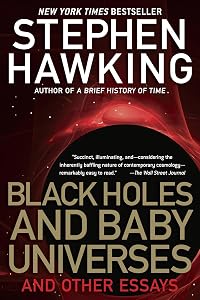
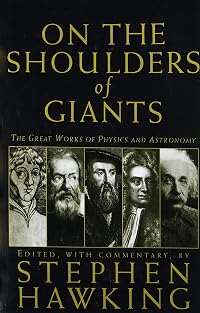
Stephen William Hawking was born in Oxford, England on January 8, 1942. He received a first class honors degree in natural science from Oxford University and a Ph.D. from Cambridge University. He was a theoretical physicist and has held the post of Lucasian Professor of Mathematics at Cambridge University from 1982 until his death. In 1974, he was show more elected a Fellow of the Royal Society, the world's oldest scientific organization. In 1963, he learned he had amyotrophic lateral sclerosis, a neuromuscular wasting disease also known as Lou Gehrig's disease. The disease confined him to a wheelchair and reduced his bodily control to the flexing of a finger and voluntary eye movements, but left his mental faculties untouched. He became a leader in exploring gravity and the properties of black holes. He wrote numerous books including A Brief History of Time: From the Big Bang to Black Holes, Black Holes and Baby Universes, On the Shoulders of Giants, A Briefer History of Time, The Universe in a Nutshell, The Grand Design, and Brief Answers to the Big Questions. In 1982, he was named a commander of the British Empire. A film about his life, The Theory of Everything, was released in 2014 and was based on his first wife Jane Hawking's book Traveling to Infinity: My Life with Stephen. He died on March 14, 2018 at the age of 76. (Bowker Author Biography) show less
Work Relationships
Is contained in
Is an expanded version of
Common Knowledge
- Original publication date
- 1996
- Related movies
- A Brief History of Time (1991 | IMDb)
- Disambiguation notice
- This is not the same work as A BRIEF HISTORY OF TIME; the two are significantly different. Please do not combine them.
Classifications
Statistics
- Members
- 1,860
- Popularity
- 11,592
- Reviews
- 15
- Rating
- (4.14)
- Languages
- 9 — Chinese, Czech, Danish, English, German, Greek, Polish, Portuguese, Spanish
- Media
- Paper
- ISBNs
- 23
- UPCs
- 1
- ASINs
- 5