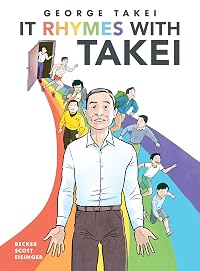
It Rhymes With Takei
by George Takei, Harmony Becker (Artist), Justin Eisinger (Adapter), Steven Scott (Adapter)
On This Page
Description
"Following the award-winning bestseller They Called Us Enemy, George Takei's new full-color graphic memoir reveals his most personal story of all--told in full for the first time anywhere! George Takei has shown the world many faces: actor, author, outspoken activist, helmsman of the starship Enterprise, living witness to the internment of Japanese Americans, and king of social media. But until October 27, 2005, there was always one piece missing--one face he did not show the world. There show more was one very intimate fact about George that he never shared...and it rhymes with Takei. Now, for the first time ever, George shares the full story of his life in the closet, his decision to come out as gay at the age of 68, and the way that moment transformed everything. Following the phenomenal success of his first graphic memoir, They Called Us Enemy, George Takei reunites with the team of Harmony Becker, Steven Scott, and Justin Eisinger for a jaw-dropping new testament. From his earliest childhood crushes and youthful experiments in the rigidly conformist 1950s, to global fame as an actor and the terrible fear of exposure, to the watershed moment of speaking his truth and becoming one of the most high-profile gay men on the planet, It Rhymes with Takei offers a sweeping portrait of one iconic American navigating the tides of LGBTQ+ history. Combining historical context with intimate subjectivity, It Rhymes with Takei shows how the personal and the political have always been intertwined. Its richly emotional words and images depict the terror of entrapment even in gay community spaces, the anguish of speaking up for so many issues while remaining silent on his most personal issue, the grief of losing friends to AIDS, the joy of finding true love with Brad Altman, and the determination to declare that love openly--and legally--before the whole world. Looking back on his astonishing life on both sides of the closet door, George Takei presents a charismatic and candid account of how far America has come...and how precious that progress is."--Publisher. show lessTags
Recommendations
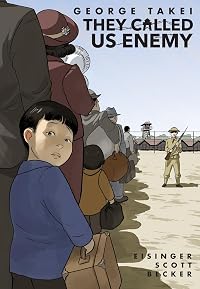


































Member Reviews
The role of a lifetime: an actor as activist.
Takei famously came out of the closet at age 68, in 2005. Ever since, the actor has been working passionately as an advocate for LGBTQ+ rights and social justice. In this sprightly and affecting graphic memoir, Takei guides readers on the winding path that led to his activism—and tells how he became an actor, known the world over for his portrayal of Hikaru Sulu in the Star Trek franchise. Takei recounts his Japanese American family’s post–Pearl Harbor imprisonment in internment camps in Arkansas and California. “We were punished for looking different,” he says. “Then came this growing realization that I had another difference”—he was attracted to other boys. “I felt so show more alone,” he says in text accompanying a poignant illustration of him with his hands in his pockets, a despairing look on his face. Thankfully, Buddhism helped the youth; his temple taught him about acceptance—“maybe my feelings were a natural part of me.” His desire to fight injustice began early, when, as a teenager, he picked strawberries and challenged fellow Japanese Americans not to exploit Mexican workers. Takei studied architecture at UC Berkeley, but his “secret aspiration” to be an actor soon became a reality: He landed a voice-over gig that paved the way for a bright future. For decades, he lived a double life, afraid of others’ finding out that he was gay (which could have ended his career). His fear, though, didn’t stop him from championing causes—in addition to serving on the board of the Japanese American National Museum in Los Angeles, he volunteered for politicians, including Tom Bradley, who, as mayor of Los Angeles, named Takei to a public transportation board. The helmsman of the USS Enterprise, it turns out, helped the City of Angels get a subway system.
A heartwarming journey that, yes, goes boldly where few men have gone before.
-Kirkus Review show less
Takei famously came out of the closet at age 68, in 2005. Ever since, the actor has been working passionately as an advocate for LGBTQ+ rights and social justice. In this sprightly and affecting graphic memoir, Takei guides readers on the winding path that led to his activism—and tells how he became an actor, known the world over for his portrayal of Hikaru Sulu in the Star Trek franchise. Takei recounts his Japanese American family’s post–Pearl Harbor imprisonment in internment camps in Arkansas and California. “We were punished for looking different,” he says. “Then came this growing realization that I had another difference”—he was attracted to other boys. “I felt so show more alone,” he says in text accompanying a poignant illustration of him with his hands in his pockets, a despairing look on his face. Thankfully, Buddhism helped the youth; his temple taught him about acceptance—“maybe my feelings were a natural part of me.” His desire to fight injustice began early, when, as a teenager, he picked strawberries and challenged fellow Japanese Americans not to exploit Mexican workers. Takei studied architecture at UC Berkeley, but his “secret aspiration” to be an actor soon became a reality: He landed a voice-over gig that paved the way for a bright future. For decades, he lived a double life, afraid of others’ finding out that he was gay (which could have ended his career). His fear, though, didn’t stop him from championing causes—in addition to serving on the board of the Japanese American National Museum in Los Angeles, he volunteered for politicians, including Tom Bradley, who, as mayor of Los Angeles, named Takei to a public transportation board. The helmsman of the USS Enterprise, it turns out, helped the City of Angels get a subway system.
A heartwarming journey that, yes, goes boldly where few men have gone before.
-Kirkus Review show less
In It Rhymes with Takei, George Takei’s fourth memoir (preceded by To the Stars, They Called Us Enemy, and My Lost Freedom) and seventh book, Takei partners with illustrator Harmony Becker and adaptors Steven Scott and Justin Eisinger to tell the story of his life through the lens of his identity as a gay man. He links this facet of his identity with other facets, such as being Japanese-American, a first-generation American through his father, an actor, a first-generation college graduate, and many more, demonstrating how it plays a role in the formation of a larger total identity rather than being a defining central element. With that said, he acknowledges how he hid this facet of his identity due to fears of personal or career show more damage. Unfortunately, this meant that his first memoir was incomplete when he might have reached audiences most in need of an ally (p. 272). However, Takei knew from the examples of Ellen Degeneres, Rock Hudson, Alec Guinness, and Tallulah Bankhead, that there could be costs for living one’s authentic life (p. 273). Takei finally decided to announce his sexuality in Frontiers magazine, though he notes “it is a life-long process. Starting out as a blank… no sensations… no thinking… nothing. Then emotions are felt… joy and pain. The narrow corridor widens a bit. With the widening come new experiences… love… hate. Then, comprehension of complexity… challenges… dread… struggle…. And finally, the will to grab that doorknob and step out for combat… And see what’s on the other side” (p. 282). Takei used his platform to advocate for LGBTQ issues with the assistance of a prior professional relationship with Howard Stern (p. 285). His continued work making connections in theatre and other performance venues opened up the possibility of telling the story of Japanese-American Internment through the Broadway musical Allegiance (p. 305, 317) and his graphic novel They Called Us Enemy. Takei concludes, “When we’re caught up in the struggling of the day, it can be easy to lose sight of the bigger picture. The amazing achievements of human ingenuity and courage. The sacrifices that are just as much a part of our story as the victories. The immense forces that we have overcome… And the vast, majestic universe, of which we are only a tiny, brief part. We are part of that majesty, every one of us. We are all traveling together on this journey” (p. 327). It Rhymes with Takei is a great first-person history of the gay rights movement, its accomplishments, and the work yet to be done. Takei leverages his fame to tell a deeply-personal narrative that will hopefully reach the right audience who most needs to read it. show less
Gorgeous, funny, serious, heartfelt. I love George Takei's bravery in talking about his long years of being in the closet, about his decision to come out and be an icon and an activist in support of LGBT+ rights, about his longstanding romance with his husband, Brad. This book feels like a beacon in a dark time, a hopeful moment that inspires us to keep trending and trying to make the world a brighter and more inclusive place. The art is on point, the message is so personal, and humor is extraordinary.
Takei guides readers through his life, from adolescence (childhood was covered in They Called Us Enemy) through the present, as he builds an acting career with support from his parents, while keeping his gay identity largely secret for fear it will destroy his acting career. Later in life, though, he joins a gay running group, meets Brad, lives through the AIDS crisis, and feels called to public activism. He loses his brother, but maintains his relationship with his mother and his niece and nephew, and the public reaction is overwhelmingly positive. Information about state legislation, referendums, and finally the Supreme Court case granting the right to gay marriage (Obergefell v. Hodges, 2015) reminds readers, if they needed show more reminding, just how recent all of this is.
Quotes
Instantly I felt shame wrap around me like a net. It was inexplicable...this feeling of silent harassment. Why did I live with this fear and scorn and lust and, yes, rage too, all bound together and tightly held within myself? (157)
That anxiety, merged with my sense of hypocrisy, was agonizing. (186)
In good times and bad, "in sickness and in health," we all need a loved one by our side. And official recognition of that love matters. (301)
Our nation's history has plenty of glorious chapters...but some of the darker chapters contain the lessons we most need to learn. (320) show less
Quotes
Instantly I felt shame wrap around me like a net. It was inexplicable...this feeling of silent harassment. Why did I live with this fear and scorn and lust and, yes, rage too, all bound together and tightly held within myself? (157)
That anxiety, merged with my sense of hypocrisy, was agonizing. (186)
In good times and bad, "in sickness and in health," we all need a loved one by our side. And official recognition of that love matters. (301)
Our nation's history has plenty of glorious chapters...but some of the darker chapters contain the lessons we most need to learn. (320) show less
nonfiction graphic biography - another well-done, high-quality nonfiction graphic from Takei picking up his story after his family was released from the Japanese Incarceration camps and covering his early school years (Mt. Vernon Jr HS, Los Angeles HS, UC Berkeley and UCLA) and his acting career as well as his increasing focus on activism and eventual coming out in 2005 at the age of 68.
Of course everything George does is 🔥. There were bits that dragged a little bit, but if you are less interested in this or that legal court case it is easy to skip ahead; the information and history is there, though, if you want it.
Of course everything George does is 🔥. There were bits that dragged a little bit, but if you are less interested in this or that legal court case it is easy to skip ahead; the information and history is there, though, if you want it.
George Takei retells, amends, and extends his 1994 memoir, To the Stars: The Autobiography of George Takei, Star Trek's Mr. Sulu, to include the major and very personal part of himself that he was hiding at the time. No longer closeted and now a prominent gay rights activist, Takei can include his love life and concerns about gay rights in with his tales about being imprisoned as a child during World War II by the U.S. government along with his family and other Japanese Americans, acting in Star Trek on television and film, and being active in California politics.
A lifelong Star Trek fan, I enjoyed learning more about the man behind Hikaru Sulu, even if the book is a bit slow-paced and overly long with a few too many digressions.
The art show more is generally adequate, but the artist isn't particularly strong when it comes to capturing the likenesses of the many celebrities who are constantly popping into Takei's life. show less
A lifelong Star Trek fan, I enjoyed learning more about the man behind Hikaru Sulu, even if the book is a bit slow-paced and overly long with a few too many digressions.
The art show more is generally adequate, but the artist isn't particularly strong when it comes to capturing the likenesses of the many celebrities who are constantly popping into Takei's life. show less
It Rhymes With Takei is George Takei's autobiography of sorts. It's a graphic novel like his award-winning earlier memoir They Called Us Enemy which was about his childhood in a Japanese internment camp during WWII. It Rhymes with Takei is a sort-of sequel about his adult life and how he got into acting and -- surprise! -- activism, something I never knew about the actor. Mostly I knew him as Sulu from the 1960s Star Trek and in more recent years, memes where he utters "Oh my" over and over again and denounces certain politicians as douchebags in a stentorian tone. The two aspects never quite came together for me and though I was amused, I didn't know he got from point A to point B.
The book explains all of that. Takei's activism took show more many forms -- civil rights, architectural preservation, city planning. But despite being gay, he didn't participate in LGBT activism, at least not in his earlier decades. As he explains it, he stayed in the closet both because of the damage it would cause to his career and to his other activism, some of which involved state and city appointments to power. This was the focus of the book and it was handled very effectively. The same artist who worked on They Called Us Enemy, Harmony Becker, did the artwork which was just as lively and enjoyable as their earlier collaboration. Takei came out as gay in 2005 and since has burst into the limelight in way he never did in his more conventional career.
The book also serves as a concise history of gay rights in American from the 1990s forward. It's sad to think that since the book's release in June of this year the federal right to gay marriage, which came about in 2015. is now in danger of being taken away yet again.
The book was also fascinating in how it shows the behind-the-scenes aspect of an actor's life. Though Takei accomplished a lot in his life and had a wide network of connections in Hollywood and the greater world, some of which interacted in surprising ways, I have the feeling he was not unique. Peel back the veneer of even a minor celebrity's private life and one might find the same thing. That is pretty humbling. show less
The book explains all of that. Takei's activism took show more many forms -- civil rights, architectural preservation, city planning. But despite being gay, he didn't participate in LGBT activism, at least not in his earlier decades. As he explains it, he stayed in the closet both because of the damage it would cause to his career and to his other activism, some of which involved state and city appointments to power. This was the focus of the book and it was handled very effectively. The same artist who worked on They Called Us Enemy, Harmony Becker, did the artwork which was just as lively and enjoyable as their earlier collaboration. Takei came out as gay in 2005 and since has burst into the limelight in way he never did in his more conventional career.
The book also serves as a concise history of gay rights in American from the 1990s forward. It's sad to think that since the book's release in June of this year the federal right to gay marriage, which came about in 2015. is now in danger of being taken away yet again.
The book was also fascinating in how it shows the behind-the-scenes aspect of an actor's life. Though Takei accomplished a lot in his life and had a wide network of connections in Hollywood and the greater world, some of which interacted in surprising ways, I have the feeling he was not unique. Peel back the veneer of even a minor celebrity's private life and one might find the same thing. That is pretty humbling. show less
Members
- Recently Added By
Lists

Youth: Sexuality & Gender
119 works; 1 member

Books Read in 2025
4,128 works; 98 members

The Best LGBTQ Nonfiction
222 works; 73 members

Best Graphic Novel Nonfiction
281 works; 102 members
Author Information

14+ Works 3,988 Members
George Hosato Takei was born on April 20, 1937. He is an American actor and author, best known for his role as Hikaru Sulu, helmsman of the USS Enterprise in the television series Star Trek. Takei is also a proponent of gay rights and active in state and local politics apart from his continued acting career. He has won several awards and show more recognition in his work on human rights and Japanese-American relations, including his work with the Japanese American National Museum. Takei enrolled in the University of California, Berkeley, where he studied architecture. Later he attended the University of California, Los Angeles, where he received both a Bachelor of Arts and a Master of Arts in theater. He attended the Shakespeare Institute at Stratford-upon-Avon in England, and Sophia University in Tokyo, Japan. In Hollywood, he studied acting at the Desilu Workshop. In 2004, the government of Japan named Asteroid 7307 "Takei" after him. In June 2012, the American Humanist Association gave Takei the LGBT Humanist Award. His book, Oh Myyy! (There Goes The Internet) was released on December 21, 2013 and became a New York Times bestseller in 2014. (Bowker Author Biography) show less
All Editions
Some Editions
Awards and Honors
Awards
Distinctions
Common Knowledge
- Original publication date
- 2025-06-10
- People/Characters
- George Takei; Brad Altman; Takekuma Norman Takei (father of George Takei); Fumiko Emily Nakamura (mother of George Takei); Henry Takei (brother of George Takei); Joy Behar (show all 54); Arnold Schwarzenegger; Howard Stern; Robin Quivers; Alfred Kinsey; Tab Hunter; Joseph McCarthy; Keye Luke; Frank Lloyd Wright; Fred Ishimoto (agent); Herbert Hirschman; Michael Colfax; Richard Burton; Josie Dotson; Cary Grant; Guglielmo Biraghi; C. Bernard Jackson; Gene Roddenberry; William Shatner; James T. Kirk; Leonard Nimoy; Spock; Hikaru Sulu; Lloyd Haynes; John Wayne; Pavel Chekov; Walter Koenig; Nyota Uhura; Nichelle Nichols; Jane Fonda; George McGovern; Tom Bradley; June Takei (wife of Henry Takei); Scott Takei (son of Henry Takei); Akemi Takei (daughter of Henry Takei); Bruce Kaji; Irene Hirano; Shane Bitney Crone; Tom Bridegroom; David Boies; Kamala Harris; Stephen Baldwin; Donald Trump; Lawrence O'Donnell; Anthony Kennedy; Barack Obama; John Cho; Joe Biden; Lea Salonga
- Important places
- California, USA; Los Angeles, California, USA; England, UK; Stratford-upon-Avon, Warwickshire, England, UK; Madrid, Spain; Rome, Italy (show all 8); Venice, Veneto, Italy; Washington, D.C., USA
- Dedication
- For Brad,
who turns every ordinary day
into one that rhymes with "Takei" –
extraordinary in every way. - First words
- May 13, 2022
THE VIEW
George Takei
Mr. Takei, they're ready. - Last words
- (Click to show. Warning: May contain spoilers.)America will be okay.
And that rhymes with Takei. - Original language
- English
Classifications
- Genres
- LGBTQ+, Graphic Novels & Comics
- DDC/MDS
- 306.7662 — Society, government, & culture Social sciences, sociology & anthropology Social Behavior - Dating, Marriage, Divorce Sexual relations Sexual orientation, transgender identity, intersexuality Homosexuality Male homosexuality
- LCC
- HQ75.8 .T35 .A3 — Social sciences The family. Marriage, Women and Sexuality The Family. Marriage. Women Sexual life Homosexuality. Lesbianism
- BISAC
Statistics
- Members
- 151
- Popularity
- 217,800
- Reviews
- 11
- Rating
- (4.27)
- Languages
- English
- Media
- Paper, Ebook
- ISBNs
- 2
- ASINs
- 1