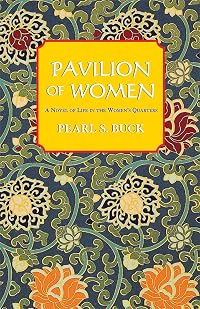
Pavilion of Women
by Pearl S. Buck
On This Page
Description
The exhilarating novel of an elegant woman's subversive new chapter in life. At forty, Madame Wu is beautiful and much respected as the wife of one of China's oldest upper-class houses. Her birthday wish is to find a young concubine for her husband and to move to separate quarters, starting a new chapter of her life. When her wish is granted, she finds herself at leisure, no longer consumed by running a sixty-person household. Now she's free to read books previously forbidden her, to learn show more English, and to discover her own mind. The family in the compound is shocked at the results, especially when she begins learning from a progressive, excommunicated Catholic priest. In its depiction of life in the compound, Pavilion of Women includes some of Buck's most enchanting writing about the seasons, daily rhythms, and customs of women in China. It is a delightful parable about the sexes, and of the profound and transformative effects of free thought. This ebook features an illustrated biography of Pearl S. Buck, including rare images from the author's estate. show lessTags
Recommendations
















Member Reviews
Imagine awakening on your fortieth birthday and deciding that you were through performing for others. Their concerns were no longer yours and from that point on you were going to live the life you always envisioned. That's exactly what Madame Wu, the lead character of Pavilion of Women does. How exciting!
I can't count the number of times I've said, "As soon as the kid leaves home, I'm starting life over." Like Madame Wu, I'll be 40 when that happens. Somehow I don't think my decision will have the same consequences.
As a mother of four, Madame Wu has been responsible for tending to her elderly mother-in-law, her simple husband, arranging quality marriages for her eldest sons and overseeing the House of Wu, one of the oldest and most show more respected families in China. Realizing that she has never really loved her husband and has given to those around without realizing any of her dreams, she makes the decision to step aside.
When a handsome, foreign priest enters Madame Wu's world, she's pleasantly surprised to find that he may be the perfect person to show her what she's been missing for the first forty years.
I'm a big fan of This Good Earth by Pearl Buck, but hadn't ventured any further into her catalog. I'm mad at myself for waiting so long to do so. I loved this story. Madame Wu is a walking contradiction, but her intentions are good. If you're looking for something out of the norm, this is the book for you. show less
I can't count the number of times I've said, "As soon as the kid leaves home, I'm starting life over." Like Madame Wu, I'll be 40 when that happens. Somehow I don't think my decision will have the same consequences.
As a mother of four, Madame Wu has been responsible for tending to her elderly mother-in-law, her simple husband, arranging quality marriages for her eldest sons and overseeing the House of Wu, one of the oldest and most show more respected families in China. Realizing that she has never really loved her husband and has given to those around without realizing any of her dreams, she makes the decision to step aside.
When a handsome, foreign priest enters Madame Wu's world, she's pleasantly surprised to find that he may be the perfect person to show her what she's been missing for the first forty years.
I'm a big fan of This Good Earth by Pearl Buck, but hadn't ventured any further into her catalog. I'm mad at myself for waiting so long to do so. I loved this story. Madame Wu is a walking contradiction, but her intentions are good. If you're looking for something out of the norm, this is the book for you. show less
https://fromtheheartofeurope.eu/the-big-wave-and-the-pavilion-of-women-by-pearl-...
It is about Madame Wu, of a wealthy family, who on her fortieth birthday decides that she will no longer have sex with her husband, procures him a concubine and embarks on her personal voyage of self-discovery, with the help of the foreign priest Father Andrei. It is not just about China, but about the development of women’s rights across the world, and about how Westerners who blunder into an ancient society thinking they have all the answers are doomed to failure, while those who take the time to sit and listen may learn something. But the core of the book is Madame Wu and her relationships with her husband, his other lovers, and their sons and show more daughters-in-law, at a time of massive social change in China. She is not a completely sympathetic character, but she and her environment are vividly drawn. show less
It is about Madame Wu, of a wealthy family, who on her fortieth birthday decides that she will no longer have sex with her husband, procures him a concubine and embarks on her personal voyage of self-discovery, with the help of the foreign priest Father Andrei. It is not just about China, but about the development of women’s rights across the world, and about how Westerners who blunder into an ancient society thinking they have all the answers are doomed to failure, while those who take the time to sit and listen may learn something. But the core of the book is Madame Wu and her relationships with her husband, his other lovers, and their sons and show more daughters-in-law, at a time of massive social change in China. She is not a completely sympathetic character, but she and her environment are vividly drawn. show less
I absolutely adore Pearl S. Buck's writing. That being said, I shall have to go through her entire bibliography in order to satisfy myself. Her prose is a warm bath, complete with the small insights and revelations that often come to one during luxurious respite. 'Pavilion of Women' presents a woman with unparalleled logic and self-control, but who also is ignorant of how coldly she views the rest of the world, those who lack her intelligence and strength of will. Through the course of the novel, she recognizes the mistakes she has made in withdrawing herself from the world and expecting the world to properly continue, and with the help from a foreign priest and a previously foreign emotion, she discovers how to continue existing. I show more feel I have a soft spot for this book, as I share many of the character traits of the protagonist (albeit not nearly as omniscient), and I love the book for being able to relate to many of its wise remarks on life in general. show less
I didn't enjoy this one as much as I expected. Parts of the book really drew me in, but then the book would take a turn and I found myself losing interest or really turned off by the new direction. The end, in particular, almost amounts to a summary. Madame Wu is sometimes fascinating, sometimes really unlikable, sometimes just hard to believe. I've had this book on my Kindle for ages, and I'm glad I finally got around to reading it, but it makes me unsure about reading the author's other works.
This book starts out on Madame Wu turning 40. She's sick and tired of having intimate relations with her husband, so she forestalls his objections by buying him a concubine.
She was smarter than her husband, and from the time she came to live with her husband's family, she was close to her father-in-law, a widely-read, intelligent man.
Madame Wu's father-in-law:
" 'This matter of intelligence - it is so great a gift, so heavy a burden. Intelligence, more than poverty and riches, divides human beings and make them friends or enemies. The stupid person fears and hates the intelligent person. Whatever the goodness of the intelligent man, he must also know that it will not win him love from one whose mind is less than his.' " P.61
On Madame show more Wu's 40th birthday, a huge party took place. During the party, something happens, that gives an example of why, at first, I didn't like the characters' culture:
"The court was lit with red - paper lanterns, and these drew the moths out of the darkness. Many of them were only small gray creatures, Dusty wisps. But now and again a great moth would flutter forth with pale green - tailed wings, or wings of black and gold. Then all the women cried out, and none could rest until it was imprisoned and impaled upon the door by a pin where all could exclaim at its beauty while they sat in comfort and ate their sweetmeats. Old lady [Madame Wu's mother-in-law] especially enjoyed the sport and clapped her hands with pleasure.
"Now, as they were all looking at the new moth, she, too [Second Wife], went to look at it. It was a creamy yellow color, like the yellow of the lemon called Buddha's hand, and it had long black antenna. These quivered as it felt itself impaled. The wide wings was flattered and dark spots upon them should green and gold for a moment. Then the moth was still." P.131
A foreign Anglo missionary, Little Sister Hsia, makes her rounds frequently, preaching her religion. She talks bad about an Italian priest who takes in Little girl-babies, who are thrown over the city wall because they're girls, and runaway girl slaves, and cares for them. He pays no mind to Little sister Hsia, and this irks her.
"Little sister Hsia's fingers were knotting themselves. 'I do not know how we came to talk about all this,' she said. 'I came here to ask you something - really, I forgot what it was, now.'
'You have forgotten because it was not what was really in your mind,' Madame Wu said kindly. 'I will answer you. No, little sister Hsia, you must leave brother Andre alone. I assure you he is like a great high rock, hard because it is high. You must not beat yourself against that Cliff. You will be wounded, your flesh will be torn, your heart will bleed, and your brains will be spilled like curds, but he will not know it. Occupy yourself with your own God - I advise it.' " P.162
Madame Wu asks the priest, Brother Andre, to teach her son Fengmo some English, so that he can get along better with his wife, who was educated in Shanghai. She sits alongside them during their lessons, and eventually comes to regard Brother Andre as her own teacher. Here she explores her feelings of guilt about turning away from her husband with Brother Andre:
"She was angry at this in her fashion. A gust of sharp temper flew like a sudden small Whirlwind out of her heart.
'Now you speak like a priest,' she said maliciously. 'You can have no understanding of what it is to be compelled to yield your body to a man year after year, without your will.' She felt in herself a strange desire to make him share her unhappiness, and she went on, sparing him nothing. 'To give one's delicate body to indelicate hands, to see lust grow hot and feel one's own flesh grow cold--to feel the heart grow faint and the mind sick, and yet to be compelled, for the sake of Peace in the house.' " P.205
Brother Andre was killed in the street by a gang of hooligans, as he was leaving Madame Wu's compound, after they had spent time together in conversation. His loss of life made her realize her true feelings about him:
" 'I should like to have seen him when he was a young Giant,' Madame Wu thought. She sat at perfect peace, and complete stillness, her hands folded one upon the other, and her rings gleaming softly on her fingers. Yes, Andre as a young man must have been a good sight for a woman. He was handsome even in his middle age, but young he must have been himself a god. Then she felt sorry for that woman whom he had rejected. Now she was married doubtless and perhaps she had many children, for women do not die because a man will not have them, but somewhere in her heart she still thought of Andre, with love or with hate. If she were a woman of little heart she would hate him, and if she were a great heart she had not blamed him and so she loved him still. Or perhaps she thought of him no more. It might be perhaps she was simply tired and past any feeling, as women can grow to be when their hearts and bodies have been too much used. It was the weakness of a woman that heart and body were in it together, warp and woof, and when the body was too much used the heart, too, became barren, unless it had love, such as she now felt toward Andre. Death had relieved her of his body. Had he lived they might have lost their souls in the snare of the flesh. She was surprised to feel at this moment a sudden Rich flesh of the blood into her vitals." P.215
Brother Andre carried his Bible with him when he came for their talks, and he would at times read her a passage. She distrusted this book:
" 'Love thy neighbor as thyself,' he read slowly.
'Love!' she had exclaimed. 'The word is too strong.'
'You are right,' he had said. 'Love is not the word. No one can love his neighbor. Say, rather, "know thy neighbor as thyself." That is, comprehend his hardships and understand his position, deal with his faults as gently as with your own. Do not judge him where you do not judge yourself. Madame, this is the meaning of the word love.' " P.270-1
This book makes you grow to love it, at first disliking the characters for their strange (to this reader) culture and ways, and seeming coldness. But the protagonist grows with the reader, in understanding, until at the end, you are loath to say goodbye. show less
She was smarter than her husband, and from the time she came to live with her husband's family, she was close to her father-in-law, a widely-read, intelligent man.
Madame Wu's father-in-law:
" 'This matter of intelligence - it is so great a gift, so heavy a burden. Intelligence, more than poverty and riches, divides human beings and make them friends or enemies. The stupid person fears and hates the intelligent person. Whatever the goodness of the intelligent man, he must also know that it will not win him love from one whose mind is less than his.' " P.61
On Madame show more Wu's 40th birthday, a huge party took place. During the party, something happens, that gives an example of why, at first, I didn't like the characters' culture:
"The court was lit with red - paper lanterns, and these drew the moths out of the darkness. Many of them were only small gray creatures, Dusty wisps. But now and again a great moth would flutter forth with pale green - tailed wings, or wings of black and gold. Then all the women cried out, and none could rest until it was imprisoned and impaled upon the door by a pin where all could exclaim at its beauty while they sat in comfort and ate their sweetmeats. Old lady [Madame Wu's mother-in-law] especially enjoyed the sport and clapped her hands with pleasure.
"Now, as they were all looking at the new moth, she, too [Second Wife], went to look at it. It was a creamy yellow color, like the yellow of the lemon called Buddha's hand, and it had long black antenna. These quivered as it felt itself impaled. The wide wings was flattered and dark spots upon them should green and gold for a moment. Then the moth was still." P.131
A foreign Anglo missionary, Little Sister Hsia, makes her rounds frequently, preaching her religion. She talks bad about an Italian priest who takes in Little girl-babies, who are thrown over the city wall because they're girls, and runaway girl slaves, and cares for them. He pays no mind to Little sister Hsia, and this irks her.
"Little sister Hsia's fingers were knotting themselves. 'I do not know how we came to talk about all this,' she said. 'I came here to ask you something - really, I forgot what it was, now.'
'You have forgotten because it was not what was really in your mind,' Madame Wu said kindly. 'I will answer you. No, little sister Hsia, you must leave brother Andre alone. I assure you he is like a great high rock, hard because it is high. You must not beat yourself against that Cliff. You will be wounded, your flesh will be torn, your heart will bleed, and your brains will be spilled like curds, but he will not know it. Occupy yourself with your own God - I advise it.' " P.162
Madame Wu asks the priest, Brother Andre, to teach her son Fengmo some English, so that he can get along better with his wife, who was educated in Shanghai. She sits alongside them during their lessons, and eventually comes to regard Brother Andre as her own teacher. Here she explores her feelings of guilt about turning away from her husband with Brother Andre:
"She was angry at this in her fashion. A gust of sharp temper flew like a sudden small Whirlwind out of her heart.
'Now you speak like a priest,' she said maliciously. 'You can have no understanding of what it is to be compelled to yield your body to a man year after year, without your will.' She felt in herself a strange desire to make him share her unhappiness, and she went on, sparing him nothing. 'To give one's delicate body to indelicate hands, to see lust grow hot and feel one's own flesh grow cold--to feel the heart grow faint and the mind sick, and yet to be compelled, for the sake of Peace in the house.' " P.205
Brother Andre was killed in the street by a gang of hooligans, as he was leaving Madame Wu's compound, after they had spent time together in conversation. His loss of life made her realize her true feelings about him:
" 'I should like to have seen him when he was a young Giant,' Madame Wu thought. She sat at perfect peace, and complete stillness, her hands folded one upon the other, and her rings gleaming softly on her fingers. Yes, Andre as a young man must have been a good sight for a woman. He was handsome even in his middle age, but young he must have been himself a god. Then she felt sorry for that woman whom he had rejected. Now she was married doubtless and perhaps she had many children, for women do not die because a man will not have them, but somewhere in her heart she still thought of Andre, with love or with hate. If she were a woman of little heart she would hate him, and if she were a great heart she had not blamed him and so she loved him still. Or perhaps she thought of him no more. It might be perhaps she was simply tired and past any feeling, as women can grow to be when their hearts and bodies have been too much used. It was the weakness of a woman that heart and body were in it together, warp and woof, and when the body was too much used the heart, too, became barren, unless it had love, such as she now felt toward Andre. Death had relieved her of his body. Had he lived they might have lost their souls in the snare of the flesh. She was surprised to feel at this moment a sudden Rich flesh of the blood into her vitals." P.215
Brother Andre carried his Bible with him when he came for their talks, and he would at times read her a passage. She distrusted this book:
" 'Love thy neighbor as thyself,' he read slowly.
'Love!' she had exclaimed. 'The word is too strong.'
'You are right,' he had said. 'Love is not the word. No one can love his neighbor. Say, rather, "know thy neighbor as thyself." That is, comprehend his hardships and understand his position, deal with his faults as gently as with your own. Do not judge him where you do not judge yourself. Madame, this is the meaning of the word love.' " P.270-1
This book makes you grow to love it, at first disliking the characters for their strange (to this reader) culture and ways, and seeming coldness. But the protagonist grows with the reader, in understanding, until at the end, you are loath to say goodbye. show less
This is the story of the upper class Chinese pre WWII. The story centers around Madame Wu, who at the age of 40, leaves her marriage bed and gets her husband a concubine. She does this for "freedom." This action causes great confusion and problems within the Wu household. Madame Wu speaks often with Brother Andre, a foreign priest and he greatly affects her and her idea of freedom. "You are free when you gain back yourself,” Madame Wu said. “You can be as free within these walls as you could be in the whole world. ......" Let him go free, and you will be free." During the first half of the book, while Madame Wu appeared to be gentle and timid, she really was a manipulator. After she came to understand what freedom really is, she was show more still a manipulator, just a kinder, gentler one! Not the best Buck, but quite enjoyable. 312 pages show less
Madame Wu takes an unheard-of decision on her fortieth birthday. She decides to withdraw from her "marital duty" [sic] and ask her husband to take a concubine to satisfy his physical needs. On top of that, she decides to search for the suitable concubine herself, because she feels she knows her husband best. This happens in chapter one. What happens as a result of this decision comprises the rest of the 466 page book.
My opinion: The book is fantastic almost entirely. Unfortunately, it falls flat towards the end (say, the last 70 or so pages.) If you can forgive the excessive religious ideas (Pearl S Buck's father was a missionary, and that shows in her writing), then the book is definitely worth your time. Madame Wu is a character who show more will stay with you. The other female characters are quite intriguing too, each facing their own demons and dealing with them in different ways. I just wish the end had been written better; I would have loved this book much more. It just seems very contrived.
Rating: 3.75/5
********************************************
Join me on the Facebook group, "Readers Forever!", for more reviews and other book-related discussions and fun. show less
My opinion: The book is fantastic almost entirely. Unfortunately, it falls flat towards the end (say, the last 70 or so pages.) If you can forgive the excessive religious ideas (Pearl S Buck's father was a missionary, and that shows in her writing), then the book is definitely worth your time. Madame Wu is a character who show more will stay with you. The other female characters are quite intriguing too, each facing their own demons and dealing with them in different ways. I just wish the end had been written better; I would have loved this book much more. It just seems very contrived.
Rating: 3.75/5
********************************************
Join me on the Facebook group, "Readers Forever!", for more reviews and other book-related discussions and fun. show less
Members
- Recently Added By
Lists

Top Five Books of 2013
1,562 works; 715 members

1940s
221 works; 25 members

500 Great Books by Women
507 works; 60 members

Stories set in China
10 works; 2 members

Books Read in 2011
684 works; 20 members
Author Information

434+ Works 37,123 Members
Pearl S. Buck, June 26, 1892 - March 6, 1973 Pearl Sydenstricker Buck was an American author, best know for her novels about China. Buck was born on June 26, 1892, in Hillsboro, West Virginia, but as the daughter of Presbyterian missionaries she was taken to China in infancy. She received her early education in Shanghai, but returned to the United show more States to attend college, and graduated from Randolph-Macon Woman's College in Virginia in 1914. Buck became a university teacher there and married John Lossing Buck, an agricultural economist, in 1917. Buck and her husband both taught in China, and she published magazine articles about life there. Her first novel East Wind, West Wind was published in 1930. Buck achieved international success with The Good Earth, which won the Pulitzer Prize in 1932. This story of a Chinese peasant family's struggle for survival was later made into a MGM film. Buck resigned from the Presbyterian Board of Foreign Missions after publishing an article that was critical of missionaries. She returned to the United States because of political unrest in China. Buck's novels during this period include Sons, A House Divided, and The Mother. She also wrote biographies of her father (Fighting Angel) and her mother (The Exile). She won the Nobel Prize for Literature in 1938. During her career, Buck published over 70 books: novels, nonfiction, story collections, children's books, and translations from the Chinese. She also wrote under the pseudonym John Sedges. In the United States, Buck was active in the civil rights and women's rights movements. In 1942 she founded the East and West Association to promote understanding between Asia and the West. In 1949, Buck established Welcome House, the first international interracial adoption agency. In 1964, she established the Pearl S. Buck foundation to sponsor support for Amerasian children who were not considered adoptable. Pearl Buck died in Danbury, Vermont, on March 6, 1973. (Bowker Author Biography) show less
Some Editions
Awards and Honors
Distinctions
Notable Lists
Series
Belongs to Publisher Series
Fischer Bücherei (5)
Cardinal Editions [Pocket Books] (C-105)
Nobelpreisträger Coron-Verlag (weiß) (1938 (USA))
De twintigste eeuw (70)
Le livre de poche (0291-0292)
Work Relationships
Is contained in
Is abridged in
Common Knowledge
- Canonical title*
- Die Frauen des Hauses Wu
- Original title
- Pavillion of Women
- Alternate titles*
- Vrouwenpaviljoen
- Original publication date
- 1946
- People/Characters
- Madame Wu
- Important places*
- China
- Related movies
- Pavilion of Women (2001 | IMDb)
- First words
- It was her fortieth birthday.
- Last words
- (Click to show. Warning: May contain spoilers.)She knew she was immortal.
- Blurbers
- Beecroft, John
- Original language*
- Amerikanisch
*Some information comes from Common Knowledge in other languages. Click "Edit" for more information.
Classifications
Statistics
- Members
- 1,386
- Popularity
- 17,111
- Reviews
- 29
- Rating
- (3.91)
- Languages
- 17 — Chinese, Czech, Danish, Dutch, English, Estonian, Finnish, French, German, Italian, Norwegian (Bokmål), Polish, Portuguese, Romanian, Russian, Spanish, Turkish
- Media
- Paper, Audiobook, Ebook
- ISBNs
- 48
- ASINs
- 55