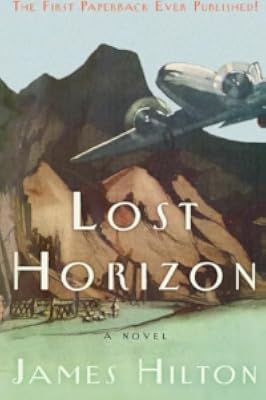
Lost Horizon
by James Hilton
On This Page
Description
Following a plane crash in the Himalayan mountains, a lost group of Englishmen and Americans stumble upon the dream-like, utopian world of Shangri-La, where life is eternal and civilization refined.Tags
Recommendations























Member Recommendations

Member Reviews
Lost Horizon is about a man who flees war to find himself in a mysterious monastery where everything is perfect and time stands still. His compatriots want to leave while he befriends the llamas and finds himself quite at home. This novel coined the term Shangri-La (the name of the monastery), which seems to have become incorrectly conflated with Xanadu in the modern western lingo. I loved the very 1930s Colonial Era Britishisms in the novel and liked the story itself. I thought the end could've gone further and brought the reader around more to contemplating whether or not extreme moderation in all things and near immortality are actually desirable. I thought Conway would come to this realization himself but he didn't. Still, a notable show more work that has stood the test of time and worth reading. show less
Lost Horizon isn’t just a novel ... it’s a mystical whisper of discovery and yearning. A story that creeps up behind you and asks the question nobody wants to face: what if peace isn’t out there to be conquered, but within us, waiting for us to stop thrashing long enough to notice?
James Hilton wrote this in the wake of a world that had just torn itself apart, and you can feel the fatigue and yearning of that time in every line. The prose is deceptively simple, yet it glows ... like candlelight in a monastery corridor. Through Hugh Conway, Hilton gives us a man teetering between civilization’s noise and the deep quiet of something that feels like enlightenment.
It’s a story about escape, yes, but not the cheap kind. The escape show more here is existential ... an invitation to let go of ambition and rediscover grace. Every time I return to it, I find another small truth I’d missed the first time, hidden like a monk’s smile behind the veil of fog.
If modern life feels like an endless sprint, Lost Horizon is the exhale you forgot you were allowed to take. It’s not just a classic ... it’s a compass. show less
James Hilton wrote this in the wake of a world that had just torn itself apart, and you can feel the fatigue and yearning of that time in every line. The prose is deceptively simple, yet it glows ... like candlelight in a monastery corridor. Through Hugh Conway, Hilton gives us a man teetering between civilization’s noise and the deep quiet of something that feels like enlightenment.
It’s a story about escape, yes, but not the cheap kind. The escape show more here is existential ... an invitation to let go of ambition and rediscover grace. Every time I return to it, I find another small truth I’d missed the first time, hidden like a monk’s smile behind the veil of fog.
If modern life feels like an endless sprint, Lost Horizon is the exhale you forgot you were allowed to take. It’s not just a classic ... it’s a compass. show less
A quite beautiful and serene reading experience, author James Hilton makes the reader feel everything that his protagonist feels upon encountering Shangri-La, a hidden city somewhere near Tibet. He unfolds the mysteries of this place expertly – "the gradual revelation of elegance", as he puts it on page 83 – and you fall completely into the book's cadences. It is made very easy for the reader to place themselves into the shoes of Conway – the protagonist – and you get the sense of spiritual wanderlust and the earnest desire to avoid apathy that forms the makeup of any sensitive man.
Perhaps Lost Horizon's greatest strength is that its utopia of Shangri-La remains elusive, and whilst its "peacefulness and its utter freedom from show more worldly cares" (pg. 127) is immensely attractive, Hilton does not shy away from its strictures and its possible unattainability. But in showing us a glimpse of it, he crafted a uniquely elegant and wistful book, and it feels as painful leaving it as it did for Conway. show less
Perhaps Lost Horizon's greatest strength is that its utopia of Shangri-La remains elusive, and whilst its "peacefulness and its utter freedom from show more worldly cares" (pg. 127) is immensely attractive, Hilton does not shy away from its strictures and its possible unattainability. But in showing us a glimpse of it, he crafted a uniquely elegant and wistful book, and it feels as painful leaving it as it did for Conway. show less
I picked this up on a lark at my local library book sale. I hadn't read it since high school...a very, very long time ago. At that time, I found the tale of a utopian city in the clouds a bit too dense for my tastes. In fact, I probably never got through the book, as I recall looking for the Cliff's Notes on it to finish my 11th grade English book report.
Fast forward a lot of years--and a lot of experience--and the book takes on a whole different meaning. I found myself sucked into the story of Hugh Conway and his companions as they explore, and (in 2 of 3 cases) learn to appreciate the value of living life a more intentional, purposeful life. Of the book: the imagery is superb, the backstory is well-developed, and its message is very show more well sent. But the ending...completely unsatisfactory. I hate cliffhangers, and not knowing whether Conway ever made it back to the fabled lamasery bothers me!
That said, I highly recommend this book. Take lots of time to read it. It isn't a regular novel that you can digest without thinking, as the themes are dense and thought provoking.
Key Themes and Useful Lessons (My Interpretation)
Interesting Quotations
On confronting the unknown:
"If you'd had all the experiences I've had, you'd know that there are times in life when the most comfortable thing to do is nothing at all. Things happen to you and you just let them happen."
-- Hugh Conway to Mallinson, on the ascent to Shangri-La
On living a purposeful life...in moderation:
"If I were to put it into very few words, my dear sir, I should say that our prevalent belief is in moderation. We inculcate the virtue of avoiding excess of all kinds -- even including, if you will pardon the paradox, excess of virtue itself. In the valley which you have seen, and in which there are several thousand inhabitants living under control of our order, we have found that the principle makes for a considerable degree of happiness. We rule with moderate strictness, and in return we are satisfied with moderate obedience. And I think I can claim our people are moderately sober, moderately chaste, and moderately honest."
-- Chang to Conway
On patience and politeness:
"To your friend's attitude there was no answer, but to the demand of a wise man there is always a response."
-- Chang to Conway on his request for an answer, after Mailinson's gruff attitude.
On passion and wisdom (or contentment):
“The exhaustion of the passions is the beginning of wisdom”
-- Conway to the High Lama
(I'm sure there are more I will pick out on my next reading....)
Finally, a note (and a warning to any prospective students writing a book report): Read the book. Don't base your report on the 1937 Frank Capra movie. Trust me on this one.
And, as to whether Conway ever made it back to Shangri-La? I'm of the camp that thinks he did. show less
Fast forward a lot of years--and a lot of experience--and the book takes on a whole different meaning. I found myself sucked into the story of Hugh Conway and his companions as they explore, and (in 2 of 3 cases) learn to appreciate the value of living life a more intentional, purposeful life. Of the book: the imagery is superb, the backstory is well-developed, and its message is very show more well sent. But the ending...completely unsatisfactory. I hate cliffhangers, and not knowing whether Conway ever made it back to the fabled lamasery bothers me!
That said, I highly recommend this book. Take lots of time to read it. It isn't a regular novel that you can digest without thinking, as the themes are dense and thought provoking.
- An absence of passion enables a more harmonious life. This is definitely not the path I took growing up; nor is it the path that we (society) feed to our children day in and day out ("To be successful/happy, you must find your passion!"), but it is most certainly worth contemplating. Would a more carefree attitude toward life and life's goals make living easier? Would it better enable (as Steven Covey points out) to ability to "live, love, learn, and leave a legacy"? On the other hand, would a passionless life allow me to provide for myself and my family ? I imagine there is a fine balance somewhere between the two.
- Wealth is a means to an end, not an end in itself. The lamasery and village are rich in gold...but the inhabitants don't exploit those riches for personal gain; they are used simply to enable trade and encourage learning. This brings to mind a quote by Captain Picard in Star Trek: First Contact, "The acquisition of wealth is no longer the driving force in our lives. We work to better ourselves and the rest of humanity." Noble...and perhaps something to strive for (but not to mean that one shouldn't be fairly compensated for the use of his/her abilities or intellect).
- Time is never of the essence -- everything is done in moderation (as a way to live a balanced and simple life). Somewhat the same as the first theme/lesson above, but not.... I see this more as slowing down to smell the roses, while the first is more focused on finding and driving action to achieve a specific purpose. It took me 20 years to learn to slow down.
Interesting Quotations
On confronting the unknown:
"If you'd had all the experiences I've had, you'd know that there are times in life when the most comfortable thing to do is nothing at all. Things happen to you and you just let them happen."
-- Hugh Conway to Mallinson, on the ascent to Shangri-La
On living a purposeful life...in moderation:
"If I were to put it into very few words, my dear sir, I should say that our prevalent belief is in moderation. We inculcate the virtue of avoiding excess of all kinds -- even including, if you will pardon the paradox, excess of virtue itself. In the valley which you have seen, and in which there are several thousand inhabitants living under control of our order, we have found that the principle makes for a considerable degree of happiness. We rule with moderate strictness, and in return we are satisfied with moderate obedience. And I think I can claim our people are moderately sober, moderately chaste, and moderately honest."
-- Chang to Conway
On patience and politeness:
"To your friend's attitude there was no answer, but to the demand of a wise man there is always a response."
-- Chang to Conway on his request for an answer, after Mailinson's gruff attitude.
On passion and wisdom (or contentment):
“The exhaustion of the passions is the beginning of wisdom”
-- Conway to the High Lama
(I'm sure there are more I will pick out on my next reading....)
Finally, a note (and a warning to any prospective students writing a book report): Read the book. Don't base your report on the 1937 Frank Capra movie. Trust me on this one.
And, as to whether Conway ever made it back to Shangri-La? I'm of the camp that thinks he did. show less
This book is a superb, mesmerizing, haunting tale that hovers somewhere between historical fiction and philosophy, between religious yearning and parboiled adventure. It’s an elegant lament for peace amidst the destructive forces of modern life on this planet, where the war drums of mad men beat without end.
At the outset it’s a story of a British diplomat who, along with a mysterious American, a British nun, and a junior British diplomat are hijacked by an unknown pilot impersonating an Air Force man in India at the sunset of the British empire. They are flown over the high mountains of Tibet and land on the outskirts of a massive, barren plain in some remote high mountain range.
They are met by a coterie of Tibetans led by a show more Chinese man named Chang who leads them to a lamasery (a monastery) at the foot of the most beautiful mountain any of them have ever seen. Slowly their host drips information to them about where they are, the identity of their hosts, and how they might return home. The hospitality is superb. But the answers don’t come quickly—especially for the junior diplomat. Days turn into weeks as they wonder about their fate in this most curious place.
The protagonist, the senior diplomat, is a youngish veteran of World War I named Conway who possesses a raft of admirable personality traits of untapped leadership—hard won from his days as a soldier in the Great War. Consequently, he possesses a wise, detached, unruffled malaise that brings him under the wing of the high llama, an extremely mysterious and impossibly aged man. Their encounters are reminiscent of the Buddha and his students. He has singled out Conway from his colleagues for some special, unknown role in this place.
When finally an opportunity to escape arrives the young British officer Mallinson takes his chance. I will leave it to the reader to discover what happens with him, Conway, and the others.
But on a deeper level, what happens in this book is a series of fluid, poetic contemplations of the meaning of life that are not overwrought but nonetheless arresting. And though certainly there is a metaphor here about war and peace and what its unending horrors do to the souls of mankind, there lingers a feeling of hope for what we may become—individually and collectively. How can we conquer the demons that keep us from our own highest destiny?
I was completely taken by Hilton’s prose in this book. From another age—an age of politeness, formality and of delicate, intricate, and creative description, absent of all vulgarity, and with an expressiveness that is hard to find in our modern age. I found myself wondering about the things that Conway wondered. I found myself wondering about what we are all meant to become. It was just a mesmerizing piece of fiction that I am thrilled to have encountered. A combination of adventure storytelling between the great world wars and philosophical meanderings that put me in a happy mood of contemplation and curious thoughts about how one could write such a compelling story and how I could discover it 85 years after it was published. Just marvelous. I do not often give five stars for books but this tale is completely deserving. Enjoy. show less
At the outset it’s a story of a British diplomat who, along with a mysterious American, a British nun, and a junior British diplomat are hijacked by an unknown pilot impersonating an Air Force man in India at the sunset of the British empire. They are flown over the high mountains of Tibet and land on the outskirts of a massive, barren plain in some remote high mountain range.
They are met by a coterie of Tibetans led by a show more Chinese man named Chang who leads them to a lamasery (a monastery) at the foot of the most beautiful mountain any of them have ever seen. Slowly their host drips information to them about where they are, the identity of their hosts, and how they might return home. The hospitality is superb. But the answers don’t come quickly—especially for the junior diplomat. Days turn into weeks as they wonder about their fate in this most curious place.
The protagonist, the senior diplomat, is a youngish veteran of World War I named Conway who possesses a raft of admirable personality traits of untapped leadership—hard won from his days as a soldier in the Great War. Consequently, he possesses a wise, detached, unruffled malaise that brings him under the wing of the high llama, an extremely mysterious and impossibly aged man. Their encounters are reminiscent of the Buddha and his students. He has singled out Conway from his colleagues for some special, unknown role in this place.
When finally an opportunity to escape arrives the young British officer Mallinson takes his chance. I will leave it to the reader to discover what happens with him, Conway, and the others.
But on a deeper level, what happens in this book is a series of fluid, poetic contemplations of the meaning of life that are not overwrought but nonetheless arresting. And though certainly there is a metaphor here about war and peace and what its unending horrors do to the souls of mankind, there lingers a feeling of hope for what we may become—individually and collectively. How can we conquer the demons that keep us from our own highest destiny?
I was completely taken by Hilton’s prose in this book. From another age—an age of politeness, formality and of delicate, intricate, and creative description, absent of all vulgarity, and with an expressiveness that is hard to find in our modern age. I found myself wondering about the things that Conway wondered. I found myself wondering about what we are all meant to become. It was just a mesmerizing piece of fiction that I am thrilled to have encountered. A combination of adventure storytelling between the great world wars and philosophical meanderings that put me in a happy mood of contemplation and curious thoughts about how one could write such a compelling story and how I could discover it 85 years after it was published. Just marvelous. I do not often give five stars for books but this tale is completely deserving. Enjoy. show less
Was curious to read the original 'Shangri-La' novel after watching both movie versions that came out in 1937 and 1973. It was a different perspective than I had expected and surprisingly carried better in the movies. The book felt somewhat uncomfortable with itself. You could tell why this story struck a chord and again became of interest in the 70's, following the anti-war sentiment and intense interest in eastern religions. I felt the changes made in the '37 re-telling were more in keeping with the novel and captured the original feel of the book very well. I could not separate the impression of Ronald Coleman from the Robert Conway character. It was spot on. Same with the exasperated George character that became the brother in this show more version, instead of just a colleague from the war. show less
Lost Horizon is not only notable for having created the influential concept of Shangri-La (which, though obviously preceded by Atlantis, Lemuria, Plato's Republic, and so forth, speaks to the 20th century much more clearly than those others do), but it pioneered an entire new book format: the paperback. I consider the latter to be more of an achievement, as it made reading dramatically cheaper and more accessible to the public, but as a representative of the subgenre of "psychological adventure novels examining Western culture", it isn't too bad either. It was written in 1933 and deals with lots of themes that made it a big hit both back then and now - orientalism vs Western culture, stasis vs growth and technological progress, revealed show more truth vs fidelity to oneself - all wrapped in several layers of frame narrative that do a good job of drawing the reader in while highlighting how fragile the chains of logic are that tie most people to their most cherished beliefs.
The book is told as a neurologist reading the manuscript of one Hugh Conway, a somewhat superhero-ish British Oxford product, who related to an acquaintance the tale of his adventure in the Tibetan highlands. At one point in the early 1930s, during an evacuation from India to Peshawar, his plane gets hijacked and his companions get taken to a mysterious mountain valley containing a lamasery where everyone is not only incredibly relaxed and dwelling in suspiciously perfect languid contemplation, but somehow have the best of everything. Slowly it's revealed that this valley has retained many Westerners over the years due to the magic powers of longevity and mental clarity it grants to residents, helped by a careful search and selection process run by the folks in charge. Conway and his hosts have many long philosophical talks about why living in the lamasery is superior to the outside world; ordinarily that technique of telling and not showing is not preferable, but since the real point of the book is the philosophical conflict between normal Western society and a live of Zen monk-ish reflection, which is hard to reduce to a more action-oriented plot, it works.
It works well with the chain of narration. While Conway's internal debate over whether or not to forsake the outside world obviously reminds me somewhat of all those other works where a Kindhearted European meets Noble Natives with Secret Wisdom Forsaken By Moderns, Hamilton is smart enough to present their lures as hearsay, which gives the main character an actual choice. Conway is never really sure what exactly is going on, and so the ending ambiguity, where he was either saved by western rationalism or missed out in spiritual enlightenment, feels more natural than something more cliché would have. There was no proof of anything either way, so it's up to people to make their own minds up about what really happened, much like with real religions. It's somewhat implausible that the taciturn Conway would really have spilled his guts to the friend who wrote his story down, but I accepted that decision as a narrative device.
A quick read, with a solid moral and a pioneering distribution format - not bad for what could have been yet another tedious screed against modernity. show less
The book is told as a neurologist reading the manuscript of one Hugh Conway, a somewhat superhero-ish British Oxford product, who related to an acquaintance the tale of his adventure in the Tibetan highlands. At one point in the early 1930s, during an evacuation from India to Peshawar, his plane gets hijacked and his companions get taken to a mysterious mountain valley containing a lamasery where everyone is not only incredibly relaxed and dwelling in suspiciously perfect languid contemplation, but somehow have the best of everything. Slowly it's revealed that this valley has retained many Westerners over the years due to the magic powers of longevity and mental clarity it grants to residents, helped by a careful search and selection process run by the folks in charge. Conway and his hosts have many long philosophical talks about why living in the lamasery is superior to the outside world; ordinarily that technique of telling and not showing is not preferable, but since the real point of the book is the philosophical conflict between normal Western society and a live of Zen monk-ish reflection, which is hard to reduce to a more action-oriented plot, it works.
It works well with the chain of narration. While Conway's internal debate over whether or not to forsake the outside world obviously reminds me somewhat of all those other works where a Kindhearted European meets Noble Natives with Secret Wisdom Forsaken By Moderns, Hamilton is smart enough to present their lures as hearsay, which gives the main character an actual choice. Conway is never really sure what exactly is going on, and so the ending ambiguity, where he was either saved by western rationalism or missed out in spiritual enlightenment, feels more natural than something more cliché would have. There was no proof of anything either way, so it's up to people to make their own minds up about what really happened, much like with real religions. It's somewhat implausible that the taciturn Conway would really have spilled his guts to the friend who wrote his story down, but I accepted that decision as a narrative device.
A quick read, with a solid moral and a pioneering distribution format - not bad for what could have been yet another tedious screed against modernity. show less
Members
- Recently Added By
Lists

501 Must-Read Books
529 works; 72 members

Read the book and saw the movie
1,170 works; 195 members

New York Public Library's Books of the Century
120 works; 20 members

Best Books About Journeys and Quests
117 works; 30 members

Books featuring monks and/or nuns
166 works; 33 members

New York Public Library's Books of the Century - All
170 works; 14 members

Backlisted
109 works; 9 members

In or About the 1930s
198 works; 26 members

Top Five Books of 2022
736 works; 272 members

Cawthorn and Moorcock's Fantasy: The 100 Best Books
110 works; 7 members

Welcome to Ruritania!
22 works; 5 members

Ten Books That Have Stayed With Me
160 works; 30 members

1930s
262 works; 5 members

Five star books
1,767 works; 110 members

Speculative Fiction to Read
706 works; 32 members

Evan's Reading List 2019
15 works; 1 member

Books Read in 2022
5,218 works; 112 members

Books Read in 2006
421 works; 8 members

The League of Extraordinary Gentlemen
87 works; 4 members

Publisher's Weekly Bestsellers Part I - 1895-1939
399 works; 8 members

Hidden Sanctuaries
6 works; 1 member
Book Worlds We'd Like To Visit
322 works; 158 members
Books We Love to Reread
688 works; 296 members

Is the book too misogynist to read/recommend?
40 works; 9 members

Evan's Reading List 2023
20 works; 1 member

Books I Own But Haven't Read
144 works; 2 members

Global Reads: Books Set in East Asia
139 works; 12 members
Backlisted Podcast
65 works; 3 members

The Five Books That Represent Us
391 works; 148 members
Author Information

James Hilton was born in Leigh, Lancashire, England on September 9, 1900. While attending the Leys School in Cambridge, he published several stories in the school magazine. In 1918, he won a scholarship to Christ's College, Cambridge, where he joined the University Officer Training Squadron. Before he saw any action, the war ended. He published show more his first novel, Catherine Herself, in 1920, while still an undergraduate. After Cambridge, he became a freelance journalist, writing chiefly for The Manchester Guardian and later The Irish Independent and reviewing fiction for The Daily Telegraph. During this time, he had several more of his novels published, though without conspicuous success. In 1931, he enjoyed his first popular success with And Now Goodbye and was able to take up writing fiction full time. His other works include Lost Horizon, which won the Hawthornden Prize, Goodbye Mr. Chips, and Random Harvest, all of which were made into highly successful motion pictures. In 1935, he was invited to Hollywood to work as a screenwriter. He wrote screenplays for Camille, Foreign Correspondent, Forever and a Day, The Story of Dr. Wassell, The Tuttles of Tahiti, and We Are Not Alone. He won the Best Screenplay Oscar for Mrs. Miniver in 1942. During his Hollywood years, he continued to write novels including Nothing So Strange, Morning Journey, and Time and Time Again. He also served as the narrator for Madame Curie and the adaptation of his novel So Well Remembered, in addition to hosting CBS Radio's Hallmark Playhouse from 1948 until 1953. He died of liver cancer on December 20, 1954. (Bowker Author Biography) show less
Some Editions
Awards and Honors
Series
Belongs to Publisher Series
Pocket Books (1)
Pan Books (2)
Work Relationships
Is contained in
Has the adaptation
Is abridged in
Inspired
Has as a reference guide/companion
Has as a student's study guide
Common Knowledge
- Canonical title
- Lost Horizon
- Original title
- Lost Horizon
- Original publication date
- 1933
- People/Characters
- Hugh "Glory" Conway; Mallinson; Lo-Tsen; Father Perrault; Barnard; Chang (show all 8); Rutherford; Miss Brinklow
- Important places
- Shangri-La, Tibet (fictitious)
- Related movies
- Lost Horizon (1937 | IMDb); Lost Horizon (1973 | IMDb); Hallmark Hall of Fame: Shangri-La (1960 | IMDb)
- First words
- Prologue:
Cigars had burned low, and we were beginning to sample the disillusionment that usually afflicts old school friends who have met again as men and found themselves with less in common than they had believed t... (show all)hey had.
Chap 1:
During that third week of May the situation in Baskul had become much worse and, on the 20th, Air Force machines arrived by arrangement from Peshawar to evacuate the white residents. - Last words
- (Click to show. Warning: May contain spoilers.)She gave him a most charming smile, but her eyes were all for the boy.
(Click to show. Warning: May contain spoilers.)Epilogue:
"Do you think he will ever find it?" I asked. - Canonical DDC/MDS
- 823.912
- Canonical LCC
- PR6015.I53
Classifications
Statistics
- Members
- 4,474
- Popularity
- 3,306
- Reviews
- 109
- Rating
- (3.91)
- Languages
- 22 — Chinese, Czech, Danish, Dutch, English, Finnish, French, German, Greek, Hungarian, Italian, Japanese, Lithuanian, Norwegian (Bokmål), Norwegian, Polish, Portuguese, Russian, Spanish, Swedish, Tibetan, Turkish
- Media
- Paper, Audiobook, Ebook
- ISBNs
- 120
- UPCs
- 2
- ASINs
- 118