
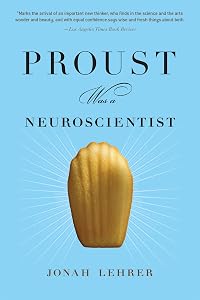
Proust Was a Neuroscientist
by Jonah Lehrer
On This Page
Description
In this technology-driven age, it's tempting to believe that science can solve every mystery. After all, science has cured countless diseases and even sent humans into space. But as Jonah Lehrer argues in this sparkling debut, science is not the only path to knowledge. In fact, when it comes to understanding the brain, art got there first. Taking a group of artists - a painter, a poet, a chef, a composer, and a handful of novelists - Lehrer shows how each one discovered an essential truth show more about the mind that science is only now rediscovering. We learn, for example, how Proust first revealed the fallibility of memory; how George Eliot discovered the brain's malleability; how the French chef Escoffier identified umami (the fifth taste); how Cezanne worked out the subtleties of vision; and how Gertrude Stein exposed the deep structure of language - a full half-century before the work of Noam Chomsky and other linguists. It's the ultimate tale of art trumping science. More broadly, Lehrer shows that there's a cost to reducing everything to atoms and acronyms and genes. Measurement is not the same as understanding, and this is what art knows better than science. An ingenious blend of biography, criticism, and first-rate science writing, Proust Was a Neuroscientist urges science and art to listen more closely to each other, for willing minds can combine the best of both, to brilliant effect. show lessTags
Recommendations





Member Recommendations
Member Reviews
This is one of the more thoughtful explorations of neuroscience I have read, and a refreshingly positive exploration of our ability as humans to know and understand our true natures through artistic self exploration. It actually made me want to read Walt Whitman, and I've been ducking that since university. For musicians, the essay on Stravinsky and the process by which we understand and enjoy music was particularly enlightening and also helps explain why I find no enjoyment in modern country music.
This is a book that links neuroscience/how the brain works to artists (poets, fiction, painters, composers, etc). And it kind of succeeds. Each chapter portrayed a different artist (with mentions of other people in that movement). Sometimes it makes sense, the language that Walt Whitman uses (I feel with my whole body) is where current neuroscience has shown, where during Whitman's time, it was thought that only the brain matters. This is the strongest chapter in the book.
The chapter on Igor Stravinsky, while very interesting in itself, is basically about how the brain predicts music it is hearing, so when it encounters something different, it hears it as bad, or awful. Unlike Whitman who was making connections about how a person feels show more emotion in his poetry, Stravinsky wasn't out to test a theory about music. He just wanted to write something different.
And that is the case with many of authors selected - they might have created a different way of doing something, but it was no different than the guy who creates a new recipe with unusual ingredients, or the person who wrote the first computer operating system.
However, the book is interesting in the people that is highlighted - names I've heard about, but didn't know why they were important (Gertrude Stein) the biography and what they did was well done - I learned a bit, and enjoyed these sections. It was when these people's accomplishments were compared to what has been discovered in neuroscience, the connection was weak and at times, a bit of an eye roll. show less
The chapter on Igor Stravinsky, while very interesting in itself, is basically about how the brain predicts music it is hearing, so when it encounters something different, it hears it as bad, or awful. Unlike Whitman who was making connections about how a person feels show more emotion in his poetry, Stravinsky wasn't out to test a theory about music. He just wanted to write something different.
And that is the case with many of authors selected - they might have created a different way of doing something, but it was no different than the guy who creates a new recipe with unusual ingredients, or the person who wrote the first computer operating system.
However, the book is interesting in the people that is highlighted - names I've heard about, but didn't know why they were important (Gertrude Stein) the biography and what they did was well done - I learned a bit, and enjoyed these sections. It was when these people's accomplishments were compared to what has been discovered in neuroscience, the connection was weak and at times, a bit of an eye roll. show less
When it comes to truths about cognition, art usually gets there first, and art can do what science cannot: describe human life from the inside. Lehrer gushes too much sometimes, and there are some holes in his thinking - it's too in love with the individual - he says we can never be intimate with anyone but ourselves, but that's patently only true in what some psychologists are now calling the WEIRD culture (Western - or White - Educated Industrialized Rich Democratic)- not at all representative of human experience in general. Collective intimacy is perhaps the major hallmark of many traditional cultures - an intimacy with time, the natural world and one another. But this is still a useful defense of the truth of artistic insight that show more the fragmented, increasingly reductionist WEIRD world ought to hear. And the great quotes, from Walt Whitman, William James, Virginia Woolf and many others are going straight into my commonplace book. show less
Lehrer argues that many 20th and 21st-century discoveries of neuroscience are actually re-discoveries of insights made earlier by various artists, including Gertrude Stein, Walt Whitman, Paul Cézanne, Igor Stravinsky, and, as mentioned in the title, Marcel Proust. It is really an exploration into the old Science vs. Art debate. As such it has some refreshing and thought-provoking ideas, although they are somewhat speculative. Lehrer takes the reader into the dusty corners of literary history, pondering over the musings of poets, writers, artists and composers in order to prove his theory – not just that Proust was a neuroscientist, but that artists are the innovative crowd in matters of science and, in particular, the human brain. show more Leher argues that it is through the boundless freedom at the heart of these artists’ work, that they have uncovered truths about science before the scientists themselves have had a chance to catch up. The artistic hypothesis which forms the foundation of the work of these creative thinkers is based on ‘measuring the immeasurable’. They attempt it by treating their art as a living entity – exploring the ‘anatomy of emotion’ rather than treating their art as pure surface matter. In this fascinating and unusual book, Lehrer makes an insightful case for Art triumphing over Science, selecting visionary thinkers to illustrate his very valid points. Whether this speculation holds any water is something else. Even if it does not the book presents an interesting hypothesis and is enjoyable to read. show less
The profound understanding of human nature we feel good art shows is officially not an illusion. Lehrer discusses the intimations great artists had about the nature of the brain, consciousness, perception, and senses that have been confirmed by recent scientific research. In particular, he chooses a few great writers, a painter, a composer, and a chef and shows how their insights proved to be true in light of modern experimental science. He talks about Walt Whitman, and his insight into the lack of duality between the mind and the body (mind is the body) and importance of feelings in our intellectual functioning, Proust and the nature of memory, George Eliot and free will, brain plasticity, and our ability to change, and Virginia Woolf show more and her great insights into consciousness and the nature of human ‘self’. Then he shows how Cezanne intimated the true nature of visual perception and Stravinsky of how we apprehend music. And, the part I found the most interesting and novel of all, how a French and then a Japanese chef came to find the essence of ‘deliciousness’, and how it related to the research on how we perceive taste.
Lehrer’s insight is that there are many ways that may be equally valid to lead us into the nature of things. Art may offer a profound understanding into the workings of our brain, the understanding that’s in no less true and legitimate than quantifiable scientific research. To take matters further, he speaks about the limitations of science and about the inadequacy of the third culture (and science popularizers like Pinker, Dawkins, Wilson, for example) to embrace the more ambiguous realms. He advocates the necessity of a ‘fourth culture’- the bridge between humanities and experimental science.
The whole book signals a recent noticeable departure, notably in The Head Trip as well, of some of the younger generation scientists from what Lehrer calls ‘reductionist science’. He means science that concerns itself only with the measurable and observable, and which ignores its own limitations and solutions and insights offered by other, less measurable sources like art, even though art can comfortably live with uncertainty to which much recent and not so recent research points as a fact of existence. Some truths may never be fully known through scientific means, yet each part of our existence (feelings and subjective insights included) can offer truths that are equally scientifically valid.
A great read. I loved how it wove literature, art, brain research and a broader humanistic view of human nature together. show less
Lehrer’s insight is that there are many ways that may be equally valid to lead us into the nature of things. Art may offer a profound understanding into the workings of our brain, the understanding that’s in no less true and legitimate than quantifiable scientific research. To take matters further, he speaks about the limitations of science and about the inadequacy of the third culture (and science popularizers like Pinker, Dawkins, Wilson, for example) to embrace the more ambiguous realms. He advocates the necessity of a ‘fourth culture’- the bridge between humanities and experimental science.
The whole book signals a recent noticeable departure, notably in The Head Trip as well, of some of the younger generation scientists from what Lehrer calls ‘reductionist science’. He means science that concerns itself only with the measurable and observable, and which ignores its own limitations and solutions and insights offered by other, less measurable sources like art, even though art can comfortably live with uncertainty to which much recent and not so recent research points as a fact of existence. Some truths may never be fully known through scientific means, yet each part of our existence (feelings and subjective insights included) can offer truths that are equally scientifically valid.
A great read. I loved how it wove literature, art, brain research and a broader humanistic view of human nature together. show less
A playful, fascinating little book that weaves the history of scientific studies of consciousness through the work of eight pathbreaking artists. The author's description of the work and milieu of artists who were initially rejected - Stravinsky, Stein, and Cezanne - is particularly insightful when related to our latest neurological understandings. For example, he explains how we create meaning from photons and the five neural layers of vision when discussing Cezanne. Neuroscience and the relation between thoughts and the body is used to examine Whitman. Neurogenesis and the creation of memory illuminates Marcel Proust's inquiry into the transcendent nature of memory. Eliot collided with her time's understandings of biological show more determinism and evolutionary theory. And so forth ... the author's writing becomes the most rhapsodic when he describes Escoffier's advances in cooking.
A true pleasure to read. I'm trying not to hold it against the author that he's only 25. (punk) show less
A true pleasure to read. I'm trying not to hold it against the author that he's only 25. (punk) show less
I really enjoyed every separate chapter of this book. It's a series of essays, each of which explores the work of an artist, and how his or her work anticipated some scientific discovery on the nature of the mind and our perceptions. We have, among others, Whitman on the embodiedness of the mind and emotion; Escoffier anticipating the discovery of umami; Cezanne exploring sight; Stein exploring language; and of course, Proust on memory. Each chapter shares the same theme: the art, and then the science that later confirms that the artist's insight was correct.
Lehrer makes a strong case for the role of art in exploring and communicating the subjectivity of human experience. But what I found very odd is that his framing discussion show more contradicts his essays. He seems to be drawing out a lesson that Art can teach us things that Science Can Not Know. But in each case, he has quite explicitly spelled out the science that actually *does* know, as a demonstration than his chosen artists were right. Wait, what?
There's also an uncomfortable cherry picking feel to it. With enough artists exploring in enough directions, somebody's bound to be aiming the right way. In the chapter on Cezanne, Lehrer discusses Cezanne's friend Zola, whose art reflected a theme of genetic determinism which time has not been kind to... so if the science had come out the other way, perhaps Zola might have been his featured artist? show less
Lehrer makes a strong case for the role of art in exploring and communicating the subjectivity of human experience. But what I found very odd is that his framing discussion show more contradicts his essays. He seems to be drawing out a lesson that Art can teach us things that Science Can Not Know. But in each case, he has quite explicitly spelled out the science that actually *does* know, as a demonstration than his chosen artists were right. Wait, what?
There's also an uncomfortable cherry picking feel to it. With enough artists exploring in enough directions, somebody's bound to be aiming the right way. In the chapter on Cezanne, Lehrer discusses Cezanne's friend Zola, whose art reflected a theme of genetic determinism which time has not been kind to... so if the science had come out the other way, perhaps Zola might have been his featured artist? show less
Members
- Recently Added By
Lists

Popular science books mentioned on WNYC Radiolab show
9 works; 3 members
Author Information

9+ Works 4,930 Members
Jonah Lehrer is a Contributing Editor at Wired and the author of How We Decide, Proust Was a Neuroscientist, and Imagine: How Creativity Works. Jonah is also a frequent contributor to The New Yorker, Radiolab, and the Wall Street Journal. (Bowker Author Biography)
Common Knowledge
- Canonical title
- Proust Was a Neuroscientist
- Original publication date
- 2007
- People/Characters
- Marcel Proust
- Dedication
- For Sarah and Ariella
- Blurbers
- Damasio, Antonio; Sacks, Oliver; Collins, Billy; Richardson, Robert D.; Pepin, Jacques
Classifications
Statistics
- Members
- 1,390
- Popularity
- 17,003
- Reviews
- 31
- Rating
- (3.60)
- Languages
- 9 — Dutch, English, French, German, Greek, Italian, Portuguese, Spanish, Turkish
- Media
- Paper, Audiobook, Ebook
- ISBNs
- 30
- UPCs
- 1
- ASINs
- 8