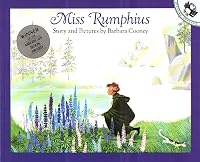
Miss Rumphius
by Barbara Cooney
On This Page
Description
As a child Great-aunt Alice Rumphius resolved that when she grew up she would go to faraway places, live by the sea in her old age, and do something to make the world more beautiful--and she does all those things, the last being the most difficult of all.Tags
Recommendations






Member Reviews
Growing up, Alice Rumphius dreamt of seeing the world, and then settling down in a little house by the sea. Confiding in her beloved grandfather - an artist like herself - Alice is told that she must do one additional thing: she must make the world a more beautiful place. Many years later, having lived her dreams, Alice sets out to fulfill her promise to her grandfather. But what can she do to make the world more beautiful...?
This was a sweet story - and the illustrations were simply gorgeous! - but I confess that I wasn't as impressed as I expected to be, given the number of goodreads friends who have awarded it four or five stars. The two main criticisms I have seen of Miss Rumphius - that planting lupines all over the place (the show more beautification project chosen by our heroine) is actually an ecologically unsound idea, as they are quite invasive, and will destroy indigenous flora; and that the wooden cigar Indians carved by Alice's grandfather are offensive, and should not have been included in a book first published in 1982 - don't really explain my lack of enthusiasm. (not that they aren't true)
I guess the truth is that I'm leery of the notion that beauty - finding it, creating it, being it - is the purpose of life. Of course, we all find our own purpose, and for an artist, beauty must surely come into it. But there is this way, in our culture, that girls and women are shepherded toward the ideal of beauty, persuaded that our highest calling is somehow entangled with it, whether in a personal way (being physically beautiful ourselves) or a practical one (creating beauty in our homes and work). And my response to that is: No. No, I don't think making the world a more beautiful place - as it is defined here - is the highest (or only) goal. I want to help make the world a more just place.
In any case, I don't want to go overboard here. As a tale of giving something back, rather than just living for oneself alone, I think Miss Rumphius has merit, and I understand why it is so beloved by other readers. But I simply can't agree with those reviewers (and there seem to be many of them) who perceive it as some kind of guide to life. A hint, perhaps - one of many... show less
This was a sweet story - and the illustrations were simply gorgeous! - but I confess that I wasn't as impressed as I expected to be, given the number of goodreads friends who have awarded it four or five stars. The two main criticisms I have seen of Miss Rumphius - that planting lupines all over the place (the show more beautification project chosen by our heroine) is actually an ecologically unsound idea, as they are quite invasive, and will destroy indigenous flora; and that the wooden cigar Indians carved by Alice's grandfather are offensive, and should not have been included in a book first published in 1982 - don't really explain my lack of enthusiasm. (not that they aren't true)
I guess the truth is that I'm leery of the notion that beauty - finding it, creating it, being it - is the purpose of life. Of course, we all find our own purpose, and for an artist, beauty must surely come into it. But there is this way, in our culture, that girls and women are shepherded toward the ideal of beauty, persuaded that our highest calling is somehow entangled with it, whether in a personal way (being physically beautiful ourselves) or a practical one (creating beauty in our homes and work). And my response to that is: No. No, I don't think making the world a more beautiful place - as it is defined here - is the highest (or only) goal. I want to help make the world a more just place.
In any case, I don't want to go overboard here. As a tale of giving something back, rather than just living for oneself alone, I think Miss Rumphius has merit, and I understand why it is so beloved by other readers. But I simply can't agree with those reviewers (and there seem to be many of them) who perceive it as some kind of guide to life. A hint, perhaps - one of many... show less
There are only a few things that I can point to and truly say "That changed the way I think.", but this book was one of them. The message stayed with me growing up and quite possibly could have been influential in my current endeavors of becoming an environmental defense lawyer (to make the world a more beautiful place, of course). As far as children's books go, this one has more depth and influence that the usual dribble that's fed to children, not to mention the outstanding art work. If you have children- or you just appreciate a damn good 12 page story- this is a must read.
My sister and I used to snuggle up together and pour over the beautiful illustrations and story that this little book holds within its pages. It's full of that lovely childhood magic that sticks with you even as you grow older and start to leave that chapter of life behind, and is an enchanting tale that, even after having heard/read it multiple times, I still find as delightful as ever, even if it is a "kids' book."
I love this beautiful story, so full of heart. Alice Rumphius has vowed to travel to travel to faraway places, and live by the sea, just like her grandfather. He asked of her only one more thing: to make the world a more beautiful place. While her first two goals are easier to accomplish, she is puzzled by her grandfather's request, until a chance wind teaches her how she can make the world a beautiful place in her own way.
This story rings with wisdom and love. It teaches children (and adults, too!) about beauty, whose nature is subjective and personal, shifting and changing, yet present in all the world. The book also challenges readers to discover his or her own definition for beauty, and moreover, to contribute their beauty to show more others. I am teary-eyed every time I finish this story. Thank you, Ms. Cooney, for leaving us such a powerful book. show less
This story rings with wisdom and love. It teaches children (and adults, too!) about beauty, whose nature is subjective and personal, shifting and changing, yet present in all the world. The book also challenges readers to discover his or her own definition for beauty, and moreover, to contribute their beauty to show more others. I am teary-eyed every time I finish this story. Thank you, Ms. Cooney, for leaving us such a powerful book. show less
Oh, my HEART. I loved this book as a kid, and I love it as an adult. I identified SO MUCH with Alice Rumphius, with her desire to travel and see faraway places and have adventures and live by the sea, and I swear to god the only thing my family wanted for me (from me? hard to tell) was for me to make the world a more beautiful place.
So. Uh.
Hi.
Some other people on goodreads have mentioned the ecological implications of Miss Rumphius' scattering of the lupine seeds, and while I see their point, I can't really bring myself to be angry: pretty watercolors and a heroine growing up and having adventures and staying herself and awesome the whole time and age not being a bad thing and YOU GUYS Alice Rumphius is my favorite.
So. Uh.
Hi.
Some other people on goodreads have mentioned the ecological implications of Miss Rumphius' scattering of the lupine seeds, and while I see their point, I can't really bring myself to be angry: pretty watercolors and a heroine growing up and having adventures and staying herself and awesome the whole time and age not being a bad thing and YOU GUYS Alice Rumphius is my favorite.
I was super duper skeptical of this book being my upcoming My First Books selection....and while I am unsure if I will use it in the actual storytime, I found this book BEAUTIFUL in its illustrations.
I love lupine. It's a favorite around the mountains. So scattering lupine around the oceans, oh the beauty! Leaving the world a more beautiful place than we left it. Making a difference. These are great life lessons for all readers. Miss Rumphius had seen the world but in the end, she made home a destination in and of itself. THIS is important to remember as we still live in Covid times. Home can be beautiful too.
I love lupine. It's a favorite around the mountains. So scattering lupine around the oceans, oh the beauty! Leaving the world a more beautiful place than we left it. Making a difference. These are great life lessons for all readers. Miss Rumphius had seen the world but in the end, she made home a destination in and of itself. THIS is important to remember as we still live in Covid times. Home can be beautiful too.
This book has depth. It is a story of a woman's life, to be sure. But because they touch on illness, and aging, and a list of things to do during your life, it has some serious fiber to it. The idea that it is of utmost importance to do something good for the world is kept alive through the book. And of course, at some point, her grandmother is a librarian, so that makes it a winner right there!
Members
- Recently Added By
Lists

Five in a Row
144 works; 8 members

Honey For a Child's Heart
1,152 works; 25 members
Ambleside Books
459 works; 18 members

Under The Chinaberry Tree
194 works; 1 member

Favorite Picture Books
479 works; 160 members

HMS: Make Your Child a Lover of Books, Ages 5-7
17 works; 2 members

NPR Books You Love: 100 Favorite Books For Young Readers
100 works; 1 member

Favorite Picture and Board Books
480 works; 1 member

Books We Loved As Children
610 works; 254 members

Written and Illustrated By
805 works; 1 member

Five in a Row
174 works; 2 members

Recommended Reading List
219 works; 1 member

CCE 1000 Good Books List
1,033 works; 12 members

Early Picture Books
467 works; 9 members

Beautiful Feet Books
304 works; 7 members

Books Read in 2022
5,226 works; 112 members

Garden
23 works; 2 members

Read Aloud Revival
108 works; 4 members
Author Information

28+ Works 16,969 Members
Barbara Cooney and her twin brother were born on 6 August 1917 in Brooklyn, New York, in the Bossert Hotel. She grew up on Long Island, but spent her summers as a child in Maine. Cooney attended a boarding school as a child. Cooney graduated from Smith College in 1938 and studied lithography and etching at Art Students League in New York. Just one show more year after graduation, she had her first commission, the illustrations for Ake and His World by Bertil Malmberg. Recalling an earlier trip to Germany before the war and the horrors that she had seen there, she felt compelled to join the Women's Army Corps during the summer of 1942. She enrolled in officer training and achieved the rank of second lieutenant, but was honorably discharged the following spring because of marriage pregnancy. The couple bought a farm in Pepperell, Massachusetts where they ran a children's camp during the summer months. By this time, Cooney was illustrating several books a year and wrote one now and then. It was for her adaptation of Chaucer's The Nun Priest's Tale that she won the prestigious Caldecott Medal, the highest honor given for illustrated children's books in the United States, in 1959. Twenty-one years later, Cooney again won the Caldecott Medal for Ox-Cart Man written by Donald Hall. In 1993, Ms. Cooney deposited more than 400 pieces of original art from 21 of her books in the Northeastern Children's Literature Collection, a part of the University Libraries' Archives and Special Collections. Works from this collection and from the artist's private collection are shown in this exhibit. Miss Rumphius won the National Book Award in 1983 and inspired the creation of the Maine Library Association's Lupine Award. Cooney died on 14 March, 2000 at the age of 83. Her last book was Basket Moon published in September of 1999. (Bowker Author Biography) show less
Awards and Honors
Awards
Distinctions
Notable Lists
Work Relationships
Common Knowledge
- Canonical title
- Miss Rumphius
- Original publication date
- 1982
- People/Characters
- Miss Rumphius; Alice
- Related movies
- Miss Rumphius (2000 | IMDb)
- First words
- The Lupine Lady lives in a small house overlooking the sea.
- Quotations
- You must do something to make the world more beautiful.
- Last words
- (Click to show. Warning: May contain spoilers.)But I do not know yet what that can be.
- Original language
- English
Classifications
Statistics
- Members
- 7,989
- Popularity
- 1,411
- Reviews
- 178
- Rating
- (4.42)
- Languages
- 5 — Chinese, English, Italian, Korean, Spanish
- Media
- Paper, Audiobook, Ebook
- ISBNs
- 59
- ASINs
- 12