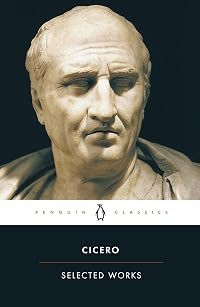
Selected Works
by Marcus Tullius Cicero, Karel Sprey (Translator)
On This Page
Description
Lawyer, philosopher, statesman and defender of Rome's Republic, Cicero was a master of eloquence, and his pure literary and oratorical style and strict sense of morality have been a powerful influence on European literature and thought for over two thousand years in matters of politics, philosophy, and faith. This selection demonstrates the diversity of his writings, and includes letters to friends and statesmen on Roman life and politics; the vitriolic Second Philippic Against Antony; and show more his two most famous philosophical treatises, On Duties and On Old Age - a celebration of his own declining years. Written at a time of brutal political and social change, Cicero's lucid ethical writings formed the foundation of the Western liberal tradition in political and moral thought that continues to this day. show lessTags
Recommendations






Member Reviews
The life of Cicero should be a cautionary tale for politicians of any era. He was a patrician, an aristocratic man of the Roman senate, a fan of the dying Republic, an opponent of tyrants like Julius Caesar, and a critic of the democracy that empowered them. He was at one time the head of state. Later, he was exiled, and his property was confiscated. As a politician, he was always caught in the middle and often charged with abandoning his own principles. He did not take part in the assassination of Julius Caesar, but he was not sorry to see him go. He wanted rule by the landed gentry, by men of his own class and education. In the end, young Octavian, operating from pure political expediency, had him assassinated. Roman politics was show more never for the faint-hearted.
Cicero's power as an orator was unparalleled in an era that revered long-winded speeches. In his Second Philippic, he skillfully dismantled Mark Anthony, painting him as a drunk, a greedy sycophant, a liar, and a lewd bisexual womanizer. He was the type of person, Cicero said, who would invite himself to dinner, consume all your wine, vomit on the table, and swipe your silver on his way out.
His Latin style was universally admired when Latin was a language every educated person knew.
His stoic philosophy and Republican theory of government reverberate through our legal and governmental history. He was a stern moralist praised by men who abandoned principle at every turn. show less
Cicero's power as an orator was unparalleled in an era that revered long-winded speeches. In his Second Philippic, he skillfully dismantled Mark Anthony, painting him as a drunk, a greedy sycophant, a liar, and a lewd bisexual womanizer. He was the type of person, Cicero said, who would invite himself to dinner, consume all your wine, vomit on the table, and swipe your silver on his way out.
His Latin style was universally admired when Latin was a language every educated person knew.
His stoic philosophy and Republican theory of government reverberate through our legal and governmental history. He was a stern moralist praised by men who abandoned principle at every turn. show less
It's an amazing feeling to hear such a contemporaneous tone from a remote era over two thousand years ago. Cicero was one of the leading figures in the Roman polity at the tumultous time of Julius Caeser and Marc Antony, and in fact was even invited to be part of the triumvirate at one stage; he declined, inveigled against Marc Antony in virulent terms, and was later decapitated for his trouble. But as per most accounts, he died nobly in dignity, and thereby demonstrated the strength of his own philosophy of how to live - and die- well. This slim volume contains his tracts and letters "against tyranny", especially "Against Verres, I", the "Second Philippic against Marc Antony", and "On Duties, III" and "Cato the Elder on Old Age", my show more favourite. I suspect that the translation has probably been cast in a modern mould, as it speaks directly without the burden of rhetorical convolutions that mar so many of the 19th century and early 20th century English works. show less
Selected Works of the great Roman orator/statesman/philosopher Cicero is an excellent book for anyone approaching his work for the first time. Not only are there selections from Cicero’s writings on politics, moral philosophy and old age but there is a superb 30 page introduction written by Michael Grant. Thank you, Penguin books and thank you, Michael Grant! To provide a little Roman rasa, below are several quotes from the book along with my comments.
From Michael Grant’s Introduction
“Cicero was not often a very successful politician, but he derives unmistakable greatness from his insistence, against odds, that such dictatorial rulers were in the wrong because they unjustifiably curtailed the freedom of the individual; whereas show more the ultimate authority should be not themselves but certain unchangeable moral principles.” -------- Anybody who picks up a newspaper anywhere in the world will recognize immediately how Cicero’s writings are as relevant today as they were in ancient Rome. Matter of fact, with our omnipresent multinational corporations added to the political mix, perhaps even more relevant.
“Cicero’s task was not an easy one; the Greek philosophers, to which with the added infusion of his own personality, he gave eloquent expression – far more eloquent than that of their original authors – contain much that was complicated and difficult, especially to unphilosophical Romans. ---------- Cicero’s achievement strikes home for me personally, living as I do in the unphilosophical Rome of the modern world: America. We should never take for granted we have access to the writings of ancient philosophers presented in well-crafted and clearly presented books such as this one.
“The moral emphasis of Stoicism (when its dogma was toned down) was very acceptable to him, and indeed the basis of a great deal of his thought and feelings on moral and ethical problems. ---------- Michael Grant provides an easy-to-read short overview of how Cicero drew from not only Stoicism but many streams of Greek philosophy, such as the Pythagoreans, Platonists, Peripatetics (followers of Aristotle) and two schools Cicero particularly despised: the Cyrenaics (immediate happiness is the ultimate good) and the Epicureans (the philosophical school that shunned pubic life). Such lively and informative readings makes for a real treat.
From ‘Against Verres’
“One thing, then, that has influenced me is this gloating of yours over your tyrannical dominance in our courts; and another is the evident existence of men who feel not the slightest shame or disgust for their repulsive and outrageous behavior.” --------- In the world of Roman opulence and excess, Cicero could tell it like it is.
From ‘On Duties’
“Once I lived with great crowds around me, in the forefront of Roman publicity. But now I shun the sight of the scoundrels who swarm on every side. I withdraw as completely as I can; and I am often alone. However, as the philosophers instruct, one must not only choose the least among evils, one must extract from them any good that they may contain.” --------- This is a lesson we can all learn from: make the best of a less than ideal situation. “
“Another objection urges that one ought to take account of compatriots but not of foreigners. But people who put forward these arguments subvert the whole foundation of the human community – and its removal means the annihilation of all kindness, generosity, goodness, and justice.” ------- Cicero’s words have a modern ring, as if he anticipated our 21st century world-wide culture and society.
From: ‘On Old Age’
“An actor need not remain on the stage until the very end of the play: if he wins applause in those acts in which he appears, he will have done well enough. In life, too, a man can perform his part wisely without staying on the stage until the play is finished. However short your life may be, it will still be long enough to live honestly and decently.” --------- This is but one of the many gold nuggets of ancient wisdom a reader will find in Cicero’s essay. show less
Selected Works of the great Roman orator/statesman/philosopher Cicero is an excellent book for anyone approaching his work for the first time. Not only are there selections from Cicero’s writings on politics, moral philosophy and old age but there is a superb 30 page introduction written by Michael Grant. Thank you, Penguin books and thank you, Michael Grant! To provide a little Roman rasa, below are several quotes from the book along with my comments.
From Michael Grant’s Introduction
“Cicero was not often a very successful politician, but he derives unmistakable greatness from his insistence, against odds, that such dictatorial rulers were in the wrong because they unjustifiably curtailed the freedom of the individual; whereas show more the ultimate authority should be not themselves but certain unchangeable moral principles.” -------- Anybody who picks up a newspaper anywhere in the world will recognize immediately how Cicero’s writings are as relevant today as they were in ancient Rome. Matter of fact, with our omnipresent multinational corporations added to the political mix, perhaps even more relevant.
“Cicero’s task was not an easy one; the Greek philosophers, to which with the added infusion of his own personality, he gave eloquent expression – far more eloquent than that of their original authors – contain much that was complicated and difficult, especially to unphilosophical Romans. ---------- Cicero’s achievement strikes home for me personally, living as I do in the unphilosophical Rome of the modern world: America. We should never take for granted we have access to the writings of ancient philosophers presented in well-crafted and clearly presented books such as this one.
“The moral emphasis of Stoicism (when its dogma was toned down) was very acceptable to him, and indeed the basis of a great deal of his thought and feelings on moral and ethical problems. ---------- Michael Grant provides an easy-to-read short overview of how Cicero drew from not only Stoicism but many streams of Greek philosophy, such as the Pythagoreans, Platonists, Peripatetics (followers of Aristotle) and two schools Cicero particularly despised: the Cyrenaics (immediate happiness is the ultimate good) and the Epicureans (the philosophical school that shunned pubic life). Such lively and informative readings makes for a real treat.
From ‘Against Verres’
“One thing, then, that has influenced me is this gloating of yours over your tyrannical dominance in our courts; and another is the evident existence of men who feel not the slightest shame or disgust for their repulsive and outrageous behavior.” --------- In the world of Roman opulence and excess, Cicero could tell it like it is.
From ‘On Duties’
“Once I lived with great crowds around me, in the forefront of Roman publicity. But now I shun the sight of the scoundrels who swarm on every side. I withdraw as completely as I can; and I am often alone. However, as the philosophers instruct, one must not only choose the least among evils, one must extract from them any good that they may contain.” --------- This is a lesson we can all learn from: make the best of a less than ideal situation. “
“Another objection urges that one ought to take account of compatriots but not of foreigners. But people who put forward these arguments subvert the whole foundation of the human community – and its removal means the annihilation of all kindness, generosity, goodness, and justice.” ------- Cicero’s words have a modern ring, as if he anticipated our 21st century world-wide culture and society.
From: ‘On Old Age’
“An actor need not remain on the stage until the very end of the play: if he wins applause in those acts in which he appears, he will have done well enough. In life, too, a man can perform his part wisely without staying on the stage until the play is finished. However short your life may be, it will still be long enough to live honestly and decently.” --------- This is but one of the many gold nuggets of ancient wisdom a reader will find in Cicero’s essay. show less
Ratings
Members
- Recently Added By
Lists

100 Books to Read in a Lifetime (That Are Older Than 200 Years)
415 works; 175 members

Philip Ward's Lifetime Reading Plan
592 works; 22 members

Europe
205 works; 6 members

Western Canon
206 works; 2 members

Ancient/Classical World
34 works; 1 member
Author Information

2,148+ Works 26,707 Members
Born in Arpinum on January 3, 106 B.C., Marcus Tullius Cicero was a Roman orator, writer, and politician. In Rome, Cicero studied law, oratory, philosophy, and literature, before embarking on a political career. Banished from Rome in 59 B.C. for the execution of some members of the Catiline group, Cicero devoted himself to literature. Cicero was show more pardoned by Julius Caesar in 47 B.C., and returned to Rome to deliver his famous speeches, known as the "Philippics," urging the senate to declare war on Marc Antony. Cicero's chief works, written between 46 and 44 B.C., can be classified in the categories of philosophical works, letters, and speeches. The letters, edited by his secretary Tiro, showcase a unique writing style and charm. The most popular work of the period was De Officiis, a manual of ethics, in which Cicero espoused fundamental Christian values half a century before Christ. Cicero was murdered in Formiae, Italy, on December 4, 43 B.C., by Antony's soldiers after the triumvirate of Antony, Lepidus, and Octavius was formed. (Bowker Author Biography) show less
All Editions
Series
Belongs to Publisher Series
Penguin Classics (L099)
Work Relationships
Common Knowledge
- Canonical title
- Selected Works
- Original title
- Cicero : een bloemlezing uit zijn redevoeringen, brieven en andere werken
- Original publication date
- 1950
- People/Characters
- Marcus Tullius Cicero; Marcus Antonius; Julius Caesar; Scipio Africanus; Cato the Elder; Gaius Verres
- Important places
- Rome
- Epigraph
- There is great force about this speech. Cicero had not attained that perfect mastery of the whole art of rhetoric which he possesed at a later period. But on the other hand there is a freedom, a boldness, a zeal for popular r... (show all)ights, a scion of the vicious and insolent gang whom he afterwards called the 'boni', which makes these early speeches more pleasing than the later.
Thomas Babington Macauley
Chapter one. - Dedication
- [None]
- First words
- Amid the recurrent crises of the twentieth century there is a curious topicality in the spectacle of this highly intelligent but far from super-human personality, first struggling to eminence in a great state, and then having... (show all) to face, as well as he could, a crushing series of almost world-wide emergencies and convulsions.
Introduction.
Judges: At this grave crisis in the history of our country, you have been offered a peculiarly desirable gift, a gift almost too opportune to be of human origin : it almost seems heaven-sent.
Against Verres . I... (show all). - Last words
- (Click to show. Warning: May contain spoilers.)That is what I think about old age. May you both live to see the condition! Then you will be able to prove by experience that what I have told you is true.
- Original language
- Latin; English
Classifications
- Genres
- Nonfiction, History, Philosophy, General Nonfiction
- DDC/MDS
- 937 — History & geography History of ancient world (to ca. 499) Italian Peninsula to 476 and adjacent territories to 476
- LCC
- PA6307 .A2 — Language and Literature Greek language and literature. Latin language and literature Roman literature Individual authors Cicero, Marcus Tullius
- BISAC
Statistics
- Members
- 1,547
- Popularity
- 14,839
- Reviews
- 5
- Rating
- (3.80)
- Languages
- Dutch, English
- Media
- Paper, Ebook
- ISBNs
- 2
- ASINs
- 15
