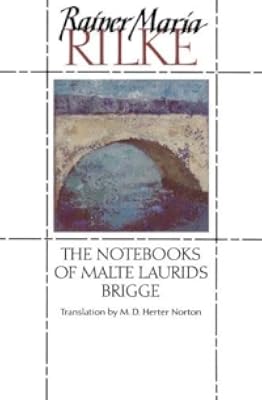
The Notebooks of Malte Laurids Brigge
by Rainer Maria Rilke
On This Page
Description
"Translator Burton Pike captures the edgy, haunting beauty of this little-known masterpiece."?O Magazine.Tags
Recommendations
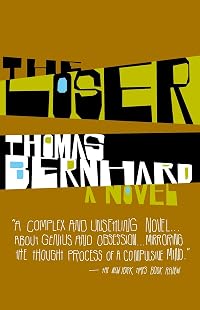
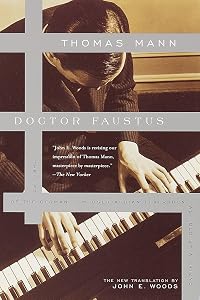

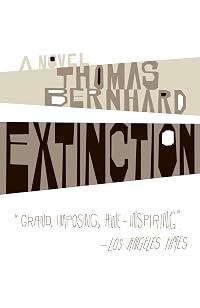
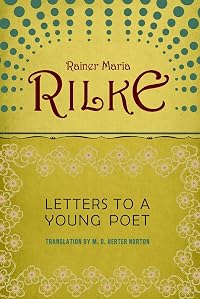
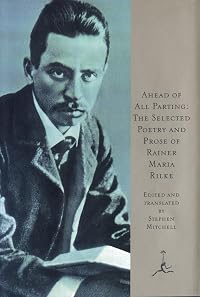




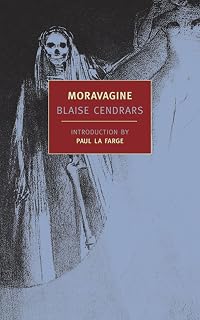
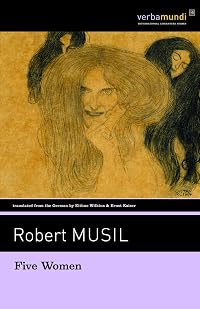
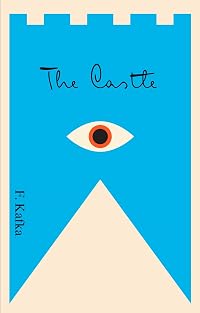

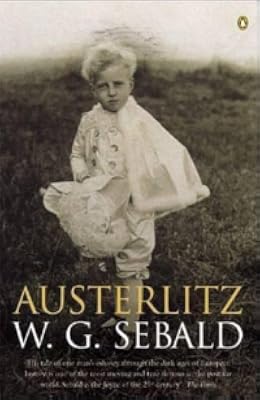
Member Recommendations

by roby72
Member Reviews
"What's the use of telling someone that I am changing? If I'm changing, I am no longer who I was; and if I am something else, it's obvious that I have no acquaintances. And I can't possibly write to strangers."
It is precisely because the form of this book is so hard to pin down that it is so effective. It challenges the reader to forget about the novel, and its easy explications and narrative arcs. (Though it feels much too organically arisen for me to use the term 'experimental'). Here we have a scattered mess, constantly morphing: Proustian memories of childhood, historical tangents on some King/Duke (this is where he lost me; I'll need to learn more and re-read), ruminations on poverty and death, ghosts, philosophy, observations, and show more Biblical stories re-told Rilkean style. But no hand is there to guide us through, we have to piece these fragments together to form the life (or at least one day in the life) of Malte Laurids Brigge. We can only imply, and only by seeing things Malte's way can we be. The story ends abruptly. No conclusions, no real story (if that is what you are looking for), only sketches, a glimpse here and there, but it feels so full! And enlarging! show less
It is precisely because the form of this book is so hard to pin down that it is so effective. It challenges the reader to forget about the novel, and its easy explications and narrative arcs. (Though it feels much too organically arisen for me to use the term 'experimental'). Here we have a scattered mess, constantly morphing: Proustian memories of childhood, historical tangents on some King/Duke (this is where he lost me; I'll need to learn more and re-read), ruminations on poverty and death, ghosts, philosophy, observations, and show more Biblical stories re-told Rilkean style. But no hand is there to guide us through, we have to piece these fragments together to form the life (or at least one day in the life) of Malte Laurids Brigge. We can only imply, and only by seeing things Malte's way can we be. The story ends abruptly. No conclusions, no real story (if that is what you are looking for), only sketches, a glimpse here and there, but it feels so full! And enlarging! show less
'The Notebooks of Malte Laurids Brigge' isn't a very novelistic novel, as it is told as a sort of diary in the first person and is semi-autobiographical. Brigge is a twenty-eight year old Danish man, alone and adrift in Paris. He wishes to transmute his fear of death into some profound literary work and fills his notebooks with memories, historical anecdote, and sketches of the Parisian streets. I was very moved by Rilke's evocation of urban alienation, of listening to your neighbours through the walls of a cheap rented room because you have no-one to talk to, and of death-obsession. I identified with Brigge's preoccupations, having on occasion been in just the same state of mind myself. On the other hand, towards the end of the book show more Brigge writes more of love than death, and this made him harder for me to relate to. (This probably doesn't reflect too well on me.)
Brigge, a solitary and melancholic figure with no direction in life but periodically overwhelmed by fear of death, seems to be a shadow or echo of Rilke. Perhaps he represents someone Rilke thought he could have been? Brigge is unhappy and there is no indication that he will ever transcend his poverty and perpetual introspection. I can very well understand being afraid of such a lonely trap of a life. In fact, one might subtitle this book, 'The Dangers of Being an Unhappy Introvert in Paris'. During the first third or so I was rather reminded of Plath's 'The Bell Jar'.
Rilke's writing is absolutely beautiful, which isn't surprising as he was famous as a poet. In fact, this was his only novel. By way of example, I was struck by this bit about reading:
I tend to find poetry intimidating and impossible to understand, but I ought to give Rilke's a chance. 'The Notebooks of Malte Laurids Brigge' suggests I have an affinity with him. No other writer I've come across has articulated the fear of death as effectively. show less
Brigge, a solitary and melancholic figure with no direction in life but periodically overwhelmed by fear of death, seems to be a shadow or echo of Rilke. Perhaps he represents someone Rilke thought he could have been? Brigge is unhappy and there is no indication that he will ever transcend his poverty and perpetual introspection. I can very well understand being afraid of such a lonely trap of a life. In fact, one might subtitle this book, 'The Dangers of Being an Unhappy Introvert in Paris'. During the first third or so I was rather reminded of Plath's 'The Bell Jar'.
Rilke's writing is absolutely beautiful, which isn't surprising as he was famous as a poet. In fact, this was his only novel. By way of example, I was struck by this bit about reading:
'Somehow I had a premonition of what I so often felt at later times: that you did not have the right to open a single book unless you engaged to read them all. With every line you read, you were breaking off a portion of the world. Before books, the world was intact, and afterwards it might be restored to wholeness once again.'
I tend to find poetry intimidating and impossible to understand, but I ought to give Rilke's a chance. 'The Notebooks of Malte Laurids Brigge' suggests I have an affinity with him. No other writer I've come across has articulated the fear of death as effectively. show less
A strange class of books: those that I conclude with the thought that I haven't understood even the first thing about them, and I can't wait to re-read. Usually this happens with books that have astonished me in the first few pages, which was not the case with Brigge. But by the end I was reeling. I can remember virtually nothing of this book, except for a scene in which Brigge dresses up in carnivale costume and mask, then runs in to a room full of adults. They think he's trying to entertain them, when in fact he's panicking, having more or less lost his sense of identity; he faints and they tear the costume from his body.
That is how I felt reading this book, for better or worse. There's a lot here, but it's more akin to a poetry show more collection than a novel. I tried to read it as the latter. Next time, I'll approach it as the former, and I imagine it'll be twice as rewarding. show less
That is how I felt reading this book, for better or worse. There's a lot here, but it's more akin to a poetry show more collection than a novel. I tried to read it as the latter. Next time, I'll approach it as the former, and I imagine it'll be twice as rewarding. show less
Rilke was a poet and his only novel demonstrates that on every page. It is a dreamlike novel that is evocative of Paris and poetry. The focus on themes of death and darkness in contrast with the power of god and belief were powerful, joining with his beautiful writing to keep me enthralled. The importance of constructing an authentic life is emphasized as a prerequisite for the prospect of a unique personal death. Death becomes a character in the novel, a "terrible rival", which may seem stronger than the living in its tolling. While Paris is the city of poetry it is also described as a place "to die in"(p 3).
More importantly this is an early contribution to the literature of existentialism and bears reading and comparison with show more Kierkegaard, Gide and Camus. In some respects Rilke appears to be a harbinger of such thinkers as Heidegger and Benjamin with his portents of the looming growth of a modern industrial society. Just as Dostoevsky before him Rilke paints a picture of a world that is being threatened by science and technology. But, you do not have to fixate or even focus on these trends in order to enjoy this novel, you merely need to relax and enjoy the poetic way Rilke serves up the prose in this haunting story. show less
More importantly this is an early contribution to the literature of existentialism and bears reading and comparison with show more Kierkegaard, Gide and Camus. In some respects Rilke appears to be a harbinger of such thinkers as Heidegger and Benjamin with his portents of the looming growth of a modern industrial society. Just as Dostoevsky before him Rilke paints a picture of a world that is being threatened by science and technology. But, you do not have to fixate or even focus on these trends in order to enjoy this novel, you merely need to relax and enjoy the poetic way Rilke serves up the prose in this haunting story. show less
This edition, as so many Oxford World’s Classis editions do, has just the perfect cover image. It’s a detail from a painting called ‘Mirror Image in Shop Window’ (1913) by August Macke. It’s perfect because Rilke in this ‘novel’ brings us a vivid portrait of a man in search of self, a faceless man in fragments who believes he is nothing.
In my last post I moaned about the inclusion of unreadable stodge in 1001 Books You Must Read Before You Die, but The Notebooks of Malte Laurids Brigge is essential reading IMO. I wish I’d read it before reading The Beat of the Pendulum by Catherine Chidgey because that is a ‘found document’ too, and I shall read Gerald Murnane’s fiction with a different eye now too, because he too show more writes fiction that isn’t fiction, in quasi-autobiographical books that defy the label ‘novel’.
Mind you, in the excellent introduction by Robert Vilain, he says that
For its time, (1910), The Notebooks of Malte Laurids Brigge was radical. It’s nothing like the 19th century novel with its coherent linear form and chronological simplicity. It purports to be a notebook of 71 fragmentary jottings, ranging from very short to quite expansive, and while it’s ‘finished’, it seems like a work that could easily continue further, (and not just because it ends unresolved). In the Introduction, Vilain describes the structure as being in three planes which are not neat sections. (Indeed, there are scholars who like to argue about where these ‘planes’ intersect, begin and end.)
The book begins with
* Malte’s experiences in Paris, apparently much like Rilke’s own, segueing into
* memories of Malte’s childhood in Denmark (he was much influenced by things Nordic, apparently), segueing into
* reflections on historical and artistic figures and places.
It’s not a book for people who like plots, or even proper characters, but once you progress a few pages into the pages about Paris, it becomes addictive.
To read the rest of my review please visit https://anzlitlovers.com/2018/04/10/the-notebooks-of-malte-laurids-brigge-by-rai... show less
In my last post I moaned about the inclusion of unreadable stodge in 1001 Books You Must Read Before You Die, but The Notebooks of Malte Laurids Brigge is essential reading IMO. I wish I’d read it before reading The Beat of the Pendulum by Catherine Chidgey because that is a ‘found document’ too, and I shall read Gerald Murnane’s fiction with a different eye now too, because he too show more writes fiction that isn’t fiction, in quasi-autobiographical books that defy the label ‘novel’.
Mind you, in the excellent introduction by Robert Vilain, he says that
Rilke never called Malte a novel, preferring ‘book’ or ‘work’, but the term novel is nowadays capacious enough for modern readers to use it without the need for inverted commas. (p.xvi)
For its time, (1910), The Notebooks of Malte Laurids Brigge was radical. It’s nothing like the 19th century novel with its coherent linear form and chronological simplicity. It purports to be a notebook of 71 fragmentary jottings, ranging from very short to quite expansive, and while it’s ‘finished’, it seems like a work that could easily continue further, (and not just because it ends unresolved). In the Introduction, Vilain describes the structure as being in three planes which are not neat sections. (Indeed, there are scholars who like to argue about where these ‘planes’ intersect, begin and end.)
The book begins with
* Malte’s experiences in Paris, apparently much like Rilke’s own, segueing into
* memories of Malte’s childhood in Denmark (he was much influenced by things Nordic, apparently), segueing into
* reflections on historical and artistic figures and places.
It’s not a book for people who like plots, or even proper characters, but once you progress a few pages into the pages about Paris, it becomes addictive.
To read the rest of my review please visit https://anzlitlovers.com/2018/04/10/the-notebooks-of-malte-laurids-brigge-by-rai... show less
Reading "The Notebooks of Malte Laurids Brigge" is to have the feeling that you have never before read words used in exactly this way for exactly this purpose. Rilke, perhaps most known for being the greatest German-language poet of the twentieth century, has written what can only be called a prose poem - but even to use this phrase is to reduce a fullness that cannot be reduced. This novel is symphonic, lush, and poignant. In its evocation of memory, it is Proust avant la lettre. But there are also moments of pureness and clarity that are reminiscent of Wittgenstein, which creates quite a striking contrast. Rilke's experience with art and art criticism highly influenced his writing. His prose-poetry is pure imagism, but is also full of show more expressionism and impressionism. All of this sounds like an unlikely salmagundi, but I can assure you that there is something lasting and moving that inheres.
We are so used to novels being narratives of action that when we meet something like this, it gives us pause. There really is no plot here as most people would conceive it. The narrator calls to mind Dostoyevsky's Underground Man, brooding and destitute. Malte is haunted by the doppelgangers that he lived with during his well-to-do childhood, all now long dead; he is the only member of his ancient Danish aristocratic family. The book flits in and out of memories of the deaths of his father and other relatives and their relationships. In many novels, one can easily separate, if one wishes, content and form; here they seem to belong to one another, the poetry and the memory inextricably intertwined.
Unlike many other reviewers, I wouldn't say that the novel is difficult reading, but it might not be something that you want to read in one or two sittings. Like the "Duino Elegies" or the "Sonnets to Orpheus," they are meant to be dipped into. The text (at least in this edition) is subdivided into seventy-one parts which serve as breaks for the narrative line of thought. If you will excuse the length, this is from section twenty-nine, and it is representative of the style throughout:
"One thing is certain: that on that evening I was drawing a knight, a quite solitary and unmistakable knight, mounted on a strangely caparisoned steed. He turned out so brightly colored that I had to change crayons frequently; but it was the red one that I used most of all, and reached for time and again. Now I needed it once again; but it rolled (I still see it) right across the brightened page, to the edge, and fell down, past me, before I could stop it, and was gone. I really did need it urgently, and having to climb down after it was distinctly vexing. Awkward as I was, it was quite a business to get down; my legs were far too long, and I couldn't draw them out from under me: remaining too long in a kneeling position had numbed my limbs; I could not tell what was mine and what was the chair's. At length, rather at sixes and sevens, I did make it to the floor, and found myself on an animal fell that extended under the table to the wall. But at this point I was confronted with a fresh difficulty. My eyes, accustomed to the brightness above and still wholly entranced by the colors on the white paper, were unable to make out anything at all below the table, where the blackness seemed so dense that I was afraid of knocking against it; so I fell back on my sense of touch and, kneeling and supporting myself on my left hand, combed through the cool, long-haired, familiar-feeling fell with my other hand. But there was no sign of the crayon." show less
We are so used to novels being narratives of action that when we meet something like this, it gives us pause. There really is no plot here as most people would conceive it. The narrator calls to mind Dostoyevsky's Underground Man, brooding and destitute. Malte is haunted by the doppelgangers that he lived with during his well-to-do childhood, all now long dead; he is the only member of his ancient Danish aristocratic family. The book flits in and out of memories of the deaths of his father and other relatives and their relationships. In many novels, one can easily separate, if one wishes, content and form; here they seem to belong to one another, the poetry and the memory inextricably intertwined.
Unlike many other reviewers, I wouldn't say that the novel is difficult reading, but it might not be something that you want to read in one or two sittings. Like the "Duino Elegies" or the "Sonnets to Orpheus," they are meant to be dipped into. The text (at least in this edition) is subdivided into seventy-one parts which serve as breaks for the narrative line of thought. If you will excuse the length, this is from section twenty-nine, and it is representative of the style throughout:
"One thing is certain: that on that evening I was drawing a knight, a quite solitary and unmistakable knight, mounted on a strangely caparisoned steed. He turned out so brightly colored that I had to change crayons frequently; but it was the red one that I used most of all, and reached for time and again. Now I needed it once again; but it rolled (I still see it) right across the brightened page, to the edge, and fell down, past me, before I could stop it, and was gone. I really did need it urgently, and having to climb down after it was distinctly vexing. Awkward as I was, it was quite a business to get down; my legs were far too long, and I couldn't draw them out from under me: remaining too long in a kneeling position had numbed my limbs; I could not tell what was mine and what was the chair's. At length, rather at sixes and sevens, I did make it to the floor, and found myself on an animal fell that extended under the table to the wall. But at this point I was confronted with a fresh difficulty. My eyes, accustomed to the brightness above and still wholly entranced by the colors on the white paper, were unable to make out anything at all below the table, where the blackness seemed so dense that I was afraid of knocking against it; so I fell back on my sense of touch and, kneeling and supporting myself on my left hand, combed through the cool, long-haired, familiar-feeling fell with my other hand. But there was no sign of the crayon." show less
A wonderfully leisurely record of the progress of an artistic soul is here: the mix of contemporary observations and ruminations on figures from the past is blended so seamlessly that although the reader may sometimes wonder where one is and how one got there, one doesn't care, for the pleasure of the story, and all the stories it contains, is so great.
The M.D. Herter Norton translation is intimate yet delicate: I'm not sure about other translations, but some of the original spirit no doubt emerges in any conscientious translation. A book not to be hurried; many passages invite immediate re-reading, and made me regret living in an age of interruptions.
The M.D. Herter Norton translation is intimate yet delicate: I'm not sure about other translations, but some of the original spirit no doubt emerges in any conscientious translation. A book not to be hurried; many passages invite immediate re-reading, and made me regret living in an age of interruptions.
Members
- Recently Added By
Published Reviews
ThingScore 100
"Eerst heb ik Malte Laurids Brigge in het Duits gelezen, rond 1978. Ik was toen al aan de eerste versie van mijn debuutroman Ruimte (1981) bezig, zeven jaar heb ik over dat boek gedaan. Ik was zo naïef en ambitieus dat ik een boek wou maken dat zijn eigen vorm meebracht. Op een appartementje aan de kust in Knokke-Heist zat ik geregeld aan Ruimte te schrijven. Het was een heel ouderwets show more appartementje, met bloemenbehang aan de muur, en daar trof ik één boek aan, Malte Laurids Brigge in de prachtige vertaling van Binnendijk en Brunt. Het is proza van een dichter." show less
added by bewogenlucht
Lists

1001 Books You Must Read Before You Die
1,448 works; 1,134 members

Le Monde - Les 100 livres du siècle
121 works; 25 members

German Literature
518 works; 55 members

20th Century Literature
1,161 works; 54 members

1910s
90 works; 16 members

Favourite Books
1,819 works; 316 members

Books Set in Germany
74 works; 12 members

Five star books
1,755 works; 107 members

Modernism
140 works; 8 members
Elegant Prose
80 works; 4 members

Existentialism
90 works; 11 members

Paris, City of Lights
103 works; 17 members
Harold Bloom - The Western Canon: D. The Chaotic Age
833 works; 24 members

.
396 works; 1 member
Author Information

More than any other modern German writer, Rainer Maria Rilke seems to match our romantic idea of what a poet should be, though, as with many writers, separating artistry from affectation is often difficult. Restless, sensitive, reverent, yet egotistical, Rilke often seems to hover in his poems like a sort of ethereal being. He was born in 1875 to show more a wealthy family in Prague. After a few years devoted to the study of art and literature, he spent most of his adult life wandering among the European capitals and devoting himself single-mindedly to poetry. His early poems reflect his interest in the visual and plastic arts, as he tries to lose himself in contemplation of objects such as an antique torso of Apollo.His later books of poetry, such as Duino Elegies (1923) and Sonnets to Orpheus (1923), on the contrary, focus intently on internal realms. The poetry of Rilke is noted, above all, for metaphysical and psychological nuances. (Bowker Author Biography) show less
Some Editions
Awards and Honors
Awards
Notable Lists
Series
Belongs to Publisher Series
Gallimard, Folio Classique (2294)
Sammlung Dieterich (188)
Bibliothek des 20. Jahrhunderts (Dt. Bücherbund) (Rilke, Rainer Maria)
Prisma Klassieken (49)
Alianza Tres (65)
insel taschenbuch (0630 / 2565 / 4529)
Salamanderpockets (124)
A tot vent (194)
Gallimard, Folio (2294)
Work Relationships
Is contained in
Has as a commentary on the text
Has as a student's study guide
Common Knowledge
- Canonical title
- The Notebooks of Malte Laurids Brigge
- Original title
- Die Aufzeichnungen des Malte Laurids Brigge
- Alternate titles*
- De aantekeningen van Malte Laurids Brigge
- Original publication date
- 1910
- People/Characters
- Malte Laurids Brigge
- Important places
- Paris, France
- First words
- This, then, is where people come to live; I'd have thought it more of a place to die.
- Last words
- (Click to show. Warning: May contain spoilers.)What did they know of him? He was now terribly difficult to love, and he felt that One alone was able for the task. But He was not yet willing.
- Original language*
- Duits
- Disambiguation notice
- 3458323309 1982 softcover German insel taschenbuch 630
3458342656 1999 softcover German insel taschenbuch 2565
3458362290 2012 softcover German insel taschenbuch 4529
*Some information comes from Common Knowledge in other languages. Click "Edit" for more information.
Classifications
- Genres
- Fiction and Literature, General Fiction
- DDC/MDS
- 833.912 — Literature & rhetoric German & related literatures German fiction 1900- 1900-1990 1900-1945
- LCC
- PT2635 .I65 .A813 — Language and Literature German, Dutch and Scandinavian literatures German literature Individual authors or works 1860/70-1960
- BISAC
Statistics
- Members
- 2,780
- Popularity
- 6,580
- Reviews
- 36
- Rating
- (3.88)
- Languages
- 20 — Catalan, Czech, Danish, Dutch, English, Estonian, Finnish, French, German, Greek, Italian, Lithuanian, Norwegian (Bokmål), Portuguese, Russian, Slovak, Slovenian, Spanish, Swedish, Turkish
- Media
- Paper, Audiobook, Ebook
- ISBNs
- 137
- ASINs
- 63