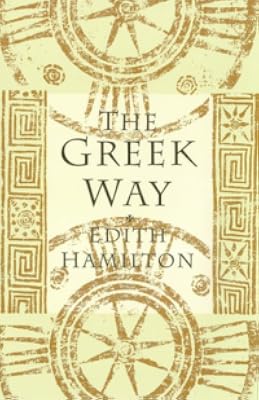
The Greek Way
by Edith Hamilton
On This Page
Description
"What the Greeks discovered, how they brought a new world to birth out of the dark confusions of an old world that had crumbled away, is full of meaning for us today who have seen an old world swept away." Based on a thorough study of Greek life and civilization, of Greek literature, philosophy, and art, "The Greek way" interprets their meaning and brings a realization of the refuge and strength the past can be to us in the troubled present. Miss Hamilton's book must take its place with the show more few interpretative volumes that are permantly rooted and profoundly alive in our literature. show lessTags
Recommendations























Member Recommendations


mambo_taxi Hamilton is lovely; de Selincourt is nearly perfect.

Member Reviews
Hamilton collects various stand-alone essays, engaging subjects both general and particular -- though I'm not certain they were written specially for this book or adapted from other presentations. They often read as if she presented them orally.
Hamilton is a cheerleader here, convinced as she is that Greek history and culture are one of the highest achievements of human civilization, and if not aiming to persuade the reader, certainly does not approach her subject with anything like skepticism. Interestingly: the essays with broad themes -- say, Greek (Western) thought contrasted with Chinese or Indian (Eastern) thought, or the role of mind versus spirit in Attic Greece -- fare worse than those dealing particularly with one or another show more Greek thinker. However, even when unpersuasive, Hamilton raises provocative questions and themes, and for that reason these essays are worth revisiting.
A case in point is Hamilton's discussion of tragedy in general, defining it as the human capacity for suffering while yet finding in this suffering cause for exaltation. I wonder if the root of tragedy really lies in this capacity for suffering and awe, but I had not wondered very specifically until reading her essay.* Hamilton does a bit better in reviewing the separate contributions of Aeschylus, Sophocles, and Euripedes: apart from hyperbole like "no other poet ever felt suffering as deeply as did Euripedes", her essays present specific examples from their writings and biography, and are the better for it.
Another example: condemning magic as mere fear and ignorance, or Egyptian civilization as cruel, aristocratic, and fixated upon the dead rather than the living. It's not so much that these points are without merit, as that they are grossly oversimplified in a way she carefully avoids when reviewing Greek civilization ... unless to heap praise upon it.
Once her perspective is seen for what it is, however (justifying the legacy of Attic Greece), Hamilton provides as fine a survey of Greek letters and history as I could wish. It remains only for me to correct her on various points by reading the specific titles she reviews.
* The role of sacrifice now occurs to me as pretty central to my idea of what makes a tragedy, but I'll have to mull that a bit. That, and immortality achieved through works outlasting their creator, which Hamilton mentions but in an entirely different context. show less
Hamilton is a cheerleader here, convinced as she is that Greek history and culture are one of the highest achievements of human civilization, and if not aiming to persuade the reader, certainly does not approach her subject with anything like skepticism. Interestingly: the essays with broad themes -- say, Greek (Western) thought contrasted with Chinese or Indian (Eastern) thought, or the role of mind versus spirit in Attic Greece -- fare worse than those dealing particularly with one or another show more Greek thinker. However, even when unpersuasive, Hamilton raises provocative questions and themes, and for that reason these essays are worth revisiting.
A case in point is Hamilton's discussion of tragedy in general, defining it as the human capacity for suffering while yet finding in this suffering cause for exaltation. I wonder if the root of tragedy really lies in this capacity for suffering and awe, but I had not wondered very specifically until reading her essay.* Hamilton does a bit better in reviewing the separate contributions of Aeschylus, Sophocles, and Euripedes: apart from hyperbole like "no other poet ever felt suffering as deeply as did Euripedes", her essays present specific examples from their writings and biography, and are the better for it.
Another example: condemning magic as mere fear and ignorance, or Egyptian civilization as cruel, aristocratic, and fixated upon the dead rather than the living. It's not so much that these points are without merit, as that they are grossly oversimplified in a way she carefully avoids when reviewing Greek civilization ... unless to heap praise upon it.
Once her perspective is seen for what it is, however (justifying the legacy of Attic Greece), Hamilton provides as fine a survey of Greek letters and history as I could wish. It remains only for me to correct her on various points by reading the specific titles she reviews.
* The role of sacrifice now occurs to me as pretty central to my idea of what makes a tragedy, but I'll have to mull that a bit. That, and immortality achieved through works outlasting their creator, which Hamilton mentions but in an entirely different context. show less
This is the very first book by the author of "Mythology", a staple in every public library. In "Mythology" Hamilton pays scrupulous attention to the Greek or Roman authors by whom the myths were transmitted to us. In this book, she discusses several of the most prominent of the Greek authors who lived before or during the Peloponnesian War. The two books do complement each other, although not in any very direct way. Most of the excerpts from the works of the various Greek authors seem to be her own translations, which is impressive. She wrote the book in 1930 and published a revised and extended version in 1943, which is the version that I read. She has a profound admiration, not so much for the ancient Greek way of life as such, but show more for what she sees as its astonishing innovations in a humane culture.
Since the book was republished in 1943 it is, necessarily, a work of scholarly propaganda, in the same way that, e.g., several of C. S. Foresters's novels and short stories were fictional propaganda. These days, when we expect propaganda to be simplistic, on social media, and only originating with the enemy and never "our side", most readers tend not to be able to recognize even the most obvious propaganda in a well-written and scholarly work which is now of limited interest to many modern readers. But the propaganda is intrinsic and ubiquitous and is strongly encouraging us, the readers, to courageously defend that culture, some vital part of which we were so lucky as to inherit from the Greeks. She wants us to understand that we are standing on the shoulders of giants and we ought to be worthy.
She makes a very strong argument for Greek sculpture as being exceptional in its idealized realism. Much other art, associated with other civilizations, she argues is either unrealistic or un-idealistic. I do think that the examination of what art a culture chooses to construct to represent itself does indicate something about the values of that culture. At present, much public art being made in the US seem to lack realism and idealism, sometimes both at once. One also thinks of advertising in the US, the enormous banners in the Boston train station advertising a new medicine for erectile disfunction, and entirely dominating any of its architectural features, for instance.
She compares Greek literature with English in a few ways, focusing mostly on the relative realism and terseness of Greek literature. When she discusses the individual authors, she may often select an English writer to compare to: Pindar is like Kipling in some ways, Aeschylus like Shakespeare, Aristophanes resembles W. S. Gilbert.
The book is erudite and opinionated. It seems very likely that this work strongly influenced Mary Renault's novels of early classical Greece: "The Praise Singer", about the events that preceded the Persian Wars in Ionia and Athens, and "The Last of the Wine", a novel of the Peloponnesian War.
Her discussion of the ancient Egyptian life and character seems entirely at odds with that of Elizabeth Peters in her books on ancient Egypt, "Red Land, Black Land" and "Temples, Tombs, and Hieroglyphs". show less
Since the book was republished in 1943 it is, necessarily, a work of scholarly propaganda, in the same way that, e.g., several of C. S. Foresters's novels and short stories were fictional propaganda. These days, when we expect propaganda to be simplistic, on social media, and only originating with the enemy and never "our side", most readers tend not to be able to recognize even the most obvious propaganda in a well-written and scholarly work which is now of limited interest to many modern readers. But the propaganda is intrinsic and ubiquitous and is strongly encouraging us, the readers, to courageously defend that culture, some vital part of which we were so lucky as to inherit from the Greeks. She wants us to understand that we are standing on the shoulders of giants and we ought to be worthy.
She makes a very strong argument for Greek sculpture as being exceptional in its idealized realism. Much other art, associated with other civilizations, she argues is either unrealistic or un-idealistic. I do think that the examination of what art a culture chooses to construct to represent itself does indicate something about the values of that culture. At present, much public art being made in the US seem to lack realism and idealism, sometimes both at once. One also thinks of advertising in the US, the enormous banners in the Boston train station advertising a new medicine for erectile disfunction, and entirely dominating any of its architectural features, for instance.
She compares Greek literature with English in a few ways, focusing mostly on the relative realism and terseness of Greek literature. When she discusses the individual authors, she may often select an English writer to compare to: Pindar is like Kipling in some ways, Aeschylus like Shakespeare, Aristophanes resembles W. S. Gilbert.
The book is erudite and opinionated. It seems very likely that this work strongly influenced Mary Renault's novels of early classical Greece: "The Praise Singer", about the events that preceded the Persian Wars in Ionia and Athens, and "The Last of the Wine", a novel of the Peloponnesian War.
Her discussion of the ancient Egyptian life and character seems entirely at odds with that of Elizabeth Peters in her books on ancient Egypt, "Red Land, Black Land" and "Temples, Tombs, and Hieroglyphs". show less
Edith Hamilton begins her 1930 classic with the following introduction:
“Five hundred years before Christ in a little town on the far western border of the settled and civilized world, a strange new power was at work... Athens had entered upon her brief and magnificent flowering of genius which so molded the world of mind and of spirit that our mind and spirit today are different... What was then produced of art and of thought has never been surpassed and very rarely equalled, and the stamp of it is upon all the art and all the thought of the Western world.”
Her love affair with Greek civilization started at an early age. She was home-schooled, and her father guided her towards studies of the classics, teaching her Latin and Greek. show more (Her mother, meanwhile, taught the children French and German.)
For most of her years, she was an educator, including a position as head administrator of Bryn Mawr School, a college preparatory school for girls in Baltimore, Maryland. It was only after retiring as an educator in 1922 that she began a second career as an author of essays and best-selling books on ancient Greek and Roman civilizations. She published The Greek Way, her first book and an instant success, when she was 62.
"I came to the Greeks early," Hamilton told an interviewer when she was ninety-one, "and I found answers in them. Greece's great men let all their acts turn on the immortality of the soul. We don't really act as if we believed in the soul's immortality and that's why we are where we are today.”
Her book has become a classic about the Classics. And indeed, the ancient Greeks did contribute many concepts and works of art that are still important and relevant today. However, methinks the lady overstates her case in more than a few instances. For example, she actually asserts, “The Greeks were the first people in the world to play, and they played on a great scale.” This assertion is just plain crazy—even animals play [ask any dog owner]—and I very much doubt that they learned to play from the Greeks. The Greeks did, however, invent the Olympics; but that is not so much play as vigorous competition. In any event, Wikipedia has a detailed rundown of pre-historic gaming here.
Ms. Hamilton is a hero worshipper, and her heroes are aristocrats, both ancient Greek and modern. She imputes to the Ancient Greeks qualities that seem rather less than human, although admittedly she shared that tendency with a great many other admirers of that idealized culture, including most infamously the Nazis. One thinks of, for example, the 1938 film by Leni Riefenstahl, “Olympia,” in which she begins by showing the Athenian Acropolis and statues of Greek athletes, before fading into the scenes from the Berlin Olympics, conveying the message that the glories of Classical Greece were now being expressed by Nazi Germany (at least, once they could get rid of the Jews…)
In any event, Hamilton’s hero worship comes out throughout the book. She makes the error of attributing to most Periclean Greeks the qualities Plato ascribes to Socrates. Plato’s Socrates, as distinguished from the historical Socrates, is pretty heroic, but he is fiction. I suspect the actual Greeks were more accurately described by Aristophanes in his bawdy comedies.
Hamilton also maintains that quality of the plays by three great Greek tragedians—Sophocles, Aeschylus, and Euripides—has been matched only by Shakespeare in the two millennia since they wrote. That’s a mighty aggressive opinion, but one characteristic of the book as a whole.
I don’t mean this review to be totally negative. Her analysis of two Greek historians—Herodotus and Thucydides—is measured and accurate. Her command of the entirety of Greek art and history is truly impressive, although she does give somewhat short shrift to Greek philosophy. And her writing style is excellent. Indeed, her sentence structure and vocabulary are so uniformly superlative that many reviewers have overlooked the enormity of many of her claims. They also, for many years, bought into her contention that the modern spirit of the West was “a Greek discovery” and that the East just wasn’t important.
Evaluation: While I enjoyed her writing and the scope of the book, she consistently praises the merits of her subject matter, occasionally misstates some facts, and consistently valorizes the West in general and the Greeks in particular while ignoring the contributions to civilization of such areas as - well, all of Asia.
(JAB) show less
“Five hundred years before Christ in a little town on the far western border of the settled and civilized world, a strange new power was at work... Athens had entered upon her brief and magnificent flowering of genius which so molded the world of mind and of spirit that our mind and spirit today are different... What was then produced of art and of thought has never been surpassed and very rarely equalled, and the stamp of it is upon all the art and all the thought of the Western world.”
Her love affair with Greek civilization started at an early age. She was home-schooled, and her father guided her towards studies of the classics, teaching her Latin and Greek. show more (Her mother, meanwhile, taught the children French and German.)
For most of her years, she was an educator, including a position as head administrator of Bryn Mawr School, a college preparatory school for girls in Baltimore, Maryland. It was only after retiring as an educator in 1922 that she began a second career as an author of essays and best-selling books on ancient Greek and Roman civilizations. She published The Greek Way, her first book and an instant success, when she was 62.
"I came to the Greeks early," Hamilton told an interviewer when she was ninety-one, "and I found answers in them. Greece's great men let all their acts turn on the immortality of the soul. We don't really act as if we believed in the soul's immortality and that's why we are where we are today.”
Her book has become a classic about the Classics. And indeed, the ancient Greeks did contribute many concepts and works of art that are still important and relevant today. However, methinks the lady overstates her case in more than a few instances. For example, she actually asserts, “The Greeks were the first people in the world to play, and they played on a great scale.” This assertion is just plain crazy—even animals play [ask any dog owner]—and I very much doubt that they learned to play from the Greeks. The Greeks did, however, invent the Olympics; but that is not so much play as vigorous competition. In any event, Wikipedia has a detailed rundown of pre-historic gaming here.
Ms. Hamilton is a hero worshipper, and her heroes are aristocrats, both ancient Greek and modern. She imputes to the Ancient Greeks qualities that seem rather less than human, although admittedly she shared that tendency with a great many other admirers of that idealized culture, including most infamously the Nazis. One thinks of, for example, the 1938 film by Leni Riefenstahl, “Olympia,” in which she begins by showing the Athenian Acropolis and statues of Greek athletes, before fading into the scenes from the Berlin Olympics, conveying the message that the glories of Classical Greece were now being expressed by Nazi Germany (at least, once they could get rid of the Jews…)
In any event, Hamilton’s hero worship comes out throughout the book. She makes the error of attributing to most Periclean Greeks the qualities Plato ascribes to Socrates. Plato’s Socrates, as distinguished from the historical Socrates, is pretty heroic, but he is fiction. I suspect the actual Greeks were more accurately described by Aristophanes in his bawdy comedies.
Hamilton also maintains that quality of the plays by three great Greek tragedians—Sophocles, Aeschylus, and Euripides—has been matched only by Shakespeare in the two millennia since they wrote. That’s a mighty aggressive opinion, but one characteristic of the book as a whole.
I don’t mean this review to be totally negative. Her analysis of two Greek historians—Herodotus and Thucydides—is measured and accurate. Her command of the entirety of Greek art and history is truly impressive, although she does give somewhat short shrift to Greek philosophy. And her writing style is excellent. Indeed, her sentence structure and vocabulary are so uniformly superlative that many reviewers have overlooked the enormity of many of her claims. They also, for many years, bought into her contention that the modern spirit of the West was “a Greek discovery” and that the East just wasn’t important.
Evaluation: While I enjoyed her writing and the scope of the book, she consistently praises the merits of her subject matter, occasionally misstates some facts, and consistently valorizes the West in general and the Greeks in particular while ignoring the contributions to civilization of such areas as - well, all of Asia.
(JAB) show less
I have always been fascinated by the beginning of Western Culture in the flowering of Athens. Somehow over the space of roughly a century or two there occurred a magnificent growth of culture and ideas in that city that has made the mind and spirit of the world today forever changed. This book is a description of the men and ideas that contributed to the changes that occurred and how they molded the Western Culture that grew out of that remarkable time.
Edith Hamilton was sixty-three when she wrote this book and she synthesized a lifetime of knowledge to bring to the reader the world of Athens during this time. Her chapter on Socrates and the growth of philosophy is a delight. Casual conversations become discussions on the nature of show more virtue. Socrates always asking questions, seeking after truth.
Her comparisons of Herodotus and Thucydides illustrate the different approaches that gave rise to Western history. Herodotus wrote down everything that came his way while Thucydides sought to provide a guide to the future through the story of the past.
The comedy of Aristophanes described by the author as the speaking picture of the follies and foibles of his day illustrates the impulse to make fun of all aspects of life. The concept of tragedy grew out of the ability to look calmly at the pain in life without fear. This grew through the plays of Aeschylus, Sophocles and Euripides developing ideas I cannot say I truly understand. She then moves forward to the works of Shakespeare to show how those beginnings grew.
Underlying this fantastic growth of ideas was the concept of freedom. The gift of the Greeks was that they felt free to think about anything that came to mind. Their thoughts were not constrained by religion or fear of the unknown. That was their great gift to Western Civilization. The ability to use their reason to think allowed them to question freely the world around them. It was their attempts to answer those questions that gave rise to the world we live in.
I feel this was a feeble attempt to bring to the reader some small glimpse of this classic book. I could read it time and again to gain a real understanding of the ideas the author has set forth. I do know that I now have a greater knowledge of who we are and the world we live in. show less
Edith Hamilton was sixty-three when she wrote this book and she synthesized a lifetime of knowledge to bring to the reader the world of Athens during this time. Her chapter on Socrates and the growth of philosophy is a delight. Casual conversations become discussions on the nature of show more virtue. Socrates always asking questions, seeking after truth.
Her comparisons of Herodotus and Thucydides illustrate the different approaches that gave rise to Western history. Herodotus wrote down everything that came his way while Thucydides sought to provide a guide to the future through the story of the past.
The comedy of Aristophanes described by the author as the speaking picture of the follies and foibles of his day illustrates the impulse to make fun of all aspects of life. The concept of tragedy grew out of the ability to look calmly at the pain in life without fear. This grew through the plays of Aeschylus, Sophocles and Euripides developing ideas I cannot say I truly understand. She then moves forward to the works of Shakespeare to show how those beginnings grew.
Underlying this fantastic growth of ideas was the concept of freedom. The gift of the Greeks was that they felt free to think about anything that came to mind. Their thoughts were not constrained by religion or fear of the unknown. That was their great gift to Western Civilization. The ability to use their reason to think allowed them to question freely the world around them. It was their attempts to answer those questions that gave rise to the world we live in.
I feel this was a feeble attempt to bring to the reader some small glimpse of this classic book. I could read it time and again to gain a real understanding of the ideas the author has set forth. I do know that I now have a greater knowledge of who we are and the world we live in. show less
The stilted, Edwardian, arcane prose was a challenge for me. Maybe I've the attention span of a short-tailed shrew, maybe I'd do better with this book in Power Point format. 2 stars for readability, 5 stars for at least understanding that these essays are most likely, genius. The biographical sermons were particularly interesting.
Boy is it nice to read an older book. It really highlights how simplified, almost dumbed down, the English language has become. Miss Hamilton explains her theory about what made the Greeks so great, basically that they found a balance between the seen and unseen, reality and spirit, the individual and the community, the likes of which has never been equalled. In so doing she discusses the surviving literature of the Athenian age, comparing Aristophanes and his satirical comedies to the plays of Gilbert and Sullivan. (Gilbert was the musician and Sullivan wrote the libretti? Very far from my area of expertise in music lore.) She goes on to compare the tragedies of Aeschylus to Shakespeare, Sophocles to Milton and Euripedes to Isaiah. As show more an aside, Isaiah is the highlight of the Bible as far as this ornery old pagan is concerned and is another of the required reading that I would mandate if I were the Thain of the Land.
The author uses parallel examples to highlight similarities between the above writers. I find Euripides to be exceptionally emotional. His play 'The Trojan Women' takes the heroism of Homer's Iliad and turns it completely around to show the anguish of the wives of defeated Troy as they lament their losses of family and home while awaiting the princes of Greece to draw lots for them. I don't think I could read the whole thing, it being just too sad.
The highlight is Chapter 7 (VII to be specific) where the author explains what exactly makes tragedy so difficult, rare and powerful. 'Why is the death of an ordinary man a wretched, chilling thing which we turn from, while the death of a hero, always tragic, warms us with a sense of quickened life? Answer this question and the enigma of tragic pleasure is solved.' An excellent primer for beginning an exploration of a great age in history as well as an exercise in reading good English, a rarity in these days when some guy can publish an entire novel in text message abbreviation. show less
The author uses parallel examples to highlight similarities between the above writers. I find Euripides to be exceptionally emotional. His play 'The Trojan Women' takes the heroism of Homer's Iliad and turns it completely around to show the anguish of the wives of defeated Troy as they lament their losses of family and home while awaiting the princes of Greece to draw lots for them. I don't think I could read the whole thing, it being just too sad.
The highlight is Chapter 7 (VII to be specific) where the author explains what exactly makes tragedy so difficult, rare and powerful. 'Why is the death of an ordinary man a wretched, chilling thing which we turn from, while the death of a hero, always tragic, warms us with a sense of quickened life? Answer this question and the enigma of tragic pleasure is solved.' An excellent primer for beginning an exploration of a great age in history as well as an exercise in reading good English, a rarity in these days when some guy can publish an entire novel in text message abbreviation. show less
The analysis of the individual works of the poets and historians are quite good. But the pervading colonial ideology and its Western bias is unforgivable and that is a shame.
Members
- Recently Added By
Lists

Maestros
15 works; 1 member

Antigua Grecia
43 works; 2 members

GreatBooks Worldview Academy Lists
133 works; 4 members

CCE 1000 Good Books List
1,033 works; 12 members

Best Books of 1926-1935
403 works; 10 members

1964 College Preparatory Reading List
202 works; 8 members

el
1,139 works; 1 member
Author Information

16+ Works 21,635 Members
Some Editions
Series
Belongs to Publisher Series
Work Relationships
Common Knowledge
- Canonical title
- The Greek Way
- Original publication date
- 1930
- People/Characters
- Plato; Socrates; Pindar; Aristophanes; Herodotus of Halicarnassus; Thucydides (show all 10); Xenophon; Aeschylus; Sophocles; Euripedes
- Important places
- Athens, Greece; Marathon, Greece; Thermopylae, Greece; Salamis, Greece; Ancient Greece
- Important events
- Retreat of the Ten Thousand (401 BCE)
- Dedication
- To Doris Fielding Reid [additional text in Greek]
- First words
- Five hundred years before Christ in a little town on the far western border of the settled and civilized world, a strange new power was at work.
- Quotations
- There have been few men ever who have wondered more than Herodotus did. The word is perpetually on his pen [...] In this disposition he was the true child of his age -- the great age of Greece. During his life his country... (show all)men were using their freedom, newly secured to them by the Persian defeat, to wonder in all directions. [100]
The special characteristic of the Greeks was their power to see the world clearly and at the same time as beautiful. [138] - Last words
- (Click to show. Warning: May contain spoilers.)They saw both sides of the paradox of truth, giving predominance to neither, and in all Greek art there is an absence of struggle, a reconciling power, something of calm and serenity, the world has yet to see again.
Classifications
Statistics
- Members
- 2,401
- Popularity
- 8,194
- Reviews
- 23
- Rating
- (3.77)
- Languages
- English, Spanish, Swedish
- Media
- Paper, Audiobook, Ebook
- ISBNs
- 24
- ASINs
- 73