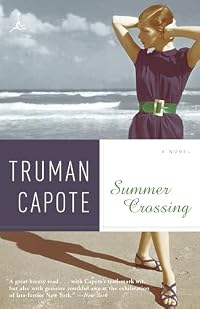
Summer Crossing
by Truman Capote
On This Page
Description
“Witness the coming together of Truman Capote’s voice, the electric-into-neon blaze that is surely one of the premier styles of postwar American literature.”—The Washington Post Book World“A great breezy read . . . with Capote’s trademark wit, but also with genuine youthful awe at the exhilaration of late-forties New York.”—New York
A lost treasure only recently found, Truman Capote’s Summer Crossing is a precocious, confident first novel from one of the twentieth show more century’s greatest writers.
Set in New York just after World War II, the story follows a young carefree socialite, Grady McNeil, whose parents leave her alone in their Fifth Avenue penthouse for the summer. Left to her own devices, Grady turns up the heat on the secret affair she’s been having with a Brooklyn-born Jewish war veteran who works as a parking lot attendant. As the season passes, the romance turns more serious and morally ambiguous, and Grady must eventually make a series of decisions that will forever affect her life and the lives of everyone around her. show less
Tags
Recommendations






















Member Recommendations
Member Reviews
A remarkable novella, technically Capote's first, although not published until many years after his death. With hints of the perfection of Breakfast at Tiffany's, this story of doomed love 'twixt the upper and lower crusts owes just a little something to Fitzgerald. When her parents plan a "crossing" to Europe to get out of New York for the summer and to check out what WWII may have left of their home in Cannes, 17-year-old Grady McNeil insists on staying behind, alone, in the closed-up apartment overlooking The Park, with occasional duty visits to her married sister in East Hampton. You see, Grady has fallen in love with the attendant of an open-air parking lot where she has been in the habit of leaving her car during spring trips into show more the city from the family's summer home in Connecticut. Of course the reader can imagine some of the misfortunes that will inevitably ensue....but not all. And the prose is purely beautiful.
The manuscript for Summer Crossing was discovered in a lot of Capote memorabilia presented to an auction house to be sold off in 2004 (Capote died in 1984). It had been known that Capote had worked on such a novel and never been satisfied with it, but as his literary executors had never found the manuscript they assumed he had given up on it, and destroyed it. Indeed, he apparently had abandoned it along with other possessions when he moved out of an apartment in Brooklyn in 1950. Rather than "put it all out at the curb for the garbage men" as Capote had instructed, a friend held on to a few boxes of documents, manuscripts and other memorabilia for nearly 50 years. The story of the manuscript's survival and ultimate publication, told in an afterword by a trustee of the Truman Capote Literary Trust, is nearly as engaging as the novel itself.
Review written in February, 2011 show less
The manuscript for Summer Crossing was discovered in a lot of Capote memorabilia presented to an auction house to be sold off in 2004 (Capote died in 1984). It had been known that Capote had worked on such a novel and never been satisfied with it, but as his literary executors had never found the manuscript they assumed he had given up on it, and destroyed it. Indeed, he apparently had abandoned it along with other possessions when he moved out of an apartment in Brooklyn in 1950. Rather than "put it all out at the curb for the garbage men" as Capote had instructed, a friend held on to a few boxes of documents, manuscripts and other memorabilia for nearly 50 years. The story of the manuscript's survival and ultimate publication, told in an afterword by a trustee of the Truman Capote Literary Trust, is nearly as engaging as the novel itself.
Review written in February, 2011 show less
this is probably best read after already reading all his other works, as more of a scholarly completist reading. it's not finished, it's not polished, and he likely wouldn't have wanted it to have been published in this form. (it's not something i probably would have read had i known that beforehand.)
that said, it's really well written. there are some especially superb turns of phrase and he takes a very common story of the time (young love between people unsuited, early pregnancy) and makes it much more readable than that plot usually is for me. i'm not familiar with his writing really (i've hardly read anything by him yet) so don't know how similar this style is here, but it's clear to me that he was an excellent writer. i suspect his show more other work is more compelling plot-wise, but he manages to inject life in a tired, overused theme. makes me want to read all of his other stuff.
"Toward midafternoon, as the heat closed in like a hand over a murder victim's mouth..." show less
that said, it's really well written. there are some especially superb turns of phrase and he takes a very common story of the time (young love between people unsuited, early pregnancy) and makes it much more readable than that plot usually is for me. i'm not familiar with his writing really (i've hardly read anything by him yet) so don't know how similar this style is here, but it's clear to me that he was an excellent writer. i suspect his show more other work is more compelling plot-wise, but he manages to inject life in a tired, overused theme. makes me want to read all of his other stuff.
"Toward midafternoon, as the heat closed in like a hand over a murder victim's mouth..." show less
In late 2004, Sotheby's in New York contacted Alan Schwartz who is a trustee of The Truman Capote Literary Trust. A manuscript had been delivered to Sotheby's for auction which appeared to be an early, unpublished novel by Truman Capote. The manuscript turned out to be Capote's first novel (really a novella) drafted when he was only nineteen years old. Schwartz' decision to publish this early work in 2005 has given readers the opportunity to enjoy a novel whose style and insight probably led to Capote's penning of Breakfast at Tiffany's.
Summer Crossing is a slim novel with surprising depth. Grady McNeil, a New York socialite, is spending a summer alone in the city. On the cusp of her eighteenth birthday, she is ripe for independence. show more Her budding relationship with a Jewish war veteran leads her down a path where the future is far from clear.
As a summer heat wave descends on New York City, the novel also heats up - leaving Grady with the consequences of her decisions.
Capote's deft literary style explores such themes as sexuality in the mid 1940s, as well as cultural, socioeconomic, class and religious issues during that time period. Filled with stunning insights into a young girl's emotional development, the novel is a compelling read. Capote uses symbolism artfully.
I breezed through this novel in less than a day, carried away by Capote's fine sense of place, as well as his deep understanding of the characters. A fastidiously written first novel, Summer Crossing is well worth the read.
Highly recommended. show less
Summer Crossing is a slim novel with surprising depth. Grady McNeil, a New York socialite, is spending a summer alone in the city. On the cusp of her eighteenth birthday, she is ripe for independence. show more Her budding relationship with a Jewish war veteran leads her down a path where the future is far from clear.
As a summer heat wave descends on New York City, the novel also heats up - leaving Grady with the consequences of her decisions.
Capote's deft literary style explores such themes as sexuality in the mid 1940s, as well as cultural, socioeconomic, class and religious issues during that time period. Filled with stunning insights into a young girl's emotional development, the novel is a compelling read. Capote uses symbolism artfully.
I breezed through this novel in less than a day, carried away by Capote's fine sense of place, as well as his deep understanding of the characters. A fastidiously written first novel, Summer Crossing is well worth the read.
Highly recommended. show less
This audio version of Capote's novella was very good. A 20th century Romeo and Juliet-esque tale set in the hot summer in NYC. So, that tells you the outcome, but it is the wonderful prose of Capote's which makes this worth reading nonetheless. His phrasing made me catch my breath a few times, it was so perfect. Capote is a painter with words. Lovely, lovely, tragic tale!
Summer Crossing was Truman Capote’s first novel, written in the 1940’s it was believed to have been lost – Capote had claimed to have destroyed the manuscript – however it was discovered in 2004 and published the following year. In an afterward to my edition, Capote’s friend and lawyer, Alan L Schwartz explains how the novel came to be discovered and published, explaining how he had to wrestle over the decision whether to publish the novel Capote had cast aside or not. Schwartz’s story in itself is an interesting one, and I am sure the Majority of Capote fans must be glad he did publish.
The interest for Capote readers I suppose lies mainly in this being Capote’s first novel. The reader cannot expect A Summer Crossing to show more have the same classic quality as Breakfast at Tiffany’s or the unforgettable brilliance of In Cold Blood, however Capote’s prose still shines, he was an exceptional writer, and in Grady McNeil we perhaps have the beginnings of the character who would later become Holly Golightly herself.
“Hot weather opens the skull of a city, exposing its white brain, and its heart of nerves, which sizzle like the wires inside a lightbulb. And there exudes a sour extra-human smell that makes the very stone seem flesh-alive, webbed and pulsing.”
Set in New York during the hot summer of 1945, Summer Crossing tells the story of Grady McNeil the seventeen year old daughter of a highly privileged prosperous family from the upper echelons of New York society. Named for the baby brother who died before she was born, Grady is beautiful, spoilt and defiant. Refusing to join her parents on their annual foreign travels, Grady is left behind in the family’s New York apartment.
summercrossingTaking advantage of her parent’s absence Grady seeks to fulfil the excitement that she craves outside of her conventional family. Several months earlier Grady had met a Jewish parking attendant Clyde Manzer, with who she’s now quick to embark upon a secret affair. In the background is the nice, handsome Peter Bell, a good friend and possible suitor, socially he is much more suitable. For Grady, Clyde represents everything her family would disapprove of, as the summer continues their romance heats up, with Grady bringing Clyde to the family penthouse in what feels like an act of particular defiance.
“He loved her, he loved her, and until he’d loved her she had never minded being alone, she’d liked too much to be alone. At school, where all the girls had crushes on one another and trailed in sweetheart pairs, she had kept to herself: except once, and that was when she’d allowed Naomi to adore her. Naomi, scholarly, and bourgeois as a napkin ring, had written her passionate poems that really rhymed, and once she’d let Naomi kiss her on the lips. But she had not loved her: it is very seldom that a person loves anyone they cannot in some way envy: she could not envy any girl, only men: and so Naomi became mislaid in her thoughts, then lost, like an old letter, one which had never been carefully read.”
Travelling to New Jersey the couple marry, suddenly and with what appears to be little thought. Caught up in this heady, deeply unwise relationship Grady is too young to realise the enormity of her rash act. Meeting Clyde’s family in Brooklyn however, Grady is faced with the reality of their social inequality. Grady leaves Clyde behind in the city while she visits her elder sister Apple in East Hampton, here she reveals her marriage and early pregnancy to her appalled sister, just before Clyde turns up to claim his wife.
In true Truman Capote fashion, things do take a rather darker turn, at the conclusion of this slight novel, I was expecting something of the kind, but I was still quite shocked. Summer Crossing certainly has that wonderful sense of place that I have come to associate with Capote’s writing, and I enjoyed and engaged with the novel. As first novel cast aside more than fifty years ago, shows so much of what was to come. I am so pleased that I rounded off my August reading of Capote with this novel,(yes I am still reviewing August’s books) it is certainly worth exploring if you are a fan of his work. show less
The interest for Capote readers I suppose lies mainly in this being Capote’s first novel. The reader cannot expect A Summer Crossing to show more have the same classic quality as Breakfast at Tiffany’s or the unforgettable brilliance of In Cold Blood, however Capote’s prose still shines, he was an exceptional writer, and in Grady McNeil we perhaps have the beginnings of the character who would later become Holly Golightly herself.
“Hot weather opens the skull of a city, exposing its white brain, and its heart of nerves, which sizzle like the wires inside a lightbulb. And there exudes a sour extra-human smell that makes the very stone seem flesh-alive, webbed and pulsing.”
Set in New York during the hot summer of 1945, Summer Crossing tells the story of Grady McNeil the seventeen year old daughter of a highly privileged prosperous family from the upper echelons of New York society. Named for the baby brother who died before she was born, Grady is beautiful, spoilt and defiant. Refusing to join her parents on their annual foreign travels, Grady is left behind in the family’s New York apartment.
summercrossingTaking advantage of her parent’s absence Grady seeks to fulfil the excitement that she craves outside of her conventional family. Several months earlier Grady had met a Jewish parking attendant Clyde Manzer, with who she’s now quick to embark upon a secret affair. In the background is the nice, handsome Peter Bell, a good friend and possible suitor, socially he is much more suitable. For Grady, Clyde represents everything her family would disapprove of, as the summer continues their romance heats up, with Grady bringing Clyde to the family penthouse in what feels like an act of particular defiance.
“He loved her, he loved her, and until he’d loved her she had never minded being alone, she’d liked too much to be alone. At school, where all the girls had crushes on one another and trailed in sweetheart pairs, she had kept to herself: except once, and that was when she’d allowed Naomi to adore her. Naomi, scholarly, and bourgeois as a napkin ring, had written her passionate poems that really rhymed, and once she’d let Naomi kiss her on the lips. But she had not loved her: it is very seldom that a person loves anyone they cannot in some way envy: she could not envy any girl, only men: and so Naomi became mislaid in her thoughts, then lost, like an old letter, one which had never been carefully read.”
Travelling to New Jersey the couple marry, suddenly and with what appears to be little thought. Caught up in this heady, deeply unwise relationship Grady is too young to realise the enormity of her rash act. Meeting Clyde’s family in Brooklyn however, Grady is faced with the reality of their social inequality. Grady leaves Clyde behind in the city while she visits her elder sister Apple in East Hampton, here she reveals her marriage and early pregnancy to her appalled sister, just before Clyde turns up to claim his wife.
In true Truman Capote fashion, things do take a rather darker turn, at the conclusion of this slight novel, I was expecting something of the kind, but I was still quite shocked. Summer Crossing certainly has that wonderful sense of place that I have come to associate with Capote’s writing, and I enjoyed and engaged with the novel. As first novel cast aside more than fifty years ago, shows so much of what was to come. I am so pleased that I rounded off my August reading of Capote with this novel,(yes I am still reviewing August’s books) it is certainly worth exploring if you are a fan of his work. show less
In the lead up to the release of yet more Popular Penguins, I decided to make a small attempt to decrease the number of unread PP in my pile. Wanting a quick read before sinking into something meatier for the weekend, I chose Summer Crossing which could be described as more of a novella at 120-odd pages.
Summer Crossing was found long after Truman Capote’s death and it was up to his lawyer amongst others to decide whether it should be published. It appeared that Capote had edited the manuscript several times and only minor changes have been made by others to the novel.
In summary, the plot is about Grady, a rich teenage New Yorker, who is left alone in the city one summer while her parents travel abroad. During this time, she falls in show more love with Clyde, a Jewish car park attendant and makes some very rash choices that have very severe consequences. Sounds good, no?
I found this to be a fantastic outline for a great novel, but the actual manuscript to be verbose and jumpy- meaning that it jumps around from thought to thought. This could have been to me a perfectly brilliant novel, but I felt it lacked detail and background. What also really annoyed me were the long, rambling sentences:
Lucy McNeil’s own debut had been a famous and sentimental affair: her grandmother, a rightfully celebrated New Orleans beauty who had married South Carolina’s Senator LaTrotta, presented Lucy and her two sisters en masse at a Camellia ball in Charleston in April of 1920; it was a presentation truly, for the three LaTrotta sisters were no more than schoolgirls whose social adventures had been heretofore conducted within the shackles of a church; so hungrily had Lucy whirled that night her feet for days had worn the bruises of this entrance into living, so hungrily had she kissed the Governor’s son that her cheeks had flamed a month in remorseful shame, for her sisters- spinsters then and spinsters still- claimed kissing made babies: no, her grandmother said, hearing her teary confession, kissing does not make babies- neither does it make ladies. (p8-9)
Yes, that’s one sentence. Phew. Even though the last part about kissing is quite cute, it rambles on and on and on. I didn’t find this when I read Breakfast at Tiffany’s and I haven’t read In Cold Blood yet (not sure if I will now).
While it’s interesting, I think if you’re after discontented American youngsters in the 1950’s you would be better off reading Richard Yates’ Revolutionary Road which is much better executed in my opinion.
http://samstillreading.wordpress.com show less
Summer Crossing was found long after Truman Capote’s death and it was up to his lawyer amongst others to decide whether it should be published. It appeared that Capote had edited the manuscript several times and only minor changes have been made by others to the novel.
In summary, the plot is about Grady, a rich teenage New Yorker, who is left alone in the city one summer while her parents travel abroad. During this time, she falls in show more love with Clyde, a Jewish car park attendant and makes some very rash choices that have very severe consequences. Sounds good, no?
I found this to be a fantastic outline for a great novel, but the actual manuscript to be verbose and jumpy- meaning that it jumps around from thought to thought. This could have been to me a perfectly brilliant novel, but I felt it lacked detail and background. What also really annoyed me were the long, rambling sentences:
Lucy McNeil’s own debut had been a famous and sentimental affair: her grandmother, a rightfully celebrated New Orleans beauty who had married South Carolina’s Senator LaTrotta, presented Lucy and her two sisters en masse at a Camellia ball in Charleston in April of 1920; it was a presentation truly, for the three LaTrotta sisters were no more than schoolgirls whose social adventures had been heretofore conducted within the shackles of a church; so hungrily had Lucy whirled that night her feet for days had worn the bruises of this entrance into living, so hungrily had she kissed the Governor’s son that her cheeks had flamed a month in remorseful shame, for her sisters- spinsters then and spinsters still- claimed kissing made babies: no, her grandmother said, hearing her teary confession, kissing does not make babies- neither does it make ladies. (p8-9)
Yes, that’s one sentence. Phew. Even though the last part about kissing is quite cute, it rambles on and on and on. I didn’t find this when I read Breakfast at Tiffany’s and I haven’t read In Cold Blood yet (not sure if I will now).
While it’s interesting, I think if you’re after discontented American youngsters in the 1950’s you would be better off reading Richard Yates’ Revolutionary Road which is much better executed in my opinion.
http://samstillreading.wordpress.com show less
This truly became a beach read when the San Francisco winter turned 70 degrees. That was pretty much the perfect way to read it -- in two hours, with sunglasses on and heels kicked up. It's unfinished, so don't make it your first Capote. I'd recommend it to anyone who likes him. It's a breezy read without being fluff.
Members
- Recently Added By
Lists

Books Set in New York City
127 works; 21 members

1940s
221 works; 25 members

Books Read in 2020
4,379 works; 124 members

Books Read in 2013
1,629 works; 51 members

Books Read in 2012
815 works; 34 members
Author Information

173+ Works 56,981 Members
Truman Capote, 1924 - 1984 Novelist and playwright Truman Streckfus Person was born in 1924 in New Orleans to a salesman and a 16-year-old beauty queen. His parents divorced when he was four years old and was then raised by relatives for a few years in Monroeville. His mother was remarried to a successful businessman, moved to New York, and Truman show more adopted his stepfather's surname. He attended Greenwich High School and never went to college. When he was 17, Capote's formal education ended when he was employed at The New Yorker magazine. He belived he did not need to go to college to be a writer, since he was writing seriously since age 11. Capote's first novel was "Other Voices, Other Rooms" (1948), which told the story of a boy growing up in the Deep South. "The Grass Harp" (1951) is about a young boy and his elderly cousin discovering that some compromise is necessary for people to live together in a community and was adapted to screen in 1996. The play "The House of Flowers" (1954) is a musical set in a West Indies bordello. Capote then wrote, "Breakfast at Tiffanys" (1958), which tells the story of how Holly Golightly goes to New York seeking happiness. Capote became preoccupied with journalism and, sparked by the murder of a wealthy family in Holcomb, Kansas, began interviewing the locals to recreate the lives of the murderers and their victims. The research and writing for this novel, "In Cold Blood" (1966), took six years for him to complete. Other works of Capote's include the classic "A Christmas Memory" (1966), which is an autobiographical account of a seven-year-old boy, his cousin, and an eccentric old lady, "Music for Chameleons" (1981), which is a collection of short pieces, interviews, stories and conversations that were published in several magazines, and "One Christmas" (1982). On August 26, 1984 in Los Angeles, Truman Capote died of liver disease complicated by phlebitis and multiple drug intoxication. Published after his death were "Conversations With Capote" (1985) and "Answered Prayers: The Untitled Novel" (1986). (Bowker Author Biography) show less
Some Editions
Series
Belongs to Publisher Series
Common Knowledge
- Canonical title
- Summer Crossing
- Original publication date
- 2005
- People/Characters
- Grady McNeil; Peter Bell; Clyde Manzer
- Important places
- Manhattan, New York, New York, USA
- First words
- Eres un misterio, querida, dijo su madre, y Grady, desde el otro lado de la mesa, a través de un centro de rosas y helechos, sonrió con indulgencia, sí, soy un misterio, y le agradaba pensarlo.
"You are a mystery, my dear," her mother said, and Grady, gazing across the table through a centerpiece of roses and fern, smiled indulgently: yes, I am a mystery, and it please her to think so. - Quotations*
- Ogni volta che cambiamo marca di sigarette, traslochiamo in una nuova casa, ci abboniamo ad un altro giornale,ci innamoriamo e disinnamoriamo, non facciamo che protestare in modo più o meno frivolo contro l'insormontabile no... (show all)ia della vita quotidiana.
- Last words*
- (Click to show. Warning: May contain spoilers.)Turning right on Fifty-ninth, the car skidded onto the Queensboro Bridge; there, above the hollow hootings of river traffic, and with a morning he was never to see changing the sky, Gump cried, "Damn it, you'll kill us," but he could not loosen her hands from the steering wheel: she said, "I know."
*Some information comes from Common Knowledge in other languages. Click "Edit" for more information.
Classifications
Statistics
- Members
- 1,148
- Popularity
- 21,768
- Reviews
- 37
- Rating
- (3.42)
- Languages
- 18 — Bulgarian, Catalan, Czech, Danish, Dutch, English, Estonian, Finnish, French, German, Galician, Greek, Italian, Norwegian (Bokmål), Russian, Spanish, Turkish, Portuguese (Portugal)
- Media
- Paper, Audiobook, Ebook
- ISBNs
- 53
- ASINs
- 9