On This Page
Description
In Bronze Age Britain, Drem must overcome the disability of a crippled arm in order to pass his tribe's test of manhood and become a warrior.Tags
Recommendations



















Member Recommendations

by Litrvixen
Member Reviews
Set in the Bronze Age, somewhere on the South Downs of England, among a tribe with broadly-sketched Celtic affinities, this is an effectively drawn tale of a boy endeavouring to become accepted as a warrior by his community, despite having the use of only one arm. After half a century, Sutcliff's portrayal of the religious and social life of the Bronze Age may not be entirely in accord with modern archaeological understanding (I'm no expert), but nevertheless it gives a coherent picture of an ancient European society, with some aspects (such as the initiation cycle for warriors) presumably based partly on more recent or present day tribal societies. The male warrior caste is definitely in control, with their blinded harpers, show more wolf-slaying initiation, and semi-shamanic wise man presiding over a Celtic-Apollo cult, while the goddess-worshipping Stone Age inhabitants linger on as an underclass of shepherds, the Half People.
Drem and his contemporaries have the same petty rivalries and alliances as children everywhere, though his dismissive attitude to girls seems even more pointed because it clearly reflects the attitude towards women of his society as a whole. The underlying tensions between the Tribe and the subject Half People is subtly but explicitly outlined. I found the story of Drem's quest to achieve the red cloak of a warrior (the "warrior scarlet" of the title), and his struggles with acceptance by various parts of the community, a definite page-turner: so much so that I skipped quite a lot of the excellent descriptive writing, and may have to read the book again more slowly!
MB 10-viii-2008
PS The 1970 OUP paperback has a number of irritating typographical errors. A couple that I checked did appear correctly in the Chancellor Press collection. show less
Drem and his contemporaries have the same petty rivalries and alliances as children everywhere, though his dismissive attitude to girls seems even more pointed because it clearly reflects the attitude towards women of his society as a whole. The underlying tensions between the Tribe and the subject Half People is subtly but explicitly outlined. I found the story of Drem's quest to achieve the red cloak of a warrior (the "warrior scarlet" of the title), and his struggles with acceptance by various parts of the community, a definite page-turner: so much so that I skipped quite a lot of the excellent descriptive writing, and may have to read the book again more slowly!
MB 10-viii-2008
PS The 1970 OUP paperback has a number of irritating typographical errors. A couple that I checked did appear correctly in the Chancellor Press collection. show less
Late bronze age british boy with a withered right arm fights to become a warrior of his people. Some heartache, some love of a good dog, as he deals with what comes to him. I would have loved this as a pre-teen, but now I'm all like what dye produces scarlet, did they ride horses before they had chariots, does iron really cut bronze or is it mostly just easier to produce once the technology is known?
Rosemary Sutcliff's Warrior Scarlet was one of my earlist forays into historical fiction, and I bless the chance that made it one of the few Sutcliffs our small-town library possessed. I reread it frequently in my formative years, and it has firmly established both my love for and standard of historical fiction. I thoroughly enjoyed this most recent reread, a good ten or more years since I had last picked it up. Some childhood favorites lose their charm when we revisit them as adults, but the best children's literature never does.
It's Britain in the Bronze Age, nine hundred years before the birth of Christ. Drem lives with his mother, grandfather, and brother in a small settlement. He is crippled; one of his arms hangs useless by his show more side. But at nine years old, he doesn't realize the far-reaching effect this might have on his future with the tribe. He dreams of slaying his wolf and taking up his Warrior Scarlet, that bright color that only a fighting man may wear. But there are three years of intense training for that, and a boy's future place in the tribe hangs so lightly on the end of his spear.
Sutcliff's characters are, as usual, perfectly rendered. They aren't cuddly, warm, comforting people with modern sensibilities. Not at all; they're actually real. Often they are harsh; Drem's older brother beats him when he causes trouble, and his grandfather is a proud, selfish old man. His mother is loving, but when she is worried, "her hand is hard." Something in me has always responded to this honesty: the characters in this story lived for me, when hundreds of carefully engineered, all-wise parent figures in other children's books have been completely forgotten.
Sutcliff never falls into the trap of transplanting modern ideas into her historical settings. It's plain right from the outset that this is a very patriarchal society. Every hearth has a Men's Side and a Women's Side, and there is never any blurring. No women would ever even think of being a warrior. Scarlet is a color only men may wear, though the women are the ones to weave it for them. And yet this, as part of the story, never put me off. That is how it was... and the admirable characters show kindness to one another within those cultural confines. Not all men back then were stupid chauvinists just because they did not open the Men's Side to the women and do other things utterly unthinkable in their society. It never even occurred to their minds — and there are still traits to admire in them. Talore the Hunter, my favorite character, is a great example of this.
And yet with all this historical and ideological accuracy, Sutcliff doesn't just dismiss her female characters. Blai's subplot is heartbreaking, exquisitely drawn. Sutcliff handles the romantic plotline carefully. It's not the focus at all, and when it does come to fruition it feels so right for the period. No gushy, Valentine-y, modern ideas of falling in love, but something poignantly written that is nevertheless extremely strong underneath. Drem matures from a thoughtless, selfish boy to a man not when he wins his Warrior Scarlet, but when he learns to see Blai as a person with feelings and thoughts of her own. That's just hugely romantic to me, in a Bronze Age kind of way!
Another thing that rings true is the bittersweet ending of Drem's relationship with the Half People. Luga is right: not even Drem One-arm can live in two worlds at once. And Doli the shepherd dies; there is no miraculous, convenient prolonging of his life due to Drem's valor. Why did I know, even as a child, that this was realistic? That life is hard, that people we care about do die, that relationships end? The way that Sutcliff brings Drem's story to a close is satisfying in a way that an artificially contrived ending could never be.
I should also say a word about Charles Keeping's wonderful illustrations. Don't look at the cover art done more recently by Moline Kramer; it's hideous. Keeping's original cover and intricate ink drawings inside capture the essence of the story perfectly. There is something very elemental about his style, and yet it captures little personal expressions, hints around the mouth or eyes, something in the sag of the shoulders. Beautiful and emotional.
No doubt this glowing review is biased somewhat because this is a book that impressed its mold deeply on me as a child. I have that deep, almost primitive attachment to it because of the ways it shaped me. But it isn't just that. I'm an older reader now, wiser in experience and much wider read, and I still can't find a flaw in this story. The history is impeccable; the characters are complex and believable and human; the writing is spare and elegant with the elegance of bones — a graceful structure under the beauty. I can't recommend Sutcliff enough, and Warrior Scarlet is one of her best. Highly recommended! show less
It's Britain in the Bronze Age, nine hundred years before the birth of Christ. Drem lives with his mother, grandfather, and brother in a small settlement. He is crippled; one of his arms hangs useless by his show more side. But at nine years old, he doesn't realize the far-reaching effect this might have on his future with the tribe. He dreams of slaying his wolf and taking up his Warrior Scarlet, that bright color that only a fighting man may wear. But there are three years of intense training for that, and a boy's future place in the tribe hangs so lightly on the end of his spear.
Sutcliff's characters are, as usual, perfectly rendered. They aren't cuddly, warm, comforting people with modern sensibilities. Not at all; they're actually real. Often they are harsh; Drem's older brother beats him when he causes trouble, and his grandfather is a proud, selfish old man. His mother is loving, but when she is worried, "her hand is hard." Something in me has always responded to this honesty: the characters in this story lived for me, when hundreds of carefully engineered, all-wise parent figures in other children's books have been completely forgotten.
Sutcliff never falls into the trap of transplanting modern ideas into her historical settings. It's plain right from the outset that this is a very patriarchal society. Every hearth has a Men's Side and a Women's Side, and there is never any blurring. No women would ever even think of being a warrior. Scarlet is a color only men may wear, though the women are the ones to weave it for them. And yet this, as part of the story, never put me off. That is how it was... and the admirable characters show kindness to one another within those cultural confines. Not all men back then were stupid chauvinists just because they did not open the Men's Side to the women and do other things utterly unthinkable in their society. It never even occurred to their minds — and there are still traits to admire in them. Talore the Hunter, my favorite character, is a great example of this.
And yet with all this historical and ideological accuracy, Sutcliff doesn't just dismiss her female characters. Blai's subplot is heartbreaking, exquisitely drawn. Sutcliff handles the romantic plotline carefully. It's not the focus at all, and when it does come to fruition it feels so right for the period. No gushy, Valentine-y, modern ideas of falling in love, but something poignantly written that is nevertheless extremely strong underneath. Drem matures from a thoughtless, selfish boy to a man not when he wins his Warrior Scarlet, but when he learns to see Blai as a person with feelings and thoughts of her own. That's just hugely romantic to me, in a Bronze Age kind of way!
Another thing that rings true is the bittersweet ending of Drem's relationship with the Half People. Luga is right: not even Drem One-arm can live in two worlds at once. And Doli the shepherd dies; there is no miraculous, convenient prolonging of his life due to Drem's valor. Why did I know, even as a child, that this was realistic? That life is hard, that people we care about do die, that relationships end? The way that Sutcliff brings Drem's story to a close is satisfying in a way that an artificially contrived ending could never be.
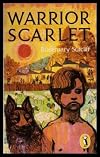
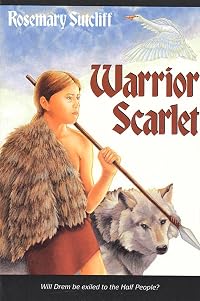
I should also say a word about Charles Keeping's wonderful illustrations. Don't look at the cover art done more recently by Moline Kramer; it's hideous. Keeping's original cover and intricate ink drawings inside capture the essence of the story perfectly. There is something very elemental about his style, and yet it captures little personal expressions, hints around the mouth or eyes, something in the sag of the shoulders. Beautiful and emotional.
No doubt this glowing review is biased somewhat because this is a book that impressed its mold deeply on me as a child. I have that deep, almost primitive attachment to it because of the ways it shaped me. But it isn't just that. I'm an older reader now, wiser in experience and much wider read, and I still can't find a flaw in this story. The history is impeccable; the characters are complex and believable and human; the writing is spare and elegant with the elegance of bones — a graceful structure under the beauty. I can't recommend Sutcliff enough, and Warrior Scarlet is one of her best. Highly recommended! show less
Vintage Sutcliff, overcoming great odds to achieve a difficult goal. But I'd love to know why her characters are always saying "Sa, Sa!" I've not come across it anywhere else.
Set much earlier than her great Roman series, this may owe something to Kipling's Knife and the Naked Chalk (as her Roman series does to his Centurion stories). --it is about prehistoric Britons among whom boys prove their manhood killing a wolf singlehanded. The protagonist fails this test and becomes an outcast with the small dark people who presumably lived in Britain before the Celts .In the end he redeems himself. Somehow this is a bit too predictable though as always with Sutcliff capably done.
I have read and enjoyed many of Rosemary Sutcliff's historical novels and I particularly like that theye are set in times that are less often featured in novels. This is set in south-east England in the late Bronze Age. The main character, Drem, has a withered right arm and so struggles to pass his test to be a warrior and wear scarlet. This is, I think aimed at children and young adults but I think I would have struggled with it at that age.
Apr 20, 2025English (UK)
Members
- Recently Added By
Lists

1001 Children's Books You Must Read Before You Grow Up
774 works; 101 members

Best Prehistoric Novels
64 works; 10 members
Honey For a Child's Heart
1,152 works; 25 members

Books Read in 2012
816 works; 31 members

Troublesome bodies
110 works; 7 members

Books Read in 2018
4,360 works; 110 members

A Book in Time World History Reading List
47 works; 2 members

GraceCollection TBR/To Buy List
106 works; 1 member

Best Children's Books You've Read
197 works; 75 members
Author Information

84+ Works 22,286 Members
Rosemary Sutcliff was on born December 14, 1920 in East Clandon in Surrey, England. As a child she had Still's Disease, a form of juvenile arthritis. The effect of this led to many stays in hospital for painful remedial operations. She ended her formal education at fourteen, and went to Bideford Art School. She passed the City and Guilds show more examination and worked as a painter of miniatures. She felt cramped by the small canvas of miniature painting and turned to writing. Her first two books, The Chronicles of Robin Hood and The Queen Elizabeth Story, were published in 1950. Her other works included The Eagle of the Ninth, The Silver Branch, Sword Song, and the autobiography Blue Remembered Hills. She won the annual Carnegie Medal from the Library Association for The Lantern Bearers in 1959 and the annual Horn Book Award for Tristan and Iseult in 1971. She won inaugural Phoenix Award in 1985 for The Mark of the Horse Lord and again in 2010 for The Shining Company. In 1975, she was appointed an Officer of the Order of the British Empire for services to children's literature, and was promoted to be a Commander of the Order of the British Empire in 1992. She died on July 23, 1992. (Bowker Author Biography) show less
Some Editions
Awards and Honors
Series

Work Relationships
Is contained in
Has the (non-series) sequel
Common Knowledge
- Canonical title*
- Om het rood van de krijger
- Original title
- Warrior Scarlet
- Original publication date
- 1958
- People/Characters
- Drem; Talore the Hunter; Blai; Luga; Doli [Hill Of Gathering 1]
- Important places
- United Kingdom (as Britain)
- First words
- The old shepherd sitting with his face turned seaward and his broad-bladed spear across his knees, seemed as much a part of the downs as did the wind-stunted whitethorn trees along the bank.
- Last words
- (Click to show. Warning: May contain spoilers.)When that was done, she sprang up and came to Drem where he waited in the doorway; and he caught her hand in his sound one, and they ducked out into the moonlight and the blustering spring wind, and ran laughing, with Whitethroat at their heels, back towards the Beltane fires.
- Original language*
- Engels
*Some information comes from Common Knowledge in other languages. Click "Edit" for more information.
Classifications
- Genres
- Children's Books, Fiction and Literature, Kids, Tween, Young Adult
- DDC/MDS
- 823.9 — Literature & rhetoric English & Old English literatures English fiction 1900-
- LCC
- PZ7 .S966 .W — Language and Literature Fiction and juvenile belles lettres Fiction and juvenile belles lettres Juvenile belles lettres
- BISAC
Statistics
- Members
- 487
- Popularity
- 61,963
- Reviews
- 7
- Rating
- (3.85)
- Languages
- 6 — Dutch, English, French, German, Portuguese, Swedish
- Media
- Paper, Ebook
- ISBNs
- 20
- ASINs
- 13