On This Page
Description
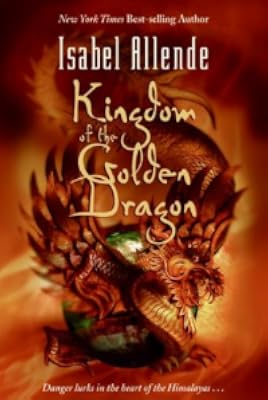
Sixteen-year-old Alexander Cold accompanies his grandmother, a writer for a geography magazine, to the remote Forbidden Kingdom in the Himalayas to help locate a sacred statue of a golden dragon before it is stolen by a greedy outsider.Tags
Recommendations















Member Recommendations
Member Reviews
The Kingdom of the Golden Dragon by bestselling author Isabel Allende is, quite simply put, a terribly bad book. The plot is utterly predictable and cliched; the characters uninteresting and uni-dimensional; and the writing bored me to tears (it may be better in the original Spanish, but I very much doubt it). The book is marketed as "young adult", but I doubt whether any discerning youngster would be enthused by it.
The story is simple. Big Bad Americans want to steal the legendary Golden Dragon from small Himalayan kingdom. This plot is thwarted by Brave Young American, his friend and grandmother, with help from a fighting monk, the prince of the kingdom and an army of Yetis. Good things happen to the good guys and bad things to the show more bad guys and all ends well.
The jacket blurb calls it an "Indiana Jones-style adventure", and I would tend to agree. But whatever the Indiana Jones movies lack in the way of intelligent content, they make up in sheer pulse-pounding excitement: something which is conspicuous by its absence here. From the first page, you know exactly where the story is meandering to. It is like a slow train journey where the start and destination are known, you only have to get through the torture of the actual trip!
But for brainlessness and a total lack of knowledge of Asian culture and religions, the book can compete with Edgar Rice Burroughs and Indiana Jones. It seems to me that Ms. Allende draws all her knowledge of India from outdated guidebooks and adventure stories of yore. Picture the following scene:
Fiction
young Alexander Cold and his grandma, Kate Cold, come out of New Delhi airport and is immediately mobbed by beggars. They somehow make their way to the hotel through similar hordes of beggars, which is a haven of peace with peacocks fluttering on the lawns and armed guards guarding the gate! It is also mentioned that the hotel was the former palace of an Indian prince who still stays there! Alexander Cold, out of "compassion" for the poor beggars camping outside the gates, goes out to give them some money and is immediately mobbed and almost trampled to death by the greedy ungrateful wretches. Then another American rushes out of the hotel, grabs a gun from one guards, and fires a few salvos into the air when the mob disappears!
Fact
Even though India has a lot of poverty and there are a lot many beggars, they don't line the streets all the way from the airport (in fact, it would be difficult to find beggars anywhere near the airport and main roads). And they don't camp outside hotels, ready to mob any tourist venturing outside-their begging schedules are much too full! Begging is a serious profession in India! As for the hotel with peacock-filled lawns, it may be some hotels in Rajasthan that the author may be meaning: there are no lavish palaces in New Delhi, nor are there any princes. And the legal possession of firearms by civilians is near-impossible in India: Tex Armadillo's caper of firing off a few shots into the air would have definitely landed him in the chokey.
To think that this drivel was written in 2003: it would have been insulting had it not been so ludicrous!
It is stated that the king of the Forbidden Kingdom (where the Golden Dragon resides) is a Buddhist: but their religion seems to be a strange mix of Buddhism, Hinduism, Tao and New Age science, with a liberal mix of martial arts and metaphysics (the original Buddha avoided speculative metaphysics like the plague). The powers gained by the monk Tensing through meditation are extraordinary, making him almost superhuman. I knew from the beginning that the poor villains didn't stand a chance. And also, there is the Scorpion Sect who seek immunity from the venom of their namesake by taking small bites from childhood onwards. Their bodies are blue-black in colour due to the venom, their teeth red due to the constant chewing of betel nuts, and they kidnap girls to produce male offspring to join their foul band (the female children are killed at birth). They worship the goddess Kali, of course (the poor goddess cannot cast off the image of the evil pagan deity, it seems, even in the 21st century!).
Not recommended for anybody; adult, young adult, or child. show less
The story is simple. Big Bad Americans want to steal the legendary Golden Dragon from small Himalayan kingdom. This plot is thwarted by Brave Young American, his friend and grandmother, with help from a fighting monk, the prince of the kingdom and an army of Yetis. Good things happen to the good guys and bad things to the show more bad guys and all ends well.
The jacket blurb calls it an "Indiana Jones-style adventure", and I would tend to agree. But whatever the Indiana Jones movies lack in the way of intelligent content, they make up in sheer pulse-pounding excitement: something which is conspicuous by its absence here. From the first page, you know exactly where the story is meandering to. It is like a slow train journey where the start and destination are known, you only have to get through the torture of the actual trip!
But for brainlessness and a total lack of knowledge of Asian culture and religions, the book can compete with Edgar Rice Burroughs and Indiana Jones. It seems to me that Ms. Allende draws all her knowledge of India from outdated guidebooks and adventure stories of yore. Picture the following scene:
Fiction
young Alexander Cold and his grandma, Kate Cold, come out of New Delhi airport and is immediately mobbed by beggars. They somehow make their way to the hotel through similar hordes of beggars, which is a haven of peace with peacocks fluttering on the lawns and armed guards guarding the gate! It is also mentioned that the hotel was the former palace of an Indian prince who still stays there! Alexander Cold, out of "compassion" for the poor beggars camping outside the gates, goes out to give them some money and is immediately mobbed and almost trampled to death by the greedy ungrateful wretches. Then another American rushes out of the hotel, grabs a gun from one guards, and fires a few salvos into the air when the mob disappears!
Fact
Even though India has a lot of poverty and there are a lot many beggars, they don't line the streets all the way from the airport (in fact, it would be difficult to find beggars anywhere near the airport and main roads). And they don't camp outside hotels, ready to mob any tourist venturing outside-their begging schedules are much too full! Begging is a serious profession in India! As for the hotel with peacock-filled lawns, it may be some hotels in Rajasthan that the author may be meaning: there are no lavish palaces in New Delhi, nor are there any princes. And the legal possession of firearms by civilians is near-impossible in India: Tex Armadillo's caper of firing off a few shots into the air would have definitely landed him in the chokey.
To think that this drivel was written in 2003: it would have been insulting had it not been so ludicrous!
It is stated that the king of the Forbidden Kingdom (where the Golden Dragon resides) is a Buddhist: but their religion seems to be a strange mix of Buddhism, Hinduism, Tao and New Age science, with a liberal mix of martial arts and metaphysics (the original Buddha avoided speculative metaphysics like the plague). The powers gained by the monk Tensing through meditation are extraordinary, making him almost superhuman. I knew from the beginning that the poor villains didn't stand a chance. And also, there is the Scorpion Sect who seek immunity from the venom of their namesake by taking small bites from childhood onwards. Their bodies are blue-black in colour due to the venom, their teeth red due to the constant chewing of betel nuts, and they kidnap girls to produce male offspring to join their foul band (the female children are killed at birth). They worship the goddess Kali, of course (the poor goddess cannot cast off the image of the evil pagan deity, it seems, even in the 21st century!).
Not recommended for anybody; adult, young adult, or child. show less
The story centres around Alex Cold, his friend Nadia and his grandmother Kate. They travel to the Forbidden Kingdom, a remote Himalayan country as part of International Geographic assignment. The King of the Forbidden Kingdom is rumoured to possess a treasure that enables him to tell the future and it is called the Golden Dragon. The bad guy in the story is the Collector who no longer wants to be the second richest man in the world and engages the services of the Specialist to steal the Golden Dragon.
The story is engaging the motives of the main characters are about protection of the environment and culture. The story has great pace, there is adventure and danger. I enjoyed the story but there were elements that I really struggled show more with. I am not sure if it was the translation but the language was stilted and unrealistic. Especially Alex, who came across sounding like fifty year old man not a teenager from California. Even though there was danger, you never felt that either Alex or Nadia were ever really going to fail or come even close to failing. They always managed to get by before things got too difficult.
I really like Allende’s writing style it flows beautifully, the work is well researched and she knows how to make a story unfold. I just was not completely immersed in this particular story but I will read more of her work. show less
The story is engaging the motives of the main characters are about protection of the environment and culture. The story has great pace, there is adventure and danger. I enjoyed the story but there were elements that I really struggled show more with. I am not sure if it was the translation but the language was stilted and unrealistic. Especially Alex, who came across sounding like fifty year old man not a teenager from California. Even though there was danger, you never felt that either Alex or Nadia were ever really going to fail or come even close to failing. They always managed to get by before things got too difficult.
I really like Allende’s writing style it flows beautifully, the work is well researched and she knows how to make a story unfold. I just was not completely immersed in this particular story but I will read more of her work. show less
This is a middle-grade/YA (but suitable for all ages) adventure that reminded me in its tone and themes of A Wrinkle in Time and other favorites from my childhood. In this novel a boy who can turn into a panther and girl who can turn into a white eagle travel to a place very much like Bhutan, but where magic works. The Kingdom of the Golden Dragon is so called because there is a golden dragon statue that lives in a secret chamber in the palace and guides the king, providing wisdom and foreknowledge. Of course, bad guys have been wanting to steal the statue for centuries, and now it seems they may succeed. Only with the help of the boy, the girl, two monks, and a bunch of yetis from the unexplored ranges of the Himalayas can the kingdom show more be saved from the thieves and their diabolical plot. show less
Two teens Alexander and Nadia follow Kate, a reporter, into a mysterious country in the Himalayas and run into trouble when a mafia-like group steal the sacred golden dragon. Adventure and mysticism ensue after Nadia & other girls from the kingdom are kidnapped and Alexander, a prince, & a monk must save them and the dragon. A community of yetis play their part as well. This is a jam-packed YA novel I enjoyed very much.
A little tedious and very predictable. It reminded me of a Clive Cussler novel with Buddhist culture mixed in for an interesting lesson.
This time Alex Cold and Nadia find themselves in the Forbidden Kingdom with Kate Cold, the intrepid journalist who also happens to be Alex's Grandmother. The novel takes place a year after the first book and now Nadia is living in New York with Kate and Alex has caught the travelling bug. They find themselves in the Forbidden Kingdom where the rulers are trained as buddhist monks and outside influences are kept to a bare minimum. An adventure ensues that tests the strength of both Alex and Nadia.
Allende again uses an exotic setting and a quickly paced plot to highlight the wisdom and beauty of another non-western culture. Although this book did not seem to flow as well as the first one, it was still a wonderful glimpse into eastern show more philosophy couched in an exciting action adventure. show less
Allende again uses an exotic setting and a quickly paced plot to highlight the wisdom and beauty of another non-western culture. Although this book did not seem to flow as well as the first one, it was still a wonderful glimpse into eastern show more philosophy couched in an exciting action adventure. show less
I didn't realize this was a young adult novel when I grabbed it at the library. When I was that age, I would never have read such a dumbed-down book -- it makes me sad to think this is what teens are reading. (If they read at all.) I'm shocked that [author: Isabel Allende] would write this.
Members
- Recently Added By
Published Reviews
La estatua del Dragón de Oro permanece oculta en un reino pequeño y misterioso, enclavado en la cordillera del Himalaya. Y según cuenta la leyenda, este magnífico objeto, un poderoso instrumento de adivinación incrustado de piedras preciosas, preserva la paz de estas tierras. Una paz que ahora, por la codicia en el alma de los hombres, puede verse perturbada.
En El Reino del Dragón de show more Oro, Isabel Allende nos invita a entrar en una doble aventura. Alexander Cold, su abuela Kate y Nadia Santos, los protagonistas de La Ciudad de las Bestias, han vuelto a reunirse. Viviremos con ellos sus peripecias y vicisitudes en la belleza desnuda, limpia, de las montañas y los valles del Himalaya en compañía de nuevos amigos. Pero la pluma mágica de Allende también nos descubre el valor y la sencillez de las enseñanzas budistas a través del lama Tensing, maestro y guía espiritual de Dil Bahadur, el joven heredero del reino, a quien conduce por la senda del budismo y ha dado a conocer el valor de la compasión, de la naturaleza, de la vida, de la paz show less
En El Reino del Dragón de show more Oro, Isabel Allende nos invita a entrar en una doble aventura. Alexander Cold, su abuela Kate y Nadia Santos, los protagonistas de La Ciudad de las Bestias, han vuelto a reunirse. Viviremos con ellos sus peripecias y vicisitudes en la belleza desnuda, limpia, de las montañas y los valles del Himalaya en compañía de nuevos amigos. Pero la pluma mágica de Allende también nos descubre el valor y la sencillez de las enseñanzas budistas a través del lama Tensing, maestro y guía espiritual de Dil Bahadur, el joven heredero del reino, a quien conduce por la senda del budismo y ha dado a conocer el valor de la compasión, de la naturaleza, de la vida, de la paz show less
added by Osko2k
Lists

A Rainbow of Books: Colors in the Title
570 works; 24 members

Tibet & Tibetan Buddhism
96 works; 1 member

Favorite Kids Books (chapter, middle grade)
170 works; 4 members
Author Information

94+ Works 85,106 Members
Isabel Allende was born in 1942 in Lima, Peru, the daughter of a Chilean diplomat. When her parents separated, young Isabel moved with her mother to Chile, where she spent the rest of her childhood. She married at the age of 19 and had two children, Paula and Nicolas. Her uncle was Salvador Allende, the president of Chile. When he was overthrown show more in the coup of 1973, she fled Chile, moving to Caracas, Venezuela. While living in Venezuela, Allende began writing her novels, many of them exploring the close family bonds between women. Her first novel, The House of the Spirits, has been translated into 27 languages, and was later made into a film. She then wrote Of Love and Shadows, Eva Luna, and The Stories of Eva Luna, all set in Latin America. The Infinite Plan was her first novel to take place in the United States. She explores the issues of human rights and the plight of immigrants and refugees in her novel, In The Midst of Winter. In Paula, Allende wrote her memoirs in connection with her daughter's illness and death. She delved into the erotic connections between food and love in Aphrodite: A Memoir of the Senses. In addition to writing books, Allende has worked as a TV interviewer, magazine writer, school administrator, and a secretary at a U.N. office in Chile. She received the 1996 Harold Washington Literacy Award. She lives in California. Her title Maya's Notebook made The New York Times Best Seller List in 2013. (Bowker Author Biography) show less
Some Editions
Awards and Honors
Awards
Series

Belongs to Publisher Series
Work Relationships
Is contained in
Common Knowledge
- Canonical title*
- Het rijk van de Gouden Draak
- Original title
- El reino del dragón del oro
- Original publication date
- 2004
- Epigraph
- [None]
- Dedication
- For my friend Tabra Tunoa, tireless traveler,
who took me to the Himalayas and told me about
the Golden Dragon. - First words
- The Buddhist Monk named Tensing and his disciple, Prince Dil Bahadur, had been climbing in the high peaks, north of the Himalayas for many days, a region of eternal ice where no one but a few lamas had ever ventured.
- Quotations*
- Todos podemos cambiar, pero nadie puede obligarnos a hacerlo. El cambio suele ocurrir cuando enfrentamos una verdad incuestionable, algo que nos obliga a revisar nuestras creencias
- Last words
- (Click to show. Warning: May contain spoilers.)Everyone burst out laughing, unable to help themselves, even the nuns who were ceremoniously serving tea, and little Boroba, who started excitedly leaping around, tossing pieces of chocolate cake into the air.
- Original language
- Spanish
*Some information comes from Common Knowledge in other languages. Click "Edit" for more information.
Classifications
Statistics
- Members
- 2,037
- Popularity
- 10,308
- Reviews
- 27
- Rating
- (3.48)
- Languages
- 19 — Czech, Danish, Dutch, English, Finnish, French, German, Greek, Icelandic, Italian, Latvian, Norwegian (Bokmål), Farsi/Persian, Portuguese, Romanian, Slovenian, Spanish, Swedish, Turkish
- Media
- Paper, Audiobook, Ebook
- ISBNs
- 89
- UPCs
- 2
- ASINs
- 19