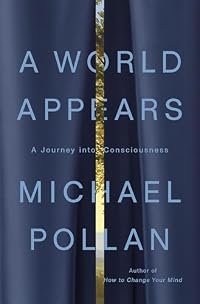
A World Appears: A Journey into Consciousness
by Michael Pollan
On This Page
Description
"When it comes to the phenomenon that is consciousness, there is one point on which scientists, philosophers, and artists all agree: that it feels like something to be us. Yet the fact we have subjective experience of the world remains one of nature's greatest mysteries. How is it that our mental operations are accompanied by feelings, thoughts, and a sense of self? What would a scientific investigation of our inner life look like, considering we have as little distance and perspective on it show more as fish do of the sea? In A World Appears, Michael Pollan traces the unmapped continent that is consciousness, bringing radically different perspectives-scientific, philosophical, literary, spiritual and psychedelic-to see what each can teach us about this central fact of life. When neuroscientists began studying consciousness in the early 1990s, they sought to explain how and why three pounds of spongy grey matter could generate a subjective point of view-assuming that the brain is the source of our felt reality. Pollan takes us to the cutting edge of the field, where scientists are entertaining more radical (and less materialist) theories of consciousness. He introduces us to "plant neurobiologists" searching for the first flicker of consciousness in plants; scientists striving to engineer feelings into AI, and psychologists and novelists seeking to capture the felt experience of our slippery stream of consciousness. In Pollan's dazzling exploration of consciousness, he discovers a world far deeper and stranger than our everyday reality. Eye-opening and mind-expanding, A World Appears takes us into the laboratories of our own minds, ultimately showing us how we might make better use of the gift of awareness to more meaningfully connect with our deepest selves"-- Provided by publisher. show lessTags
Recommendations













Member Reviews
This highly readable and absorbing consciousness book is unusual in being written not by a specialist in the field but by a freelance writer and sometime college-level teacher, Michael Pollan. The many professionals he leans on to tell us of his "journey" range from biologists to philosophers and fiction writers. Of these, some names (Christof Koch, David Chalmers, Karl Damasio, the 1800s' William James, the 1700s' David Hume, Anil Seth, Thomas Metzinger, . . .) were already well known to me, while others (Michael Levin, Karl Friston, Mark Solms, Russell Hurlburt, Kalina Christoff Hadjiilieva, Lucy Ellman, Alison Gopnik, Carlos Montemayor, . . .) were not but evidently should have been. In the preface, after introducing Koch, Chalmers, show more Integrated Information Theory (IIT), and Global Workspace Theory (GWT), Pollan sets out his 4-aspects view of consciousness studies -- Sentience, Feeling, Thought, and Self. These words serve as the titles of the book's 4 chapters proper. The Sentience chapter is where, drawing upon work by biologist Levin and by physicist Friston, he advances his own opinion that plants have at least a basic level of consciousness. The Feeling chapter is largely the domain of neurologist Damasio and his one-time student Solms. The former might well opine that "I feel, therefore I am" is what Descartes *should* have said; the latter is trying to build an AI/robot on this basis -- both Pollan and I doubt he'll succeed. The phenomenology of qualia, streams of consciousness, and works of fiction are topics for the Thought chapter. In the Self chapter, Levin's idea that alterations in self and modifications to memory go hand in hand struck me as very insightful. I also liked philosopher Montemayor's contention that the familiarity quale is both very important and very resistant to machine simulation. Lastly, we learn that Koch is no longer a materialist/physicalist; he slyly says Pollan has made progress by admittedly knowing *less* about consciousness than at the start of the journey! show less
I find this book hard to describe and review. On one hand, by the author's own admission, at the end he found himself almost back where he started. I felt more confused than when I started. But on the other hand, I have a new appreciation for the difficulties associated with trying to study consciousness. Maybe sometimes we all need some confusion to make us think harder.
A thought provoking book about consciousness
Ratings
Members
- Recently Added By
Lists

To Read
130 works; 1 member

The Economist Books of 2026 So Far (June 2026)
25 works; 1 member
Author Information

32+ Works 42,524 Members
Michael Pollan is a contributing writer for "The New York Times Magazine" as well as a contributing editor at "Harper's" magazine. He is the author of two prize-winning books: "Second Nature: A Gardener's Education" and "A Place of My Own: The Education of an Amateur Builder." Pollan lives in Connecticut with his wife and son. (Publisher Provided) show more Michael Pollan was born in 1955 and raised on Long Island, NY. He received his B.A. in English from Bennington College in 1977 and his Masters, also in English, from Columbia University, in 1981. He is the author of Cooked: A Natural History of Transformation, as well as 5 New York Times bestselling books: Food Rules: An Eater's Manual, In Defense of Food: An Eater's Manifesto, The Omnivore's Dilemma: A Natural History of Four Meals. The Botany of Desire: A Plant's-Eye View of the World and Ho wto Change Your Mind: What the New Science of Psychedelics Teaches Us about Consciousness, Dying, Addiction, Depression, and Transcendence. (Bowker Author Biography) show less
Awards and Honors
Distinctions
The Guardian Book of the Day (2026-02-16)
Common Knowledge
- Original publication date
- 2026
- Publisher's editor
- Godoff, Ann
Classifications
Statistics
- Members
- 227
- Popularity
- 141,914
- Reviews
- 3
- Rating
- (3.95)
- Languages
- English
- Media
- Paper, Audiobook, Ebook
- ISBNs
- 5
- ASINs
- 3