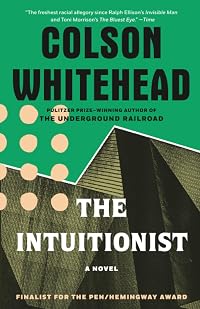
The Intuitionist
by Colson Whitehead
On This Page
Description
This debut novel by the two time Pulitzer Prize-winning author of The Underground Railroad and The Nickel Boys wowed critics and readers everywhere and marked the debut of an important American writer.Nominated as one of America’s best-loved novels by PBS’s The Great American Read
It is a time of calamity in a major metropolitan city's Department of Elevator Inspectors, and Lila Mae Watson, the first black female elevator inspector in the history of the department, is at the center of show more it. There are two warring factions within the department: the Empiricists, who work by the book and dutifully check for striations on the winch cable and such; and the Intuitionists, who are simply able to enter the elevator cab in question, meditate, and intuit any defects.
Lila Mae is an Intuitionist and, it just so happens, has the highest accuracy rate in the entire department. But when an elevator in a new city building goes into total freefall on Lila Mae's watch, chaos ensues. It's an election year in the Elevator Guild, and the good-old-boy Empiricists would love nothing more than to assign the blame to an Intuitionist. But Lila Mae is never wrong.
The sudden appearance of excerpts from the lost notebooks of Intuitionism's founder, James Fulton, has also caused quite a stir. The notebooks describe Fulton's work on the "black box," a perfect elevator that could reinvent the city as radically as the first passenger elevator did when patented by Elisha Otis in the nineteenth century. When Lila Mae goes underground to investigate the crash, she becomes involved in the search for the portions of the notebooks that are still missing and uncovers a secret that will change her life forever.
Look for Colson Whitehead’s bestselling new novel, Harlem Shuffle!. show less
Tags
Recommendations















Member Recommendations
CGlanovsky Creative spins on the genre of detective fiction with intricate webs of corrupt people and organizations with obscure motivations
Member Reviews
um, whew. it's kind of amazing that this was published. as a first novel, i would have thought it would be a tough sell. not because it isn't written well - actually it's quite brilliant. all around brilliant. but unusual enough that for a debut author, i'd have thought it'd be a barrier. man, what a book. he is *such* a good writer.
but, this was a hard read for me. it's one of the only times i can remember where i was interested in the story (because, come on! what a story! i've never read anything like it before!) and absolutely loved the writing, but still had real trouble moving through the book. part of it is just that it's (he's) smarter than me, so it was tough reading, and i know i missed stuff. like a lot of stuff. like what he show more meant and what he was doing. but i still liked it because the writing and the interesting story carried it through, even while i wasn't understanding the rest. i'd like to take a class on this book.
i loved his ambiguous time period. we have clues as to when it takes place - he uses the word colored to describe black people, for example. he says that she rented a room for $15 and 45cents a week, for example.
i love that the crux of this book is a philosophical difference, between the intuitionists and the empiricists. i mean, i'm sure he means more than that, but i don't know what. i look forward to thinking about it more, about what he's saying around race in particular. i'm glad to have a book group to discuss it with.
"She thinks, these white men see her as a threat but refuse to make her a threat, cunning, duplicitous. They see her as a mule, ferrying information back and forth, not clever or curious enough to explore the contents. Brute. Black."
"Her hatred. Fulton's hatred of himself and his lie of whiteness. White people's reality is built on what things appear to be -- that's the business of Empiricism. They judge them on how they appear when held up to the light, the wear on the carriage buckle, the stress fractures in the motor casing. His skin. Picture this: Fulton, the Great Reformer, the steady man at the helm of the Department of Elevator Inspectors, gives up his chair when the elevator companies try to buy his favor, place him in their advertisements. They have already bought off many of the street men -- building owners lay cash on inspectors in exchange for fastidious blindness to defect. Their sacred Empiricism has no meaning when it can be bought. When they can't even see that this man is colored because he says he is not. Or doesn't even say it. They see his skin and see a white man. Retreat behind the stone walls of the Institute does not change matters. He is still not colored. There is another world beyond this one. He was trying to tell them and they wouldn't hear it. Don't believe your eyes." show less
but, this was a hard read for me. it's one of the only times i can remember where i was interested in the story (because, come on! what a story! i've never read anything like it before!) and absolutely loved the writing, but still had real trouble moving through the book. part of it is just that it's (he's) smarter than me, so it was tough reading, and i know i missed stuff. like a lot of stuff. like what he show more meant and what he was doing. but i still liked it because the writing and the interesting story carried it through, even while i wasn't understanding the rest. i'd like to take a class on this book.
i loved his ambiguous time period. we have clues as to when it takes place - he uses the word colored to describe black people, for example. he says that she rented a room for $15 and 45cents a week, for example.
i love that the crux of this book is a philosophical difference, between the intuitionists and the empiricists. i mean, i'm sure he means more than that, but i don't know what. i look forward to thinking about it more, about what he's saying around race in particular. i'm glad to have a book group to discuss it with.
"She thinks, these white men see her as a threat but refuse to make her a threat, cunning, duplicitous. They see her as a mule, ferrying information back and forth, not clever or curious enough to explore the contents. Brute. Black."
"Her hatred. Fulton's hatred of himself and his lie of whiteness. White people's reality is built on what things appear to be -- that's the business of Empiricism. They judge them on how they appear when held up to the light, the wear on the carriage buckle, the stress fractures in the motor casing. His skin. Picture this: Fulton, the Great Reformer, the steady man at the helm of the Department of Elevator Inspectors, gives up his chair when the elevator companies try to buy his favor, place him in their advertisements. They have already bought off many of the street men -- building owners lay cash on inspectors in exchange for fastidious blindness to defect. Their sacred Empiricism has no meaning when it can be bought. When they can't even see that this man is colored because he says he is not. Or doesn't even say it. They see his skin and see a white man. Retreat behind the stone walls of the Institute does not change matters. He is still not colored. There is another world beyond this one. He was trying to tell them and they wouldn't hear it. Don't believe your eyes." show less
On first glance The Intuitionist is a story about the female elevator inspector Lila Mae who becomes entangled in the politicking of her higher-ups who compete for the presidency of the Elevator Guild. The story is set in a city with many skyscrapers that while never specifically identified as New York City does certainly remind you of it. From the language one can assume that it takes place in the first half of the 20th century, as Lila Mae is still called 'colored'. Basically, the elevator inspectors in the novel can be subdivided into two factions: empiricists and intuitionists. While the former are very diligent in checking each bolt and nut in their inspections, the latter ride the elevator and intuit how smoothly it runs and show more whether there is something wrong with it. Lila Mae is an intuitionist and as the competition for the presidency of the Elevator Guild is also a competition between an empiricist and an intuitionist, Lila Mae seems to be the perfect scapegoat when an elevator that she has inspected suddenly crashes down into the ground. The novel then follows Lila Mae in trying to find out why the elevator really crashed, exploring the origin of intuitionism in the process.
On a deeper level, the novel is an exploration of race relations in the US and provides an insight into the lengths people might go to to protect an idea and cover up secrets in order to preserve their own careers. The perceptions of race as shown by the color of one's skin are blurred and there is a deconstruction of a label that seems to have utmost importance but is not more than a simple label that should not bear any relevance at all. Whitehead plays with the notion of credibility being assigned on the basis of race or skin color and superbly shows how this is all just a matter of what people want to believe in the end.
I really enjoyed reading this novel. 4.5 stars. show less
On a deeper level, the novel is an exploration of race relations in the US and provides an insight into the lengths people might go to to protect an idea and cover up secrets in order to preserve their own careers. The perceptions of race as shown by the color of one's skin are blurred and there is a deconstruction of a label that seems to have utmost importance but is not more than a simple label that should not bear any relevance at all. Whitehead plays with the notion of credibility being assigned on the basis of race or skin color and superbly shows how this is all just a matter of what people want to believe in the end.
I really enjoyed reading this novel. 4.5 stars. show less
If asked to give a list of exciting professions, most people would likely think of things like spy, model or personal assistant to Jason Momoa or Scarlet Johansson; it seems unlikely that elevator safety inspector would make many lists, with the possible exception of the occasional elevator safety inspector who really love their job – and readers of Colson Whitehead’s debut novel The Intuitionist.
The novel’s protagonist is Lila Mae Watson, the first coloured female inspector to enter the Department of Elevator Inspection, and it is her we follow in close third person perspective through most of its events (although there are occasional switches to different points of view, as well as the occasional interspersed auctorial comment show more – just two of the many “yes, but not quite” moments that are scattered throughout the novel on all levels), said Lita Mae Watson, then, finds out just how unpleasantly exciting her job can become when an elevator she inspected and cleared has an accident and she is set up to take the fall for it. So she goes underground in an attempt to clear her name, and, while being pursued and threatened by all kinds of unsavoury types, uncovers a network of conspiracy and corruption that extends to the highest level of power… This is of course your archetypical noir plot – except that it isn’t. Not quite, anyway.
The world The Intuitionist is set in, appears strange, yet is strangely familiar. While the city where it takes place is (as far as I can remember) never named, it is quite obviously modelled after New York. The novel draws an obvious parallel between its elevator safety inspectors and the police force, it is populated with well-worn character types like the corrupt, power-hungry politician, the ruthless mafiosi, the idealistic journalists and a protagonist that doggedly searches for the truth, no matter what the obstacles; and finally, the plot with its mixture of violence, social criticism and existential melancholy will be familiar to anyone who has ever read a noir story or watched a noir movie. Does that mean that The Intuitionist is a crime novel in flimsy disguise? Well, kind of. But not really.
At least I have yet to come across a crime novel where one of the major plot points revolves around competing schools of epistemology. The conflicts between the Empiricist and Intuitionist schools of elevator safety inspection (based – more or less – on positivism and phenomenology, respectively) seems more like a gimmick at first (and application of phenomenological philosophy to elevator safety – “separate the elevatorness from the elevator” – makes for some hilarious moments in what is otherwise a very grim novel), but as the plot progresses and Whitehead gradually unfolds all of the metaphorical and allegorical implications, it becomes clear that there is more to it than meets the eye (which in itself constitutes one of the main thematic strands of the novel).
Also, while it is never explicitely stated, there is a strong retro vibe about The Intuitionist, a pervading if implicit sense that it takes place some time during the thirties of the twentieth centure, evoked by the noirish plot, the way the characters talk and the descriptive language which adds an additional level of patina to what it depicts – tinting them not so much in the sepia tones of nostalgic romanticisation, but depicting them in the stark black and white colours of a noir movie. Which is very much not a coincidence (and neither is that the various factions in the novel are chasing after a “black box” rather than a Maltese Falcon), for as removed as the world of The Intuitionist might seem from ours in some respects, there is at least one element they both share, and that is its discrimination of coloured people, the racism that Lila Mae Watson and other characters of the novel encounter at almost every step they make. The distance Whitehead puts between his novel and its readers turns out to be a distancing effect, a Brechtian Verfremdung (and note that Brecht wrote several of his best works during the thirties) that distorts our own, all too familiar world into recognisability.
The theme of racism radiates out into all levels of The Intuitionist, literal and figurative ones, and Whitehead spins a complex web of allegory and metaphor around that center, holding it all in a fragile, trembling balance. That he holds all of it together and that it does not come crashing down is mainly due to his intelligent, precise writing that still transmits the passion that glows in its core. It’s hard to believe that this is a first novel, and I am very curious to find out where Whitehead moved on from here. show less
The novel’s protagonist is Lila Mae Watson, the first coloured female inspector to enter the Department of Elevator Inspection, and it is her we follow in close third person perspective through most of its events (although there are occasional switches to different points of view, as well as the occasional interspersed auctorial comment show more – just two of the many “yes, but not quite” moments that are scattered throughout the novel on all levels), said Lita Mae Watson, then, finds out just how unpleasantly exciting her job can become when an elevator she inspected and cleared has an accident and she is set up to take the fall for it. So she goes underground in an attempt to clear her name, and, while being pursued and threatened by all kinds of unsavoury types, uncovers a network of conspiracy and corruption that extends to the highest level of power… This is of course your archetypical noir plot – except that it isn’t. Not quite, anyway.
The world The Intuitionist is set in, appears strange, yet is strangely familiar. While the city where it takes place is (as far as I can remember) never named, it is quite obviously modelled after New York. The novel draws an obvious parallel between its elevator safety inspectors and the police force, it is populated with well-worn character types like the corrupt, power-hungry politician, the ruthless mafiosi, the idealistic journalists and a protagonist that doggedly searches for the truth, no matter what the obstacles; and finally, the plot with its mixture of violence, social criticism and existential melancholy will be familiar to anyone who has ever read a noir story or watched a noir movie. Does that mean that The Intuitionist is a crime novel in flimsy disguise? Well, kind of. But not really.
At least I have yet to come across a crime novel where one of the major plot points revolves around competing schools of epistemology. The conflicts between the Empiricist and Intuitionist schools of elevator safety inspection (based – more or less – on positivism and phenomenology, respectively) seems more like a gimmick at first (and application of phenomenological philosophy to elevator safety – “separate the elevatorness from the elevator” – makes for some hilarious moments in what is otherwise a very grim novel), but as the plot progresses and Whitehead gradually unfolds all of the metaphorical and allegorical implications, it becomes clear that there is more to it than meets the eye (which in itself constitutes one of the main thematic strands of the novel).
Also, while it is never explicitely stated, there is a strong retro vibe about The Intuitionist, a pervading if implicit sense that it takes place some time during the thirties of the twentieth centure, evoked by the noirish plot, the way the characters talk and the descriptive language which adds an additional level of patina to what it depicts – tinting them not so much in the sepia tones of nostalgic romanticisation, but depicting them in the stark black and white colours of a noir movie. Which is very much not a coincidence (and neither is that the various factions in the novel are chasing after a “black box” rather than a Maltese Falcon), for as removed as the world of The Intuitionist might seem from ours in some respects, there is at least one element they both share, and that is its discrimination of coloured people, the racism that Lila Mae Watson and other characters of the novel encounter at almost every step they make. The distance Whitehead puts between his novel and its readers turns out to be a distancing effect, a Brechtian Verfremdung (and note that Brecht wrote several of his best works during the thirties) that distorts our own, all too familiar world into recognisability.
The theme of racism radiates out into all levels of The Intuitionist, literal and figurative ones, and Whitehead spins a complex web of allegory and metaphor around that center, holding it all in a fragile, trembling balance. That he holds all of it together and that it does not come crashing down is mainly due to his intelligent, precise writing that still transmits the passion that glows in its core. It’s hard to believe that this is a first novel, and I am very curious to find out where Whitehead moved on from here. show less
Unusual mix of crime mystery, science fiction, and speculative fiction. The setting is unnamed, likely an alternate version of mid twentieth century New York. Protagonist Lila Mae Watson, a graduate of the Institute for Vertical Transport, is the first black female elevator inspector in a society in which elevator operations are considered of utmost importance, as the future lies in verticality. An elevator inspector is a valued position, approaching celebrity status.
Lila Mae is an Intuitionist, basing her inspections upon feelings. The competing approach, Empiricism, bases inspections upon traditional measurements. She inspects an elevator, and, when it crashes, believes she has been framed. An election will soon take place for the show more leadership of the powerful Elevator Guild, and one of the candidates has ties to the mob. Lila Mae becomes caught up in a power struggle between rival groups of elevator inspectors and must hide out while trying to uncover the suspected conspiracy. While in hiding, she discovers the existence of plans for a perfect elevator, designed by the founder of Intuitionism, which would revolutionize the elevator industry.
This book is creative and well-written. At times it feels rather disjointed, jumping to various topics that do not readily fit into the storyline. There is also an allegorical layer regarding race and social change, relating elevators to upward mobility and taking society to task for prejudice and inequality. It takes a bit of work to keep track all the plot threads and layers of meaning. I found it thought-provoking, but not an overly enjoyable reading experience. I can recommend Whitehead’s The Nickel Boys and plan to read more of his work. show less
Lila Mae is an Intuitionist, basing her inspections upon feelings. The competing approach, Empiricism, bases inspections upon traditional measurements. She inspects an elevator, and, when it crashes, believes she has been framed. An election will soon take place for the show more leadership of the powerful Elevator Guild, and one of the candidates has ties to the mob. Lila Mae becomes caught up in a power struggle between rival groups of elevator inspectors and must hide out while trying to uncover the suspected conspiracy. While in hiding, she discovers the existence of plans for a perfect elevator, designed by the founder of Intuitionism, which would revolutionize the elevator industry.
This book is creative and well-written. At times it feels rather disjointed, jumping to various topics that do not readily fit into the storyline. There is also an allegorical layer regarding race and social change, relating elevators to upward mobility and taking society to task for prejudice and inequality. It takes a bit of work to keep track all the plot threads and layers of meaning. I found it thought-provoking, but not an overly enjoyable reading experience. I can recommend Whitehead’s The Nickel Boys and plan to read more of his work. show less
Whitehead uses a fictional city department (Elevator Inspectors) to explore race relations, the tension between fact- and faith- based wisdom, and the strange evolution of urban space. His light touch, dry wit, and good heart make for a wonderful first novel. The city he creates is almost familiar, but not quite; the characters that live there are one level below hyperbolic; the enigmatic prophet that creeps through the storyline is just homely enough to be believed. I'm happy to discover that Whitehead has quite a few other novels.
A noir about elevators that works on so many levels.. ho ho. As is often the case, the payoff disappoints but the journey and po-faced seriousness with which it treats its ridiculous premise is richly rewarding.
http://www.weather.com/travel/worlds-craziest-elevators-20130418?pageno=2
I read Whitehead's 'Zone One' for post-apocalyptic book club, and liked it - someone at our meeting recommended 'The Intuitionist' to me - but all they would say is 'Well, it's about elevator repairmen. But I think you would like it.'
Admittedly, I didn't immediately think that reading about elevator repair sounded like the most thrilling activity. You may not be instantly hooked by that description. You might even think it sounds dull. Well, you would be wrong!
'The Intuitionist' is set in an alternate-history late-1950s-early-1960's, in a United States where elevator technology has changed the world by introducing verticality to urban centers. Moving far beyond show more mere functionality, elevators are a both a rich field of study and a lucrative business. There are business conventions. There are corporate rivalries (and espionage). There is a conflict between the two main 'schools' of elevator inspection theory (The Empiricists and the Intuitionists). And there is the mystical philosophy of Theoretical Elevators.
In this world, we are introduced to Lila Mae - an excellent elevator inspector, an Intuitionist, brilliant and passionate about her field, and a trailblazer - the first black woman to become an Inspector in an overwhelmingly white boys' club.
A terrible accident occurs - and it looks like Lila Mae is going to be framed as the one culpable. To clear her name, she will have to both navigate a hostile world and delve deeper into the hidden secrets of the history of elevator inspection.
Colson Whitehead's writing is just gorgeous, and the intricate combination of social commentary, philosophy and technology woven through the story means, I believe, that this book would appeal both to fans of steampunk and cyberpunk - it's doing a lot of the same things, just in a different era. (What if William Gibson tackled the recent past, rather than the near future?) show less
I read Whitehead's 'Zone One' for post-apocalyptic book club, and liked it - someone at our meeting recommended 'The Intuitionist' to me - but all they would say is 'Well, it's about elevator repairmen. But I think you would like it.'
Admittedly, I didn't immediately think that reading about elevator repair sounded like the most thrilling activity. You may not be instantly hooked by that description. You might even think it sounds dull. Well, you would be wrong!
'The Intuitionist' is set in an alternate-history late-1950s-early-1960's, in a United States where elevator technology has changed the world by introducing verticality to urban centers. Moving far beyond show more mere functionality, elevators are a both a rich field of study and a lucrative business. There are business conventions. There are corporate rivalries (and espionage). There is a conflict between the two main 'schools' of elevator inspection theory (The Empiricists and the Intuitionists). And there is the mystical philosophy of Theoretical Elevators.
In this world, we are introduced to Lila Mae - an excellent elevator inspector, an Intuitionist, brilliant and passionate about her field, and a trailblazer - the first black woman to become an Inspector in an overwhelmingly white boys' club.
A terrible accident occurs - and it looks like Lila Mae is going to be framed as the one culpable. To clear her name, she will have to both navigate a hostile world and delve deeper into the hidden secrets of the history of elevator inspection.
Colson Whitehead's writing is just gorgeous, and the intricate combination of social commentary, philosophy and technology woven through the story means, I believe, that this book would appeal both to fans of steampunk and cyberpunk - it's doing a lot of the same things, just in a different era. (What if William Gibson tackled the recent past, rather than the near future?) show less
Members
- Recently Added By
Published Reviews
A dizzyingly-high-concept debut of genuine originality, despite its indebtedness to a specific source, ironically echoes and amusingly inverts Ralph Ellison’s classic Invisible Man.... Whitehead skillfully orchestrates these noirish particulars together with an enormity of technical-mechanical detail and resonant meditations on social and racial issues, bringing all into a many-leveled show more narrative equally effective as detective story and philosophical novel. Ralph Ellison would be proud. show less
added by Lemeritus
The young African-American writer to watch may well be a thirty-one-year-old Harvard graduate with the vivid name of Colson Whitehead... Whitehead unfolds his raddled undercity with the terse poetry and numinous dignity of the early Malamud. The prose is a gas, bubbly, clean, often funny in its bursts of mock-mandarin social exposition:
added by Lemeritus
...an ambitious, wide-ranging exploration of racial struggle and the dynamics of social progress. The idea of physical elevation, of course, has obvious metaphorical significance in this context, and Whitehead makes much of it, framing his subject as a contest between warring conceptions of how best to lift people from one level of being to the next.... He's obviously trying to do for show more second-generation elevator transport what Thomas Pynchon did for alternative mail delivery in ''The Crying of Lot 49'' -- using it ironically as a metaphor for a radical new way of restructuring the accepted reality. That's a tall order, but the fact that Whitehead has succeeded as well as he has is news worth spreading. Literary reputations may not always rise and fall as predictably as elevators, but if there's any justice in the world of fiction, Colson Whitehead's should be heading toward the upper floors. show less
added by Lemeritus
Lists

PBS The Great American Read
100 works; 21 members

Significant works of postmodern fiction
86 works; 25 members

Black Authors
384 works; 32 members

Books Read in 2015
3,299 works; 129 members

Books Read in 2022
5,168 works; 111 members

TED 2013 Summer Reading List
190 works; 13 members

The Atlantic's The Great American Novel
136 works; 12 members

Schomburg Centennial Reading List
100 works; 4 members

Books Read 2026
9 works; 1 member
Author Information

19+ Works 29,872 Members
Colson Whitehead was born on November 6, 1969. He graduated from Harvard College and worked at the Village Voice writing reviews of television, books, and music. His first novel, The Intuitionist, won the Quality Paperback Book Club's New Voices Award. His other books include The Colossus of New York, Sag Harbor, and Zone One. He won the Young show more Lions Fiction Award and the Anisfield-Wolf Book Award for John Henry Days, the PEN/Oakland Award for Apex Hides the Hurt, and the National Book Award for fiction and the Pulitzer Prize for fiction for The Underground Railroad. His reviews, essays, and fiction have appeared in numerous publications including the New York Times, The New Yorker, New York Magazine, Harper's and Granta. He has received a MacArthur Fellowship, a Whiting Writers Award, and a fellowship at the Cullman Center for Scholars and Writers. (Bowker Author Biography) show less
Some Editions
Awards and Honors
Series
Belongs to Publisher Series
Work Relationships
Common Knowledge
- Canonical title
- The Intuitionist
- Original title
- The Intuitionist
- Original publication date
- 1999
- Dedication
- for my parents
- First words
- It's a new elevator, freshly pressed to the rails, and it's not built to fall this fast.
- Quotations
- But before he can say something more, something tangible that Lila Mae can use to prepare herself, the tunnel eats the transmission. Like that. Then there’s just the agitated scratch of static inside her sedan and the earne... (show all)st humming of multiple tires on the tunnel floor outside. Near silence, to better contemplate the engineering marvel they travel through, the age of miracles they live in. The air is poisonous.
Government buildings are generally squat rather than tall, presumably to better accommodate deep file drawers of triplicate ephemera. So it has been for generations.
The drivers mellow once they hit the city because they remember again what the city is like and get exhausted, one by one as they exit the tunnel, and can’t remember why they were in such a hurry to get there. The interneci... (show all)ne system of one-way streets and prohibited U-turns makes retreat a difficult enterprise. This is on purpose.
They can turn rabid at any second; this is the true result of gathering integration: the replacement of sure violence with deferred sure violence.
It is failure that guides evolution; perfection provides no incentive for improvement, and nothing is perfect. Nothing we create works the way it should.
The spa failed after newer spas opened in the weatherless regions of the Southwest. Weatherlessness is much more amenable to those in search of succor for bodily complaint, evoking timelessness and immortality, and soon the r... (show all)ich neurasthenic women from the Northeast’s larger cities boarded planes to be free of the seasons and the proximity of their braying families, the cause of their disrepair.
The letter urges “swift action” regarding Fulton’s “eccentric” behavior (“eccentric” being a word, Lila Mae notes dryly, that white people use to describe crazy white people of stature), detailed below.
It is easier to breathe than in the city, there’s less to see.
Mrs. Rogers was quite adamant about holding on to the journals, and assailed her landlords with invective not often heard in Yankee climes, by white ears, relenting in her insufferable behavior only when ordered to do so by t... (show all)he court of the Honorable James Madison (no relation).
Ants have it easy for speaking in chemicals. Food. Flight. Follow. Nouns and verbs only, and never in concert. There are no mistakes for there is no sentence save the one nature imposes (mortality).
(Hope, it has been observed, is the most terrible of all torture implements.)
the broken windows so secure in their shattering that they no longer remember glass.
In person he is too flesh, a handful of raw meat. Dogs have been known to follow him, optimistic.
It was the third moon of the summer, and it hung above the treeline as if the night were a farm and it a farmer, and he would take his time as he tracked through the crops, knowing and understanding it was his and only his an... (show all)d he knew all its secrets.
She understood that the library would be empty if these scholars knew Fulton was colored. No one would have worshipped him, his books probably would never have been published at all, or would exist under a different name, the... (show all) name of the plagiarizing white man Fulton had been fool enough to share his theories with. She read the words in her lap, horizontal thinking in a vertical world is the race’s curse, and hated him.
She allowed him to touch her, she allowed herself to be led down the hallway, past walls of the alienating gray made famous in prisons and schools across this country.
“Just think of it—Fulton’s black box. Do you know what it means? The second elevation is coming. Everything around us, all that out there, will come down. All of it,” animated, looking at Lila Mae for a companion in h... (show all)is romance of the future.
Understanding that something is always lost when it comes to human beings.
The colored man passing for white and the innocent elevator must rely on luck, the convenience of empty streets and strangers who know nothing, dread the chance encounter with the one who knows who they are. The one who knows... (show all) their weakness.
The human face is only capable of two or three real expressions, and they leave their mark.
is the moment he has feared since he left his town. When he will be revealed for who he is, the catastrophic accident.
They were all slaves to what they could see.’ But there was a truth behind that they couldn’t see for the life of them.”
White people’s reality is built on what things appear to be—that’s the business of Empiricism.
There will be no redemption because the men who run this place do not want redemption. They want to be as near to hell as they can.
Anyone can start a religion. They just need the need of others.
They trickle to the corporate world only after a tour of duty down there, in the shadows, dodging rats. Only after being tested, after considering the grim pennies of a city paycheck, do they return to Arbo and United and the... (show all) rest, defeated, hats in hand, begging for release and better suits. Near graduation time, the elevator concerns extend invitations, and the students listen to the devil and hold their ground. - Last words
- (Click to show. Warning: May contain spoilers.)She will make the necessary adjustments. It will come. She is never wrong. It's her intuition.
- Original language
- English
- Canonical DDC/MDS
- 813.54
- Canonical LCC
- PS3573.H4768
Classifications
Statistics
- Members
- 2,569
- Popularity
- 7,400
- Reviews
- 74
- Rating
- (3.71)
- Languages
- 8 — Dutch, English, French, German, Italian, Polish, Portuguese, Spanish
- Media
- Paper, Audiobook, Ebook
- ISBNs
- 32
- ASINs
- 12