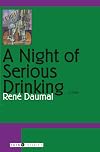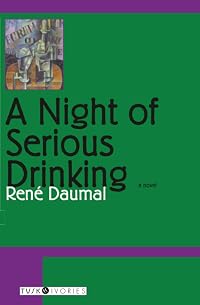
A Night of Serious Drinking
by René Daumal
On This Page
Description
A Night of Serious Drinking is among Rene Daumal's most important literary works. Like Daumal's Mount Analogue it is a classic work of symbolic fiction. An unnamed narrator spends an evening getting drunk with a group of friends; as the party becomes intoxicated and exuberant, the narrator embarks on a journey that ranges from seeming paradises to the depths of pure hell. The fantastic world depicted in A Night of Serious Drinking is actually the ordinary world turned upside down. The show more characters are called the Anthographers, Fabricators of useless objects, Scienters, Nibblists, Clarificators, and other absurd titles. Yet the inhabitants of these strange realms are only too familiar: scientists dissecting an animal in their laboratory, a wise man surrounded by his devotees, politicians, poets expounding their rhetoric. These characters perform hilarious antics and intellectual games, which they see as serious attempts to find meaning and freedom. show lessTags
Recommendations















Member Reviews
“Philosophy teaches how man thinks he thinks; but drinking shows how he really thinks.”
Most of the way through this I kept it in my mental bookcase alongside Flann O’Brien’s The Third Policeman and Karel Čapek’s War With the Newts, as another artful late-1930s satire of European modernism. In a tradition going back at least to Rabelais, A Night of Serious Drinking skewers religion and education, propaganda and science, mathematics and poetry, ideology, philosophy, and art—but with a nod to the early-20th c. Dada and Surrealist avant-gardes. (The book jacket on my copy calls Daumal an ex-Surrealist, which probably means that he pissed off André Breton somehow.) What made the 1930s such a rich context for satire was the show more realization that the European Era was over; for Daumal, the prevailing between-the-wars pessimism evaded nihilism only by embracing the absurd—which he transforms into a kind of optimism in the end. I didn’t see it coming.
Part One, entitled “A labored dialogue on the power of words and the frailty of thought," finds the narrator among a group of drinkers in the front salon of an unfamiliar residence. A voice from behind the mantle insists on pontificating on the uses of language (‘If only you knew how much I’d like to stop talking, you wouldn’t be so thirsty’) and the narrator relates his encounters with a number of eccentric characters.
On the last syllable, the guitar exploded in Gonzague’s hand. One of the strings caught him on the upper lip. He allowed a few drops of blood to fall onto the back of his hand. Then he drained his glass. Then he jotted down in his notebook the rudiments of an extraordinary poem which would be plagiarized the following day and betrayed in every language by two hundred and twelve minor poets; from it sprang the same number of avant-garde artistic movements, twenty-seven historic brawls, three political revolutions on a Mexican farm, seven bloody wars on the Paropamisus, a famine in Gibraltar, a volcano in Gabon, a dictator in Monaco, and not quite lasting glory for the half-baked.
In Part Two, having stumbled up a staircase, the narrator is startled to discover ‘the universe in a garret.’ He is given a guided tour, and we get Daumal’s dark-comic disquisition on all manner of human foibles. Up here, excellence in all endeavors aims at uselessness, whether of household objects, new colors, scientific theorems, 'numbers which cannot be expressed, spaces shaped like espaliers or corkscrews, stretches of nothing with holes and bumps in it.' Thanks to picture books, 'children take no time at all to learn everything about art without ever having to create anything, everything about science without having to think, everything about religion without having to live.' People may turn into thermometers, bookworms, or pianos. The narrator encounters a heretic writing a book called A Night of Serious Drinking, which depicts the nightmares of lost souls, drunken and stupefied, stuck in a delusion of paradises until the cold harsh light of day and its unexpected revelations. Some people speak a language designed so that fallacy and imprecision cannot be expressed.
Some of them live in houses made entirely of glass which they call ivory towers; some in concrete boxes which they call glass houses; large numbers in photographic dark rooms which they call Nature; and many more in dog-headed baboon cages, vampire caves, penguin parks, performing-flea circuses, and puppet theatres that they call the world or society: and they all dote on and pamper one of their internal bodily organs, usually one with something wrong with it, such as intestine, liver, lung, thyroid, or brain, stroking it fondly, embellishing it with flowers and jewels, stuffing it with the choicest morsels, calling it “my soul,” “my life,” “my truth,” and they are always ready to launder in blood the most trifling insult to the object of their inner devotions. They call this “living in the world of ideas.”
The narrator’s ascension culminates with a scrum of gods, hunched over a trapdoor, lustily inhaling vaporous fumes and gestures of adulation from below. It’s Dante inside out at the Cabaret Voltaire with absinthe and Alfred Jarry.
In the final section, the narrator queries the reader as to the best method of extricating himself from his baffled condition. What has happened? Should he awake, as from a dream? Daumal refuses the neat dénouement. Having described the seemingly familiar from a perspective impossible to occupy in what we think of as the ‘real world,’ Daumal turns the tables on us. Is the narrator to be trusted? By the end, the reader is just as likely to question her own interpretation of the narration as to doubt the reliability of the narrator. We arrive full circle at the question of language and intention. The last few pages change the way we understand what we have been reading. The sensation is of falling up, as from a drunken stupor, into a bemusement that is oddly reassuring. show less
Most of the way through this I kept it in my mental bookcase alongside Flann O’Brien’s The Third Policeman and Karel Čapek’s War With the Newts, as another artful late-1930s satire of European modernism. In a tradition going back at least to Rabelais, A Night of Serious Drinking skewers religion and education, propaganda and science, mathematics and poetry, ideology, philosophy, and art—but with a nod to the early-20th c. Dada and Surrealist avant-gardes. (The book jacket on my copy calls Daumal an ex-Surrealist, which probably means that he pissed off André Breton somehow.) What made the 1930s such a rich context for satire was the show more realization that the European Era was over; for Daumal, the prevailing between-the-wars pessimism evaded nihilism only by embracing the absurd—which he transforms into a kind of optimism in the end. I didn’t see it coming.
Part One, entitled “A labored dialogue on the power of words and the frailty of thought," finds the narrator among a group of drinkers in the front salon of an unfamiliar residence. A voice from behind the mantle insists on pontificating on the uses of language (‘If only you knew how much I’d like to stop talking, you wouldn’t be so thirsty’) and the narrator relates his encounters with a number of eccentric characters.
On the last syllable, the guitar exploded in Gonzague’s hand. One of the strings caught him on the upper lip. He allowed a few drops of blood to fall onto the back of his hand. Then he drained his glass. Then he jotted down in his notebook the rudiments of an extraordinary poem which would be plagiarized the following day and betrayed in every language by two hundred and twelve minor poets; from it sprang the same number of avant-garde artistic movements, twenty-seven historic brawls, three political revolutions on a Mexican farm, seven bloody wars on the Paropamisus, a famine in Gibraltar, a volcano in Gabon, a dictator in Monaco, and not quite lasting glory for the half-baked.
In Part Two, having stumbled up a staircase, the narrator is startled to discover ‘the universe in a garret.’ He is given a guided tour, and we get Daumal’s dark-comic disquisition on all manner of human foibles. Up here, excellence in all endeavors aims at uselessness, whether of household objects, new colors, scientific theorems, 'numbers which cannot be expressed, spaces shaped like espaliers or corkscrews, stretches of nothing with holes and bumps in it.' Thanks to picture books, 'children take no time at all to learn everything about art without ever having to create anything, everything about science without having to think, everything about religion without having to live.' People may turn into thermometers, bookworms, or pianos. The narrator encounters a heretic writing a book called A Night of Serious Drinking, which depicts the nightmares of lost souls, drunken and stupefied, stuck in a delusion of paradises until the cold harsh light of day and its unexpected revelations. Some people speak a language designed so that fallacy and imprecision cannot be expressed.
Some of them live in houses made entirely of glass which they call ivory towers; some in concrete boxes which they call glass houses; large numbers in photographic dark rooms which they call Nature; and many more in dog-headed baboon cages, vampire caves, penguin parks, performing-flea circuses, and puppet theatres that they call the world or society: and they all dote on and pamper one of their internal bodily organs, usually one with something wrong with it, such as intestine, liver, lung, thyroid, or brain, stroking it fondly, embellishing it with flowers and jewels, stuffing it with the choicest morsels, calling it “my soul,” “my life,” “my truth,” and they are always ready to launder in blood the most trifling insult to the object of their inner devotions. They call this “living in the world of ideas.”
The narrator’s ascension culminates with a scrum of gods, hunched over a trapdoor, lustily inhaling vaporous fumes and gestures of adulation from below. It’s Dante inside out at the Cabaret Voltaire with absinthe and Alfred Jarry.
In the final section, the narrator queries the reader as to the best method of extricating himself from his baffled condition. What has happened? Should he awake, as from a dream? Daumal refuses the neat dénouement. Having described the seemingly familiar from a perspective impossible to occupy in what we think of as the ‘real world,’ Daumal turns the tables on us. Is the narrator to be trusted? By the end, the reader is just as likely to question her own interpretation of the narration as to doubt the reliability of the narrator. We arrive full circle at the question of language and intention. The last few pages change the way we understand what we have been reading. The sensation is of falling up, as from a drunken stupor, into a bemusement that is oddly reassuring. show less
If this book were written by anybody else, it would probably be a two or three star book. It's a bit too plainly allegorical, its critiques of society were a bit too simplistic, and its concluding sentiment was a bit too tidy. But even with all these faults, it's the particularities of Daumal's humor, his fantastical inventions, his logical propositions that lead inevitably to a higher non-sense, his wordplay and wit, his sincere truth-seeking (always thirsting for transcendence), and his ultimate quirky vision that saves this book from its larger faults.
The parts are greater than the sum here. Perhaps Daumal knew this when he decided to include a 5 page index to this 113-page book (this is probably the shortest book I've ever read show more with a full index) with entries as varied as 'young people', 'timeless truths', 'axolotl', 'dietary systems', 'Jarry, Alfred', 'bicycle (made of gold)', 'Flatulencers', 'hashish', 'space (secretion of)', 'pre-actors', 'caterpillar', 'useless gestures (art of)', and 'ouroborism'. show less
The parts are greater than the sum here. Perhaps Daumal knew this when he decided to include a 5 page index to this 113-page book (this is probably the shortest book I've ever read show more with a full index) with entries as varied as 'young people', 'timeless truths', 'axolotl', 'dietary systems', 'Jarry, Alfred', 'bicycle (made of gold)', 'Flatulencers', 'hashish', 'space (secretion of)', 'pre-actors', 'caterpillar', 'useless gestures (art of)', and 'ouroborism'. show less
Reading this immediately following "Mount Analogue," it seems the perfect complement. As invective against the abuses of language common in Daumal's day (and in ours), it leaves little to be desired. As an invitation to seek meaning, and as a guide to that endeavor, it is a great work.
Very weird and interesting...
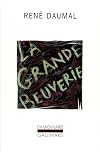
> LA GRANDE BEUVERIE, de René Daumal (Gallimard, L'imaginaire n° 165,1986)
Se reporter à la critique de Denys LELIÈVRE
In: (1986).). Compte rendu de [Commentaires]. Nuit blanche, (25), p. 21. … ; (en ligne),
URL : https://id.erudit.org/iderudit/20580ac
Se reporter à la critique de Denys LELIÈVRE
In: (1986).). Compte rendu de [Commentaires]. Nuit blanche, (25), p. 21. … ; (en ligne),
URL : https://id.erudit.org/iderudit/20580ac
Aug 21, 2020 (Edited)French
Ratings
Members
- Recently Added By
Author Information

73+ Works 1,534 Members
Awards and Honors
Notable Lists
Series
Belongs to Publisher Series
Common Knowledge
- Canonical title
- A Night of Serious Drinking
- Original title
- La Grande Beuverie; Grande Beuverie
- Original publication date
- 1938
- First words*
- Io nego che un pensiero chiaro possa essere indicibile. Tuttavia l'apparenza mi contraddice: perché, come vi è una certa intensità di dolore in cui il corpo non è più interessato perché, se ne fosse partecipe sia pure c... (show all)on un singhiozzo, sarebbe, sembra, subito ridotto in cenere, come vi è un culmine in cui il dolore vola con le sue proprie ali, così vi è una certa intensità del pensiero in cui le parole non hanno più parte. Le parole convengono a una certa precisione del pensiero, come le lacrime a un certo grado del dolore. Il più vago è innominabile, il più preciso è indicibile. Ma, davvero, non è che un'apparenza. Se il linguaggio non esprime con precisione che un'intensità media del pensiero, è perché la media dell'umanità pensa con quel grado di intensità; è a quell'intensità che acconsente, è a quel grado di precisione che aderisce. Se non riusciamo a farci capire chiaramente, non è lo strumento che dobbiamo accusare.
PREMESSA
CHE PUÒ SERVIRE DA ISTRUZIONI PER L'USO
Era tardi, quando ci mettemmo a bere. Pensavamo tutti che era ormai tempo di cominciare. Quel che c'era stato prima, non lo si ricordava più. Solo ci dicevamo che era già tardi. Sapere da dove ciascuno veniva, in qual punto... (show all) del globo si era, o se era veramente un globo ( in ogni caso non era un punto), e i giorno del mese di quale anno, tutto ciò era troppo per noi. Non si sollevano questioni simili quando si ha sete. - Quotations*
- Un linguaggio chiaro presuppone tre condizioni: un parlatore che sappia quello che vuol dire, un ascoltatore allo stato di veglia, e una lingua che sia loro comune. Ma non basta che il linguaggio sia chiaro, come lo è una pr... (show all)oposizione algebrica. Bisogna inoltre che abbia un contenuto reale, e non soltanto possibile. Per questo occorre tra gli interlocutori, come quarto elemento, un'esperienza comune della cosa di cui si parla. Tale esperienza comune è la riserva aurea che conferisce un valore di scambio a quella moneta che sono le parole; senza questa riserva di esperienze comuni, tutte le nostre parole sono degli assegni scoperti; l'algebra, appunto, non è che una vasta operazione di credito intellettuale, una moneta falsa legittima perché confessata: tutti sanno che essa ha il suo fine e il suo senso in altro che in se stessa, cioè nell'aritmetica. Ma non basta ancora che il linguaggio abbia un contenuto, come quando dico "quel giorno pioveva" oppure "tre e due fanno cinque"; bisogna inoltre che abbia uno scopo e una necessità.
Altrimenti, da linguaggio si cade in conversazione, dalla conversazione in chiacchiere, dalle chiacchiere in confusione.
Quando si ha sete, si spiano le occasioni per bere e, quanto al resto, si fa solo finta di stare attenti. Per questo è così difficile, dopo, raccontare esattamente quello che si è vissuto. È una gran tentazione, quando si... (show all) riferiscono avvenimenti passati, mettere chiarezza e orine là dove non c'e né l'una né l'altro. È una gran tentazione ed è molto pericoloso. È così che si diventa prematuramente filosofi.
"Quando è solo, il microbo (stavo per dire: l'uomo) reclama, così come piagnucola, un'anima gemella perché gli tenga compagnia. Se l'anima gemella arriva, non possono sopportare di essere due, e ognuno comincia a farnetica... (show all)re per diventare uno con l'oggetto dei suoi contorcimenti viscerali. Non c'è senso comune: uno, vuole essere due; due, vuol essere uno. Se l'anima gemella non arriva, egli si scinde in due, e si dice: buon giorno, vecchio mio, si getta tra le proprie braccia, si riappiccica di traverso e si prende per qualcosa, o persino per qualcuno. E tuttavia non avete che una cosa in comune, ed è la solitudine; come dire tutto o niente, dipende da voi."
[...] sappiamo molto bene che sotto l'aspetto sensibile del suono si nasconde un'essenza silenziosa. È da lei, da questo punto critico dove il germe del sensibile non ha ancora scelto di essere suono o luce o altro, da quest... (show all)o retro-pianodella natura dove chi vede vede il suono, dove chi ode ode i soli, è da questa medesima essenza che il suono trae la sua potenza e la sua virtù ordinatrice.
Ero furibondo, di dentro, senza sapere bene perché. Sentivo che "non era quello il problema", che "c'era qualcosa di ben piu urgente da fare", che "il vecchio ci frastornava", ma era come quando si sogna e tutt'a un tratto s... (show all)i pensa "non è questa la realtà", ma non si trova subito il gesto da fare, che è di aprire gli occhi. Dopo, tutto è chiaro e semplice.
C'e dei momenti che non sai piu,
Non sai piu niente, niente del tutto.
L'indomani ti accorgi
Che in quel momento sapevi tutto.
Ma non sai piu,
Più niente del tutto,
Tutto è distrutto! - Last words*
- (Click to show. Warning: May contain spoilers.)In questa confusione delle lingue gli uomini, anche se hanno esperienze comuni, non hanno una lingua per scambiarne i frutti. Poi, quando la confusione diventa intollerabile, si inventano lingue universali, chiare e vuote, in cui le parole non sono più che moneta falsa che non garantisce più l'oro di un'esperienza reale; lingue grazie alle quali, fin dall'infanzia, noi ci gonfiamo di falsi saperi. Tra la confusione di Babele e questi sterili esperanto, non c'è scelta. Sono queste le due forme di incomprensione che cercherò di descrivere, ma soprattutto la seconda.
PREMESSA
CHE PUÒ SERVIRE DA ISTRUZIONI PER L'USO
(Click to show. Warning: May contain spoilers.)Ci alzammo tutti, perché c'erano, per ognuno di noi, molte cose urgenti da fare. C'erano molte cose da fare, per vivere.
*Some information comes from Common Knowledge in other languages. Click "Edit" for more information.
Classifications
Statistics
- Members
- 306
- Popularity
- 105,105
- Reviews
- 5
- Rating
- (4.02)
- Languages
- 6 — English, French, German, Italian, Japanese, Spanish
- Media
- Paper, Ebook
- ISBNs
- 17
- ASINs
- 6