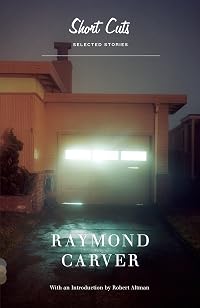
Short Cuts: Selected Stories
by Raymond Carver
On This Page
Description
Gathers the nine stories that were the basis for the Robert Altman motion picture.Tags
Recommendations





Member Recommendations

Member Reviews
I had never read a Raymond Carver (1938-1988) before, so I don't know if these short stories are really a representative choice. What struck me most was the very slow rhythm, very un-American, I think. And then the sadness that hangs over all these stories. Carver really puts the emptiness of existence and the inability of people to deal with it in the spotlight. I suspect that I am not at all original, but he seems to be the Edward Hopper of literature. Of course, Carver adds his own touch to that: his characters are not just static, they go through a crisis, and derail, very briefly, and then the screen goes dark. "Yes, there was a great evil pushing at the world, he thought, and it only needed a little slipway, a little opening", it show more is a short quote, somewhere in the middle of this book, but it says a lot. I don't know if I'll ever try another Carver, because his approach is a bit too nihilistic for me, but it's clear to me that he was a remarkable writer show less
This has been sitting on my DVD shelf for a few years now as the Criterion companion to the movie. While I really enjoy the movie, I think I ended up buying it just because there was a book included in the packaging. And thank goodness...Carver might have continued to go undetected by me as--for the most part--all I've ever heard him discussed is a one sentence nod of approval in passing. Not that I could have predicted it, but I'm glad I've waited to read his work because I might not have appreciated it as much had I read it before this particular moment of my life...whatever that is.
So this is a collection of his stories (plus one poem) that Robert Altman used in his film, which added a whole other level to my reading that I enjoyed. show more I usually like to read the book before I see the movie, but in this case I'm glad it went the other way around. It was fascinating to find what elements Altman used and their point of departure, and really I can't say that I enjoyed one more than the other in its own right. However, Carver's style really shines through...I love the open ends he leaves in his stories. In other authors' writing, this technique often seems to me like a cop out, a lazy solution for a plot they never quite thought out, but with Carver I feel a sense of certainty planted within what might seem ambiguous. Like this is where we close our eyes to go to sleep for the day, and even though the future likely will sling us every which way, at least we know tomorrow will come, even if maybe not for us...that much we may rely on.
I give this four stars because this is Altman's selection of Carver. Now I want to read Carver's selection of Carver, the way he intended. I am enamored. I have been wooed. I am prepared to blissfully writhe in his stories like a pup when he finds that funky patch of grass in the park. Yeah. show less
So this is a collection of his stories (plus one poem) that Robert Altman used in his film, which added a whole other level to my reading that I enjoyed. show more I usually like to read the book before I see the movie, but in this case I'm glad it went the other way around. It was fascinating to find what elements Altman used and their point of departure, and really I can't say that I enjoyed one more than the other in its own right. However, Carver's style really shines through...I love the open ends he leaves in his stories. In other authors' writing, this technique often seems to me like a cop out, a lazy solution for a plot they never quite thought out, but with Carver I feel a sense of certainty planted within what might seem ambiguous. Like this is where we close our eyes to go to sleep for the day, and even though the future likely will sling us every which way, at least we know tomorrow will come, even if maybe not for us...that much we may rely on.
I give this four stars because this is Altman's selection of Carver. Now I want to read Carver's selection of Carver, the way he intended. I am enamored. I have been wooed. I am prepared to blissfully writhe in his stories like a pup when he finds that funky patch of grass in the park. Yeah. show less
It was really interesting to go back to the volume of short stories to look again at the (post-Hemmingway) father of the contemporary short story. He really was a masterful writer, and I don't know too many authors who can capture the unease, trouble or human question behind a set of circumstances, or a relationship, with saying so little. All of these stories are uneasy in some way or another, mostly marriages in trouble, and Carver's characters tend to be alcohol-sodden and hard to like. But that said, such is humanity. I don't think all of these stories work, and some push the boundaries of weird for the sake of being weird (and not in a good way). But overall, a strong collection and well worth re-visiting considering the resurgence show more of the short story form. It's also really refreshing to read some "real" short stories amidst the surge of "magic realism" currently glutting the market. show less
Esse é o primeiro livro que leio de Raymond Carver, e fiquei fascinada pela sua habilidade de contista. O primeiro conto, "Neighbors", sobre um casal que lentamente assume as vidas de um casal vizinho, que está viajando e cujo estilo de vida eles admiravam, é uma abertura fantástica.
"Will You Please Be Quiet, Please?" é sobre um homem que se torna obcecado com a idéia de que a mulher, com quem é casado desde a faculdade, o traiu.
"So Much Water So Close to Home" é sobre uma mulher que fica horrorizada ao descobrir que o marido e os amigos encontraram o corpo de uma jovem durante uma pescaria, e só chamaram a polícia no dia seguinte para continuar com a pescaria.
"A Small, Good Thing" é sobre um casal cujo filho é atropelado, e show more que passa a sofrer com o confeiteiro que liga constantemente para pedir que eles busquem o bolo encomendado para o aniversário do menino.
Esses quatro contos, que estão entre os mais famosos de Carver, impressionaram-me tão fortemente que me deram vontade de ler todos os contos do autor, além de Catedral, livro considerado por muitos como sua obra-prima.
Os outros contos também são muito interessantes. show less
"Will You Please Be Quiet, Please?" é sobre um homem que se torna obcecado com a idéia de que a mulher, com quem é casado desde a faculdade, o traiu.
"So Much Water So Close to Home" é sobre uma mulher que fica horrorizada ao descobrir que o marido e os amigos encontraram o corpo de uma jovem durante uma pescaria, e só chamaram a polícia no dia seguinte para continuar com a pescaria.
"A Small, Good Thing" é sobre um casal cujo filho é atropelado, e show more que passa a sofrer com o confeiteiro que liga constantemente para pedir que eles busquem o bolo encomendado para o aniversário do menino.
Esses quatro contos, que estão entre os mais famosos de Carver, impressionaram-me tão fortemente que me deram vontade de ler todos os contos do autor, além de Catedral, livro considerado por muitos como sua obra-prima.
Os outros contos também são muito interessantes. show less
This book probably represents the best half-dollar I ever spent at a yard sale. Raymond Carver wrote mostly short stories, and he is among the best short stories writers of the latter part of the 20th century. I had never heard of this book, although I have read several of the stories.
Raymond Carver died at the young age of 50. He wrote five collections of stories, and five collections of poetry. His first published story appeared in a college literary journal, and his first book of poetry was published by a college press. His career was plagued with bankruptcies and alcoholism. The American Academy and Institute of Arts and Letters awarded him a fellowship, which allowed him to write full time. At age 49, he was diagnosed with lung show more cancer, and despite radiation, chemo, and surgery, he died in August of 1988
Robert Altman wrote the Introduction to Short Cuts, because he assembled a selection of nine Carver stories and a poem and made a film with the same title. Amazon should shortly process my order for the film.
Each of these nine stories tells a tale of families and relationships. Individuals, who through fate, carelessness, accidents, and plain old stupidity, find themselves in a corner of dark shadows, fears, and stressful situations. Raymond Carver short stories often probe the psyche of men and women caught in uncomfortable positions. Most of these slice of life stories end up without resolution, as the character founders and struggles with the consequences of his or her own deeds.
I do not have a single favorite. Unlike most collections of stories, Carver’s Short Cuts, has no lumps of coal. They are all gems. However, one story intrigued me slightly more than the others – “So Much Water So Close to Home.” In this intense story, four friends, bowl, play cards, drink, and a couple of times year, travel over 100 miles for a long weekend of fishing. One trip, however, will alter Stuart Kane’s life forever.
Carver wrote, “On Friday afternoon these four men left for a three-day fishing trip to the Naches River. They parked the car in the mountains and hiked several miles to where they wanted to fish. They carried their bedrolls, food and cooking utensils, their playing cards, their whiskey. The first evening at the river, even before they could set up camp, Mel Dorn found the girl floating face down in the river, nude, lodged near the shore in some branches” (71).
Imagine what happens next! All of these stories revolve around a crisis of some sort, and they all shatter lives and relationships. A nifty collection and a first-rate introduction to a master of the short story. 5 stars.
--Jim, 12/31/12 show less
Raymond Carver died at the young age of 50. He wrote five collections of stories, and five collections of poetry. His first published story appeared in a college literary journal, and his first book of poetry was published by a college press. His career was plagued with bankruptcies and alcoholism. The American Academy and Institute of Arts and Letters awarded him a fellowship, which allowed him to write full time. At age 49, he was diagnosed with lung show more cancer, and despite radiation, chemo, and surgery, he died in August of 1988
Robert Altman wrote the Introduction to Short Cuts, because he assembled a selection of nine Carver stories and a poem and made a film with the same title. Amazon should shortly process my order for the film.
Each of these nine stories tells a tale of families and relationships. Individuals, who through fate, carelessness, accidents, and plain old stupidity, find themselves in a corner of dark shadows, fears, and stressful situations. Raymond Carver short stories often probe the psyche of men and women caught in uncomfortable positions. Most of these slice of life stories end up without resolution, as the character founders and struggles with the consequences of his or her own deeds.
I do not have a single favorite. Unlike most collections of stories, Carver’s Short Cuts, has no lumps of coal. They are all gems. However, one story intrigued me slightly more than the others – “So Much Water So Close to Home.” In this intense story, four friends, bowl, play cards, drink, and a couple of times year, travel over 100 miles for a long weekend of fishing. One trip, however, will alter Stuart Kane’s life forever.
Carver wrote, “On Friday afternoon these four men left for a three-day fishing trip to the Naches River. They parked the car in the mountains and hiked several miles to where they wanted to fish. They carried their bedrolls, food and cooking utensils, their playing cards, their whiskey. The first evening at the river, even before they could set up camp, Mel Dorn found the girl floating face down in the river, nude, lodged near the shore in some branches” (71).
Imagine what happens next! All of these stories revolve around a crisis of some sort, and they all shatter lives and relationships. A nifty collection and a first-rate introduction to a master of the short story. 5 stars.
--Jim, 12/31/12 show less
Very effective realism, but these people are so forlorn, so lost. Sometimes it is hard to read on that account.
We studied these stories in high school literature. I really enjoyed them at the time, though I'd love to re-read them again.
Members
- Recently Added By
Lists

Books Read in 2016
4,666 works; 199 members
Author Information

209+ Works 20,786 Members
Born in 1938 in an Oregon logging town, Raymond Carver grew up in Yakima, From California he went to Iowa to attend the Iowa Writers Workshop. Soon, however, he returned to California, where he worked at a number of unskilled jobs before obtaining a teaching position. Widely acclaimed as the most important short story writer of his generation, show more Carver writes about the kind of lower-middle-class people whom he knew growing up. His characters are waitresses, mechanics, postmen, high school teachers, factory workers, door-to-door salesmen who lead drab lives because of limited funds. Critics have said that may have the most distinctive vision of the working class. Nominated posthumously for both a National Book Critics Circle Award (1988) and a Pulitzer Prize (1989) for Where I'm Calling From: New and Selected Stories (1988), Carver is one of a handful of writers credited with reviving the short story form. Some have put Carver in the tradition of Ernest Hemingway and Stephen Crane. Carver's stories tend to be brief, with enigmatic endings, although never erupting. Violence is often just below the surface. An air of quiet desperation pervades his stories, as Carver explores the collapse of human relationships in bleak circumstances. In later works, Carver strikes a note of redemption, unheard at the beginning of his career. But for readers who are not attuned to Carver's voice of resignation, these moments may sound sentimental and unconvincing. Carver died of lung cancer in 1988. (Bowker Author Biography) show less
Some Editions
Series
Belongs to Publisher Series
Common Knowledge
- Original title
- Short Cuts
- Original publication date
- 1993
- Related movies
- Short Cuts (1993 | IMDb)
- Dedication
- To Royal Nemiah
Classifications
Statistics
- Members
- 1,186
- Popularity
- 21,196
- Reviews
- 11
- Rating
- (3.91)
- Languages
- 10 — Dutch, English, Finnish, French, German, Italian, Norwegian (Bokmål), Portuguese, Spanish, Swedish
- Media
- Paper, Audiobook, Ebook
- ISBNs
- 29
- ASINs
- 9