On This Page
Description
The fourth installment of Bernard Cornwell's New York Times bestselling series chronicling the epic saga of the making of England, "like Game of Thrones, but real" (The Observer, London)—the basis for The Last Kingdom, the hit television series.The year is 885, and England is at peace, divided between the Danish kingdom to the north and the Saxon kingdom of Wessex in the south. Warrior by instinct and Viking by nature, Uhtred, the dispossessed son of a Northumbrian lord, has land, a wife show more and children—and a duty to King Alfred to hold the frontier on the Thames. But a dead man has risen, and new Vikings have invaded the decayed Roman city of London with dreams of conquering Wessex... with Uhtred's help. Suddenly forced to weigh his oath to the king against the dangerous turning tide of shifting allegiances and deadly power struggles, Uhtred—Alfred's sharpest sword—must now make the choice that will determine England's future.
. show less
Tags
Recommendations









Member Reviews
Wow! Just wow! Uthred is himself again, with the killing and all. He's lured by the Danes that he will become king of Mercia, to then overthrow Alfred with the help of Haesten and co. Two Northmen, brothers, enter the scene as well. Uthred negotiates with them, is able to rescue father Pyrlig. They return to Alfred to witness the marriage between Aethelflaed and Aethelred (Ealdorman of Mercia, Uthred's cousin). And Uthred swore to keep his oath to Alfred. Afterwards Uthred battles the the Norse brothers Thurgilson at Luddgate, where Osferth heavily injures Sigefrid. So much happens in this book, it's hard to not reveal it all. Anyway, Aethelred and Uthred will never be friends, Aethelflaed plays a more important role here (in the show more context of the Church, later as a captive). Ransom is demanded, Alfred will pay whatever is needed. Secretly Uthred goes then out to rescue Aethelflaed, but not without the obligatory fight, which he hadn't foreseen. And like before, another warlord (so to speak) gets killed. Well, two. Since England is still not formed, the story continues in The Burning Land. Sword Song is very well written story with the usual elements like friendship, love, trust, betrayal... and of course bloody battles, of which the description can make your stomach turn a few times. show less
This series just keeps getting better and better. In this installment our hero has a few moral dilemmas and he "passes" the text in all cases (from the Anglo-Saxon viewpoint). Not sure if all the conniving of Alfred the Great or his uber (and sometimes unjust, IMHO) piousness was true; so hard to tell if he's a "good" guy or just a controlling, manipulative man. I have this entire series on Kindle--so glad, because at sometime I will want to re-read them, as I will Gabaldon. When exposed to so much new history and culture, it's hard to absorb it all and I'm sure I've missed many nuances. 338 pages
Note: This is a review of an ARE I received from Harper Collins. Given that the book has been published in the UK, I assume it is essentially a finished product and it read that way.
“Doom [Judge] very evenly! Do not doom one doom to the rich; another to the poor! Nor doom one doom to your friend; another to your foe!” King Alfred in the Doom Book or Code of Alfred.
Bernard Cornwell has given us another smashing tale of war and love from 9th century “England”. The year is 885 CE and King Alfred of Wessex struggles to consolidate his control of the Saxon lands as defined in the treaty with Guthrum that divided the island between Saxon and the Danelaw.
Cornwell’s once again uses the narrative voice of Lord Uhtred of Bebbanburg as show more he reflects on his life in extreme old age (probably around 940 CE). Uhtred, now 25, is a Saxon raised as a Dane, pagan serving a most Christian king. Uhtred worships the old Norse gods and looks forward to long days of battle and nights of song, drink, and women at Odin’s Death Hall (Valhalla). In Uhtred’s eyes, Alfred worships the ‘Christian nailed god’, a god who fences men in with laws and rules so limiting that a man is not allowed to lust after his neighbor’s wife!
Alfred needs Uhtred because as Lincoln said of Grant, ‘he fights’ and exceedingly well. Alfred seeks to reclaim Mercian Lundene (London) and that battle forms the centerpiece of the first half of the book. The latter half centers on battles on the lower Temes (Thames) at Beamfleot (Benfleet), including some crashing marine assaults. Sword Song does not lack for ringing swords, shield walls, smashed skulls, splintered oars, battle fear and death – and also broken hearts.
Uhtred requires assistance and Cornwell supplies with him familiar friends from earlier volumes: Steapa, the warrior priest Pyrlig, and most necessary of all, Uhtred’s wife Gisela.
Uhtred is a simple man, violent in battle, bound by his sense of honor, an esteemed and rightly feared warrior, and a loving and loved husband. Gisela and Uhtred have a relationship that struck this reader as perhaps a bit too modern in its mutual respect.
Uhtred never seems to be fighting for his own interests. He longs to return and take Bebbanburg in Northumbria, but cannot or will not break his oath to Alfred. (One hopes that Cornwell will keep the Saxon stories going until Uhtred fights that battle.) The heroic Uhtred is offset by Alfred’s son-in-law Aethelred, a cowering and grasping little weasel who Alfred elevates to Earl of Mercia precisely because he wants a weak ruler there – Alfred’s aim is to be King of the Anglo-Saxons, King of ‘England’, a place that doesn’t even exist yet. Aethelred also turns out to be a vicious husband. (By the way, Cornwell’s Aethlered is based on an historical figure, but is not to be confused with the later Aethelred unfairly tagged the Unready.)
Uhthred’s worthy battle opponents are Danes with their pagan amulets (like his own), their shields and battle axes. He understands these Danes, respects them, is comfortable with them. Some of the Danes do prove to be a bit treacherous, but what do you expect from a bunch of 9th century pagan warriors?!
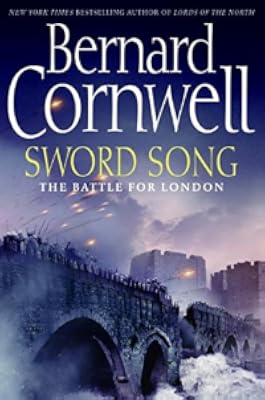
Cornwell’s historical note admits that he has probably been very unfair to Aethelred. The fact is the historical record for this era is thin indeed. Cornwell’s telling captures a plausible feel for the era, mostly limited to the perspective of a warrior lord. A small quibble: The image on the book cover shows warriors heaving lighted spears from a broken stone bridge over the Temes, an image unsupported by the historical record in at least one detail. The first stone bridge over the Thames at London was not completed until the early 14th century.
Cornwell might have explored why the Christian god with all his rules and restrictions had broader appeal than the free-spirited Norse gods. Indeed, Alfred’s Christian religion eventually prevailed more effectively than warfare in uniting England. Why? Was this because the nailed god’s church offered some salvation to every man whereas the Norse gods really only appealed to the warrior class? Or that the Christian church had organized proselytizers? The nailed god seems to have not only demanded more, but also offered more and to more people than Odin.
Sword Song is a compact, exhilarating tale of historical adventure that entertains a lot, informs a little, and won’t overtax your noggin. Stoke the fire in your hearth and settle in for a good story. A fine addition to the Saxon Stories and Cornwell promises that “Uhtred and his story will continue.” show less
“Doom [Judge] very evenly! Do not doom one doom to the rich; another to the poor! Nor doom one doom to your friend; another to your foe!” King Alfred in the Doom Book or Code of Alfred.
Bernard Cornwell has given us another smashing tale of war and love from 9th century “England”. The year is 885 CE and King Alfred of Wessex struggles to consolidate his control of the Saxon lands as defined in the treaty with Guthrum that divided the island between Saxon and the Danelaw.
Cornwell’s once again uses the narrative voice of Lord Uhtred of Bebbanburg as show more he reflects on his life in extreme old age (probably around 940 CE). Uhtred, now 25, is a Saxon raised as a Dane, pagan serving a most Christian king. Uhtred worships the old Norse gods and looks forward to long days of battle and nights of song, drink, and women at Odin’s Death Hall (Valhalla). In Uhtred’s eyes, Alfred worships the ‘Christian nailed god’, a god who fences men in with laws and rules so limiting that a man is not allowed to lust after his neighbor’s wife!
Alfred needs Uhtred because as Lincoln said of Grant, ‘he fights’ and exceedingly well. Alfred seeks to reclaim Mercian Lundene (London) and that battle forms the centerpiece of the first half of the book. The latter half centers on battles on the lower Temes (Thames) at Beamfleot (Benfleet), including some crashing marine assaults. Sword Song does not lack for ringing swords, shield walls, smashed skulls, splintered oars, battle fear and death – and also broken hearts.
Uhtred requires assistance and Cornwell supplies with him familiar friends from earlier volumes: Steapa, the warrior priest Pyrlig, and most necessary of all, Uhtred’s wife Gisela.
Uhtred is a simple man, violent in battle, bound by his sense of honor, an esteemed and rightly feared warrior, and a loving and loved husband. Gisela and Uhtred have a relationship that struck this reader as perhaps a bit too modern in its mutual respect.
Uhtred never seems to be fighting for his own interests. He longs to return and take Bebbanburg in Northumbria, but cannot or will not break his oath to Alfred. (One hopes that Cornwell will keep the Saxon stories going until Uhtred fights that battle.) The heroic Uhtred is offset by Alfred’s son-in-law Aethelred, a cowering and grasping little weasel who Alfred elevates to Earl of Mercia precisely because he wants a weak ruler there – Alfred’s aim is to be King of the Anglo-Saxons, King of ‘England’, a place that doesn’t even exist yet. Aethelred also turns out to be a vicious husband. (By the way, Cornwell’s Aethlered is based on an historical figure, but is not to be confused with the later Aethelred unfairly tagged the Unready.)
Uhthred’s worthy battle opponents are Danes with their pagan amulets (like his own), their shields and battle axes. He understands these Danes, respects them, is comfortable with them. Some of the Danes do prove to be a bit treacherous, but what do you expect from a bunch of 9th century pagan warriors?!
Cornwell’s historical note admits that he has probably been very unfair to Aethelred. The fact is the historical record for this era is thin indeed. Cornwell’s telling captures a plausible feel for the era, mostly limited to the perspective of a warrior lord. A small quibble: The image on the book cover shows warriors heaving lighted spears from a broken stone bridge over the Temes, an image unsupported by the historical record in at least one detail. The first stone bridge over the Thames at London was not completed until the early 14th century.
Cornwell might have explored why the Christian god with all his rules and restrictions had broader appeal than the free-spirited Norse gods. Indeed, Alfred’s Christian religion eventually prevailed more effectively than warfare in uniting England. Why? Was this because the nailed god’s church offered some salvation to every man whereas the Norse gods really only appealed to the warrior class? Or that the Christian church had organized proselytizers? The nailed god seems to have not only demanded more, but also offered more and to more people than Odin.
Sword Song is a compact, exhilarating tale of historical adventure that entertains a lot, informs a little, and won’t overtax your noggin. Stoke the fire in your hearth and settle in for a good story. A fine addition to the Saxon Stories and Cornwell promises that “Uhtred and his story will continue.” show less
I wasn't sure about this to begin with, the genre is not my usual. It was a library book, so not a great risk other than my time. Something about it beckoned - I enjoy the historical novels of other writers (Philippa Gregory comes to mind) and Anglo history specifically. Sword Song is told from a grizzled old warrior's point of view and the battle depictions are visceral. But there is a story to it. And Cornwell does a beautiful job of depicting characters with tremendous depth and dimension. And the story... There is a story winding its way through this -- a love story, at that -- which is beautiful and heartwrenching too. I realized after reading this that there are other books in this series and I'll do what I can to get my hands on show more them post-haste! show less
Bernard Cornwell does an amazing job of weaving great historical detail into a captivating story of a warrior torn between loyalties. There is plenty of action, but battle scenes are never drawn out, and there is human drama throughout: love, jealousy, cunning, and striving to do the right thing in the face of a difficult situation. Even minor characters have fully realized personalities and the narrator is just the man you would want on your side. The prose is never dry though the book is full of interesting information, and fortunately the characters never seem to do anything anachronistic. The antagonism between the pagans and the Christians was especially believable and fascinating.
Much as Uhtred hates Alfred and wishes to fully identify with the Danes who raised him, he finds himself once again drawn into the conflicts on the Saxon side instead of taking his hereditary castle, Bebbanburg, from his scheming uncle. This time, Uhtred must capture London for his cousin, Aethelred, who is marrying Aethelflaed, Alfred’s daughter and Uhtred’s friend. This book is the fourth in the Saxon Tales series, which is ongoing.
As usual, Cornwell delivers on many fronts. His books always provide exciting battle scenes, arrogant and capable main characters, and satisfying friendships and rivalries. Usually, however, Cornwell doesn’t do so well with women. They tend to be on the edges of the story, flat characters who serve as show more love interests and nothing else, and I’ve heard that this is the worst in the Sharpe series. I was a little worried about this here. Aethelflaed is one of my absolute favorite historical characters. We know very little about her, but we do know that she led men to battle and that she was known as “Lady of the Mercians”, effectively ruling Mercia when her husband Aethelred died. This, to our knowledge, is extremely rare in Anglo-Saxon England, so I was hoping for Cornwell to more fully portray Aethelflaed, perhaps on par with the men Uhtred fights with. She’s not there yet, but she does have a small, defiant, royal place in this series. She is still young in the series timeline, but I am hoping that Cornwell will continue to flesh her out as he writes more books.
This book also strays a bit more from the historical record, as the author’s note tells us, but Cornwell pulls it off and his fictional events seem plausible next to the real battles. He knows what he’s talking about and it’s obvious. His battle scenes are some of the best I’ve ever come across, and he just seems to be getting better; they’re not glorious heroes of war, they are flesh and blood men trying to kill each other just to stay alive. I like this perspective; I think if we thought about wars that way, we might fight less of them. (Wishful thinking?)
I’ll continue to recommend this series and I’ll look forward to the next, although I’ve no idea when it’s coming out.
http://chikune.com/blog/?p=232 show less
As usual, Cornwell delivers on many fronts. His books always provide exciting battle scenes, arrogant and capable main characters, and satisfying friendships and rivalries. Usually, however, Cornwell doesn’t do so well with women. They tend to be on the edges of the story, flat characters who serve as show more love interests and nothing else, and I’ve heard that this is the worst in the Sharpe series. I was a little worried about this here. Aethelflaed is one of my absolute favorite historical characters. We know very little about her, but we do know that she led men to battle and that she was known as “Lady of the Mercians”, effectively ruling Mercia when her husband Aethelred died. This, to our knowledge, is extremely rare in Anglo-Saxon England, so I was hoping for Cornwell to more fully portray Aethelflaed, perhaps on par with the men Uhtred fights with. She’s not there yet, but she does have a small, defiant, royal place in this series. She is still young in the series timeline, but I am hoping that Cornwell will continue to flesh her out as he writes more books.
This book also strays a bit more from the historical record, as the author’s note tells us, but Cornwell pulls it off and his fictional events seem plausible next to the real battles. He knows what he’s talking about and it’s obvious. His battle scenes are some of the best I’ve ever come across, and he just seems to be getting better; they’re not glorious heroes of war, they are flesh and blood men trying to kill each other just to stay alive. I like this perspective; I think if we thought about wars that way, we might fight less of them. (Wishful thinking?)
I’ll continue to recommend this series and I’ll look forward to the next, although I’ve no idea when it’s coming out.
http://chikune.com/blog/?p=232 show less
I’ve been reading Bernard Cornwell’s historical novels for approximately two years now and it never ceases to amaze me on how well written, profound, robust and deadly his stories can be and his latest is no exception. “Sword Song” his fourth book in Mr. Cornwell’s Saxon chronicles featuring Uhtred on Bebbanburg, Alfred the Great and the origins of England were an incredible read. I took my time reading this book savoring it like a fine wine during a scrumptious repast. As an aperitif Mr. Cornwell begins the novel with our hero Uhtred recounting one of the most brutal battles I’ve read. For the main course he gives us the sack of London. And as a final dessert a love story –akin to Tristan and Isolde- coupled with a show more mêlée to end all mêlées. Needless to say I will definitely be picking up Mr. Cornwell’s next Saxon novel, fate is inexorable. show less
Members
- Recently Added By
Lists

Historical Fiction
889 works; 91 members

Books Read in 2020
4,379 works; 124 members
Author Information

186+ Works 94,146 Members
Bernard Cornwell was born in London, England, on February 23, 1944, and came to the United States in 1980. He received a B.A. from the University of London in 1967. Cornwell served as producer of the British Broadcasting Corporation from 1969-1976. After this he was head of current affairs for BBC-TV in Belfast, Northern Ireland. In 1979 he became show more editor of television news for Thames Television of London. Since 1980 he has been a freelance writer. he lives with his wife on Cape Cod. Cornwell's Sharpe series, adventure stories about a British soldier set in the Peninsula War of 1808-1814, are built on the author's interest in the Duke of Wellington's army. Titles include Sharpe's Rifles, Sharpe's Revenge, Sharpe's Siege, Sharpe's Regiment, and Sharpe's Waterloo. The Last Kingdom series has ten books. Book ten, The Flame Bearer is on the bestsellers list. He has also written other works including Wildtrack, Killer's Wake, Sea Lord, Stormchild, Rebel, Copperhead, and Battle Flag. His title Death of Kings made The New York Times Best Seller List in 2012 and In 2014 his title The Pagan Lord made the list again. (Bowker Author Biography) show less
Series

Belongs to Publisher Series
Work Relationships
Is contained in
Has the adaptation
Is abridged in
Common Knowledge
- Canonical title
- Sword Song
- Original title
- Sword Song
- Original publication date
- 2007-09-01
- People/Characters
- Uhtred of Bebbanburg; Gisela (wife of Uhtred); Alfred the Great (king of Wessex); Æthelred (Lord of the Mercians, cousin of Uhtred); Æthelflæd (daughter of Alfred); Sigefrid Thurgilson (Danish warlord in Lundene) (show all 20); Erik Thurgilson (brother of Sigefrid); Haesten Storrison; Bjorn (dead man talking); Finan the Agile (warrior for Uhtred); Father Pyrlig; Father Willibald; Asser (Welsh monk, servant of Alfred); Clapa (warrior for Uhtred); Steapa Snotor (warrior for Alfred); Osferth (bastard son of Alfred, nephew of Leofric); Sihtric Kjartanson (servant of Uhtred); Erkenwald (Saint, Bishop of Lundene/London); Aldhelm (servant of Æ | thelred); Rypere (warrior for Uhtred)
- Important places
- London, England, UK (as Lundene); Cookham, Berkshire, England, UK (as Coccham); River Thames, England, UK (as Temes); Winchester, Hampshire, England, UK (as Wintanceaster); Benfleet, Essex, England, UK (as Beamfleot); Canvey Island, Essex, England, UK (as Caninga) (show all 7); Thames Estuary, England, UK
- Important events
- Viking Age; Middle Ages
- Dedication
- Sword Song is voor Aukje,
met liefde:
Er was eens... - First words
- Darkness. Winter. A night of frost and no moon. [Prologue]
'The dead speak,' Æthelwold told me. [Chapter One] - Last words
- (Click to show. Warning: May contain spoilers.)As I took Æthelflaed home.
- Blurbers
- Martin, George R.R.; Pollard, Justin
- Original language
- English
Classifications
Statistics
- Members
- 2,632
- Popularity
- 7,190
- Reviews
- 48
- Rating
- (4.01)
- Languages
- 13 — Czech, Danish, English, Finnish, French, German, Greek, Italian, Norwegian (Bokmål), Romanian, Spanish, Swedish, Portuguese (Brazil)
- Media
- Paper, Audiobook, Ebook
- ISBNs
- 60
- UPCs
- 2
- ASINs
- 29