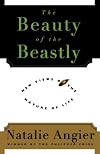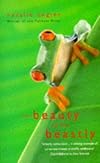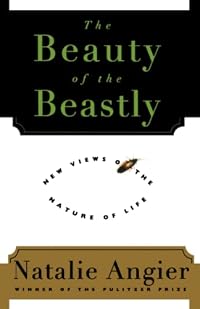
The Beauty of the Beastly: New Views on the Nature of Life
by Natalie Angier
On This Page
Description
""The beauty of the natural world lies in the details, and most of those details are not the stuff of calendar art," Natalie Angier writes in the introduction to The Beauty of the Beastly. "I have made it a kind of hobby, almost a mission, to write about organisms that many people find repugnant: spiders, scorpions, parasites, worms, rattlesnakes, dung beetles, hyenas. I have done so out of a perverse preference for subjects that other writers generally have ignored, and because I hope to show more inspire in readers an appreciation for diversity, for imagination, for the twisted, webbed, infinite possibility of the natural world. Every single story that nature tells is gorgeous."" "She has taken pains to learn her science from the molecule up, finding "the very pulse of the machine" in everything from the supple structure of DNA to the erotic ways of barn swallows, queen bees, and the endangered, otherworldly primate called the aye-aye. Angier knows all that scientists know - and sometimes more - about the power of symmetry in sexual relations, about the brutal courting habits of dolphins, about the grand deceit of orchids, about the impact of female and male preference on evolution. She knows how scientists go about their work, and she describes their ways, their visions, and their arguments."--Jacket. show lessTags
Recommendations

















Member Reviews
from scorpions to spotted hyenas, Angier raises the the unpopular and the obscure to new, fascinating heights. nature, in short, is a mad scientist. and Angier is here to convey that message in a variety of different ways, all with some wit and sparkle.
My mother-in-law is crazy about Natalie Angier and I hope she never reads this because I have never disagreed with her on anything in almost 2.5 years, but I dunno guys, I felt this book was a bunch of evolutionary bio/sociobiological bullshit so 90s that I actually had futurechills from, you know, now. This is written pre-Craig Venter, pre-genome, pre-babies in jars.But I liked the part about parasites! Did you guys know that there are these certain parasites that infect the brains of mice so that they act very hyper, making them stand out and become more susceptible to being spotted and eaten by predators, thusly ensuring that the parasite finds a new host in the predator? And then there's ones that make the mouse do the exact show more opposite, making it really sluggish, so that the predator has an easier time catching it with the same outcome for the parasite? That's some shit.Anyway, skim it. show less
Up close to life: Angier's urge to teach us all about Nature is irrepressible. Metaphor is her bow, with anthropomorphism a valuable arrow in her quiver. Enzymes become muscular bodyguards, orchids are lazy, deceptive, or magnanimous and scorpions can be "model spouses and parents." Such imagry will leave many "bench scientists" aghast at her "softening" the science, but others, and we readers, applaud her ability at stripping away the arcane aspects of dealing with Nature's wonders. She exposes life with a fresh view, making us intimate with its wonders and coming away with enhanced interest to learn more. That is precisely her aim and she scores a bullseye with every essay. She has grouped the essays into seven major topic areas show more ranging from adapting to slithering. The categories cover genetic mechanisms DNA uses through mating practices to the ultimate "subject that knows no species boundaries, the cloak with room to cover us all - death." Before arriving at this terminal condition, however, Angier is able to sprinkle petals of flowery prose on prolonging life. In "Why Vegetables Are Good For You," she provides new information on plant chemistry's impact on our bodies. That dread aspect of civilized life, fat, is also given attention - and its due. You will be delighted with her revelations on "adipose pucker."
After a set of paeans celebrating various practicing scientists, Angier finally turns to the "great mystery" - the ending of life. "Cell death is universal to life," she begins. Demonstrating its necessity in allowing evolution to proceed, she proceeds to relate how the process of cell death provides insights in the diagnosis and treatment of various afflictions. In tracking the mechanisms leading to the demise of various cells, particularly within our immune system, reseachers have found new genetic signals that keep our bodies healthy. Otherwise, we would be likely to self-destruct. It's a fine balance kept continually on a fine tightrope. Yet, after aknowledging its necessity, Angier doesn`t accept there's such a thing as "a good way to die." The loss of a friend leads her to express the mechanism of the AIDS
virus and the epidemic's effect on social thinking. Angier's imaginative essays provide a wealth of topics for further thought, even investigation. It's a pity she failed to provide any supportive reading suggestions. Many of her essays discuss the researchers while omitting to identify them. There's no reason to discount the facts she provides for our enjoyment and edification, but pursuit of a chosen topic is impeded by lack of pointers. That shortcoming is alleviated only by the fact that an index is provided. However, the range of topics and Angier's prose nearly overcome the lack of a bibliography. show less
virus and the epidemic's effect on social thinking. Angier's imaginative essays provide a wealth of topics for further thought, even investigation. It's a pity she failed to provide any supportive reading suggestions. Many of her essays discuss the researchers while omitting to identify them. There's no reason to discount the facts she provides for our enjoyment and edification, but pursuit of a chosen topic is impeded by lack of pointers. That shortcoming is alleviated only by the fact that an index is provided. However, the range of topics and Angier's prose nearly overcome the lack of a bibliography. show less
I read this book in an effort to expand my reading horizons. It came from the science section of the bookstore, an area where I am woefully under-read, but looked interesting and approachable. I was delighted to find this nonfiction book very readable. The book consists of individual essays that cover a range of topics but are all united by the broader subject of nature. In particular, I found her essay on possible causes and purposes of menstruation, and the essay on the longevity of the cockroach, to be truly fascinating. (See? A very wide range of topics.) This format was nice for someone who doesn't read a lot of nonfiction, because it allowed me to dip in and out of the book in small doses. I highly recommend it for the layman whom show more wants to dip into some scientific reading but is scared off by the heavier tomes. show less
"The beauty is in the details", quoting the quotidian author, who writes about life forms which many find repugnant. She finds everything gorgeous -- from the molecule on up through the germs, worms, crawling things, and the scientists themselves. Filled with myth-busting facts: E.g. Few creatures are "busy" -- most of them are inactive most of their lives. Even bees, hummingbirds, and ants [165]. Filled with valuable information -- oxytocin really is sexy, cruciforms fight cancer, and creativity is madness.
The 41 articles compiled from the New York times, are Chapters under the following wonderful groups: Loving, Dancing, Slithering, Adapting, Healing, Creating, Dying.
The 41 articles compiled from the New York times, are Chapters under the following wonderful groups: Loving, Dancing, Slithering, Adapting, Healing, Creating, Dying.
a great collection of essays with something for everyone. I read it cover to cover, but there is no need to as the essays each stand alone, though they gain something from being read together. I enjoyed the ones on animals most, but there is plenty on dna, celss, women in science and even psychology for hose so inclined
Ratings
Members
- Recently Added By
Lists

Recommended Nature Writing
346 works; 180 members
Author Information

11+ Works 4,101 Members
Natale Angier is a Pulitzer Prize winning writer for the New York Times and a frequent contributor to many magazines. Her honors include the Lewis Thomas Award and the AAAS Science Journalism Award. Her books include Natural Obsessions: Striving to Unlock the Deepest Secrets of the Cancer Cell and The Beauty of the Beastly: New Views on the Nature show more of Life. She lives near Washington D.C. (Bowker Author Biography) show less
Awards and Honors
Distinctions
Common Knowledge
- Canonical title
- The Beauty of the Beastly: New Views on the Nature of Life
Classifications
Statistics
- Members
- 221
- Popularity
- 147,079
- Reviews
- 6
- Rating
- (3.94)
- Languages
- English, French, German, Italian
- Media
- Paper, Ebook
- ISBNs
- 11
- UPCs
- 2
- ASINs
- 2