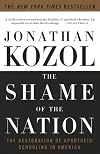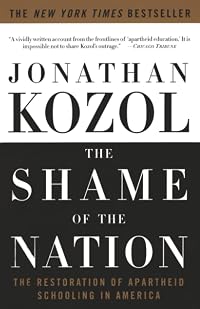
The Shame of the Nation: The Restoration of Apartheid Schooling in America
by Jonathan Kozol
On This Page
Description
"This is a book about betrayal of the young, who have no power to defend themselves. It is not intended to make readers comfortable." Visiting nearly 60 public schools, Kozol finds that conditions have grown worse for inner-city children in the 15 years since federal courts began dismantling the landmark 1954 ruling in Brown v. Board of Education. First, the segregation of black children is at a level not seen since 1968. Few of these students know any white children. Second, discipline show more modeled on methods traditionally used in prisons is targeted at black and Hispanic children. And third, liberal education in our inner-city schools has been increasingly replaced by culturally barren and robotic methods of instruction. Kozol pays tribute to those undefeated educators who persist against the odds, and offers a humane, dramatic challenge to our nation to fulfill at last the promise made some 50 years ago to all our youngest citizens.--From publisher description. show lessTags
Recommendations







Member Reviews
I usually like Kozol's works, but this one I had to drop after a while and scan. Kozol as always brings to life the situation of neglected schools and children in this country. And as he is also good at conveying a sense of outrage at how this nation simply chooses to abandon a large group of their own children. However, this particular book is extremely depressing. As an educator, I just found myself wondering if there was any hope at all. I mean, we can document the atrocity of separating children and then neglecting them. But somehow I just don't see any changes or hope that things will change. And once you reach that conclusion, the book just spirals down into a depressing and grim scenario. It's a heavy read overall, and yet, one show more that many educators and parents as well as those interested in education should read. I give it only two stars because the book basically left me drained. Kozol simply piles up the facts and evidence along with the children's stories. It is hard not to be outraged, and harder to keep some hope. I wish I could be more optimistic, but I don't think I can be. People have to choose change, and I get the feeling simply burying the problem is easier for them, even as we need to educate all our children if we are to have a good future.
I will likely read Kozol's other books, if he writes something new. After all, I have read most of his other books (which I have enjoyed, even if they left me outraged at times), and I even met him once. But this one was a bit too heavy for me. For teachers, I would recommend Savage Inequalities and his Letters book.
show less
I will likely read Kozol's other books, if he writes something new. After all, I have read most of his other books (which I have enjoyed, even if they left me outraged at times), and I even met him once. But this one was a bit too heavy for me. For teachers, I would recommend Savage Inequalities and his Letters book.
show less
Kozol's righteous outrage is infectious, and I agree with his belief that real desegregation never happened after Brown vs. Board of Education. He has some interesting theories about why this is so: mainly, that the country was tired of thinking about race and wanted to move on. These issues still predominate many urban and suburban school systems, but the political obstacles to real change are formidable. Regardless, equality of access to educational opportunity must be on the top of the list of any reform movement.
Essential reading. Describes the process of de facto segregation in schooling, based on population, demographics, and funding. This problem goes back decades, and is self-perpetuating, feeding into itself due to the effects of poverty and crime and prejudice and how they all feed into each other.
How could all this happen, even after the de jure ban on segregation passed by Brown v. Board of Education?
-The schools are underfunded due to the system which is dependent upon property taxes, which also are derived from poorer neighborhoods. (See also, [b:Savage Inequalities: Children in America's Schools|25078|Savage Inequalities Children in America's Schools|Jonathan Kozol|http://d.gr-assets.com/books/1348278848s/25078.jpg|25833])
-This show more underfunding leads to a poor quality materials, decaying buildings, lack of cafeteria food or desks, etc.
-Misguided and overly strict education programs, which try and force all types of students into a standardized mold instead of allowing some variation for different career tracks
-A 'corporate' approach to education, making students think like 'managers', 'team-players', and being subservient to a larger authority or group
-A heavy and misguided focus on standardized testing, forcing students to prepare for the test above all. This is also related to the problem of underfunding, as the 'No Child Left Behind' debacle left students with bad scores without funding. Thus the problem is compounded and made worse.
And so forth. All of this leads to the segregation of schools by race and class, and a major cause of socioeconomic stratification in America. In other words, apartheid - not directly by law, but indirectly.
Would integration alone resolve this problem? Hardly. There are so many compounding factors that relying upon only one method would be woefully inadequate. But attacking the funding deficit would be a start. Or removing the over-regimented program of standardized testing. Or...
Not too long ago, I worked in my state senate, and talked to a Republican senator who was an advocate in doubling state funding for preschool programs. He was almost alone in his party in advocating this program, and he'd had almost no success in pushing it through over the past six years - arguably due to a climate of 'fiscal austerity' and unsubtle racist code phrases against any educational reform. When I asked him about why he pushed it and very few others did, he looked at me with a sigh of resignation and said "Preschoolers don't have lobbyists." show less
How could all this happen, even after the de jure ban on segregation passed by Brown v. Board of Education?
-The schools are underfunded due to the system which is dependent upon property taxes, which also are derived from poorer neighborhoods. (See also, [b:Savage Inequalities: Children in America's Schools|25078|Savage Inequalities Children in America's Schools|Jonathan Kozol|http://d.gr-assets.com/books/1348278848s/25078.jpg|25833])
-This show more underfunding leads to a poor quality materials, decaying buildings, lack of cafeteria food or desks, etc.
-Misguided and overly strict education programs, which try and force all types of students into a standardized mold instead of allowing some variation for different career tracks
-A 'corporate' approach to education, making students think like 'managers', 'team-players', and being subservient to a larger authority or group
-A heavy and misguided focus on standardized testing, forcing students to prepare for the test above all. This is also related to the problem of underfunding, as the 'No Child Left Behind' debacle left students with bad scores without funding. Thus the problem is compounded and made worse.
And so forth. All of this leads to the segregation of schools by race and class, and a major cause of socioeconomic stratification in America. In other words, apartheid - not directly by law, but indirectly.
Would integration alone resolve this problem? Hardly. There are so many compounding factors that relying upon only one method would be woefully inadequate. But attacking the funding deficit would be a start. Or removing the over-regimented program of standardized testing. Or...
Not too long ago, I worked in my state senate, and talked to a Republican senator who was an advocate in doubling state funding for preschool programs. He was almost alone in his party in advocating this program, and he'd had almost no success in pushing it through over the past six years - arguably due to a climate of 'fiscal austerity' and unsubtle racist code phrases against any educational reform. When I asked him about why he pushed it and very few others did, he looked at me with a sigh of resignation and said "Preschoolers don't have lobbyists." show less
This is an AMAZING book regarding education in the US. Although written in 2005, I can't say that I have hope that all of the problems he shines light on has suddenly disappeared.
This book challenges the notion that schools are integrated, even though Brown vs Board of Education was....over 60 years ago. In fact, as Kozol finds, if you go to a school named for one of the civil rights leaders that fought for integration and desegregation (Rosa Parks, Martin Luther King, Jr)...you'll likely find irony in that most of the students in that school are students of color, and most likely in a school that is on the short end of funding and resources. In effect: our schools are still very much separate, but not anywhere near equal.
My TFA show more folks--think about the schools where you taught, is it true? show less
This book challenges the notion that schools are integrated, even though Brown vs Board of Education was....over 60 years ago. In fact, as Kozol finds, if you go to a school named for one of the civil rights leaders that fought for integration and desegregation (Rosa Parks, Martin Luther King, Jr)...you'll likely find irony in that most of the students in that school are students of color, and most likely in a school that is on the short end of funding and resources. In effect: our schools are still very much separate, but not anywhere near equal.
My TFA show more folks--think about the schools where you taught, is it true? show less
This is an AMAZING book regarding education in the US. Although written in 2005, I can't say that I have hope that all of the problems he shines light on has suddenly disappeared.
This book challenges the notion that schools are integrated, even though Brown vs Board of Education was....over 60 years ago. In fact, as Kozol finds, if you go to a school named for one of the civil rights leaders that fought for integration and desegregation (Rosa Parks, Martin Luther King, Jr)...you'll likely find irony in that most of the students in that school are students of color, and most likely in a school that is on the short end of funding and resources. In effect: our schools are still very much separate, but not anywhere near equal.
My TFA show more folks--think about the schools where you taught, is it true? show less
This book challenges the notion that schools are integrated, even though Brown vs Board of Education was....over 60 years ago. In fact, as Kozol finds, if you go to a school named for one of the civil rights leaders that fought for integration and desegregation (Rosa Parks, Martin Luther King, Jr)...you'll likely find irony in that most of the students in that school are students of color, and most likely in a school that is on the short end of funding and resources. In effect: our schools are still very much separate, but not anywhere near equal.
My TFA show more folks--think about the schools where you taught, is it true? show less
I'm so angry! This book has been a real life changer for me, even though it was written several years ago. Suddenly, as an educator, I can't sit still. I can't let this passion pass without doing something! But what? How and where to start? Kozol believes that the only way we will be able to overcome the segregation that has settled back into our nation, including the "apartheid schools" of inner cities all over the country, is to begin a grass roots political movement that will force those in positions of leadership and legislative power to listen. I concur. Check out Education Action to learn how you can join in on the conversation.
This is an incredibly depressing book. It starts out with mind-numbing statistics that describe the facts that in many American cities and urban centers schools are effectively separate and unequal. In many urban centers the vast majority of students are comprised of minorities - generally ~90+% black and/or Hispanic. It describes the teaching, curriculum, and class control methods that are used in these schools. These methods are derived from corporate and/or trade school structures and do not instill either basic knowledge nor a love of learning. The book then describes how and why this has come to be and then takes a look at the prospects for this to change in the near future. Throughout, each is bleak.
Two main things are not show more addressed with this book, namely real and/or perceived violence and drugs rampant in poor urban schools systems - though I will be very quick to admit that these are not limited or unique to poor urban school systems.
Kozol makes an argument that integration is necessary and that where it has happened many of the problems that have been described are not as prevalent -- test scores increase, etc. Personally, I think this is one of only many things that need to happen, and further that why it works is more straightforward than he lets on.
In any case, this is an incredibly enlightening book, and one that is quite readable ... once I could bring myself to face it again. But I had a hard time picking this book up each time and often could only read a few pages at a time. show less
Two main things are not show more addressed with this book, namely real and/or perceived violence and drugs rampant in poor urban schools systems - though I will be very quick to admit that these are not limited or unique to poor urban school systems.
Kozol makes an argument that integration is necessary and that where it has happened many of the problems that have been described are not as prevalent -- test scores increase, etc. Personally, I think this is one of only many things that need to happen, and further that why it works is more straightforward than he lets on.
In any case, this is an incredibly enlightening book, and one that is quite readable ... once I could bring myself to face it again. But I had a hard time picking this book up each time and often could only read a few pages at a time. show less
Members
- Recently Added By
Lists

Books discovered on LibraryThing
256 works; 36 members

Books We Discovered On LibraryThing
530 works; 130 members
Author Information

19+ Works 7,390 Members
Educator and author Jonathan Kozol was born in Boston. He graduated from Harvard University in 1958. Kozol has an concerns with topics such as illiteracy, children trying to learn in bad neighborhoods and homelessness. His books include Death at an Early Age, Illiterate American and Rachel and Her Children: Homeless Families in America. (Bowker show more Author Biography) show less
Awards and Honors
Distinctions
Common Knowledge
- Original publication date
- 2005
- Dedication
- For Louis Bedrock: a good teacher who has stayed the course
Classifications
- Genres
- Sociology, Nonfiction, General Nonfiction
- DDC/MDS
- 379.2630973 — Society, government, & culture Education Public policy issues in education Illiteracy; Instruction of Illiterates
- LCC
- LC212.62 .K69 — Education Special aspects of education Special aspects of education Social aspects of education Educational sociology Sex differences in education
- BISAC
Statistics
- Members
- 876
- Popularity
- 31,065
- Reviews
- 12
- Rating
- (4.13)
- Languages
- English
- Media
- Paper, Audiobook, Ebook
- ISBNs
- 11
- ASINs
- 6