
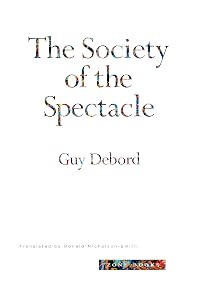
The Society of the Spectacle
by Guy Debord
On This Page
Description
'The Debordian analysis of modern life resonates more deeply and darkly than perhaps even its creator thought ' - The New Yorker 'Never before has Debord's work seemed quite as relevant as it does now' - The Guardian 'Guy Debord is a time bomb, and a difficult one to defuse.' - Michael Löwy First published in 1967, Guy Debord's stinging revolutionary critique of contemporary society, The Society of the Spectacle has since acquired a cult status. The Das Kapital of the 20th century. An show more essential text, and the main theoretical work of the Situationists. Few works of political and cultural theory have been as enduringly provocative. From its publication amid the social upheavals of the 1960's up to the present, the volatile theses of this book have decisively transformed debates on the shape of modernity, capitalism, and everyday life. 'In Society of the Spectacle, Debord sets out his best-known statement of how the categories of capitalism colonise everyday life to such an extent that we can barely imagine an existence beyond them.' - Sydney Review of Books 'The Society of the Spectacle [is] about not just the clamor of images but also the silence of power, a silence which, since the seventies, has become deafening.' - McKenzie Wark 'Never before has Debord's work seemed quite as relevant as it does now, in the permanent present that he so accurately foretold? Open his book, read it, be amazed, pour yourself a glass of supermarket wine - as he would wish - and then forget all about it, which is what the Spectacle wants.' - Will Self 'In The Society of the Spectacle, Debord made plain that a 'unified critique of culture' implied a critique of the social totality. This was his practico-theoretical method throughout his career as a revolutionary: he saw no distinction between cultural work and political work.' - Bruce Russell 'I read [The Society of the Spectacle] again and I thought, "This is a fucking amazing book!" I had forgotten how terrific it was, and it was actually quite different to how I remembered it. I insist that the key chapter is not the first one, on the spectacle itself, but the second to last - the chapter on détournement. To me, that concept is the great gift of the Situationists. [They] realized that one can exploit this critically - one can copy and correct in the direction of hope.' - McKenzie Wark About the author Guy Debord (1931-1994) was a Marxist theorist, writer, poet, filmmaker, hypergraphist, cultural revolutionary and a founding member of the Lettrist International and Situationist International - groups that fused avant-garde art and politics as an anti-capitalist weapon. Few works of political and cultural theory have been as enduringly provocative as Debord's Society of the Spectacle, which decisively transformed debates on the shape of modernity, capitalism and contemporary life. show lessTags
Recommendations






































Member Recommendations


Member Reviews
Two hundred and twenty-one paragraphs in nine chapters on unnumbered pages, with occasional black-and-white photographs only hieroglyphically related to the text, an anonymous translation from the original French boasting a lack of copyright, my copy of Guy Debord's Society of the Spectacle snuggled down into my library and moved with me through seven residences before I finally read it. When I did, it had me from the opening epigram: Ludwig Feuerbach's observation that in modernity "the highest degree of illusion comes to be the highest degree of sacredness."
This book is penetrating, provocative, prescient, and probably peerless. Although it seems to share many of the same concerns, it gave me a reading experience diametrically opposed show more to the one that I had recently with Heidegger (The Question Concerning Technology and Other Essays). Every sentence in Heidegger seemed to be an invitation to dream, accumulating a load of lofty but cloudy impressions with only a remote analogy to the world of daily life. By contrast, each sentence in Debord demanded that I wake up, and appreciate the urgency of my routine inability to see the real conditions of living in which I am immersed.
One might read a passage on modern alienation like paragraphs 24 and 25 and think that Debord was describing a capitalist phase that the Internet is helping us to transcend--that our 21st-century technologies supply the means of real communication among the proletariat. But in truth, his direst observations are now more true than ever. Digital "social media" atomize society into quantifiable, surveilled packets. The 'net habitué who strives to develop his "personal brand" is the epitome of Debord's paragraph 33: "Separated from his product, man himself produces all of the details of his world with increasing power, and thus finds himself ever more separated from his world. The more his life is now his product, the more he is separated from his life." Caught in the Web, a netizen experiences diminishing dialogue, as it is supplanted by podcast (messages strewn from the virtual pods in which we are encased) and other forms of self-monitoring reportage. Real communication is increasingly impoverished by the economizing of bandwidth: telephoning rather than visiting, texting rather than telephoning, we are more and more removed from the humanity, let alone the full expressions, of our interlocutors.
The title of Chapter 4 "The Proletariat as Subject and Representation" contains a clear nod to Schopenhauer, but the substance of that chapter is a comprehensive and devastating critique of socialism, anarchism, and communism from the left. It supplies a clear-headed historical perspective that must have been up-to-the-minute in 1967, and has lost little of its accuracy as a result of later events and revelations. (Debord can be faulted retrospectively for overvaluing the potential of the "revolutionary workers' Councils" of his own day.)
My reading allows me to infer an intimate relationship of this book to subsequent French philosophy. It appears to supply the foundations of Baudrillard's later work. It explains (or perhaps even determined) Foucault's motives in casting himself as "post-Structuralist" (see paragraphs 201 and 202). While Derrida got the term "deconstruction" from Nietzsche, his actual agenda seems to have been fully forecast by the single-sentence paragraph 205 of this book by Debord, which calls for the "necessary destruction" of "existing concrete concepts" in a dialectical process.
So, perhaps it was important for me to wait so long before reading Society of the Spectacle, a book I've owned for years, so that I could really appreciate its import and consequence. In any case, it's good that the wait is over. show less
This book is penetrating, provocative, prescient, and probably peerless. Although it seems to share many of the same concerns, it gave me a reading experience diametrically opposed show more to the one that I had recently with Heidegger (The Question Concerning Technology and Other Essays). Every sentence in Heidegger seemed to be an invitation to dream, accumulating a load of lofty but cloudy impressions with only a remote analogy to the world of daily life. By contrast, each sentence in Debord demanded that I wake up, and appreciate the urgency of my routine inability to see the real conditions of living in which I am immersed.
One might read a passage on modern alienation like paragraphs 24 and 25 and think that Debord was describing a capitalist phase that the Internet is helping us to transcend--that our 21st-century technologies supply the means of real communication among the proletariat. But in truth, his direst observations are now more true than ever. Digital "social media" atomize society into quantifiable, surveilled packets. The 'net habitué who strives to develop his "personal brand" is the epitome of Debord's paragraph 33: "Separated from his product, man himself produces all of the details of his world with increasing power, and thus finds himself ever more separated from his world. The more his life is now his product, the more he is separated from his life." Caught in the Web, a netizen experiences diminishing dialogue, as it is supplanted by podcast (messages strewn from the virtual pods in which we are encased) and other forms of self-monitoring reportage. Real communication is increasingly impoverished by the economizing of bandwidth: telephoning rather than visiting, texting rather than telephoning, we are more and more removed from the humanity, let alone the full expressions, of our interlocutors.
The title of Chapter 4 "The Proletariat as Subject and Representation" contains a clear nod to Schopenhauer, but the substance of that chapter is a comprehensive and devastating critique of socialism, anarchism, and communism from the left. It supplies a clear-headed historical perspective that must have been up-to-the-minute in 1967, and has lost little of its accuracy as a result of later events and revelations. (Debord can be faulted retrospectively for overvaluing the potential of the "revolutionary workers' Councils" of his own day.)
My reading allows me to infer an intimate relationship of this book to subsequent French philosophy. It appears to supply the foundations of Baudrillard's later work. It explains (or perhaps even determined) Foucault's motives in casting himself as "post-Structuralist" (see paragraphs 201 and 202). While Derrida got the term "deconstruction" from Nietzsche, his actual agenda seems to have been fully forecast by the single-sentence paragraph 205 of this book by Debord, which calls for the "necessary destruction" of "existing concrete concepts" in a dialectical process.
So, perhaps it was important for me to wait so long before reading Society of the Spectacle, a book I've owned for years, so that I could really appreciate its import and consequence. In any case, it's good that the wait is over. show less
Few works of political and cultural theory have been as enduringly provocative as Guy Debord’s Society of the Spectacle. From its publication amid the social upheavals of the 1960s to the present, the volatile theses of this book have decisively transformed debates on the shape of modernity, capitalism, and everyday life in the late twentieth century. Now finally available in a superb English translation approved by the author, Debord’s text remains as crucial as ever for understanding the contemporary effects of power, which are increasingly inseparable from the new virtual worlds of our rapidly changing image / information culture.
“In all that has happened in the last twenty years, the most important change lies in the very show more continuity of the spectacle. Quite simply, the spectacle’s domination has succeeded in raising a whole generation moulded to its laws. The extraordinary new conditions in which this entire generation has lived constitute a comprehensive summary of all that, henceforth, the spectacle will forbid; and also all that it will permit.”― Guy Debord (1988) show less
“In all that has happened in the last twenty years, the most important change lies in the very show more continuity of the spectacle. Quite simply, the spectacle’s domination has succeeded in raising a whole generation moulded to its laws. The extraordinary new conditions in which this entire generation has lived constitute a comprehensive summary of all that, henceforth, the spectacle will forbid; and also all that it will permit.”― Guy Debord (1988) show less
A mindblowing and poetic critique of modern alienation and mediation interwoven with history lessons (capped with a history of history), attacks on various Marxist and anarchist factions, and sections of such obtuseness I'm still not sure if the fault was mine or the book's. Still, more genius per page than the leading brand and it looks good in a cafe.
Guy Debord wrote/published this book in 1967. The book is tough to read, and some passages may seem opaque. You may need familiarity with Marxian philosophy to appreciate one chapter.
However, his analysis of society and history is frightening and relevant. The analysis becomes more relevant by the day.
Definitely, buy the book and read it.
However, his analysis of society and history is frightening and relevant. The analysis becomes more relevant by the day.
Definitely, buy the book and read it.
"What brings people into relation with each other by liberating them from their local and national limitations is also what keeps them apart. What requires increased rationality is also what nourishes the irrationality of hierarchical exploitation and repression. What produces society's abstract power also produces its concrete lack of freedom"
I believe we are moving increasingly faster into a superficial present. War and peace are the only guardrails.
I believe we are moving increasingly faster into a superficial present. War and peace are the only guardrails.
Most are well-aware of Noam Chomsky and Edward Herman and the Propaganda Model presented in Manufacturing Consent, of how the media is pure propaganda. But the idea of 'spectacle' being something part of our daily lives, not just in the media, of our consumer society as one of consuming spectacles virtually everywhere, is under-studied, under-talked about and more relevant than ever. Guy Debord relates it all to technology, without bowing to a weak primitivist stance. He helps us realize that technology controls virtually everything now. He was prescient. Think mobile phones, internet, Blackberries, Facebook, Twitter, clictivism, Google, if you still that it's far-fetched.
The intellectual technologies and practices Google has pioneered show more promote the speedy, superficial skimming of information and discourage any deep, prolonged engagement with a single argument, idea, or narrative. ‘Our Goal,’ says Irene Au, ‘it to get users in and out really quickly. All our design decisions are based on that strategy.’ Google’s profits are tied directly to the velocity of people’s information intake. The faster we surf across the surface of the Web - the more links we click and pages we view - the more opportunities Google gains to collect information about us and to feed us advertisements. It’s advertising system, moreover, is explicitly designed to figure out which messages are most likely to grab our attention and then to place those messages in our field of view. Every click we make on the Web marks a break in our concentration, a bottom-up disruption of our attention - and it’s in Google’s economic interest to make sure we click as often as possible.”
In layman's terms, A.D.D. is rampant. We need to be concerned, we need to reclaim the cyber commons and we need to read, slowly, and surely. This book is important in its understanding of how technology/spectacle when controlled by capital alienates, marginalizes, dissipates commonality, community. Google or capitalism does not intend to empower the individual with technology, they intened to make money. A consumer-oriented, historically amnesiac, attention deficit, and mobility addicted society of a never-ending cycle of spectacle is what they need.
This kind of book is what I think we need.
Pure genius. show less
The intellectual technologies and practices Google has pioneered show more promote the speedy, superficial skimming of information and discourage any deep, prolonged engagement with a single argument, idea, or narrative. ‘Our Goal,’ says Irene Au, ‘it to get users in and out really quickly. All our design decisions are based on that strategy.’ Google’s profits are tied directly to the velocity of people’s information intake. The faster we surf across the surface of the Web - the more links we click and pages we view - the more opportunities Google gains to collect information about us and to feed us advertisements. It’s advertising system, moreover, is explicitly designed to figure out which messages are most likely to grab our attention and then to place those messages in our field of view. Every click we make on the Web marks a break in our concentration, a bottom-up disruption of our attention - and it’s in Google’s economic interest to make sure we click as often as possible.”
In layman's terms, A.D.D. is rampant. We need to be concerned, we need to reclaim the cyber commons and we need to read, slowly, and surely. This book is important in its understanding of how technology/spectacle when controlled by capital alienates, marginalizes, dissipates commonality, community. Google or capitalism does not intend to empower the individual with technology, they intened to make money. A consumer-oriented, historically amnesiac, attention deficit, and mobility addicted society of a never-ending cycle of spectacle is what they need.
This kind of book is what I think we need.
Pure genius. show less
Disclaimer:
This book/essay is not written in a straightforward manner, and it's not always clear what the author is trying to say (if anything at all). Some of it feels just like arbitrary subject-object inversion ("are you watching TV... or is it watching you? Is X doing Y... or is Y doing X? "). This means I can't honestly tell if the ideas I got out of this work were actually put in by the author, or whether it was some sort of verbal Rorschach where you see what you want.
Overall though, I was deeply fascinated by what I think this was about, and I think it has lots of deep insight and 'food-for-thought' about our entertainment-based society.
This book/essay is not written in a straightforward manner, and it's not always clear what the author is trying to say (if anything at all). Some of it feels just like arbitrary subject-object inversion ("are you watching TV... or is it watching you? Is X doing Y... or is Y doing X? "). This means I can't honestly tell if the ideas I got out of this work were actually put in by the author, or whether it was some sort of verbal Rorschach where you see what you want.
Overall though, I was deeply fascinated by what I think this was about, and I think it has lots of deep insight and 'food-for-thought' about our entertainment-based society.
Members
- Recently Added By
Published Reviews
ThingScore 75
Here on terra firma, on the brink of our brave new nirvana six years later, Debord's integrated spectacle — the techno-media juggernaut — looms larger than life. Just prior to his death, the 62-year-old who drank too much and wrote too little had wryly observed, in the "Preface to the Third French Edition" of his uncannily prescient text, that the "same formidable question that has been show more haunting the world for two centuries is about to be posed again, everywhere: How can the poor be made to work once their illusions have been shattered and once force has been defeated?" show less
added by Caco_Velho
Lists

Ten Books That Have Stayed With Me
160 works; 30 members
Favourite Books
1,817 works; 316 members
1960s, Best books published therein
254 works; 22 members

20th Century Literature
1,161 works; 55 members

culture
320 works; 1 member

Books Read in 2021
5,361 works; 114 members

Library Wishlist
46 works; 1 member
Blindpill
20 works; 2 members

el
1,139 works; 1 member
Author Information

79+ Works 4,869 Members
Some Editions
Awards and Honors
Series
Belongs to Publisher Series
Work Relationships
Common Knowledge
- Canonical title*
- La sociedad del espectáculo
- Original title
- La Société du Spectacle
- Original publication date
- 1967
- People/Characters
- Karl Marx; Joseph Stalin; Vladimir Lenin; Georg Wilhelm Friedrich Hegel
- First words
- In societies dominated by modern conditions of production, life is presented as an immense accumulation of spectacles.
- Original language
- French
- Canonical DDC/MDS
- 320.534
*Some information comes from Common Knowledge in other languages. Click "Edit" for more information.
Classifications
- Genres
- Philosophy, Sociology, Nonfiction, General Nonfiction, Literature Studies and Criticism
- DDC/MDS
- 320.534 — Society, government, & culture Political science Types of Government Political ideologies Radicalism, collectivism, fascism Situationist
- LCC
- HM291 .D413 — Social sciences Sociology (General) Sociology These are obsolete numbers no longer used
- BISAC
Statistics
- Members
- 3,499
- Popularity
- 4,715
- Reviews
- 34
- Rating
- (4.02)
- Languages
- 16 — Czech, Danish, Dutch, English, Estonian, Finnish, French, German, Greek, Hebrew, Italian, Japanese, Portuguese, Spanish, Swedish, Turkish
- Media
- Paper, Audiobook, Ebook
- ISBNs
- 56
- UPCs
- 1
- ASINs
- 19