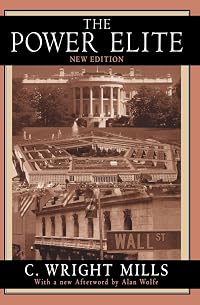
The Power Elite
by C. Wright Mills
On This Page
Description
First published in 1956, The Power Elite stands as a contemporary classic of social science and social criticism. C. Wright Mills examines and critiques the organization of power in the United States, calling attention to three firmly interlocked prongs of power: the military, corporate, and political elite. The Power Elite can be read as a good account of what was taking place in America at the time it was written, but its underlying question of whether America is as democratic in practice show more as it is in theory continues to matter very much today. What The Power Elite informed readers of in 1956 was how much the organization of power in America had changed during their lifetimes, and Alan Wolfe's astute afterword to this new edition brings us up to date, illustrating how much more has changed since then. Wolfe sorts out what is helpful in Mills's book and which of his predictions have not come to bear, laying out the radical changes in American capitalism, from intense global competition and the collapse of communism to rapid technological transformations and ever changing consumer tastes. The Power Elite has stimulated generations of readers to think about the kind of society they have and the kind of society they might want, and deserves to be read by every new generation. show lessTags
Recommendations














Member Recommendations
Member Reviews
C. Wright Mills’ The Power Elite is a masterwork of political sociology and one of the most influential critiques of American power structures in the 20th century. First published in 1956, the book remains eerily relevant today. Mills boldly argues that a small, interconnected group of elites—drawn from the top tiers of government, military, and corporate leadership—control the most significant decisions affecting the lives of ordinary citizens.
What makes this book so compelling is its clarity and urgency. Mills doesn’t just offer abstract theory—he names institutions, examines patterns of privilege, and outlines how these elites sustain their influence through closed networks and shared interests. His writing is incisive and show more unsparing, yet accessible, making it as valuable to students as it is to seasoned political thinkers.
While some critics have challenged the scope of Mills’ conclusions, few can deny the lasting impact of his thesis. In an age still plagued by wealth inequality, corporate lobbying, and political insiderism, The Power Elite feels less like a dated Cold War-era critique and more like a prophetic warning. show less
What makes this book so compelling is its clarity and urgency. Mills doesn’t just offer abstract theory—he names institutions, examines patterns of privilege, and outlines how these elites sustain their influence through closed networks and shared interests. His writing is incisive and show more unsparing, yet accessible, making it as valuable to students as it is to seasoned political thinkers.
While some critics have challenged the scope of Mills’ conclusions, few can deny the lasting impact of his thesis. In an age still plagued by wealth inequality, corporate lobbying, and political insiderism, The Power Elite feels less like a dated Cold War-era critique and more like a prophetic warning. show less
Perhaps one of the best, most detailed analyses of the power holders and power structure of the United States I've read so far. C. Wright Mills spares nothing in his description of the various groups that play a role within the power elite--the upper class (top 2%), the government, the military, the corporations--and how they take advantage of their positions and interactions with one another to reduce the public to a politically empty mass and to circumvent the Constitution and Law for their own gain. It is a weighty tome and does not lend itself to be read quickly. I marked much in this book, seeing uncanny similarities between the political world Mills described in 1956 and the one we see today. Nothing really has changed, only the show more names of the players are new.
His deep and logical processing of information demonstrates quite clearly how the People, who are supposed to be the political "backbone" of this nation and the true inheritors of its political and economic power, have been unwittingly manipulated into a position in which the only "power" they retain is that of creating and maintaining a stalemate with other mid-level political blocs which, in turn, vie for their own slice of the ever-shrinking political and economic pie.
Although not necessarily done deliberately, the power elite have used mass media, advertising, public relations, Hollywood celebrity and other propaganda tools to relegate the public to a position of powerlessness. The masses may believe they have a say in the policy decisions that the government enacts, but in most cases these decisions have already been made and it is simply the work of PR consultants and corporations to maneuver the public into accepting them.
What is so frightening about The Power Elite is how so little has changed for the better. Rather than becoming more aware of this situation because of the increase in media resources, we have become more blinded by the ever-present barrage of media images, sounds and glamour. As Mills rightly assesses, the masses have bought into the neo-liberal rhetoric co-opted by the conservative factions to legitimize their authoritarian position without having to actually reveal their intentions or the glaring flaw in their position: they have no basis in any real American tradition, and rely on the ever-changing present to keep the masses constantly off-guard and confused in order to obscure the fact that there is no real conservative ideology based on the same kinds of tradition found in Western European feudalism.
I also found the afterword by Alan Wolfe unrepresentative of Mills's work. It was meant to somehow give a contemporary critique of this work in light of our time, but unfortunately much changed in 2001 and with these changes we can now see what our predecessors could not. In times of prosperity, people find comfort in their caves--why venture too far beyond when the benefits inside are so satisfying? Yet, with economic uncertainty and global instability (climate change, war, uprisings, etc.) we are now having to face squarely what we tried to ignore the decade prior. Mills offers us a way to view the power structures of our nation with clear eyes and no illusions. It's a book everyone should read. show less
His deep and logical processing of information demonstrates quite clearly how the People, who are supposed to be the political "backbone" of this nation and the true inheritors of its political and economic power, have been unwittingly manipulated into a position in which the only "power" they retain is that of creating and maintaining a stalemate with other mid-level political blocs which, in turn, vie for their own slice of the ever-shrinking political and economic pie.
Although not necessarily done deliberately, the power elite have used mass media, advertising, public relations, Hollywood celebrity and other propaganda tools to relegate the public to a position of powerlessness. The masses may believe they have a say in the policy decisions that the government enacts, but in most cases these decisions have already been made and it is simply the work of PR consultants and corporations to maneuver the public into accepting them.
What is so frightening about The Power Elite is how so little has changed for the better. Rather than becoming more aware of this situation because of the increase in media resources, we have become more blinded by the ever-present barrage of media images, sounds and glamour. As Mills rightly assesses, the masses have bought into the neo-liberal rhetoric co-opted by the conservative factions to legitimize their authoritarian position without having to actually reveal their intentions or the glaring flaw in their position: they have no basis in any real American tradition, and rely on the ever-changing present to keep the masses constantly off-guard and confused in order to obscure the fact that there is no real conservative ideology based on the same kinds of tradition found in Western European feudalism.
I also found the afterword by Alan Wolfe unrepresentative of Mills's work. It was meant to somehow give a contemporary critique of this work in light of our time, but unfortunately much changed in 2001 and with these changes we can now see what our predecessors could not. In times of prosperity, people find comfort in their caves--why venture too far beyond when the benefits inside are so satisfying? Yet, with economic uncertainty and global instability (climate change, war, uprisings, etc.) we are now having to face squarely what we tried to ignore the decade prior. Mills offers us a way to view the power structures of our nation with clear eyes and no illusions. It's a book everyone should read. show less
4 stars because it's a classic in the field and it's well written. Pinko commie propaganda! The afterword by Alan Wolfe is worth reading. C. Wright Mills was well known in the 1950's as a sharp critic of the power structures of American Societies. I read this book because I really liked his "The Sociological Imagination," another classic in the field.
Lucid explanation of American 'aristocracies'. Slightly outdated, but not nearly as much as I had anticipated. Simplistic, but still insightful.
Excellent sociology. Somewhat detailed and overwhelming near the middle but the ending is worth the wait.
Classic study of the power holders in American society
Regarded as "great" on Forum, by Michael Krasney.
Members
- Recently Added By
Lists

LT picks: Blue Books
197 works; 44 members

Exposing the Man Behind the Curtain
28 works; 3 members
Author Information

42+ Works 4,261 Members
C. Wright Mills, an American sociologist, was one of the most controversial social scientists of the mid-twentieth century. He considered himself a rebel against both the academic establishment and American society in general, and he rarely tried to separate his radical ideas from his teaching and writing. Irving Louis Horowitz summarized much of show more Mills's ideas in the subtitle of his biography of him: An American Utopian. Mill's most traditional sociological study is The Puerto Rican Journey. His most direct attack on his colleagues in sociology is The Sociological Imagination (1959) (which he found left much to be desired). His most ideological work is The Power Elite (1956), an attempt to explain the overall power structure of the United States. Mills thought that the dominant "value-free" methodology of American sociology was an ideological mask, hiding values that he did not share. According to his younger colleague Immanuel Wallerstein, Mills was essentially a utopian reformer who thought that knowledge properly used could bring about a better society. (Bowker Author Biography) show less
Awards and Honors
Series
Belongs to Publisher Series
Common Knowledge
- Canonical title
- The Power Elite
- Original publication date
- 1956
- First words
- "The powers of ordinary men are circumscribed by the everyday worlds in which they live, yet even in these rounds of job, family, and neighborhood they often seem driven by forces they can neither understand nor govern." -- c... (show all)hapter one, The Higher Circles
- Last words
- (Click to show. Warning: May contain spoilers.)"The men of higher circles are not representative men; their high position is not a result of moral virtue; their fabulous success is not firmly connected with meritorious ability. Those who sit in the seats of the high and the mighty are selected and formed by the means of power, the sources of wealth, the mechanics of celebrity, which prevail in their society. They are not men selected and formed by a civil service that is linked with the world of knowledge and sensibility. They are not men shaped by nationally responsible parties that debate openly and clearly the issues this nation now so unintelligently confronts. They are not men held in responsible check a plurality of voluntary associations which connect debating publics with the pinnacles of decision. Commanders of power unequaled in human history, they have succeeded within the American system of organized irresponsibility." -- Chapter fifteen, The Higher Immorality
- Original language
- English
Classifications
- Genres
- Sociology, Nonfiction, General Nonfiction, Politics and Government, History
- DDC/MDS
- 303.30973 — Society, government, & culture Social sciences, sociology & anthropology Social processes Coordination and control History, geographic treatment, biography North America United States
- LCC
- E169.1 .M64 — History of the United States United States General
- BISAC
Statistics
- Members
- 1,001
- Popularity
- 26,082
- Reviews
- 11
- Rating
- (3.99)
- Languages
- 9 — English, French, German, Hebrew, Hungarian, Italian, Spanish, Swedish, Turkish
- Media
- Paper, Ebook
- ISBNs
- 13
- ASINs
- 8