On This Page
Description
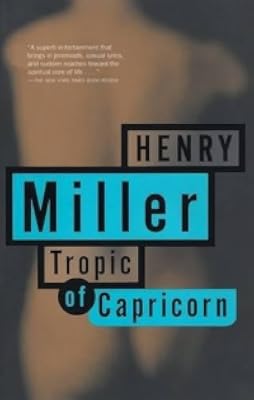
Banned in America for almost thirty years because of its explicit sexual content, this companion volume to Miller's Tropic of Cancer chronicles his life in 1920s New York City. Famous for its frank portrayal of life in Brooklyn's ethnic neighborhoods and Miller's outrageous sexual exploits, The Tropic of Capricorn is now considered a cornerstone of modern literature.Tags
Recommendations


























Member Reviews
After Tropic of Cancer and Black Spring, Miller carried on his confessions in 'Tropic of Capricorn', without a shadow of a doubt the most crucial book of the whole trilogy. Crucial because, little by little, he shows us how he discovered his call to be a writer.
The style might be more melancholic, moving in certain passages (especially when dealing with childhood memories) yet, 'Tropic of Capricorn' remains Miller through and through: a violently beating heart, a raging storm catching you by surprise and sending you waltzing over a vertiginous pit of chaos!
Should we laugh or cry? Is this a dream or an awaken nightmare? Reality of fantasy? We don't know. Miller himself has no clue, and, we absolutely can't care less! This book is a show more monster, denouncing a monstrous society, in a big act of spite as if spiting at the face of a whole system: American capitalism. Miller purports to be a marginal, on the margin of what, to him, replace human beings by numbers, dehumanise, are the roots of misery and injustice. Far from being 'a social justice warrior' of sort, though, Miller is nothing but a vile character himself, who knows it and has absolutely no qualm telling us all about it. He is a leech, living off the money of his 'friends'. He has no compassion for anyone. He manipulates He lies. He scams. He cheats on his wife... There is no sympathy nor admiration to have for him here! Everything is thrown out at us like rubbish in a thrash, in what is but a big middle finger up to hypocrisy. And, what is more hypocritical than American society, with its puritanism bordering on the absurd, for instance when it comes to sex?
Here's another key feature in Miller's writing (although you would be wrong to reduce him to that): his obsession with sex. His language is crude; so crude, in fact, that his books would be forbidden in the USA until the 1960s, accused to be, as they were, 'pornography'! From a European perspective, of course, (and, especially one like mine, being French...) it might all seem utterly ridiculous; and yet... Isn't it because everything is about freedom with sex? The act itself, the memories of it, fantasies coming in its trail, even its descriptions... And, wasn't freedom what Miller craved beyond everything else?
I had discovered this as a teenager. At the time, it had truly stricken me for being a remarkable work. I confess having outgrown him a bit -there is indeed something childish, immature, and, with him, as corrupt as the corrupt system he denounced- and yet, written by a man who dreamt himself absolutely free in a conformist, consumerist society, 'Tropic of Capricorn' remains, to me, the best of the trilogy. As such, I highly recommend it as a gateway to Miller's work. show less
The style might be more melancholic, moving in certain passages (especially when dealing with childhood memories) yet, 'Tropic of Capricorn' remains Miller through and through: a violently beating heart, a raging storm catching you by surprise and sending you waltzing over a vertiginous pit of chaos!
Should we laugh or cry? Is this a dream or an awaken nightmare? Reality of fantasy? We don't know. Miller himself has no clue, and, we absolutely can't care less! This book is a show more monster, denouncing a monstrous society, in a big act of spite as if spiting at the face of a whole system: American capitalism. Miller purports to be a marginal, on the margin of what, to him, replace human beings by numbers, dehumanise, are the roots of misery and injustice. Far from being 'a social justice warrior' of sort, though, Miller is nothing but a vile character himself, who knows it and has absolutely no qualm telling us all about it. He is a leech, living off the money of his 'friends'. He has no compassion for anyone. He manipulates He lies. He scams. He cheats on his wife... There is no sympathy nor admiration to have for him here! Everything is thrown out at us like rubbish in a thrash, in what is but a big middle finger up to hypocrisy. And, what is more hypocritical than American society, with its puritanism bordering on the absurd, for instance when it comes to sex?
Here's another key feature in Miller's writing (although you would be wrong to reduce him to that): his obsession with sex. His language is crude; so crude, in fact, that his books would be forbidden in the USA until the 1960s, accused to be, as they were, 'pornography'! From a European perspective, of course, (and, especially one like mine, being French...) it might all seem utterly ridiculous; and yet... Isn't it because everything is about freedom with sex? The act itself, the memories of it, fantasies coming in its trail, even its descriptions... And, wasn't freedom what Miller craved beyond everything else?
I had discovered this as a teenager. At the time, it had truly stricken me for being a remarkable work. I confess having outgrown him a bit -there is indeed something childish, immature, and, with him, as corrupt as the corrupt system he denounced- and yet, written by a man who dreamt himself absolutely free in a conformist, consumerist society, 'Tropic of Capricorn' remains, to me, the best of the trilogy. As such, I highly recommend it as a gateway to Miller's work. show less
In certain respects this work supersedes that of Cancer. If Cancer is a work that revolves around fluids, around the Seine, around piss, spermatozoa etc. then Capricorn is one of solids. In Brooklyn we find ourselves forced to go toward the spiritual Land of Fuck, in the Southern States we are forced to contend with arid landscapes and racial tensions so tense that they could kill a man through a mere gaze.
The best way to describe the work is to highlight Miller’s own self described evolution from skater to swimmer to rock. Having broken through the futility of Dante’s ice, Miller quits the skating shtick and joyfully dives in to the freshly thawed oceans, before realising that one must become immutable at the very depths of the show more ocean. One must paradoxically be bone dry surrounded by the sea, a lighthouse that stands strong against the ensuing waves.
So yeah, this shit was pretty fucking good. Especially loved whenever he brought up Dostoevsky, Bergson or Nietzsche, it’s fun to see what he reads into them. show less
The best way to describe the work is to highlight Miller’s own self described evolution from skater to swimmer to rock. Having broken through the futility of Dante’s ice, Miller quits the skating shtick and joyfully dives in to the freshly thawed oceans, before realising that one must become immutable at the very depths of the show more ocean. One must paradoxically be bone dry surrounded by the sea, a lighthouse that stands strong against the ensuing waves.
So yeah, this shit was pretty fucking good. Especially loved whenever he brought up Dostoevsky, Bergson or Nietzsche, it’s fun to see what he reads into them. show less
Following on from recently finishing Tropic of Cancer, Mrs Arukiyomi picked this one out for me. I thought I was in for the same rollocking ride that Miller took me on through the streets of Paris and was looking forward to more of the same.
Things started out with promise as we encounter Miller (not necessarily the author) at his desk in the Dickensianly dysfunctional Cosmodemonic Telegraph Company. His job is in the HR department which stands less for Human Resources than it does for Hell Released. Before him traipses the last dregs of humanity none of whom, because of quotas, he can turn away and none of whom are in any way hire-worthy. This was thoroughly entertaining.
But as you see Miller languishing in the banality of a wife and show more kid life, kicking against the goads, you know that it’s only a matter of time until he leaps from domestic frying pan into immoral fire. Such is the case.
It thus begins with the same celebratory tirade for and against the human condition that marks out Cancer as such a groundbreaking work, and I was quite enjoying it until about halfway through where he abandoned form at the same rate that he adopted fornication.
From hereon out to the end, the reader is left to make what sense he can of writing that is, at times, entirely formless and nonsensical and yet continuously punctuated by sex – the incongruous literary lovechild of James Joyce and Leslie Thomas.
Although this definitely disappointed me, I think it’s the only logical way that Miller could have ended this pair of novels. After all, he started out, prior to Cancer by telling a friend, “I start tomorrow on the Paris book: First person, uncensored, formless – fuck everything!” If he didn’t quite achieve that with the first novel, he certainly did with Capricorn, but it’s not an achievement that did much for me. show less
Things started out with promise as we encounter Miller (not necessarily the author) at his desk in the Dickensianly dysfunctional Cosmodemonic Telegraph Company. His job is in the HR department which stands less for Human Resources than it does for Hell Released. Before him traipses the last dregs of humanity none of whom, because of quotas, he can turn away and none of whom are in any way hire-worthy. This was thoroughly entertaining.
But as you see Miller languishing in the banality of a wife and show more kid life, kicking against the goads, you know that it’s only a matter of time until he leaps from domestic frying pan into immoral fire. Such is the case.
It thus begins with the same celebratory tirade for and against the human condition that marks out Cancer as such a groundbreaking work, and I was quite enjoying it until about halfway through where he abandoned form at the same rate that he adopted fornication.
From hereon out to the end, the reader is left to make what sense he can of writing that is, at times, entirely formless and nonsensical and yet continuously punctuated by sex – the incongruous literary lovechild of James Joyce and Leslie Thomas.
Although this definitely disappointed me, I think it’s the only logical way that Miller could have ended this pair of novels. After all, he started out, prior to Cancer by telling a friend, “I start tomorrow on the Paris book: First person, uncensored, formless – fuck everything!” If he didn’t quite achieve that with the first novel, he certainly did with Capricorn, but it’s not an achievement that did much for me. show less
Miller’s Capricorn is a strange and scruffy, albeit extraordinarily beautiful and lilting work. The novel, which blurs over into autobiography and poetry, represents the tangled flux of emotions, sentiments, actions and interactions that flow around the young Henry Miller – a disgruntled postal employee in a New York of the 1930s and 40s.
Miller’s novel is brazen, shocking and profound. The narrator undergoes something like a schizophrenic transfer from brutal disgust at the world around him to unapologetic love (and returns again, of course). At once he wants to bring the stale morals of America, its hypocrisy and indifference down to the ground. And at the same time he is captured by his own moral code, his own desire to be, to show more understand, to grow.
The narrator is then a difficult figure; at times he is simple and likeable, a witty guide through the streets of Brooklyn. On the other hand he can be distasteful and cruel.
To say that CAPRICORN is directionless would be inaccurate. It does have a motion, but more like the flow of an ocean than a road. The tone and tense, the present of the novel, change throughout, in a sense ramping up the speed, the delirium, the significance. At the beginning of the novel we can rather easily follow Henry – his workmates, his lovers, his job. As the work presses on, however, Henry shifts back and forth in time from childhood to the present, revisiting people, reimagining people. At some moments his narrative is stable – for example, a thorough examination, a turning inside out, of his father’s late-life finding of God. In another moment it is a Proust-like memory brought forth by the smell and taste of sourdough bread.
As the text wears on, however, the stability of characters becomes dislodged; mystical, unreal elements of personalities share the page with real people. Symbols come alive. In the most hectic, grandiloquent passages at the centre of the book (Miller’s “intermission”), the narrator invokes an elaborate sea of metaphors and images around a woman, almost Woman in general, who is both real and unreal, a gentle lover as well as a vulture eating his flesh, a woman his age but also a timeless beauty, literally stretching across eternity. In these sections of the book you very much lose your anchorage to normality, but you can just about hold on. Miller dazzles with fine, witty, eloquent, beautiful imagery. If nothing else the linguistic, the sound sense of it all is an incredible experience, really pushing text and the human voice to its limits (I guess in the way that Scat music makes use of the voice as an instrument, or screamo does the same with grunting and shouting). Miller’s narrator is, after all, an aspiring writer. The problem, he says, is not the lack of theme but the sense that he simply can’t “shut off” his flow of ideas and images.
And besides all of the arrogance and swagger and abstraction, there is an honest gut in there. Miller appears profoundly drawn to and fascinated by the people around him – he feels free both to damn them and help them in the same sentence, seeing them almost as whole-selves rather than parts of selves (even if he does paradoxically use metonyms, single images, to refer to whole people). In other words, he sees everything; he sees people’s goodness as well as their strangeness, their shame, their arrogance, their badness. He sees a continuum, and this continuum is what really constitutes people – real people living real, flawed lives always on the edge of understanding.
The faults you might lay at the novel are the way in which abstraction can scupper its purpose. Or perhaps we should ask what that purpose was in the first place – what does this young, insightful and intelligent but hopelessly troubled narrator want in live, and what is Miller telling us? Other readers have said that if you look at Capricorn as one of a stack of books about anomie, about existentialism, then there’s less purpose and clarity than, say, Dostoevsky’s Notes from Underground, or perhaps the straight forwardness of a Kerouac. At the same time, what you’ve got here is undifferentiated human nature, the raw nerves and bones and organs of humanity laid out. It seems a little trite to say the meaning and purpose are contained in its meaninglessness and lack of purpose, but maybe that isn’t so far from the truth.
At the end of it all you can take it or leave it – some love Miller’s verbosity, his swagger, his wit. Others think him brutal and crude and artless. I think he’s simply, in a very flawed and very human way, trying to be honest. At times, this book elevates and humbles and opens the mind in a way that I’ve never experienced before. At others it leaves you cold and rotten. But it is beyond doubt a powerful, unforgettable experience. show less
Miller’s novel is brazen, shocking and profound. The narrator undergoes something like a schizophrenic transfer from brutal disgust at the world around him to unapologetic love (and returns again, of course). At once he wants to bring the stale morals of America, its hypocrisy and indifference down to the ground. And at the same time he is captured by his own moral code, his own desire to be, to show more understand, to grow.
The narrator is then a difficult figure; at times he is simple and likeable, a witty guide through the streets of Brooklyn. On the other hand he can be distasteful and cruel.
To say that CAPRICORN is directionless would be inaccurate. It does have a motion, but more like the flow of an ocean than a road. The tone and tense, the present of the novel, change throughout, in a sense ramping up the speed, the delirium, the significance. At the beginning of the novel we can rather easily follow Henry – his workmates, his lovers, his job. As the work presses on, however, Henry shifts back and forth in time from childhood to the present, revisiting people, reimagining people. At some moments his narrative is stable – for example, a thorough examination, a turning inside out, of his father’s late-life finding of God. In another moment it is a Proust-like memory brought forth by the smell and taste of sourdough bread.
As the text wears on, however, the stability of characters becomes dislodged; mystical, unreal elements of personalities share the page with real people. Symbols come alive. In the most hectic, grandiloquent passages at the centre of the book (Miller’s “intermission”), the narrator invokes an elaborate sea of metaphors and images around a woman, almost Woman in general, who is both real and unreal, a gentle lover as well as a vulture eating his flesh, a woman his age but also a timeless beauty, literally stretching across eternity. In these sections of the book you very much lose your anchorage to normality, but you can just about hold on. Miller dazzles with fine, witty, eloquent, beautiful imagery. If nothing else the linguistic, the sound sense of it all is an incredible experience, really pushing text and the human voice to its limits (I guess in the way that Scat music makes use of the voice as an instrument, or screamo does the same with grunting and shouting). Miller’s narrator is, after all, an aspiring writer. The problem, he says, is not the lack of theme but the sense that he simply can’t “shut off” his flow of ideas and images.
And besides all of the arrogance and swagger and abstraction, there is an honest gut in there. Miller appears profoundly drawn to and fascinated by the people around him – he feels free both to damn them and help them in the same sentence, seeing them almost as whole-selves rather than parts of selves (even if he does paradoxically use metonyms, single images, to refer to whole people). In other words, he sees everything; he sees people’s goodness as well as their strangeness, their shame, their arrogance, their badness. He sees a continuum, and this continuum is what really constitutes people – real people living real, flawed lives always on the edge of understanding.
The faults you might lay at the novel are the way in which abstraction can scupper its purpose. Or perhaps we should ask what that purpose was in the first place – what does this young, insightful and intelligent but hopelessly troubled narrator want in live, and what is Miller telling us? Other readers have said that if you look at Capricorn as one of a stack of books about anomie, about existentialism, then there’s less purpose and clarity than, say, Dostoevsky’s Notes from Underground, or perhaps the straight forwardness of a Kerouac. At the same time, what you’ve got here is undifferentiated human nature, the raw nerves and bones and organs of humanity laid out. It seems a little trite to say the meaning and purpose are contained in its meaninglessness and lack of purpose, but maybe that isn’t so far from the truth.
At the end of it all you can take it or leave it – some love Miller’s verbosity, his swagger, his wit. Others think him brutal and crude and artless. I think he’s simply, in a very flawed and very human way, trying to be honest. At times, this book elevates and humbles and opens the mind in a way that I’ve never experienced before. At others it leaves you cold and rotten. But it is beyond doubt a powerful, unforgettable experience. show less
Tras la fama que le reportó Trópico de Cáncer (1934), Henry Miller confirmó la valía de su propuesta literaria con esta novela, que le situó definitivamente entre las voces más recias y profundas del siglo XX.
Las experiencias sexuales, laborales y familiares de un empleado de la Western Union sirven de hilo conductor a una ficción autobiográfica de la que surge con una inusitada fuerza la crítica mirada de Miller hacia el mundo y los hombres que le rodean, sus disquisiciones filosóficas y su poderoso canto a la individualidad. Miller dio un paso realmente importante en la evolución de la literatura con su personal modo de enfocar el arte narrativo.
Las experiencias sexuales, laborales y familiares de un empleado de la Western Union sirven de hilo conductor a una ficción autobiográfica de la que surge con una inusitada fuerza la crítica mirada de Miller hacia el mundo y los hombres que le rodean, sus disquisiciones filosóficas y su poderoso canto a la individualidad. Miller dio un paso realmente importante en la evolución de la literatura con su personal modo de enfocar el arte narrativo.
It's been more than two years since I've read Cancer, but that work impressed itself upon me to the degree where I can still declare today that this is its equal, at the very least. This is very much the reverse of the same coin, pulling us back from the hero's Parisian days to his genesis, his childhood and his early adulthood, when Miller was building Miller, as he so eloquently illustrates and flat out proclaims at one point. The feverish ruminations here stretch a little longer than usual for him, and these fruits are sweet and rotten in equal parts, the lesser of them not marring the work as a whole. Aside from these two components, this volume seems to contain more explicit sex than Cancer, though even these passages are humorous show more or illuminating in their own way. Less of a plot than Cancer, similar in a way to Black Spring. At times Capricorn is more illuminating, and dare I say more fun, than either. show less
Yes, yes, I know; this is a classic, one of the 1001 books to read before you die, Henry Miller is a genius blah blah blah. But, my God, this was dull!! Either I'm just not intellectual enough to 'get' Miller (though I enjoyed Tropic of Cancer), or the people who pronounced this a classic wanted to be perceived as intellectuals.
Tropic of Capricorn starts off well. Miller comes across as a strangely self-aware narcissist, full of himself but also aware of his own shortcomings. He considers himself well-liked in his circles, though the character as written is, to me, wholly unlikeable. But the stories he tells, and the way he tells them, are good. The tales of his life at Western Union make for interesting, sometimes humorous, sometimes show more shocking, reading.
But halfway through, we move from the autobiographical tone to abstract, stream-of-consciousness stuff, which I have to say, I found thoroughly dull. It's like he's run out of interesting things to say about his life so thought he'd pad out the book with the contents of his alcohol-fuelled dreams. Some may find that style of writing a good read. But it's not for me.
So, having read both Tropic of Cancer and Tropic of Capricorn, my experience of Henry Miller is now at an end. show less
Tropic of Capricorn starts off well. Miller comes across as a strangely self-aware narcissist, full of himself but also aware of his own shortcomings. He considers himself well-liked in his circles, though the character as written is, to me, wholly unlikeable. But the stories he tells, and the way he tells them, are good. The tales of his life at Western Union make for interesting, sometimes humorous, sometimes show more shocking, reading.
But halfway through, we move from the autobiographical tone to abstract, stream-of-consciousness stuff, which I have to say, I found thoroughly dull. It's like he's run out of interesting things to say about his life so thought he'd pad out the book with the contents of his alcohol-fuelled dreams. Some may find that style of writing a good read. But it's not for me.
So, having read both Tropic of Cancer and Tropic of Capricorn, my experience of Henry Miller is now at an end. show less
Members
- Recently Added By
Lists

1001 Books You Must Read Before You Die
1,448 works; 1,136 members

Unread books
1,063 works; 83 members

Amanda's Guaranteed Books
110 works; 5 members

Paris, City of Lights
103 works; 17 members

Erotic Fiction
53 works; 5 members

Blue Pyramid 1,276 Best Books of All Time
1,248 works; 32 members

Our Favorite Banned Books
138 works; 122 members

Recommended Reading : 600 Classics Reviewed, Editors of Salem Press, 2015
634 works; 6 members

Personal 2026 reads
32 works; 1 member

Weird and Weirder Fiction
270 works; 34 members
Author Information

232+ Works 31,673 Members
Some Editions
Awards and Honors
Series

Belongs to Publisher Series
Work Relationships
Is contained in
Common Knowledge
- Canonical title*
- Kauriin kääntöpiiri
- Original title
- Tropic of Capricorn
- Alternate titles*
- Wendekreis des Steinbocks
- Original publication date
- 1939
- People/Characters
- Henry Miller
- Important places
- Brooklyn, New York, New York, USA; New York, New York, USA; New York, USA
- Dedication
- TO HER
- First words
- Once you have given up the ghost, everything follows with dead certainty, even in the midst of chaos.
- Quotations
- From the beginning it was never anything but chaos; it was a fluid which enveloped me, which I breathed in through the gills.
Confusion is a word we have invented for an order which is not understood. - Last words
- (Click to show. Warning: May contain spoilers.)Tomorrow, tomorrow . . .
- Blurbers*
- Huxley, Aldous; Williams, William Carlos; Powys, John Cowper; Orwell, George; Cendrars, Blaise; Ferber, Christian
- Original language*
- englanti
- Canonical DDC/MDS
- 813.52
- Canonical LCC
- PS3525.I5454
*Some information comes from Common Knowledge in other languages. Click "Edit" for more information.
Classifications
Statistics
- Members
- 4,025
- Popularity
- 3,896
- Reviews
- 48
- Rating
- (3.67)
- Languages
- 19 — Catalan, Czech, Danish, Dutch, English, Finnish, French, German, Greek, Hungarian, Italian, Lithuanian, Norwegian (Bokmål), Polish, Portuguese, Romanian, Spanish, Swedish, Turkish
- Media
- Paper, Audiobook, Ebook
- ISBNs
- 104
- ASINs
- 87