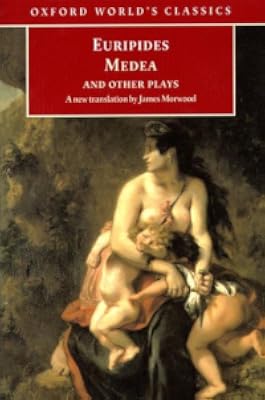
4 Plays: Electra / Helen / Hippolytus / Medea
by Euripides
On This Page
Description
`the most tragic of the poets' Aristotle Euripides was one of the most popular and controversial of all Greek tragedians, and his plays are marked by an independence of thought, ingenious dramatic devices, and a subtle variety of register and mood. He is also remarkable for the prominence he gave to female characters, whether heroines ofvirtue or vice. In the ethically shocking Medea, the first known child-killing mother in Greek myth to perform the deed in cold blood manipulates her world show more in order to wreak vengeance on her treacherous husband. Hippolytus sees Phaedra's confession of her passion for her stepson herald disaster,while Electra's heroine helps her brother murder their mother in an act that mingles justice and sin. Lastly, lighter in tone, the satyr drama, Helen, is an exploration of the impossibility of certitude as brilliantly paradoxical as the three famous tragedies. This new translation does full justice to Euripides's range of tone and gift for narrative. A lucid introduction provides substantial analysis of each play, complete with vital explanations of the traditions and background to Euripides's world. show lessTags
Recommendations





















Member Reviews
Euripides is, of course, wonderful, and the four plays in this volume ("Hippolyta," "Electra," and "Helen" are included as well) are all lovely--but the translation and the edition are horrid. I know nothing about translating from Ancient Greek into English, but I do know good English when I read it, and there's little to be found here. James Morwood's prose translation is filled with tired phrasing and cliches, which drag down the dynamic subject matter. Worse are the "notes" at the end of the book, to which a liberal supply of in-text asterisks point. Roughly half of Morwood's notes are insulting to the reader's intelligence: pointing out overarching themes, explaining the meaning of common English words, and interpreting the actions show more and thoughts of the characters. This is especially annoying given that the other half of the notes, which provide historical background and cultural context, are useful. It took me two plays to figure out which notes to check and which ones not too--an effort that truly wasn't worth it.
I'm going to try and find a verse translation of Euripides and try again in a few years. I would strongly recommend not reading this edition. show less
I'm going to try and find a verse translation of Euripides and try again in a few years. I would strongly recommend not reading this edition. show less
Ratings
Members
- Recently Added By
Author Information

1,346+ Works 34,270 Members
Euripides was born in Attica, Greece probably in 480 B.C. He was the youngest of the three principal fifth-century tragic poets. In his youth he cultivated gymnastic pursuits and studied philosophy and rhetoric. Soon after he received recognition for a play that he had written, Euripides left Athens for the court of Archelaus, king of Macedonia. show more Fragments of about fifty-five plays survive. Among his best-known plays are Alcestis, Medea and Philoctetes, Electra, Iphigenia in Tauris, The Trojan Women, and Iphigenia in Aulis Iphigenia. He died in Athens in 406 B.C. (Bowker Author Biography) show less
All Editions
Series
Belongs to Publisher Series
Work Relationships
Contains
Common Knowledge
- Canonical title
- 4 Plays: Electra / Helen / Hippolytus / Medea
- Original publication date
- 1997
- People/Characters
- Medea; Jason [Argonaut]; Hippolytus; Theseus; Phaedra; Aphrodite (show all 11); Electra; Orestes; Clytemnestra; Helen of Troy; Menelaus
- Important places
- Corinth, Greece; Troezen, Greece; Argos, Greece; Egypt
- Disambiguation notice
- This work combines Medea with Electra; Helen; and Hippolytus. Please do not combine with editions containing a differing selection of works.
Classifications
- Genre
- Fiction and Literature
- DDC/MDS
- 882.01 — Literature & rhetoric Classical & modern Greek literatures Classical Greek dramatic poetry and drama standard subdivisions; collections; history, description, critical appraisal; Specific periods Ancient period to ca. 499
- LCC
- PA3975 .A2 — Language and Literature Greek language and literature. Latin language and literature Greek literature Individual authors Euripedes
- BISAC
Statistics
- Members
- 481
- Popularity
- 64,037
- Reviews
- 1
- Rating
- (3.55)
- Languages
- English
- Media
- Paper
- ISBNs
- 2
- ASINs
- 1