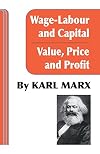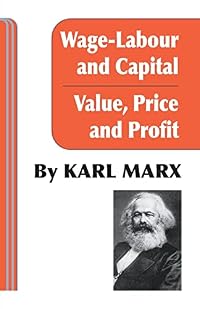
Wage-Labour and Capital {and} Value, Price, and Profit
by Karl Marx
On This Page
Description
This pamphlet first appeared as a series of articles in 1849. An early precursor to the landmark Das Kapital, here Marx develops the ideas of supply, demand, labor-as-commodity, the distinction between labor and power, and capitalism's dependence on the exploitation of labor, with the prediction that capitalism would eventually collapse..
Tags
Recommendations
































Member Reviews
one of the most important leftist texts out there just read it it takes like an hour cmon
Capitalism sucks, but you need to understand how it works.
Concise overview of how capitalism works
Good introductory text on economics.
Ratings
Members
- Recently Added By
Lists

Top Five Books of 2013
1,562 works; 715 members
Author Information

1,849+ Works 54,399 Members
Karl Heinrich Marx, one of the fathers of communism, was born on May 5, 1818 in Trier, Germany. He was educated at a variety of German colleges, including the University of Jena. He was an editor of socialist periodicals and a key figure in the Working Man's Association. Marx co-wrote his best-known work, "The Communist Manifesto" (1848), with his show more friend, Friedrich Engels. Marx's most important work, however, may be "Das Kapital" (1867), an analysis of the economics of capitalism. He died on March 14, 1883 in London, England. (Bowker Author Biography) show less
Series
Belongs to Publisher Series
Work Relationships
Common Knowledge
- Canonical title
- Wage-Labour and Capital {and} Value, Price, and Profit
- Original title
- Lohnarbeit und Kapital & Lohn, Preis und Profit
- First words
- From various quarters we have been reproached for neglecting to portray the economic conditions which form the material basis of the present struggles between classes and nations. [Wage-Labour and Capital]
There reigns now on the Continent a real epidemic of strikes, and a general clamour for a rise of wages. [Value, Price and Profit] - Quotations
- Wie nun wird eine Summe von Waren, von Tauschwerten zu Kapital?
Dadurch, dass sie als selbständige gesellschaftliche Macht, d.h. als die Macht eines Teils der Gesellschaft sich erhält und vermehrt durch den Austausch... (show all) gegen die unmittelbare, lebendige Arbeitskraft. Die Existenz einer Klasse, die nichts besitzt als die Arbeitsfähigkeit, ist eine notwendige Voraussetzung des Kapitals.
Die Herrschaft der aufgehäuften, vergangnen, vergegenständlichen Arbeit über die unmittelbare, lebendige Arbeit macht die aufgehäufte Arbeit erst zum Kapital. - Last words
- (Click to show. Warning: May contain spoilers.)We thus see that if capital grows rapidly, competition among the workers grows with even greater rapidity, i.e., the means of employment and subsistence for the working class decrease in proportion even more rapidly; but, this notwithstanding, the rapid growth of capital is the most favourable condition for wage-labour. [Wage-Labour and Capital]
(Click to show. Warning: May contain spoilers.)They fail generally, from limiting themselves to a guerrilla war against the effects of the existing system, instead of simultaneously trying to change it, instead of using their organised forces as a lever for the final emancipation of the working class, that is to say, the ultimate abolition of the wages system. [Value, Price and Profit] - Disambiguation notice
- This work is the combination of two pamphlet-sized titles also available separately, and should not be merged with either of them.
Classifications
- Genres
- Economics, Nonfiction, General Nonfiction, Philosophy, Politics and Government
- DDC/MDS
- 335.412 — Society, Government, and Culture Economics Socialism and related systems Marxian systems Philosophic foundations, economic concepts, aims Economic concepts
- LCC
- HB301 .M3813 — Social sciences Economic theory. Demography Economic theory. Demography
- BISAC
Statistics
- Members
- 333
- Popularity
- 94,955
- Reviews
- 4
- Rating
- (3.86)
- Languages
- 8 — Dutch, English, French, German, Italian, Japanese, Spanish, Swedish
- Media
- Paper, Ebook
- ISBNs
- 17