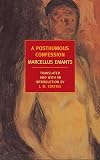
A Posthumous Confession
by Marcellus Emants
On This Page
Description
Termeer, the narrator of A Posthumous Confession, is a twisted man and a troubled one. The emotionally stunted son of a cold, forbidding, and hypocritical father, Termeer has only succeeded in living up to his parents' low expectations when, to his own and others' astonishment, he finds himself wooing a beautiful and gifted woman--a woman whose love he wins. But instead of finding happiness in marriage, Termeer discovers it to be a new source of self-hatred, hatred that he turns upon his show more wife and child. And when he becomes caught up in an affair with a woman as demanding as his own self-loathing, he is driven to murder. What is the self, and how does it evade or come to terms with itself? What can make it go permanently, lethally wrong? Marcellus Emants's grueling and gripping novel--a late-nineteenth-century tour de force of psychological penetration--is a lacerating exposition of the logic of identity that looks backward to Dostoyevsky, forward to Simenon, and beyond to the confessional literature, whether fiction or fact, of our own day. show lessTags
Recommendations




Member Recommendations
giovannigf Both novels are first-hand accounts by tortured narrators consumed by self-hatred and jealousy, and both share existentialist themes.
Member Reviews
Thirty-five year old Willem Termeer is the narrator of this confession. He tells the reader right away on the first page that he has just murdered his wife. The rest of his "confession" is his decidedly one-sided summation of his life, for Willem assumes his auditor will be "...interested in the course of my development", that he will "...understand how different I seem to myself from the vast majority of people."
He then gives a self-serving account of his life from his entry into grade school forward. At times coloured by self loathing, at other times by empty bravado, Termeer shows himself as one of those weak whingeing creatures whom every bully recognizes on sight, and as the one no work team or social group would choose for a show more member. Throughout his life, he has done nothing but disappoint, often deliberately. He persists in seeing himself as a victim of circumstance, doing nothing to try to alter those circumstances.
Why read such a self analysis then? Well as J M Coetzee tells us in his introduction, Marcellus Emants was interested in psychology, in analyzing "the new sciences of heredity and psychopathology to explain human motivation". Coetzee sees Termeer's confession "...as a monument to himself, thereby turning a worthless life into art". No matter how despicable Termeer may have been as a person, no matter how disinclined the reader may be to empathize, Emants has done an excellent job of making the reader feel so strongly about such an odious and inconsequential person, and of having that person reveal himself so convincingly, and it is his writing that is the reward. show less
He then gives a self-serving account of his life from his entry into grade school forward. At times coloured by self loathing, at other times by empty bravado, Termeer shows himself as one of those weak whingeing creatures whom every bully recognizes on sight, and as the one no work team or social group would choose for a show more member. Throughout his life, he has done nothing but disappoint, often deliberately. He persists in seeing himself as a victim of circumstance, doing nothing to try to alter those circumstances.
Why read such a self analysis then? Well as J M Coetzee tells us in his introduction, Marcellus Emants was interested in psychology, in analyzing "the new sciences of heredity and psychopathology to explain human motivation". Coetzee sees Termeer's confession "...as a monument to himself, thereby turning a worthless life into art". No matter how despicable Termeer may have been as a person, no matter how disinclined the reader may be to empathize, Emants has done an excellent job of making the reader feel so strongly about such an odious and inconsequential person, and of having that person reveal himself so convincingly, and it is his writing that is the reward. show less
A Dutch Underground Man, but nowhere near as scathing and psychologically probing as Dostoevsky's finer work. Still, Dutch existentialism has its own nuances, its own rhythms—and Coetzee is a masterful translator here. Many kudos to NYRB for reprinting this, but, in reality it is best read with the real Underground Man in mind—preferably after a long break away from Dostoevsky's text, or as a prefatory primer for virgin readers to the true Underground Man.
Despite all of his singular and cultural differences, which do make for interesting reading, Emants's narrator, Termeer, is a mere lackey to Dostoevsky's Underground Man, not to mention the Russian writer's more masterful—and even more terse—explorations of alienation, show more misanthropy, and utter annihilation combined with a psychological insight that makes Emants's work, while groundbreaking in its way, read like charcoal sketches held up beside a dizzyingly taut masterpiece. show less
Despite all of his singular and cultural differences, which do make for interesting reading, Emants's narrator, Termeer, is a mere lackey to Dostoevsky's Underground Man, not to mention the Russian writer's more masterful—and even more terse—explorations of alienation, show more misanthropy, and utter annihilation combined with a psychological insight that makes Emants's work, while groundbreaking in its way, read like charcoal sketches held up beside a dizzyingly taut masterpiece. show less
A psychological tour de force that is reminiscent of Dostoevsky, I found this as riveting as Hunger or Notes from Underground. Consider what you would do if you looked inside yourself and found you had no feelings at all. This is the state that the narrator contemplates and finds terrifying.
I think the premise of this book was quite interesting, however, the character was so frustrating and obnoxious I found it utterly impossible to be the least bit sympathetic with him (and this coming from someone who could in fact sympathize with a lot of what he was feeling!), and hence was just very annoyed. That said, I do think it's worth reading.
This novel is a classic of Dutch literature. It is a psychological novel which deals with the guilt complex of the main character after committing a murder.
Vrank en vrij, onthutsend en deprimerend, sterk dostojevskiaan (ook la chute van Camus)
Aug 24, 2010Dutch
Members
- Recently Added By
Lists

Canon van de Nederlandse letterkunde
125 works; 5 members

Mooie titels
80 works; 1 member

School Made Us Read It
380 works; 197 members
Author Information

39+ Works 661 Members
Emants's A Posthumous Confession, his best-known novel, is the first-person account of a social misfit who murders his wife. In spite of Emants's awkward style, it created a sensation when it appeared in 1894. To the author's dismay, the public tended to identify him with the protagonist. Emants's work frequently serves to demonstrate the Dutch show more involvement in naturalism. (Bowker Author Biography) show less
Some Editions
Awards and Honors
Series
Belongs to Publisher Series
Common Knowledge
- Canonical title
- A Posthumous Confession
- Original title
- Een nagelaten bekentenis
- Original publication date
- 1894
- People/Characters*
- Willem Termeer
- Important places*
- Voorburg, Zuid-Holland, Nederland; Zuid-Holland, Nederland
- First words*
- Mijn vrouw is dood en al begraven.
- Last words*
- (Click to show. Warning: May contain spoilers.)Als ik haar nu eens alles bekende en tegelijkertijd de beschikking aanbood over mijn hele fortuin; zou ze me dan om die daad ... om die misdaad ... niet willen ... niet kunnen ... liefhebben?
- Original language*
- Nederlands
*Some information comes from Common Knowledge in other languages. Click "Edit" for more information.
Classifications
- Genres
- General Fiction, Fiction and Literature
- DDC/MDS
- 839.3 — Literature & rhetoric German & related literatures Other Germanic literatures Netherlandish literatures
- LCC
- PT5833 .N313 — Language and Literature German, Dutch and Scandinavian literatures Dutch literature Individual authors or works 1800-1960
- BISAC
Statistics
- Members
- 305
- Popularity
- 105,647
- Reviews
- 8
- Rating
- (3.88)
- Languages
- Dutch, English, German, Spanish
- Media
- Paper, Ebook
- ISBNs
- 18
- ASINs
- 3