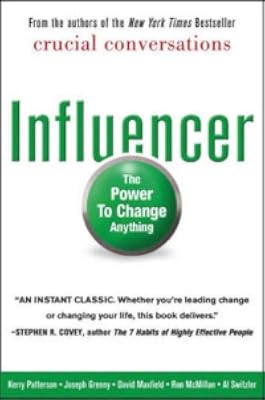
Influencer: The Power to Change Anything
by Kerry Patterson, Joseph Grenny, David Maxfield, Ron McMillan, Al Switzler
On This Page
Description
By drawing from the skills of hundreds of successful influencers and combining them with five decades of the best social science research, Influencer shares eight powerful principles for changing behaviors--principles almost anyone can apply to change almost anything.Tags
Recommendations


Member Recommendations
Member Reviews
From a "reform school" with a 90% success rate, to HIV elimination in Bangkok, to Guinea worm (there's a reason you've probably never heard of that) eradication in Africa, to the beginning of woman's rights in India... this tells amazing and real stories. Read it, if only to realize that great things are happening. Internalize it, if you want to make changes.
This book presented a great model and made great use of a small number of case studies explored in depth. What keeps it from being 5-stars is primarily that many of the chapters felt overly repetitive. I almost forgave that and gave an extra star because the chapter summaries are so great — but not quite.
Influence is not a matter of personality or charisma. Rather, influence is achieved by systematically applying techniques to motivate change. Before you can apply, you need to know what change you want to achieve. Thus, the first step of the influence process is to identify the results you want and how you could measure those results.
Next, you need to find vital behaviors. These are the high-leverage activities that, if changed, can show more make a significant difference in the desired outcomes Both words are important here. These must be behaviors, not outcomes. E.g., when losing weight, "Consume fewer calories than you expend" sounds like a behavior but it is actually the outcome. Behaviors are more specific: "Use a smaller plate" is a behavior. Second, these behaviors must be vital: they must be the ones that actually drive the desired outcome. Vital behaviors can be discovered by looking at cases of positive deviance: looking to see where outcomes are unexpectedly good and seeing what they do differently than the average and bad cases. Once a vital behavior is hypothesized, it should be tested.
After identifying a vital behavior, you can start to influence. Effective influence needs to address two key questions: "Is this worth it?" (motivation) and "Can I do it?" (ability). Each of these can be influenced at a personal, social, and structural level. The bulk of the book is going through each of the six types of influence resulting from this model in detail. The brief summary (from the diagram they use throughout the book):
Personal motivation: Make the undesirable desirable. I.e., change intrinsic motivations.
Personal ability: Surpass your limits. I.e., training and practice.
Social motivation: Harness peer pressure. I.e., utilize the influence of well-respected, well-connected individuals and social norms.
Social ability: Find strength in numbers. I.e., use the social capital of a group to pool skills and resources.
Structural motivation: Design rewards and demand accountability. I.e., how to carefully supplement intrinsic and social motivation with extrinsic motivators.
Structural ability: Change the environment. I.e., change the powerful (and often unobserved) cues that influence behavior.
The book contains much more detail, as well as concrete illustrations of the principles in practice. It is worth the read. (And, I suspect, will be harder to put in practice than to read about.) show less
Influence is not a matter of personality or charisma. Rather, influence is achieved by systematically applying techniques to motivate change. Before you can apply, you need to know what change you want to achieve. Thus, the first step of the influence process is to identify the results you want and how you could measure those results.
Next, you need to find vital behaviors. These are the high-leverage activities that, if changed, can show more make a significant difference in the desired outcomes Both words are important here. These must be behaviors, not outcomes. E.g., when losing weight, "Consume fewer calories than you expend" sounds like a behavior but it is actually the outcome. Behaviors are more specific: "Use a smaller plate" is a behavior. Second, these behaviors must be vital: they must be the ones that actually drive the desired outcome. Vital behaviors can be discovered by looking at cases of positive deviance: looking to see where outcomes are unexpectedly good and seeing what they do differently than the average and bad cases. Once a vital behavior is hypothesized, it should be tested.
After identifying a vital behavior, you can start to influence. Effective influence needs to address two key questions: "Is this worth it?" (motivation) and "Can I do it?" (ability). Each of these can be influenced at a personal, social, and structural level. The bulk of the book is going through each of the six types of influence resulting from this model in detail. The brief summary (from the diagram they use throughout the book):
Personal motivation: Make the undesirable desirable. I.e., change intrinsic motivations.
Personal ability: Surpass your limits. I.e., training and practice.
Social motivation: Harness peer pressure. I.e., utilize the influence of well-respected, well-connected individuals and social norms.
Social ability: Find strength in numbers. I.e., use the social capital of a group to pool skills and resources.
Structural motivation: Design rewards and demand accountability. I.e., how to carefully supplement intrinsic and social motivation with extrinsic motivators.
Structural ability: Change the environment. I.e., change the powerful (and often unobserved) cues that influence behavior.
The book contains much more detail, as well as concrete illustrations of the principles in practice. It is worth the read. (And, I suspect, will be harder to put in practice than to read about.) show less
When Stephen Covey labeled this new book "an instant classic," I knew it was a must-read for me.
But I was floored at how brilliant this book really is.
Many books deal with some aspect or particular technique of change in people. Influencer is radically different: it presents a complete structural blueprint of the science of change, and takes you step by step through the critical factors behind change and how to apply them to any problem.
Instead of endless dry facts or empty clichés, Influencer breaks down its major points chapter by chapter, illustrating them with a detailed analysis of several real-world case studies of seemingly insurmountable change problems, including Delancy, a rehab center for hard-core criminal drug addicts show more which has an astonishing success rate of over 90%. Interspersed are personal and family case studies, research, and history all engagingly written in a well-organized, coherent style. At the end of each chapter is a summary of key concepts covered.
Influencer immediately helped me understand both my own thinking processes toward change and those of others, and jump-started good ideas for both my personal growth and solving several business issues. Influencer is by far the most original and useful book I have read this year. Highly recommended. show less
But I was floored at how brilliant this book really is.
Many books deal with some aspect or particular technique of change in people. Influencer is radically different: it presents a complete structural blueprint of the science of change, and takes you step by step through the critical factors behind change and how to apply them to any problem.
Instead of endless dry facts or empty clichés, Influencer breaks down its major points chapter by chapter, illustrating them with a detailed analysis of several real-world case studies of seemingly insurmountable change problems, including Delancy, a rehab center for hard-core criminal drug addicts show more which has an astonishing success rate of over 90%. Interspersed are personal and family case studies, research, and history all engagingly written in a well-organized, coherent style. At the end of each chapter is a summary of key concepts covered.
Influencer immediately helped me understand both my own thinking processes toward change and those of others, and jump-started good ideas for both my personal growth and solving several business issues. Influencer is by far the most original and useful book I have read this year. Highly recommended. show less
This book articulates the strategies that the world's most influential people use to solve persistent, resistant problems. The biggest eye-opener for me was the point that verbal persuasion can't solve all the world's problems, especially when you're trying to convince someone to change their behavior. I've always believed in the power of a carefully crafted argument and prided myself on being able to put forth an effective argument for certain things. But this book made me realize that verbal persuasion is just one eensy weensy technique in the grab-bag of influential techniques, and it's an overused and often ineffective technique at that.
I love how this book teases out the different techniques and gives lots of examples of each. The show more authors recommend that you read it with a problem in mind that you want to solve. The problem I kept in mind as I was reading was how to get more people at my company to recycle everything that's possible to recycle. Too many times at work, I walk by a trash can that contains a perfectly recyclable piece of paper or aluminum can. And the recycling bin is right. next. to. the. trash. If the person had just moved their hand a measly couple of inches to one side, they could have dropped the item in a recycling bin instead of the trash! But I digress...
For some of the techniques, I immediately got ideas for how to apply them to this problem. For others, I couldn't think of anything. So while I don't think all these techniques will work for every problem, this book certainly made me look at the lack of recycling at my office in a new light, and it gave me a renewed sense of hope for increasing the amount we recycle.
I'm going to put this on my wish list to own because I could see myself referring to it fairly often. The authors also have a web site, influencerbook.com, with a worksheet you can fill out to brainstorm solutions to a problem you're trying to solve. show less
I love how this book teases out the different techniques and gives lots of examples of each. The show more authors recommend that you read it with a problem in mind that you want to solve. The problem I kept in mind as I was reading was how to get more people at my company to recycle everything that's possible to recycle. Too many times at work, I walk by a trash can that contains a perfectly recyclable piece of paper or aluminum can. And the recycling bin is right. next. to. the. trash. If the person had just moved their hand a measly couple of inches to one side, they could have dropped the item in a recycling bin instead of the trash! But I digress...
For some of the techniques, I immediately got ideas for how to apply them to this problem. For others, I couldn't think of anything. So while I don't think all these techniques will work for every problem, this book certainly made me look at the lack of recycling at my office in a new light, and it gave me a renewed sense of hope for increasing the amount we recycle.
I'm going to put this on my wish list to own because I could see myself referring to it fairly often. The authors also have a web site, influencerbook.com, with a worksheet you can fill out to brainstorm solutions to a problem you're trying to solve. show less
The authors give enough persuasive information and illustrations that one has all the tools one needs to bring about real change IF one is willing to apply what one read. Excellent material.
This book has great real life stories in it. It sets forth principles for influencing others. I learned a lot, but I'm still not sure how to apply all the principles. I listened to it while on the treadmill. This is one I think I need to go back and read. I may understand the application better when I can concentrate on the book alone and not be distracted by my exercise routine.
This book has great real life stories in it. It sets forth principles for influencing others. I learned a lot, but I'm still not sure how to apply all the principles. I listened to it while on the treadmill. This is one I think I need to go back and read. I may understand the application better when I can concentrate on the book alone and not be distracted by my exercise routine.
Members
- Recently Added By
Author Information

16 Works 7,838 Members

21+ Works 8,400 Members

4 Works 1,698 Members

9 Works 7,836 Members

10 Works 7,960 Members
Awards and Honors
Distinctions
Common Knowledge
- Canonical title
- Influencer: The Power to Change Anything
- People/Characters
- Albert Bandura; Ethna Reid; Everett Rogers; Steve Kerr; Donald Hopkins; Wiwat Rojanapithayakorn (show all 7); Brian Wansink
- Important places
- Delancey Street Foundation, San Francisco, California, USA; San Francisco, California, USA; Africa; India; Thailand
- Dedication
- We dedicate this book to influencers everywhere -- to the tenacious scholars and practitioners who, through the careful blending of theory and experience, have not only added to an ever-growing knowledge of how things work, b... (show all)ut have also curbed the cynic's smirk, restored hope, and made it possible for each of us to become a powerful agent of change.
- Quotations
- For now, let's meet the one almost all cited as the scholar or scholars: Albert Bandura. He's a genius whom influence masters routinely study. When we first entered the offices of the practitioners we studied, most displaye... (show all)d Dr. Bandura's works on their bookshelves. His name leaped out at us because our history with him goes back over 30 years.
In fact, his strategy focuses on an outcome, not on behaviors. What he's really saying is that if he does something right, as a result of his efforts he'll burn more calories than he eats. What he has to do is still unknown... (show all).
Confusing outcomes with behaviors is no small issue. In fact, when you look at most failed influence strategies, you're likely to find at least one example of means/ends confusion.
One of the vital behaviors consists of the use of praise versus the use of punishment. Top performers reward positive performance far more frequently than their counterparts. Bottom performers quickly become discouraged and... (show all) mutter things such as, "Didn't I just teach you that two minutes ago?" The best consistently reinforce even moderately good performance, and learning flourishes.
Since lectures don't work with phobics and you can't get them to conquer their fear through personal experience, you have to find something in between--something more than words and less than personal action. This "in betwee... (show all)n" thing turns out to be one of the most highly valued tools in any influence genius's arsenal. It's referred to as vicarious experience.
Here's how vicarious experience works. When you expose subjects to other people who are demonstrating a vital behavior, the subjects learn from the surrogates's successes and failures. Watching others in action is the next best thing to experiencing something on your own.
If you want to change behavior, any behavior, you have to change maps of cause and effect.
Effective stories and other vicarious experiences overcome this flaw. A well-told narrative provides concrete and vivid detail rather than terse summaries and unclear conclusions. It changes people's view of how the world w... (show all)orks because it presents a plausible, touching, and memorable flow of cause and effect that can alter people's view of the consequences of various actions or beliefs.
It turns out that one of the keys to motivation lies in a force just barely outside the activity itself. It lies in the mastery of ever-more challenging goals.
Bandura's research has uncovered four processes that allow individuals to act in ways that are clearly disconnected from their moral compass. These strategies that transform us into amoral agents include moral justification,... (show all) dehumanization, minimizing, and displacing responsibility.
She explains, "I don't like the word self-esteem. Ultimately if you don't earn your own self-respect, you'll tear yourself apart. No one else can give it to you. It doesn't come from sitting in a group and having someone s... (show all)ay, 'I feel very good about you.' . . . You convince yourself over time that you're good, and it takes hard work.
"But you can't do it alone. You don't get it by someone helping you. You get it by you helping someone else. It's being the helper that makes you like yourself. So will you confront people who screw up? Yes, you will. Will you take responsibility for someone else's problems? Yes, you will. And when you do, you'll respect yourself. Because you matter when you matter to someone else."
This discovery led Miller to develop an influence method called motivational interviewing. Through a skillful use of open and nondirective questions, the counselor helps others examine what is most important to them and what... (show all) changes in their life might be required in order for them to live according to their values. When you listen and they talk, they discover on their own what they must do. Then they make the necessary changes. - Blurbers
- Covey, Stephen R.; Yunus, Muhammad; Taurel, Sidney; Norville, Deborah
Classifications
Statistics
- Members
- 803
- Popularity
- 34,603
- Reviews
- 10
- Rating
- (3.96)
- Languages
- English, German
- Media
- Paper, Audiobook, Ebook
- ISBNs
- 8
- UPCs
- 1
- ASINs
- 4