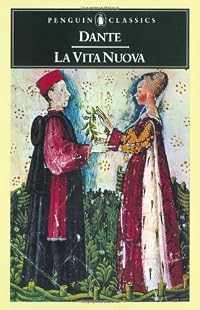
La Vita Nuova
by Dante Alighieri
On This Page
Description
Fall in love with love in this gorgeous collection of poems from Italian master Dante Alighieri, author of The Divine Comedy. Although collections of lyric poems singing the praises of love are as old as the written word, La Vita Nuova is remarkably innovative. Combining works in verse and prose in a linked series of pieces exploring the complexities of courtly love, this enchanting anthology is a must-read for poetry fans..
Tags
Recommendations

















Member Reviews
This was a great, first-person look at Dante's young life and his exposure to Beatrice- who permeated and influenced much of his work. The passion, trembling and careful, that he espouses onto the pages here is without measure in nearly all accounts that I have seen. This is seeing Dante's world through his own eyes and it is quite a portrait indeed. Through reading this, I was able to understand him a little better and that's a great thing when we are dealing with someone with such an important literary stature and importance.
4 stars.
4 stars.
Your sisters bringing messages of gladness;
And you, who are the daughter of my sadness,
Seek out their company, disconsolate.
Lovely structure and I applaud the Florentine when he isn’t burning sinners. The spirit and sense data are privileged over reason. Our boy is loopy over Beatrice. He drools and convulses in her presence. Composure is found afterwards and sonnets composed. He’s got it bad.
I won’t spoil the turn. Extreme emotion appears fairly uniform. That is a treatise all its own. As would be a song cycle from Beatrice’s perspective. The entire project reeks of dislocation, not yearning.
There’s an intriguing aside late in the text regarding the rise of vernacular poetry. It occurred so women could be wooed. Also show more ubiquitous is the number nine, though I fear if you played it backwards it would say turn me on, dead man, turn me on. If that isn’t a plea for Christ, I don’t know what is. I again offer apologies for my apostasy. show less
And you, who are the daughter of my sadness,
Seek out their company, disconsolate.
Lovely structure and I applaud the Florentine when he isn’t burning sinners. The spirit and sense data are privileged over reason. Our boy is loopy over Beatrice. He drools and convulses in her presence. Composure is found afterwards and sonnets composed. He’s got it bad.
I won’t spoil the turn. Extreme emotion appears fairly uniform. That is a treatise all its own. As would be a song cycle from Beatrice’s perspective. The entire project reeks of dislocation, not yearning.
There’s an intriguing aside late in the text regarding the rise of vernacular poetry. It occurred so women could be wooed. Also show more ubiquitous is the number nine, though I fear if you played it backwards it would say turn me on, dead man, turn me on. If that isn’t a plea for Christ, I don’t know what is. I again offer apologies for my apostasy. show less
A wonderful hybrid - part poetry, part prose narrative, part theological treatise, part literary criticism with a fascinating glimpse into the Dante creative process.
Everyone should take the chance to yell at a long-dead Florentine and call him a jackass; my edition is en face, which makes it much more fun, but regardless, I cannot be the only person to read this and boggle. Because, seriously, this is not a relationship, this is not even the relationship of a muse to an artist, this is pure symbolism and abstraction, and I keep getting so angry on Beatrice's behalf -- yes, I am projecting, thank you.
What I think I like best about this little book is the way the young Dante's character comes through – earnest, naive, idealistic. At least two things are happening here: he is describing his unrequited teenage love for Beatrice, and he is becoming a poet. Love and the desire to write about it are timeless, which is why the book still has the power to delight us today, more than seven centuries later. There is a spiritual allegory here as well, in the images of Love as a godlike figure who must be obeyed and the spiritualized Beatrice as an image of the pure virgin goddess/the Virgin Mary – all bound up in the tradition of courtly love. The poems (sonnets and canzoni) are lovely, and, in the Hesperus edition, impressively translated show more by J. G. Nichols. This edition also includes an engaging foreword by the novelist Louis de Bernières, who describes the importance the book had for him when he was himself a teenager, and a very helpful introduction by Nichols, who places the book in the context of the literary traditions of the 13th century. Although there is a certain repetitiveness in the narrative, and Dante's redundant "explanations" of his poems can become tedious, all in all this is a charming book. show less
Arguably the very best book of poetry I will ever read, though that's mostly because I hate poetry and love technical writer stuff. Seriously, the Lord of the Rings is about half as long for me as it was for it's author - I read perhaps two lines of poetry in the entire thing before giving up. Weirdly, the explanations in this one actually made me want to go back and read the poems.
Also awesome from a former-history-major standpoint. If you'd like to know how educated young people in the 13th century thought, it's a must-read.
I particularly appreciated my translator (Penguin Classics edition) - she didn't bother with "thee" and such, and made the whole thing a lot more accessible (and I say this as a girl who prefers her Bible to be the show more King James Version.) show less
Also awesome from a former-history-major standpoint. If you'd like to know how educated young people in the 13th century thought, it's a must-read.
I particularly appreciated my translator (Penguin Classics edition) - she didn't bother with "thee" and such, and made the whole thing a lot more accessible (and I say this as a girl who prefers her Bible to be the show more King James Version.) show less
თვითონ პოეზიასთან არ მაქვს არგუმენტები - მაინდამაინც ვერ ვერკვევი, მაგრამ აქ რა ლექსებიცაა ნამდვილად შთამბეჭდავად მეჩვენება! პროზაული ნაწილია ჩემთვის სუსტი, თანაც არა ფორმით (მაგარი პოეტი პროზაშიც მაგარია, თან მაინც XIII საუკუნეა ჯერ), არამედ შინაარსით - არ შემიძლია ამდენი შორით show more დაგვა და ღაწვთა ხოკვა, ნერვებს მიშლის :) show less
Members
- Recently Added By
Lists

Favourite Medieval Books
49 works; 17 members

Italian Literature
556 works; 38 members

Philip Ward's Lifetime Reading Plan
592 works; 22 members

Favorite Literary Love Stories
182 works; 101 members
Love and Marriage
93 works; 10 members

Harold Bloom - The Western Canon: B. The Aristocratic Age
231 works; 13 members

Folio Society
831 works; 53 members

How to Read a Book's Recommended Reading List
309 works; 10 members

Greatest Books, allegedly
484 works; 9 members

Las mejores obras literarias leídas en 2023 -- Excelentes (R. D.)
21 works; 1 member

Reading LIst
648 works; 1 member
Talk Discussions
Past Discussions
La Vita Nuova in Fine Press Forum (May 2023)
Author Information

Some Editions
Awards and Honors
Series
Belongs to Publisher Series
Work Relationships
Is contained in
Contains
Is abridged in
Inspired
Has as a student's study guide
Common Knowledge
- Canonical title
- La Vita Nuova
- Original title
- La vita nuova
- Alternate titles
- Vita Nova; The New Life
- Original publication date
- 1292
- People/Characters
- Dante Alighieri; Beatrice Portinari
- Important places
- Florence, Tuscany, Italy; Tuscany, Italy; Italy
- Important events
- 13th century; Middle Ages
- First words
- In quella parte del libro de la mia memoria dinanzi a la quale poco si potrebbe leggere, si trova una rubrica la quale dice: Incipit vita nova.
- Original language*
- Italiaans
*Some information comes from Common Knowledge in other languages. Click "Edit" for more information.
Classifications
- Genres
- Poetry, Fiction and Literature
- DDC/MDS
- 851.1 — Literature & rhetoric Italian, Romanian & related literatures Italian poetry Early Italian; Age of Dante –1375
- LCC
- PQ4315.58 .R4 — Language and Literature French, Italian, Spanish and Portuguese literatures Italian literature Individual authors and works to 1400
- BISAC
Statistics
- Members
- 2,572
- Popularity
- 7,354
- Reviews
- 28
- Rating
- (3.88)
- Languages
- 19 — Catalan, Czech, Danish, Dutch, English, Estonian, Finnish, French, German, Hungarian, Indonesian, Italian, Latin, Latvian, Multiple languages, Portuguese, Russian, Spanish, Swedish
- Media
- Paper, Audiobook, Ebook
- ISBNs
- 181
- UPCs
- 1
- ASINs
- 55