Leadership Secrets of Attila the Hun
by Wess Roberts
On This Page
Description
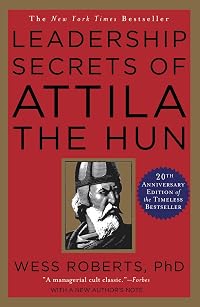
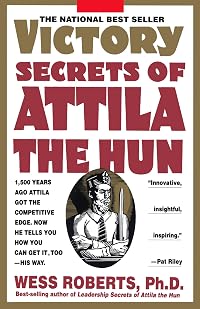
This is the book you've heard about. The book that leaped to the top ranks of the bestseller lists. The book that's got the business world reading, thinking, and quoting. This is the book that reveals the leadership secrets of Attila the Hun-the man who centuries ago shaped an aimless band of mercenary tribal nomads into the undisputed rulers of the ancient world, and who today offers us timeless lessons in win-directed, take-charge management.Tags
Recommendations










Member Reviews
This book is a fairly easy read. The author follows an interesting approach. Each chapter gives a small historical episode about Attila, then for the advice segment, where you get the lessons, he would set up little scenes of Attila talking to his chieftains. It is unlikely the great warrior sat around dispensing advice, but it makes for good reading, and it makes for a good way to get the lessons. Now, as for the lessons, much of it is common sense, but I can see how the book, at its time, was such a popular text for CEOs and executives. Too bad you can't deal with disloyal and disruptive people the way Attila advises (removal). And for me, there are a couple of gems here applicable to librarianship.
The central idea of this book - that Attila must've known something about people - is interesting. Roberts has a very modern interpretation of the history, which might be useful even if it's not true.
Most of the book is written in an aphoristic style, which seemed refreshing at first, but gradually made me wonder if I shouldn't be reading Sun Tzu instead (or eating fortune cookies.)
Oh, and fair warning: Roberts found his exclamation point key! And uses it! A lot! Just like the great Attila would!
Most of the book is written in an aphoristic style, which seemed refreshing at first, but gradually made me wonder if I shouldn't be reading Sun Tzu instead (or eating fortune cookies.)
Oh, and fair warning: Roberts found his exclamation point key! And uses it! A lot! Just like the great Attila would!
It's an interesting concept, but for me it failed in execution. Though far from our image of a heroic leader, Attila, the "Scourge of God," still must have had excellent charisma and leadership skills. This book uses his history as a device for framing a series of leadership messages. It didn't resonate with me. The lessons are too varied to carry any deep impact and not heavy enough for any substantial historic connection. Some of the lessons encourage cut-throat tactics we now associate with an older school of management.
Recently trolling the bargain audiobooks on Amazon, I came across two books on management from former generals: The Scourge of God (Attila the Hun), and the father of our country (George Washington). I thought it might be fun to compare and contrast what has been written about them.
The comparison will have to wait until later in the week when I finish the George Washington book. Meanwhile, Attila clocks in about half the size. While the great leader of the Huns left no documentation behind describing his management style, author Wess Roberts extrapolates from his deeds what Attila might have said addressing groups of chieftains or rising tribal leaders. He constructs parables from both Attila's many success and his greatest failure.
Each show more chapter begins with a little history lesson of what we know about Attila, and his adversaries, particularly the Roman general Aetius whose paths had intertwined since childhood. Attila did not seize power until relatively late in life, so is thought to have been wiser than some of the more rash tribal leaders. The Hun were a people, but also a collection of tribes, tribes that did not necessarily get along very well. Like departments in a corporation, Attila counsels them to put aside differences, engage in diplomacy, and attack the enemy only when it is the best remaining option. Through his unexpected death are cautioned that life is unpredictable, and when fate intervenes, new leadership must be installed quickly and decisively.
It all comes together as a little gimmicky in a fun way. Roberts leaves it to the readers to apply each chapter to their own situation, and I can imagine this leading to lively discussion in management workshops. There are no great revelations here -- most is common sense, but since corporations notoriously lack common sense, it makes for a good reminder.
Now we'll see what George has to say. show less
The comparison will have to wait until later in the week when I finish the George Washington book. Meanwhile, Attila clocks in about half the size. While the great leader of the Huns left no documentation behind describing his management style, author Wess Roberts extrapolates from his deeds what Attila might have said addressing groups of chieftains or rising tribal leaders. He constructs parables from both Attila's many success and his greatest failure.
Each show more chapter begins with a little history lesson of what we know about Attila, and his adversaries, particularly the Roman general Aetius whose paths had intertwined since childhood. Attila did not seize power until relatively late in life, so is thought to have been wiser than some of the more rash tribal leaders. The Hun were a people, but also a collection of tribes, tribes that did not necessarily get along very well. Like departments in a corporation, Attila counsels them to put aside differences, engage in diplomacy, and attack the enemy only when it is the best remaining option. Through his unexpected death are cautioned that life is unpredictable, and when fate intervenes, new leadership must be installed quickly and decisively.
It all comes together as a little gimmicky in a fun way. Roberts leaves it to the readers to apply each chapter to their own situation, and I can imagine this leading to lively discussion in management workshops. There are no great revelations here -- most is common sense, but since corporations notoriously lack common sense, it makes for a good reminder.
Now we'll see what George has to say. show less
An interesting take on leadership roles, advice, and leadership talk. Most of the advice in the book are common sense, practical things, that any leader should know. It's good to have these in one place, one source, for a new leader to read; but this isn't anything ultimately indispensable. Fun light read with an intriguing take on things, nothing more than that though really.
Found this among the sale books, it maybe the epitome of 1980s book of leadership "secrets," not much in the exploration of ideas or motivations just truisms. The greatest lessons not fully developed relate to the mentoring of leaders and the long term goals of society over short term goals. If you must read, read the first and last chapters, what lies in between is filler. I understand it's a book on leadership and not history, however it might have been more interesting if it contained a single foot or end note relating to sources.
Fast read, but no new info on leadership here.
1) Beyond a list of leadership qualities that you can adapt for any industry and argue they will lead to success, we are given bon mots like "you've got to want to lead" and "pick your enemies wisely".
2) Dress for the job you want, not the job you have. Be sure you conduct yourself accordingly, because you are always being watched.
3) Take responsibility, be decisive, delegate, negotiate, be resilient, and reward and recognize great performance. Learn from your failures, and move on.
I have just saved you an hour of reading time. Go forth and lead.
1) Beyond a list of leadership qualities that you can adapt for any industry and argue they will lead to success, we are given bon mots like "you've got to want to lead" and "pick your enemies wisely".
2) Dress for the job you want, not the job you have. Be sure you conduct yourself accordingly, because you are always being watched.
3) Take responsibility, be decisive, delegate, negotiate, be resilient, and reward and recognize great performance. Learn from your failures, and move on.
I have just saved you an hour of reading time. Go forth and lead.
Members
- Recently Added By
Lists

Very Very Bad
22 works; 7 members
Author Information

Awards and Honors
Distinctions
Common Knowledge
- Original publication date
- 1987
- People/Characters
- Attila the Hun
- First words
- Beginning as a vague idea some ten years before it commanded my full attention, "Leadership Secrets of Attila the Hun" occupied my early mornings, late nights and weekends for nearly a year. [Author's note, page ix]
- Last words
- (Click to show. Warning: May contain spoilers.)The consequence for not adequately training your Huns is their failure to accomplish that which is expected of them. [page 110]
- Blurbers
- Perot, H. Ross; Peters, Tom; Dyer, Wayne W.; Coors, William K.; DeGarmo, Scott; Schuller, Robert H. (show all 22); Waitley, Denis; Patterson, James B.; Crandall, R. J.; Koopman, George; Theismann, Joe; Kiam, Victor; Riley, Pat; Charan, Ram; Augustine, Norman R.; Qubein, Nido J.; Calhoun, Jr., Andrew P.; Zalecki, Paul H.; Bahnsen, John C. "Dow"; LeBouef, Michael; Lee, Albert; Blanchard, Ken
Classifications
Statistics
- Members
- 813
- Popularity
- 34,143
- Reviews
- 12
- Rating
- (3.16)
- Languages
- Dutch, English, Italian, Spanish
- Media
- Paper, Audiobook, Ebook
- ISBNs
- 18
- ASINs
- 14