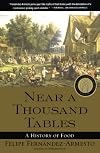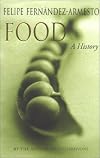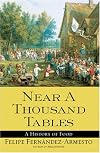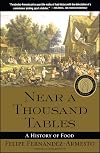
Near a Thousand Tables: A History of Food
by Felipe Fernández-Armesto
On This Page
Description
Explores eight milestones in the cultural and culinary history of food, including the origins of cooking, the ritualization of eating, the inception of herding, the invention of agriculture, the rise of the class system, food trade, ecological exchanges, and the industrialization and globalization of food.Tags
Recommendations


















Member Reviews
I read this book back in 2003. Here is what I wrote in my journal at the time:
>>Finished reading Fernandez-Armesto's Near a Thousand Table. This history of food is a book to be savored; it is not fast paced, but it is a book with interesting content. The book is arranged on the basis of major revolutions in food history, but then we get to see how these revolutions affected human history. Some of these revolutions include the concept of cooking, the idea of eating as having ritualistic significance, and the idea of food consumption as a social marker (the concept of haute cuisine falls into this). A particularly interesting idea for me was the author's link between cannibals and vegans. Cannibals in ancient and primitive cultures would show more consume their slain enemies in order to gain their strength or bravery. Vegans eat vegetables in order to improve their health, and it can also have a spiritual angle. The common idea is that both consume food in order to improve their bodies and spirits. Also interesting to read were the narratives of food travels from one continent to another, and how this shaped history. Overall, this would be a book I would strong recommend. A similar title would be Jared Diamond's Guns, Germs, and Steel.
Today, I would add that a book like Cognac, which I have reviewed here, would be in a similar vein as well. show less
>>Finished reading Fernandez-Armesto's Near a Thousand Table. This history of food is a book to be savored; it is not fast paced, but it is a book with interesting content. The book is arranged on the basis of major revolutions in food history, but then we get to see how these revolutions affected human history. Some of these revolutions include the concept of cooking, the idea of eating as having ritualistic significance, and the idea of food consumption as a social marker (the concept of haute cuisine falls into this). A particularly interesting idea for me was the author's link between cannibals and vegans. Cannibals in ancient and primitive cultures would show more consume their slain enemies in order to gain their strength or bravery. Vegans eat vegetables in order to improve their health, and it can also have a spiritual angle. The common idea is that both consume food in order to improve their bodies and spirits. Also interesting to read were the narratives of food travels from one continent to another, and how this shaped history. Overall, this would be a book I would strong recommend. A similar title would be Jared Diamond's Guns, Germs, and Steel.
Today, I would add that a book like Cognac, which I have reviewed here, would be in a similar vein as well. show less
Such. A. Slow. Read.
With just 224 pages of text, you would think this would go quickly. But oh the writing. Though this book is very generalized (obviously, 224 pages for a history of food?), the writing style is still very dry and academic. It absolutely does not flow well--each paragraph tends to be an example, so each paragraph means trying to figure out how it relates to the section and chapter topics.
But, I'm done. It was interesting, but I don't think I'll be reading anything else by this author.
With just 224 pages of text, you would think this would go quickly. But oh the writing. Though this book is very generalized (obviously, 224 pages for a history of food?), the writing style is still very dry and academic. It absolutely does not flow well--each paragraph tends to be an example, so each paragraph means trying to figure out how it relates to the section and chapter topics.
But, I'm done. It was interesting, but I don't think I'll be reading anything else by this author.
This is a fairly good overview of the history and social history of food. The author covers a series of revolutions or evolutions, from the invention of cooking using fire – separating us from animals, to the establishment of agriculture and herding – the domestication of both livestock and crop is seen as crucial, the rise of ritualistic/magical connotations of eating, through food as a reflection of social differentiation and the current industrialization of food production.
I found this quite informative, and the author makes a compelling case for each of his stages. It was quite surprising to read about what our ancestors ate – from the hominids to Roman reveler and sailors. The food, the dishes and the tastes are fairly well show more described but the author could have been clearer in his writing, and who the hell knows what 'calid' means and why is it used so often in this book? show less
I found this quite informative, and the author makes a compelling case for each of his stages. It was quite surprising to read about what our ancestors ate – from the hominids to Roman reveler and sailors. The food, the dishes and the tastes are fairly well show more described but the author could have been clearer in his writing, and who the hell knows what 'calid' means and why is it used so often in this book? show less
A disappointing cavalcade of facts with little novelty & no unifying big idea.
Read Aug 2006
Read Aug 2006
To investigate: Were Snails among the first cultivated/ grown foods? (also Oysters)
Un grande viaggio attraverso il compagno della storia dell’uomo: il cibo. Con passaggi verticali, attraverso il tempo, ed orizzontali, lungo la terra. Arnesta punta con tutta evidenza ad un lavoro di tipo divulgativo, privilegiando la freschezza della lettura all’approfondimento tematico. E lo fa con ottimi risultati. Dal cibo crudo, bacche, carne e pesce, al sushi ed alla tartare ci sono decine di migliaia di anni. E nei secoli l’uomo, spesso contestualmente in tutto il mondo, ha adeguato la sua vita alle modalità di raccolta e di cucina del cibo. Le armi per la caccia, gli strumenti per la pastorizia e per l’agricoltura. E poi la navigazione e la pesca, ed ancora le tecniche di osservazione dell’essiccamento al vento e del show more congelamento. Con una prospettiva sul futuro, sulla necessità di sfamare chi, degnamente o indegnamente, occupa questo straordinario pianeta e dallo stesso deve trovare i mezzi per andare avanti. Serve mandarlo indietro. Un bel libro, senza troppe pretese. show less
Aug 29, 2020Italian
Members
- Recently Added By
Lists

Books discovered on LibraryThing
256 works; 35 members

Books We Discovered On LibraryThing
530 works; 130 members
Author Information

65+ Works 6,148 Members
Felipe Fernandez-Armesto, a world-renowed scholar and author, is the Principe de Asturias Professor of Spanish Culture and Civilization at Tufts University
Awards and Honors
Series
Belongs to Publisher Series
Los 5 sentidos (38)
Common Knowledge
- Original title
- Food: A History
- Alternate titles
- Near a Thousand Tables: A History of Food
- Original publication date
- 2001
Classifications
- Genres
- History, Nonfiction, Anthropology, General Nonfiction, Food & Cooking
- DDC/MDS
- 641.3009 — Applied science & technology Home economics & family management Food, Cooking & Recipes / Meals, Picnics Food History, geographic treatment, biography
- LCC
- TX353 .F437 — Technology Home economics Home economics Nutrition. Foods and food supply
- BISAC
Statistics
- Members
- 620
- Popularity
- 46,875
- Reviews
- 7
- Rating
- (3.67)
- Languages
- 5 — English, Italian, Polish, Portuguese, Spanish
- Media
- Paper, Ebook
- ISBNs
- 11
- ASINs
- 2