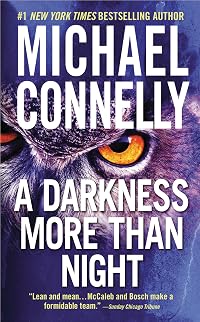
A Darkness More Than Night
by Michael Connelly
Terry McCaleb (2), Harry Bosch (7), Harry Bosch Universe (9)
On This Page
Description
LAPD Detective Harry Bosch crosses paths with FBI profiler Terry McCaleb in the most dangerous investigation of their lives.Harry Bosch is up to his neck in a case that has transfixed all of celebrity-mad Los Angeles: a movie director is charged with murdering an actress during sex, and then staging her death to make it look like a suicide. Bosch is both the arresting officer and the star witness in a trial that has brought the Hollywood media pack out in full-throated frenzy.
Meanwhile, show more Terry McCaleb is enjoying an idyllic retirement on Catalina Island when a visit from an old colleague brings his former world rushing back. It's a murder, the unreadable kind of murder he specialized in solving back in his FBI days. The investigation has stalled, and the sheriff's office is asking McCaleb to take a quick look at the murder book to see if he turns up something they've missed.
McCaleb's first reading of the crime scene leads him to look for a methodical killer with a taste for rituals and revenge. As his quick look accelerates into a full-sprint investigation, the two crimes - his murdered loner and Bosch's movie director - begin to overlap strangely. With one unsettling revelation after another, they merge, becoming one impossible, terrifying case, involving almost inconceivable calculation. McCaleb believes he has unmasked the most frightening killer ever to cross his sights. But his investigation tangles with Bosch's lines, and the two men find themselves at odds in the most dangerous investigation of their lives. show less
Tags
Recommendations
Member Reviews
Terry McCaleb is done with his profiling days - he lives on Catalina island, has a daughter now and he is running fishing tours out from Catalina and he does not want to hear about serial killers anymore. Except that the universe and his old colleagues missed the memo - so he gets asked to just look at a case, almost for old times sake. Which is the last thing you do to a man who used to love his job.
Meanwhile, in LA proper, Harry Bosch is stuck in a courtroom, trying to assist the prosecution win its case against a murderer. The trial is in the news - the accused is a famous movie director, the victim is a wannabe actress and that makes everyone in tinsel town pay attention - one way or another, Hollywood will find a way to thrive on show more that.
The two cases do not seem to have anything in common at the start but then they would not be in the same book if they did not - and before long McCaleb builds a profile that matches Bosch. And with Harry being everyone's favorite in the police department (not), it comes down to the accused himself to try to clear his own name.
It is a tightly plotted novel and the "detective is accused in the crime" trope appears in most detective series sooner or later. This one was done well - using McCaleb made it look less as a hatchet job and more of a real possibility for awhile. The fact that it did not seem to be connected to Bosch's case also helped although if one had read enough novels in the genre, it was obvious that they must intersect somewhere. The appearance of Jack McEvoy and his role in the whole thing reinforced the idea that all of Connelly's series are essentially part of a mega-series and a shared universe and you can expect anyone to pop up in any of the novels.
While the end of the case was expected (even of how we got there was somewhat unorthodox), the end of the novel threw yet another curve ball at the reader. As is often the case, white and black do not exist when people are concerned and even if Bosch was not a killer, he was not entirely innocent either.
Another strong novel in the Bosch mega-series. show less
Meanwhile, in LA proper, Harry Bosch is stuck in a courtroom, trying to assist the prosecution win its case against a murderer. The trial is in the news - the accused is a famous movie director, the victim is a wannabe actress and that makes everyone in tinsel town pay attention - one way or another, Hollywood will find a way to thrive on show more that.
The two cases do not seem to have anything in common at the start but then they would not be in the same book if they did not - and before long McCaleb builds a profile that matches Bosch. And with Harry being everyone's favorite in the police department (not), it comes down to the accused himself to try to clear his own name.
It is a tightly plotted novel and the "detective is accused in the crime" trope appears in most detective series sooner or later. This one was done well - using McCaleb made it look less as a hatchet job and more of a real possibility for awhile. The fact that it did not seem to be connected to Bosch's case also helped although if one had read enough novels in the genre, it was obvious that they must intersect somewhere. The appearance of Jack McEvoy and his role in the whole thing reinforced the idea that all of Connelly's series are essentially part of a mega-series and a shared universe and you can expect anyone to pop up in any of the novels.
While the end of the case was expected (even of how we got there was somewhat unorthodox), the end of the novel threw yet another curve ball at the reader. As is often the case, white and black do not exist when people are concerned and even if Bosch was not a killer, he was not entirely innocent either.
Another strong novel in the Bosch mega-series. show less
This seventh book in Michael Connelly’s Harry Bosch series was a strange experience for me: first because it is a sort of crossover with some of his other works, given that there is an extended cameo appearance for Jack McEvoy, who I previously met in The Poet, and a co-starring role for Terry McCaleb, retired FBI profiler who first appeared in Blood Work, a book I did not read but whose story I’m familiar with thanks to the 2002 movie, starring Clint Eastwood, which I happened to see some time ago. The other difference with previous Harry Bosch books I’ve read comes from the fact that here the LAPD detective has a less active role than usual and the bulk of the investigative process is left in the hands of McCaleb. Still, this show more odd combination works, creating a suspenseful framework that kept my attention riveted from start to finish, even though - as it happened with the previous books - I was aware of the general narrative threads thanks to the TV series that propelled me toward these novels since last year.
Harry Bosch is heavily involved in the trial of David Storey, a movie director accused of the murder of a young actress he strangled during sex, then taking her body home and staging an apparent suicide. Meanwhile, Detective Winston of the LAPD is dealing with the murder of a lowlife named Edward Gunn, whose strangely ritualistic details have her so baffled that she seeks the advice of Terry McCaleb, once a noted FBI profiler but now retired after a massive heart attack and subsequent transplant. When McCaleb discovers that Bosch had been watching Gunn for some time looking for the evidence of a crime, and that some of the grisly details of the murder link back to the works of Dutch painter Hieronymus Bosch, after whom the detective is named, he becomes convinced that Harry murdered Gunn in an act of deranged vengeance - and he’s determined to get to the bottom of it, as the two narrative threads of the story become dramatically entangled.
As I stated above, this novel has a peculiar flavor if compared with the previous ones, mostly because Harry Bosch here looks more like a guest star and Terry McCaleb is the front and center character, and for once it’s odd to see Harry not taking part in an investigation, although I have to say that the courtroom scenes where he finally enjoys the spotlight are among the best segments of the book: Connelly takes us through the sometimes painstaking details of the judicial process with such a flair that these sections are as engaging and thrilling as action scenes and they actually infuse some vitality in what had been something of a slow start with McCaleb’s part of the story. Moreover, this change in perspective allows us to see another side of Harry Bosch - or maybe the evolution of his personality that started with the previous book: even though he’s still quite determined (or dogged, some would say), he looks more grounded, less prone to stormy outbursts, and instead focuses more closely on getting things done the right way to insure that the guilty face the justice they deserve. He’s still somewhat cynical about the system and the loopholes it offers to offenders, but he looks better inclined than before to stay within the rules to get the desired results.
On the other hand, I was dubious about McCaleb as a character, given that for someone who used to be a successful profiler he seems to fall far too easily for what is clearly a frame-up: even discarding the fact that we readers know intuitively that Bosch could not have murdered Gunn, because that’s not his style, the clues left in Gunn’s murder scene, those references pointing toward Bosch the painter and the punishments for sinners depicted in his works, everything looks contrived and - as detective Winston points out - plainly foolish for Harry to leave such a trail of breadcrumbs leading back to him. But McCaleb is so determined to follow his instinct that he chooses to ignore the obvious: this led me to wonder whether he truly was such a great profiler or if he rather wanted so badly to be once again in the “game” that he preferred to shoehorn the evidence into his choice framework rather than collecting it and then, and only then, assembling the whole picture. Or maybe he wants so badly to reconnect with the past he clearly misses so much, that he’s ready to ignore reason and listen only to that instinct that used to serve him so well once - a that now does not seem to work that well. This single focus that at times looks close to obsession did little to endear his character to me, and even later, when he understands he might have been barking up the proverbial wrong tree, I struggled to change my opinion and to see him in a better light.
Still, the conflict between these two different individuals drives the story just as much as the two narrative threads at its root, evolving into a novel that is compellingly fast-paced, its two halves merging into one another with effortless ease and showing once again the dark side of a city where glamor and glitter hide corruption and darkness more often than not. Showing also how Michael Connelly’s writing and plotting skills kept improving as he moved forward with this series, which to date remains one of my go-to choices when I am in the mood for some engaging thriller. show less
Harry Bosch is heavily involved in the trial of David Storey, a movie director accused of the murder of a young actress he strangled during sex, then taking her body home and staging an apparent suicide. Meanwhile, Detective Winston of the LAPD is dealing with the murder of a lowlife named Edward Gunn, whose strangely ritualistic details have her so baffled that she seeks the advice of Terry McCaleb, once a noted FBI profiler but now retired after a massive heart attack and subsequent transplant. When McCaleb discovers that Bosch had been watching Gunn for some time looking for the evidence of a crime, and that some of the grisly details of the murder link back to the works of Dutch painter Hieronymus Bosch, after whom the detective is named, he becomes convinced that Harry murdered Gunn in an act of deranged vengeance - and he’s determined to get to the bottom of it, as the two narrative threads of the story become dramatically entangled.
As I stated above, this novel has a peculiar flavor if compared with the previous ones, mostly because Harry Bosch here looks more like a guest star and Terry McCaleb is the front and center character, and for once it’s odd to see Harry not taking part in an investigation, although I have to say that the courtroom scenes where he finally enjoys the spotlight are among the best segments of the book: Connelly takes us through the sometimes painstaking details of the judicial process with such a flair that these sections are as engaging and thrilling as action scenes and they actually infuse some vitality in what had been something of a slow start with McCaleb’s part of the story. Moreover, this change in perspective allows us to see another side of Harry Bosch - or maybe the evolution of his personality that started with the previous book: even though he’s still quite determined (or dogged, some would say), he looks more grounded, less prone to stormy outbursts, and instead focuses more closely on getting things done the right way to insure that the guilty face the justice they deserve. He’s still somewhat cynical about the system and the loopholes it offers to offenders, but he looks better inclined than before to stay within the rules to get the desired results.
On the other hand, I was dubious about McCaleb as a character, given that for someone who used to be a successful profiler he seems to fall far too easily for what is clearly a frame-up: even discarding the fact that we readers know intuitively that Bosch could not have murdered Gunn, because that’s not his style, the clues left in Gunn’s murder scene, those references pointing toward Bosch the painter and the punishments for sinners depicted in his works, everything looks contrived and - as detective Winston points out - plainly foolish for Harry to leave such a trail of breadcrumbs leading back to him. But McCaleb is so determined to follow his instinct that he chooses to ignore the obvious: this led me to wonder whether he truly was such a great profiler or if he rather wanted so badly to be once again in the “game” that he preferred to shoehorn the evidence into his choice framework rather than collecting it and then, and only then, assembling the whole picture. Or maybe he wants so badly to reconnect with the past he clearly misses so much, that he’s ready to ignore reason and listen only to that instinct that used to serve him so well once - a that now does not seem to work that well. This single focus that at times looks close to obsession did little to endear his character to me, and even later, when he understands he might have been barking up the proverbial wrong tree, I struggled to change my opinion and to see him in a better light.
Still, the conflict between these two different individuals drives the story just as much as the two narrative threads at its root, evolving into a novel that is compellingly fast-paced, its two halves merging into one another with effortless ease and showing once again the dark side of a city where glamor and glitter hide corruption and darkness more often than not. Showing also how Michael Connelly’s writing and plotting skills kept improving as he moved forward with this series, which to date remains one of my go-to choices when I am in the mood for some engaging thriller. show less
No offense, Mr. Connelly, but I'm not too keen on your other tent-pole characters. Here, Terry McCaleb returns, he who was made famous by Clint's portrayal in the [Blood Work] film. Since being medically retired from the FBI, McCaleb's become a fishing boat captain with an urge to profile in criminal investigations, his old job with the Bureau. When a cop brings him a file, Bosch seems in the frame, and Bosch plays along until the very end when he turns the table on the real baddie. Another thing I didn't like here was the dissimulation and manipulation from Bosch. Sure, here's playing the bad guys like a cheap French horn, but it doesn't fit. Bosch is nothing if not a straight at you kinda guy, and this feels like an attempt by show more Connelly to force some darkness into Bosch. He doesn't need to work at that, the character is already plenty dark. Not my favorite in the series.
3 1/2 bones!!!!
Recommended only for the completist. show less
3 1/2 bones!!!!
Recommended only for the completist. show less
A Darkness More Than Night is a fascinating and compelling entry in Michael Connelly’s Harry Bosch/contemporary-noir series. Connelly reframes the ordinary murder mystery setup in an unusual way: Bosch is tied up in court, and instead of tracking down the bad guys, he unknowingly becomes a suspect himself in a killing that’s got ‘avenging angel’ written all over it. This twist sounds forced, but Connelly executes it neatly, with sometimes-protagonist Terry McCaleb brought into the story to do the legwork. Very enjoyable, and highly recommended.
Retired FBI agent Terry McCaleb is approached by a LAPD detective to consult on a murder case that has overtones of a serial killer. The victim was a criminal named Gunn who had previously been questioned by McCaleb's old friend, Detective Harry Bosch, about the death of a prostitute. After viewing the videotape of the murder scene and reading through the police reports McCaleb gets a terrible feeling that Bosch may have meted out his own justice to Gunn who had beaten the rap of murder in the prostitue case. Bosch, meanwhile, is a witness in a high profile case involving a wealthy movie producer who has been accused of killing a young starlet during a night of passion. McCaleb secretely investigates Bosch but when his query is leaked show more to a reporter Bosch and McCaleb find themselves on opposite sides of the case. The criminal investigation into Bosch could also cause problems with the case in which he is a witness. Did Harry commit the crime?
This was an interesting story of how two old friends become antagonists although they both want the same end result. There was so much going on at times and so many characters to keep straight that I had a hard time following the plot line at times. Being a steadfast lover of Harry Bosch stories it was a bit strange to think he might be a bad guy for a change! show less
This was an interesting story of how two old friends become antagonists although they both want the same end result. There was so much going on at times and so many characters to keep straight that I had a hard time following the plot line at times. Being a steadfast lover of Harry Bosch stories it was a bit strange to think he might be a bad guy for a change! show less
Listened to the audiobook. Had a major problem with the voice the actor chose to use for Bosch, too Popeye-sounding, but aside from that, this is another excellent mistery thriller by one of the very best authors of this genre. The best one I know, for sure.
Another minor issue I had concerns the plot: I found it too hard to believe that McCaleb would buy so easily into Bosch as a murder suspect, when the murder was such an obvious set up. It just didn't work very well for me that he wouldn't just start hunting down on the "set up" theory and give it the predominance that it would realistically have had. The question "why on Earth would Bosch have linked the murder to his own name??" comes out only once and without the strength that it show more should have had.
I guess one of the problems when reading these extremely realistic-feeling procedural books is that I forget it's fiction, and as a reader I need to remember to give them some slack! show less
Another minor issue I had concerns the plot: I found it too hard to believe that McCaleb would buy so easily into Bosch as a murder suspect, when the murder was such an obvious set up. It just didn't work very well for me that he wouldn't just start hunting down on the "set up" theory and give it the predominance that it would realistically have had. The question "why on Earth would Bosch have linked the murder to his own name??" comes out only once and without the strength that it show more should have had.
I guess one of the problems when reading these extremely realistic-feeling procedural books is that I forget it's fiction, and as a reader I need to remember to give them some slack! show less
Mi spiace aver dovuto dare tre stelline a Connelly, che di solito mi piace abbastanza, per un libro che pure è, come sempre, teso e ben scritto, ma il meccanismo questa volta è leggermente inceppato, e solo personaggi di una estrema ingenuità potrebbero credere alla messa in scena che è il cuore del meccanismo narrativo, e i personaggi di Connelly invece non lo sono ...
Members
- Recently Added By
Lists

Best Crime Fiction
262 works; 39 members

Top Cops (Detectives in Fiction)
86 works; 24 members

Books Read in 2017
4,249 works; 130 members

Books Read in 2009
464 works; 11 members

Books Read in 2018
4,360 works; 110 members

Books - Connolly, Michael: Bosch
44 works; 1 member
Author Information

160+ Works 154,697 Members
Michael Connelly was born in Philadelphia, Pennsylvania on July 21, 1956. He graduated from the University of Florida in 1980 where he majored in journalism and minored in creative writing. After graduation, he worked at newspapers in Daytona Beach and Fort Lauderdale, Florida, specializing in the crime beat. In 1986, he interviewed survivors of a show more plane crash with two other reporters and the magazine story subsequently written on the crash was on the short list for the Pulitzer Prize for feature writing. This story led to a job as a crime reporter for the Los Angeles Times. After three years there, he began writing his first novel. His first novel, The Black Echo, was published in 1992 and won the Edgar Award for best first novel. He is the author of the Harry Bosch series, the Jack McEvoy series, and the Mickey Haller series. He has won numerous awards including the Anthony Award, Macavity Award, Shamus Award, Dilys Award, Nero Award, Barry Award, Ridley Award, Maltese Falcon Award (Japan), .38 Caliber Award (France), Grand Prix Award (France), Premio Bancarella Award (Italy), and the Pepe Carvalho Award (Spain). (Bowker Author Biography) show less
Some Editions
Awards and Honors
Awards
Distinctions
Series


Belongs to Publisher Series
Work Relationships
Is contained in
Jack McEvoy Appearances: The Poet / A Darkness More Than Night / The Brass Verdict / The Scarecrow by Michael Connelly
Terry McCaleb Appearances: Blood Work / A Darkness More Than Night / The Narrows by Michael Connelly
The Black Echo / The Black Ice / The Concrete Blonde / The Last Coyote / The Poet / Trunk Music / Blood Work / Angels Flight / Void Moon / A Darkness More Than Night / City of Bones / Lost Light / The Narrows / The Closers / The Lincoln Lawyer / Echo Park / The Overlook / The Brass Verdict / Nine Dragons / The Reversal by Michael Connelly
Has the (non-series) prequel
Common Knowledge
- Canonical title
- A Darkness More Than Night
- Original title
- A DARKNESS MORE THAN NIGHT
- Original publication date
- 2001
- People/Characters
- Hieronymus 'Harry' Bosch; Janis Langwiser; Kizmin 'Kiz' Rider; Jerry Edgar; Terry McCaleb; Graciela McCaleb (show all 23); Cielo 'CiCi' Azul; Raymond; Buddy Lockridge; Jaye Winston; Kurt Mintz; Jack McEvoy; John A. Houghton; John Reason Fowkkes; Annabelle Crowe; David N. Storey; Jody Krementz (Donatella Speers); Rudy Tafero; Jesse Tafero; Don Twilley; Marcus Friedman; Teresa Corazón; Edward Gunn
- Important places
- California, USA; Los Angeles, California, USA
- Dedication
- This is for Mary and Jack Lavelle, who provded there are second acts.
- First words
- Bosch looked through the small square of glass and saw that the man was alone in the tank.
- Last words
- (Click to show. Warning: May contain spoilers.)Tears started to roll down his cheeks. Soon the wind off the water dried them on his face.
- Original language
- English
Classifications
Statistics
- Members
- 4,706
- Popularity
- 3,064
- Reviews
- 87
- Rating
- (3.83)
- Languages
- 15 — Czech, Danish, Dutch, English, Estonian, Finnish, French, German, Hungarian, Italian, Portuguese, Spanish, Swedish, Thai, Turkish
- Media
- Paper, Audiobook, Ebook
- ISBNs
- 103
- UPCs
- 5
- ASINs
- 44