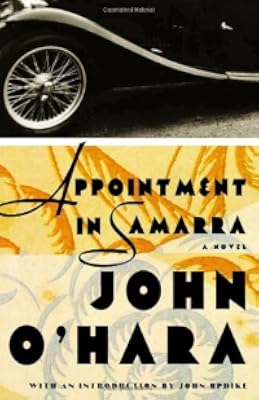
Appointment in Samarra
by John O'Hara
On This Page
Description
"In December 1930, just before Christmas, the Gibbsville, Pennsylvania, social circuit is electrified with parties and dances. At the center of the social elite stand Julian and Caroline English. But in one rash moment born inside a highball glass, Julian breaks with polite society and begins a rapid descent toward self-destruction"--Amazon.com.Tags
Recommendations










Member Recommendations
Member Reviews
Once things start unraveling for Julian English, the tragic hero of this small-town hero-to-zero tale, they do so exponentially. The pacing here is terrific — somehow English's decline spins out of control against the oh-so-static backdrop of the well-to-do set he's a part of. So there's a frantic kind of parallax going on as the more things change for Julian, the more they stay the same for everyone else. This is an essential entry in the canon of self-destruction imo, because of course there's no real reason why it has to happen — like the scariest downward-spirals, it just has to be that way.
Also a very interesting book for the way it portrays its characters' sex-lives. It's realistic and mature, even by today's standards I think.
Also a very interesting book for the way it portrays its characters' sex-lives. It's realistic and mature, even by today's standards I think.
If Ernest Hemingway had written The Great Gatsby, it might have come out something like this. It's brilliantly done, but I didn't like it, if you know what I mean. The characters are virtually soul-less, but some of them almost grasp what's missing in their lives. For the most part, they haven't a clue what to do about it, other than to keep throwing parties and observing the strict social rules that structure their WASP existence. These are not the filthy rich of the Hamptons, but the middle class well-off's of small town America. Full of ironies and very well-executed scenes --I've never read a better portrayal of a man slipping into inebriated blabbering anywhere. I give it a solid 3 1/2 stars, and recommend wider readership for John show more O'Hara. show less
A sort of inverted The Scarlet Letter peopled by dreary snobs, John O'Hara's Appointment in Samarra is a decent – though limited – idea let down by the author's indulgence and ennui; a long-winded joke that I was tired of long before the punchline.
Set in Christmas 1930 amongst the well-to-do WASPs of a Pennsylvania milieu, O'Hara's novel begins with an epigraph quoting W. Somerset Maugham's 'Appointment in Samarra' fable, about a man who flees to the town of Samarra after seeing the Grim Reaper in a Baghdad marketplace. When questioned on this, the Grim Reaper expresses bemusement, because he had not expected to see him in Baghdad: they had an appointment in Samarra. O'Hara's novel is pretty much a mechanism reiterating this tale, show more but whereas Maugham told it succinctly and evocatively in a single paragraph, O'Hara drags it out to novel length and to lesser effect.
In O'Hara's version, a slight, vain, upper-class wet named Julian English has a moment of pique at a dinner party, and throws his drink in the face of one of his peers, Harry Reilly. Julian then suffers the banal fallout of this act – amounting to some mild and ineffectual disapproval from his social circle – but, tying himself in knots over this nonsense and fearing retaliation from the well-connected Harry, Julian begins a downward spiral. Fulfilling the twist of the 'Appointment in Samarra' fable, there's a rewarding moment of bathos at the end as it turns out a bemused Harry has not been plotting any revenge at all, and still thinks relatively highly of Julian – on the rare occasions he thinks of him at all.
It's a cute idea, but O'Hara is painfully serious about the whole thing. If you read a biography of the author, he comes across as an inveterate and insufferable snob, and this also comes across in Appointment in Samarra. The depiction of Julian's social scene – with the town of Gibbsville being a fictional carbon-copy of the town O'Hara himself was raised in – would only really be tolerable if there was an element of satire to it, whether black or comic, but there is none. Instead, there is an indulgent morass of WASP frippery, some inconsequential writerly tangents that any merciful editor would have excised, and scarce few characters who transcend the cardboard cutouts O'Hara has designated for them. The book is quite well-written but the indulgence spoils it, and the ending is anti-climactic. Appointment in Samarra might be respectable enough, but it is disappointing and doesn't reward the amount of effort one must put into it. A largely shallow tale about some shallow people. show less
Set in Christmas 1930 amongst the well-to-do WASPs of a Pennsylvania milieu, O'Hara's novel begins with an epigraph quoting W. Somerset Maugham's 'Appointment in Samarra' fable, about a man who flees to the town of Samarra after seeing the Grim Reaper in a Baghdad marketplace. When questioned on this, the Grim Reaper expresses bemusement, because he had not expected to see him in Baghdad: they had an appointment in Samarra. O'Hara's novel is pretty much a mechanism reiterating this tale, show more but whereas Maugham told it succinctly and evocatively in a single paragraph, O'Hara drags it out to novel length and to lesser effect.
In O'Hara's version, a slight, vain, upper-class wet named Julian English has a moment of pique at a dinner party, and throws his drink in the face of one of his peers, Harry Reilly. Julian then suffers the banal fallout of this act – amounting to some mild and ineffectual disapproval from his social circle – but, tying himself in knots over this nonsense and fearing retaliation from the well-connected Harry, Julian begins a downward spiral. Fulfilling the twist of the 'Appointment in Samarra' fable, there's a rewarding moment of bathos at the end as it turns out a bemused Harry has not been plotting any revenge at all, and still thinks relatively highly of Julian – on the rare occasions he thinks of him at all.
It's a cute idea, but O'Hara is painfully serious about the whole thing. If you read a biography of the author, he comes across as an inveterate and insufferable snob, and this also comes across in Appointment in Samarra. The depiction of Julian's social scene – with the town of Gibbsville being a fictional carbon-copy of the town O'Hara himself was raised in – would only really be tolerable if there was an element of satire to it, whether black or comic, but there is none. Instead, there is an indulgent morass of WASP frippery, some inconsequential writerly tangents that any merciful editor would have excised, and scarce few characters who transcend the cardboard cutouts O'Hara has designated for them. The book is quite well-written but the indulgence spoils it, and the ending is anti-climactic. Appointment in Samarra might be respectable enough, but it is disappointing and doesn't reward the amount of effort one must put into it. A largely shallow tale about some shallow people. show less
Julian English seems to have everything: a gorgeous (and smart) wife, a good job, wealth and glamour. But his actions at a party one night cause his near-perfect life to begin unraveling, and readers soon see that his reality is quite far from perfect.
O'Hara was a contemporary of and often compared to F. Scott Fitzgerald, and truthfully I was often comparing this story in my head with The Great Gatsby. Oddly enough, I may even have liked it better. Maybe because their glitzy country club life was a little more small-town than New York, maybe because I felt like the characters had foibles that I could forgive a little more than Gatsby's. Certainly no one is on a pedestal in this story, which is introduced by the short story "Appointment show more in Samarra" by W. Somerset Maugham and addresses the inevitability of fate. Though the essential action takes place over three days of Christmas 1930, many times we get a glimpse of past events in several characters' lives, helping us see how everything came together in just this way. I didn't always like what happened but couldn't imagine things ending up any other way, and that's about the highest compliment I can give a writer. show less
O'Hara was a contemporary of and often compared to F. Scott Fitzgerald, and truthfully I was often comparing this story in my head with The Great Gatsby. Oddly enough, I may even have liked it better. Maybe because their glitzy country club life was a little more small-town than New York, maybe because I felt like the characters had foibles that I could forgive a little more than Gatsby's. Certainly no one is on a pedestal in this story, which is introduced by the short story "Appointment show more in Samarra" by W. Somerset Maugham and addresses the inevitability of fate. Though the essential action takes place over three days of Christmas 1930, many times we get a glimpse of past events in several characters' lives, helping us see how everything came together in just this way. I didn't always like what happened but couldn't imagine things ending up any other way, and that's about the highest compliment I can give a writer. show less
Most people will be familiar with the parable that the title alludes to, in which a man, encountering death in a Baghdad bazaar, immediately flees to the distant city of Samarra in hopes of eluding his fate ... only to find death waiting for him there, explaining: "I, too, was surprised to encounter you at the market, as our appointment was always in Samarra." The idea being that there's no escaping fate once it has you in its sites.
This is certainly the plight of Julian English, the protagonist of this tale of upper middle class WASPS in 1930s Gibbsville, Illinois. Julian's the owner of a prosperous Cadillac dealership, husband to a wife who genuinely loves him (in her whiny 1930s way), with a social life that revolves around the local show more country club and its WASPy members. But in the course of an eventful two days, fate relentlessly hunts our golden boy down, the result of a combination of misbehaviour, mischance, misapprehension, and not an insignificant measure of hubristic overreach, as Julian (along with many other characters in this novel) consistently reaches for more than he needs or wants.
O'Hara's claim to fame is that he was, at one time, the most prolific contributor of tales to the New Yorker magazine, and boy does this read like something Woody Allen would pen. It's well written and crafted, but the incessant whininess of the characters can get a little fatiguing. With the exception of a subplot involving a low-level hood named Al Grecco, everyone here is dealing with WASP-y first-world problems: attending the "right" college, driving the "right" car, marrying the "right" spouse, living in the "right" neighborhood, attending the "right" social events and parties, drinking, gossiping, and judging each other relentlessly. The crimes that destroy Julius aren't crimes in the legal sense, but crimes against the norms of his class: throwing a drink into the face of a social peer, drinking too much, humiliating his wife.
Almost 100yrs later, some aspects of this tale - the country club dances & raccoon coats, the male-centric marriages, the insane drinking - may feel like a time capsule. Alas, however, the central themes of this tale - social gamesmanship and snobbery, hypocrisy, hubris & self-emoliation - are timeless. show less
This is certainly the plight of Julian English, the protagonist of this tale of upper middle class WASPS in 1930s Gibbsville, Illinois. Julian's the owner of a prosperous Cadillac dealership, husband to a wife who genuinely loves him (in her whiny 1930s way), with a social life that revolves around the local show more country club and its WASPy members. But in the course of an eventful two days, fate relentlessly hunts our golden boy down, the result of a combination of misbehaviour, mischance, misapprehension, and not an insignificant measure of hubristic overreach, as Julian (along with many other characters in this novel) consistently reaches for more than he needs or wants.
O'Hara's claim to fame is that he was, at one time, the most prolific contributor of tales to the New Yorker magazine, and boy does this read like something Woody Allen would pen. It's well written and crafted, but the incessant whininess of the characters can get a little fatiguing. With the exception of a subplot involving a low-level hood named Al Grecco, everyone here is dealing with WASP-y first-world problems: attending the "right" college, driving the "right" car, marrying the "right" spouse, living in the "right" neighborhood, attending the "right" social events and parties, drinking, gossiping, and judging each other relentlessly. The crimes that destroy Julius aren't crimes in the legal sense, but crimes against the norms of his class: throwing a drink into the face of a social peer, drinking too much, humiliating his wife.
Almost 100yrs later, some aspects of this tale - the country club dances & raccoon coats, the male-centric marriages, the insane drinking - may feel like a time capsule. Alas, however, the central themes of this tale - social gamesmanship and snobbery, hypocrisy, hubris & self-emoliation - are timeless. show less
A deeply pessimistic look at the idiocy and falsehood of American life when there was a glossy finish on the outside to hide faults, flaws, kinks, and desires. At times Julian English reminded me a little bit of J.P. Donleavy's Ginger Man, but without as much wittism or humor or nuance. Perhaps my issue is that all the characters save Julian and Caroline are simple mechanisms. The moments of self-awareness are there for the lead characters and there is some level of insight into the need to create a identity that we can not only present to the world, but also to ourselves in a coherent way. It's a sad point. While likely very true today, I imagine it was even more glaring in O'Hara's day. All told, this novel should probably be show more considered a minor classic of American Lit. particularly for that era. show less
I have read so much about O'Hara being an author who was once wildly popular, but who is no longer considered in the same breath as his contemporaries, and seen this novel in particular mentioned so many times, that I had to read it!
I wasn't disappointed. At times, O'Hara's prose is simply dazzling as he describes an incident or a character's thoughts or the social life of Gibbsville (an alias for O'Hara's hometown of Pottsville, Pennsylvania). The story itself shifts back and forth between a number of characters, but its primary focus is on the self-destructive Julian English, who sets the novel's events in motion by throwing a drink in the face of an acquaintance whom he inwardly detests. But the pleasure in this novel isn't show more ultimately in how this event plays itself out, which is a bit contrived, but rather in the keen insights O'Hara provides into the lives of his characters. The parts of the novel that flashback to flesh out characters' earlier lives are especially compelling. I would gladly dive into more of O'Hara's work to get to know people this well. Their small foibles, how they deal with everyday life, how they face their troubles, O'Hara portrays it all, and does a memorable job.
John Updike's introduction in my edition is quite good--but wait until after you have finished the book to read it. show less
I wasn't disappointed. At times, O'Hara's prose is simply dazzling as he describes an incident or a character's thoughts or the social life of Gibbsville (an alias for O'Hara's hometown of Pottsville, Pennsylvania). The story itself shifts back and forth between a number of characters, but its primary focus is on the self-destructive Julian English, who sets the novel's events in motion by throwing a drink in the face of an acquaintance whom he inwardly detests. But the pleasure in this novel isn't show more ultimately in how this event plays itself out, which is a bit contrived, but rather in the keen insights O'Hara provides into the lives of his characters. The parts of the novel that flashback to flesh out characters' earlier lives are especially compelling. I would gladly dive into more of O'Hara's work to get to know people this well. Their small foibles, how they deal with everyday life, how they face their troubles, O'Hara portrays it all, and does a memorable job.
John Updike's introduction in my edition is quite good--but wait until after you have finished the book to read it. show less
Members
- Recently Added By
Lists

Time Magazine's "All-Time 100"
113 works; 15 members

20th Century Literature
1,161 works; 55 members

Love and Marriage
93 works; 10 members
Time's All-Time 100 Novels
100 works; 27 members

Harold Bloom - The Western Canon: D. The Chaotic Age
833 works; 24 members
The Modern Library's 100 Best Novels: The Board's List
85 works; 6 members

1930s
262 works; 5 members

Books Set in Pennsylvania
17 works; 5 members
Books Set in Small Towns and Villages
278 works; 16 members

Plan to Read Books
75 works; 1 member
Franklit
95 works; 1 member

Classics Book Club 2024
9 works; 1 member

Books Read in 2024
4,727 works; 128 members

Recommended Reading : 600 Classics Reviewed, Editors of Salem Press, 2015
634 works; 6 members

Dishonorable Mentions of 2024
8 works; 2 members

Literature About Suicide
24 works; 4 members
End of Your Life Book Club
134 works; 4 members

Books With Place Names in the Title
315 works; 12 members
Modern Library's 100 Best Novels
100 works; 2 members
Author Information

John Henry O'Hara was born in Pottsville, Pennsylvania on January 31, 1905. Many of his novels and short stories were set in fictionally named Pennsylvania towns with the main themes centering on class conflict and status. He began writing for the New Yorker in 1928; and during his life, sold 225 stories to the magazine. His first collection, The show more Doctor's Son and Other Stories (1935) was followed by twelve more. Pal Joey (1940) was made into a Broadway musical by Richard Rodgers and Lorenz Hart and later was adapted into a film starring Frank Sinatra and Rita Hayworth. Some of his published novels include Appointment in Samarra (1934), A Rage to Live (1949), The Lockwood Concern (1965), and The Good Samaritan and Other Stories (published posthumously in 1974). Ten North Frederick (1955) won the National Book Award and Butterfield 8 (1935) and From the Terrace (1958) were adapted into movies in 1960. He died from cardiovascular disease on April 11, 1970. (Bowker Author Biography) show less
Some Editions
Awards and Honors
Series
Belongs to Publisher Series
Work Relationships
Is contained in
Has as a student's study guide
Common Knowledge
- Canonical title
- Appointment in Samarra
- Original title
- Appointment in Samarra
- Original publication date
- 1934
- People/Characters
- Julian English; Caroline English
- Important places
- Gibbsville, Pennsylvania, USA; Pennsylvania, USA
- Important events
- Christmas
- Epigraph
- DEATH SPEAKS: There was a merchant in Bagdad who sent his servant to market to buy provisions and in a little while the servant came back, white and trembling, and said, Master, just now when I was in the marketplace I was jo... (show all)stled by a woman in the crowd and when I turned I saw it was Death that jostled me. She looked at me and made a threatening gesture; now, lend me your horse, and I will ride away from this city and avoid my fate. I will go to Samarra and there Death will not find me. The merchant lent him his horse, and the servant mounted it, and he dug his spurs in its flanks and as fast as the horse could gallop he went. Then the merchant went down to the marketplace and he saw me standing in the crowd and he came to me and said, Why did you make a threatening gesture to my servant when you saw him this morning? That was not a threatening gesture, I said, it was only a start of surprise. I was astonished to see him in Bagdad, for I had an appointment with him tonight in Samarra. -W. Somerset Maughm
- Dedication
- to F.P.A.
- First words
- Originally published in 1934, Appointment in Samarra is still the only American novel I know that begins with a scene of a married couple - Luther and Irma Fliegler - having sex and on Christmas morning, no less. Later... (show all) in the book, another married couple - Julia English, the novel's protagonist, and his wife, Caroline - make love in the middle of Christmas afternoon. Julia has been dispatched on a disagreeable errand, and Caroline rewards him by waiting in their bedroom in a black lace negligee she called her "whoring gown." About their love-making, the novel says, "she was as passionate and as curious, as experimental and joyful as ever he was."
...Before O'Hara, sex in American novels - polite novels, anyway - was mostly adulterous, not something that proper married women engaged in, or if they did, they weren't known to enjoy it. The sexual needs of women, apart from pleasing their husbands or their lovers, went on to become one of O'Hara's great themes, and in later novels, like A Rage to Live and Lovey Childs, he rode it like a hobbyhorse. But in Apppointment there us a bracing tenderness and freshness in the way he descrives the private lives of the Flieglers and the Englishes.... Introduction, Charles McGrath
Our story opens in the mind of Luther L. (L. for LeRoy) Fliegler, who is lying in his bed, not thinking of anything, but just aware of sounds, conscious of his own breathing, and sensitive to his own heartbeats. Lying beside ... (show all)him is his wife, lying on her right side and enjoying her sleep. She has earned her sleep, for it is Christmas morning, strictly speaking, and all the day before she has worked like a dog, cleaning the turkey and baking things, and, until a few hours ago, trimming the tree. The awful proximity of his heartbeats make Luther Fliegler begin to want his wife a little, but Irma can say no when she is tired. It is too much trouble, she say, when she is tired, and she won't take any chance. Three children is enough; three children in ten years. So Luther Fliegler does not reach out for her. It is Christmas morning, and he will do her the favor of letting her enjoy her sleep; a favor which she will never know he did for her. - Last words
- (Click to show. Warning: May contain spoilers.)"Oh. So what did you say to him?" said Irma.
- Original language
- English
- Canonical DDC/MDS
- 813.52
- Canonical LCC
- PS3529.H29 A8
Classifications
Statistics
- Members
- 2,028
- Popularity
- 10,376
- Reviews
- 46
- Rating
- (3.80)
- Languages
- 10 — Danish, Dutch, English, French, German, Italian, Portuguese, Spanish, Swedish, Turkish
- Media
- Paper, Audiobook, Ebook
- ISBNs
- 47
- ASINs
- 41