19 Ways of Looking at Wang Wei: How a Chinese Poem is Translated
by Eliot Weinberger, Octavio Paz, Wang Wei
On This Page
Description
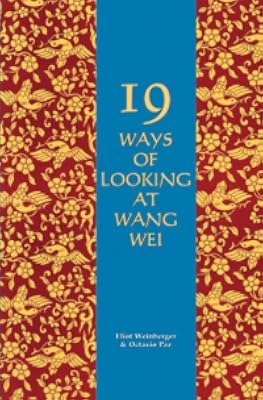
The difficulty (and necessity) of translation is concisely described inNineteen Ways of Looking at Wang Wei, a close reading of different translations of a single poem from the Tang Dynasty--from a transliteration to Kenneth Rexroth's loose interpretation. As Octavio Paz writes in the afterword, "Eliot Weinberger's commentary on the successive translations of Wang Wei's little poem illustrates, with succinct clarity, not only the evolution of the art of translation in the modern period but show more at the same time the changes in poetic sensibility." show lessTags
Recommendations









Member Reviews
This a a very short book, and really quite a riot. Even after reading, what, 29 translations of this short poem... how is the light hitting, where is that moss? Weinberger's comments are short, pointed, and often funny. But he brings it a lot of substantial observations too. The Daoist slant, opposites playing together, the western light as Amitabha's.
The whole thing reminds me of Borges. It's even more fantastical because it is real!
The whole thing reminds me of Borges. It's even more fantastical because it is real!
Especially given that this slim volume is barely 50 pages long, I unhesitatingly recommend it to just about anyone who is even vaguely conscious about what they read, especially if they regularly read anything in translation.
On its surface, and a gossamer-thin surface it is, this book is a comparative-literature exercise, with its laser focus on a single, four-line Chinese poem by Wang Wei, dated from about 1200 years ago. Per the title, there are 19 translations investigated by Eliot Weinberger, including one by Octavio Paz (in two versions), who also provided commentary on the art of translation.
Weinberger's prose is about as far from the original poem as it could be -- where the poem is placid, interrupted by two sublime instances, show more he is stalwart, headstrong, and, in a word, loud. At times, it verges on a situation where he, through sheer force of presence, threatens to overshadow the actual subject, but he can get away with it because he is, in essence, almost always correct in his declarations about why one poem works and one doesn't (eg., "Chang translates 12 of Wang's 20 words, and makes up the rest" and, when writing of an attempt by William McNaughton, "Line 1 has been turned into a statement, almost a parody of Eastern Wisdom"). show less
On its surface, and a gossamer-thin surface it is, this book is a comparative-literature exercise, with its laser focus on a single, four-line Chinese poem by Wang Wei, dated from about 1200 years ago. Per the title, there are 19 translations investigated by Eliot Weinberger, including one by Octavio Paz (in two versions), who also provided commentary on the art of translation.
Weinberger's prose is about as far from the original poem as it could be -- where the poem is placid, interrupted by two sublime instances, show more he is stalwart, headstrong, and, in a word, loud. At times, it verges on a situation where he, through sheer force of presence, threatens to overshadow the actual subject, but he can get away with it because he is, in essence, almost always correct in his declarations about why one poem works and one doesn't (eg., "Chang translates 12 of Wang's 20 words, and makes up the rest" and, when writing of an attempt by William McNaughton, "Line 1 has been turned into a statement, almost a parody of Eastern Wisdom"). show less
I'm taking a workshop on translation next semester, and my professor assigned this book to us ahead of time. I have learned more than I expected to about the difficulties of translation, particularly the problem of ego inherent to a poet's translation of another poet, from this tiniest of books. The snarky comments about various translations of Wang Wei's short poem are wonderful. My personal favorite: "To me this sounds like Gerard Manley Hopkins on LSD..."
Nineteen Ways of Looking at Wang Wei offers at least twenty versions by various hands of a quatrain by the eighth-century Chinese poet Wang Wei. The author comments, sometimes acidulously, on each. The Mexican Octavio Paz contributes his own perceptive comments (particulary regarding Ezra Pound's Cathay) occasioned by his own Spanish version of the poem.
The quatrain itself has the iconic qualities of classic Chinese verse, spareness, objectivity, and ambiguity. These seem irresistibly to betray the Western translator or critic into Symbolism. I am not convinced the poet intended the layers of metaphysical and spiritual speculation that Weinberger and Paz see in this simple, direct poem, though it may be these are derived from Chinese show more critical tradition, especially Ch'an Buddhist.
However, the very short (53-page) book is an intriguing exercise in both translation and criticism, a primer in classical Chinese poetics, and offers some entertaining commentary by its author. One does have to decide whether it is worth its price, in view of its brevity and, frankly, ephemerality. show less
The quatrain itself has the iconic qualities of classic Chinese verse, spareness, objectivity, and ambiguity. These seem irresistibly to betray the Western translator or critic into Symbolism. I am not convinced the poet intended the layers of metaphysical and spiritual speculation that Weinberger and Paz see in this simple, direct poem, though it may be these are derived from Chinese show more critical tradition, especially Ch'an Buddhist.
However, the very short (53-page) book is an intriguing exercise in both translation and criticism, a primer in classical Chinese poetics, and offers some entertaining commentary by its author. One does have to decide whether it is worth its price, in view of its brevity and, frankly, ephemerality. show less
Weinberger crams more insight and understanding into this slim masterpiece than many other tomes of literary criticism and translation theory. It should be reread on a regular basis by all translators of poetry.
"Not much rhymes with 'moss', it's something of an albatross."
"Not much rhymes with 'moss', it's something of an albatross."
This slim volume is interesting in that it compiles about 23 translated versions of a single Wang Wei poem. Editor Weinberger appends a brief commentary on the strengths and failings (more often than not, failings) of each. Unfortunately, said commentaries are childishly snide, which greatly decreases both the reader's enjoyment of, and attention to, the points he is trying to make.
A delightful, grumpy consideration of translation issues through a single Chinese poem.
Members
- Recently Added By
Lists

The China Project Book List
100 works; 2 members

In Our Time books
4,934 works; 2 members
Author Information

49+ Works 1,483 Members
Eliot Weinberger was born on February 6, 1949. He is a writer, editor and translator. His work has been published in 30 languages. He first gained recognition from his translations of Nobel Prize winner and poet Octavio Paz. These translations include Collected Poems 1957-1987 and In Light of India. He has also translated other writers such as show more Vicente Huidobro's Altazor. He received the National Board Critic's Circle Award for his edition of Borge's Selected Non-Fictions. Today Eliot Weinberger is mostly known for his essays and political articles focusing on U.S. politics and foreign policy. His literary writings include An Elemental Thing, which was selected by The Village Voice as one of the "20 Best Books of the Year for 2009. He is also the co-author of a study of Chinese poetry translations, 19 Ways of Looking at Wang Wei. In 2000 he was the only American literary writer to be awarded the order of the Aztec Eagle by the government of Mexico. (Bowker Author Biography) show less

324+ Works 9,921 Members
Octavio Paz was born in Mexico City, Mexico on March 31, 1914. In 1938, he became one of the founders of the journal, Taller. In 1943, he travelled to the United States on a Guggenheim Fellowship where he became immersed in Anglo-American Modernist poetry. He entered the Mexican diplomatic service in 1945 and was sent to France then India. In show more 1968, he resigned from the diplomatic service in protest against the government's suppression of the student demonstrations during the Olympic Games in Mexico. He was a poet and an essayist. His works include The Labyrinth of Solitude, The Grammarian Monkey, East Slope, and The Other Mexico. He received numerous awards including the Cervantes award in 1981, the American Neustadt Prize in 1982, and the Nobel Prize in Literature in 1990. He also worked as an editor and publisher. He founded two magazines dedicated to the arts and politics: Plural and Vuelta. He died of cancer on April 19, 1998. (Bowker Author Biography) show less
59+ Works 695 Members
All Editions
Awards and Honors
Notable Lists
Common Knowledge
- Original publication date
- 1987
- People/Characters
- Wang Wei
- Important events
- Tang Dynasty
Classifications
- Genres
- Poetry, Fiction and Literature, Literature Studies and Criticism
- DDC/MDS
- 895.113 — Literature & rhetoric Literatures of other languages Literatures of East and Southeast Asia Chinese Chinese poetry Tang and Five dynasties 618-960
- LCC
- PL2676 .A683 .W4 — Language and Literature Languages and literatures of Eastern Asia, Africa, Oceania Languages of Eastern Asia, Africa, Oceania Chinese language and literature Chinese literature Individual authors and works
- BISAC
Statistics
- Members
- 321
- Popularity
- 99,329
- Reviews
- 10
- Rating
- (3.96)
- Languages
- English, French, German
- Media
- Paper, Ebook
- ISBNs
- 6
- ASINs
- 2