On This Page
Description
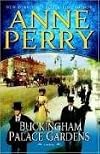
Pitt investigates the murder of a maid at Buckingham Palace, narrowing his group of suspects down to several house guests who are meeting with the Prince of Wales to discuss the funding of a huge project: the Cape to Cairo railway. While the Prince might overlook the unfortunate loss of a maid, the Queen, who is due back soon, will likely veto any Royal support in the scheme if she finds out.Tags
Recommendations





Member Reviews
Why haven't I read Anne Perry's Charlotte and Thomas Pitt books before? Victorian era mysteries, right in (one of my) sweet spots. I'm told that it's better to read the series in sequence to see how the relationships develop, but I think I had enough fun reading this that I don't mind reading out of order.
The way it started, with a prostitute gorily murdered in Buckingham Palace, gave me a rather persistent thought of "London... SVU?" which I had trouble shaking over the first couple of chapters. But that's more a commentary on myself than it is on the quality of the book.
The thing that impressed me most was the way the investigation and the interrogation got bound and constrained by social niceties of status and of how different show more classes were allowed to interact. Perry switched perspectives in different chapters, enough so that I could really see the discrepancy between characters' interior lives and the constrained way they behaved towards each other, navigating the social sphere in a series of calculations of how much to say to whom, when. I don't think I've seen that captured quite so well in other Victorian era historicals I've read. I think I have, for the first time, in years of reading Victorian era historical mysteries, an understanding of just the sheer painful stiltedness and constraints of having to conduct a murder investigation in a society bent on keeping up rigid social structures. I enjoyed a few moments where investigators were trying to shield women, or servants from what was going on, only to be dumbfounded by what people already knew.
Definitely going to read as many more books in this series as I can. show less
The way it started, with a prostitute gorily murdered in Buckingham Palace, gave me a rather persistent thought of "London... SVU?" which I had trouble shaking over the first couple of chapters. But that's more a commentary on myself than it is on the quality of the book.
The thing that impressed me most was the way the investigation and the interrogation got bound and constrained by social niceties of status and of how different show more classes were allowed to interact. Perry switched perspectives in different chapters, enough so that I could really see the discrepancy between characters' interior lives and the constrained way they behaved towards each other, navigating the social sphere in a series of calculations of how much to say to whom, when. I don't think I've seen that captured quite so well in other Victorian era historicals I've read. I think I have, for the first time, in years of reading Victorian era historical mysteries, an understanding of just the sheer painful stiltedness and constraints of having to conduct a murder investigation in a society bent on keeping up rigid social structures. I enjoyed a few moments where investigators were trying to shield women, or servants from what was going on, only to be dumbfounded by what people already knew.
Definitely going to read as many more books in this series as I can. show less
Why haven't I read Anne Perry's Charlotte and Thomas Pitt books before? Victorian era mysteries, right in (one of my) sweet spots. I'm told that it's better to read the series in sequence to see how the relationships develop, but I think I had enough fun reading this that I don't mind reading out of order.
The way it started, with a prostitute gorily murdered in Buckingham Palace, gave me a rather persistent thought of "London... SVU?" which I had trouble shaking over the first couple of chapters. But that's more a commentary on myself than it is on the quality of the book.
The thing that impressed me most was the way the investigation and the interrogation got bound and constrained by social niceties of status and of how different show more classes were allowed to interact. Perry switched perspectives in different chapters, enough so that I could really see the discrepancy between characters' interior lives and the constrained way they behaved towards each other, navigating the social sphere in a series of calculations of how much to say to whom, when. I don't think I've seen that captured quite so well in other Victorian era historicals I've read. I think I have, for the first time, in years of reading Victorian era historical mysteries, an understanding of just the sheer painful stiltedness and constraints of having to conduct a murder investigation in a society bent on keeping up rigid social structures. I enjoyed a few moments where investigators were trying to shield women, or servants from what was going on, only to be dumbfounded by what people already knew.
Definitely going to read as many more books in this series as I can. show less
The way it started, with a prostitute gorily murdered in Buckingham Palace, gave me a rather persistent thought of "London... SVU?" which I had trouble shaking over the first couple of chapters. But that's more a commentary on myself than it is on the quality of the book.
The thing that impressed me most was the way the investigation and the interrogation got bound and constrained by social niceties of status and of how different show more classes were allowed to interact. Perry switched perspectives in different chapters, enough so that I could really see the discrepancy between characters' interior lives and the constrained way they behaved towards each other, navigating the social sphere in a series of calculations of how much to say to whom, when. I don't think I've seen that captured quite so well in other Victorian era historicals I've read. I think I have, for the first time, in years of reading Victorian era historical mysteries, an understanding of just the sheer painful stiltedness and constraints of having to conduct a murder investigation in a society bent on keeping up rigid social structures. I enjoyed a few moments where investigators were trying to shield women, or servants from what was going on, only to be dumbfounded by what people already knew.
Definitely going to read as many more books in this series as I can. show less
Why haven't I read Anne Perry's Charlotte and Thomas Pitt books before? Victorian era mysteries, right in (one of my) sweet spots. I'm told that it's better to read the series in sequence to see how the relationships develop, but I think I had enough fun reading this that I don't mind reading out of order.
The way it started, with a prostitute gorily murdered in Buckingham Palace, gave me a rather persistent thought of "London... SVU?" which I had trouble shaking over the first couple of chapters. But that's more a commentary on myself than it is on the quality of the book.
The thing that impressed me most was the way the investigation and the interrogation got bound and constrained by social niceties of status and of how different show more classes were allowed to interact. Perry switched perspectives in different chapters, enough so that I could really see the discrepancy between characters' interior lives and the constrained way they behaved towards each other, navigating the social sphere in a series of calculations of how much to say to whom, when. I don't think I've seen that captured quite so well in other Victorian era historicals I've read. I think I have, for the first time, in years of reading Victorian era historical mysteries, an understanding of just the sheer painful stiltedness and constraints of having to conduct a murder investigation in a society bent on keeping up rigid social structures. I enjoyed a few moments where investigators were trying to shield women, or servants from what was going on, only to be dumbfounded by what people already knew.
Definitely going to read as many more books in this series as I can. show less
The way it started, with a prostitute gorily murdered in Buckingham Palace, gave me a rather persistent thought of "London... SVU?" which I had trouble shaking over the first couple of chapters. But that's more a commentary on myself than it is on the quality of the book.
The thing that impressed me most was the way the investigation and the interrogation got bound and constrained by social niceties of status and of how different show more classes were allowed to interact. Perry switched perspectives in different chapters, enough so that I could really see the discrepancy between characters' interior lives and the constrained way they behaved towards each other, navigating the social sphere in a series of calculations of how much to say to whom, when. I don't think I've seen that captured quite so well in other Victorian era historicals I've read. I think I have, for the first time, in years of reading Victorian era historical mysteries, an understanding of just the sheer painful stiltedness and constraints of having to conduct a murder investigation in a society bent on keeping up rigid social structures. I enjoyed a few moments where investigators were trying to shield women, or servants from what was going on, only to be dumbfounded by what people already knew.
Definitely going to read as many more books in this series as I can. show less
Why haven't I read Anne Perry's Charlotte and Thomas Pitt books before? Victorian era mysteries, right in (one of my) sweet spots. I'm told that it's better to read the series in sequence to see how the relationships develop, but I think I had enough fun reading this that I don't mind reading out of order.
The way it started, with a prostitute gorily murdered in Buckingham Palace, gave me a rather persistent thought of "London... SVU?" which I had trouble shaking over the first couple of chapters. But that's more a commentary on myself than it is on the quality of the book.
The thing that impressed me most was the way the investigation and the interrogation got bound and constrained by social niceties of status and of how different show more classes were allowed to interact. Perry switched perspectives in different chapters, enough so that I could really see the discrepancy between characters' interior lives and the constrained way they behaved towards each other, navigating the social sphere in a series of calculations of how much to say to whom, when. I don't think I've seen that captured quite so well in other Victorian era historicals I've read. I think I have, for the first time, in years of reading Victorian era historical mysteries, an understanding of just the sheer painful stiltedness and constraints of having to conduct a murder investigation in a society bent on keeping up rigid social structures. I enjoyed a few moments where investigators were trying to shield women, or servants from what was going on, only to be dumbfounded by what people already knew.
Definitely going to read as many more books in this series as I can. show less
The way it started, with a prostitute gorily murdered in Buckingham Palace, gave me a rather persistent thought of "London... SVU?" which I had trouble shaking over the first couple of chapters. But that's more a commentary on myself than it is on the quality of the book.
The thing that impressed me most was the way the investigation and the interrogation got bound and constrained by social niceties of status and of how different show more classes were allowed to interact. Perry switched perspectives in different chapters, enough so that I could really see the discrepancy between characters' interior lives and the constrained way they behaved towards each other, navigating the social sphere in a series of calculations of how much to say to whom, when. I don't think I've seen that captured quite so well in other Victorian era historicals I've read. I think I have, for the first time, in years of reading Victorian era historical mysteries, an understanding of just the sheer painful stiltedness and constraints of having to conduct a murder investigation in a society bent on keeping up rigid social structures. I enjoyed a few moments where investigators were trying to shield women, or servants from what was going on, only to be dumbfounded by what people already knew.
Definitely going to read as many more books in this series as I can. show less
This is my first Anne Perry book. By and large, the women in it are better---kinder, wiser---than the men. Although the story is a third-person narrative, the author gives us the inner thoughts of Thomas Pitt, the detective who is now part of Special Branch; Gracie, his servant who goes undercover to work in Buckingham Palace; Elsa Dunkeld, the wife of a man who wants to head up a project to build a Cape-to-Cairo railroad in Africa; and Narraway, Pitt's boss. Gracie uncovers vital clues, but, while she recognizes them as vital clues, her discoveries require too much luck. There are lots of descriptions of clothing, especially gowns. The names are surprisingly strange. Unlike an Agatha Christie mystery, removing the killers and one of show more the victims from society and world makes life better and simpler for everyone else.
A quote: "He was a good-looking man with an intelligent and sensual face. He dressed well, but without that effortless elegance of a man who, once having understood fashion, can follow it or ignore it as he pleases." (p. 88) show less
A quote: "He was a good-looking man with an intelligent and sensual face. He dressed well, but without that effortless elegance of a man who, once having understood fashion, can follow it or ignore it as he pleases." (p. 88) show less
Thomas Pitt, member of the Special Services, is called to Buckingham Palace to find out who killed a prostitute and hid her body in a linen closet. The matter must be solved expediently and without any publicity!
Queen Victoria is away from the castle, but is due back in one week. The Prince of Wales has invited four men of industry to discuss the possibility of building a railroad in Africa. The wives of the men have been invited to give the appearance of a social event.
The prostitutes had been invited for the men,s enjoyment much later in the evening — after the wives had retired. The discovery of the body is to be kept secret from the guests and is to be dealt with without the help of the Prince of Wales or the police. All hush-hush show more and in only a week’s time.
To give Pitt and inside connection, he has Gracie, his cockney maid from home, to be hired in at the palace. She would have better access to any gossip among the staff and guests that may have seen something helpful.
Meanwhile there are familial connections between the guests and a competition to become the leader of the project.
Pitt’s persistent untangling of the slender threads, some seeming to lead nowhere, finally reveals the connections and complete picture of the crime. He also discovers a cover-up from the past along with some interesting connections among the guests.
Pitt is a man who thinks things through, rather than jump to conclusions. Sort of along the lines of Donna Leon’s Brunetti or Louse Penny’s Gamache…thinking men. show less
Queen Victoria is away from the castle, but is due back in one week. The Prince of Wales has invited four men of industry to discuss the possibility of building a railroad in Africa. The wives of the men have been invited to give the appearance of a social event.
The prostitutes had been invited for the men,s enjoyment much later in the evening — after the wives had retired. The discovery of the body is to be kept secret from the guests and is to be dealt with without the help of the Prince of Wales or the police. All hush-hush show more and in only a week’s time.
To give Pitt and inside connection, he has Gracie, his cockney maid from home, to be hired in at the palace. She would have better access to any gossip among the staff and guests that may have seen something helpful.
Meanwhile there are familial connections between the guests and a competition to become the leader of the project.
Pitt’s persistent untangling of the slender threads, some seeming to lead nowhere, finally reveals the connections and complete picture of the crime. He also discovers a cover-up from the past along with some interesting connections among the guests.
Pitt is a man who thinks things through, rather than jump to conclusions. Sort of along the lines of Donna Leon’s Brunetti or Louse Penny’s Gamache…thinking men. show less
Intricate story that took a little too long to tell. Thomas Pitt endures insults and rage to uncover a sinister plot in Buckingham Palace with the assistance of his housemaid Gracie. Perry does her usual yeoman job of giving us a slice of life in 19th century England. She does a particularly nice job of showing the void between the different social classes and how they see each other.
Members
- Recently Added By
Lists

Stories about Gardens
10 works; 1 member
Author Information

198+ Works 54,946 Members
Anne Perry was born Juliet Hume on October 28, 1938 in Blackheath, London. Sent to Christchurch, New Zealand to recover from a childhood case of severe pneumonia, she became very close friends with another girl, Pauline Parker. When Perry's family abandoned her, she had only Parker to turn to, and when the Parkers planned to move from New Zealand, show more Parker asked that Perry be allowed to join them. When Parker's mother disagreed, Perry and Parker bludgeoned her to death. Perry eventually served five and a half years in an adult prison for the crime. Once she was freed, she changed her name and moved to America, where she eventually became a writer. Her first Victorian novel, The Cater Street Hangman, was published in 1979. Although the truth of her past came out when the case of Mrs. Parker's murder was made into a movie (Heavenly Creatures), Perry is still a popular author and continues to write. She has written over 50 books and short story collections including the Thomas Pitt series, the William Monk series, and the Daniel Pitt series. Her story, Heroes, won the 2001 Edgar Award for Best Short Story. Her title's Blind Justice and The Angel Court Affair made The New York Times Best Seller List. (Bowker Author Biography) show less
Some Editions
Awards and Honors
Awards
Series

Belongs to Publisher Series
Il giallo Mondadori (3093)
Work Relationships
Common Knowledge
- Canonical title
- Buckingham Palace Gardens
- Original title
- Buckingham Palace Gardens
- Original publication date
- 2008-03-25
- People/Characters
- Gracie Phipps Tellman; Thomas Pitt; Charlotte Pitt; Victor Narraway; Cahoon Dunkeld; Elsa Dunkeld (show all 21); Julius Sorokine; Minnie Sorokine; Olga Marquand; Liliane Quase; Simnel Marquand; Hamilton Quase; Somerset Carlisle; Emily Ellison; Vespasia Cumming-Gould; Watson Forbes; Amelia Parr; Maurice Kelter; Wilhelmina Sorokine; Edward VII, King of the United Kingdom (as Prince of Wales); Alexandra of Denmark, Queen Consort of the United Kingdom (as Princess of Wales)
- Important places
- Buckingham Palace, London, England, UK
- Dedication
- To my friends Meg MacDonald and Meg Davis, for their unfailing help and encouragement
- First words
- 'She was apparently found in the linen cupboard, poor creature,' Narraway replied, his lean face dour, his eyes so dark they seemed black in the interior shadow of the hansom cab.
- Last words
- (Click to show. Warning: May contain spoilers.)Perhaps it was enough.
- Original language*
- Englisch
*Some information comes from Common Knowledge in other languages. Click "Edit" for more information.
Classifications
Statistics
- Members
- 807
- Popularity
- 34,010
- Reviews
- 26
- Rating
- (3.72)
- Languages
- 5 — English, French, German, Italian, Spanish
- Media
- Paper, Audiobook, Ebook
- ISBNs
- 40
- ASINs
- 12