On This Page
Description
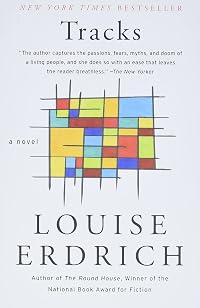
Tracks is a tale of passion and deep unrest. Over the course of ten crucial years, as tribal land and trust between people erode ceaselessly, men and women are pushed to the brink of their endurance - yet their pride and humour prohibit surrender. The reader will experience shock and pleasure in encountering characters that are compelling and rich in their vigour, clarity, and indomitable vitality.Tags
Recommendations























Member Reviews
This novel takes us back in time, before either Love Medicine or The Beet Queen, and enhances our understanding of the relationships among many of the characters we met in those two novels. We see how "family" is defined not just by blood but by affinity and intent. And we see how treacherous it can be to navigate the lake waters and shores of Matchimanito when under the influence of passion. Narrated alternately by Nanapush whom we trust, and by Pauline Puyat whom perhaps we shouldn't, the early life of Fleur Pillager and her fearsome connection with something outside the realm of human powers, is the primary story line here. Recurring threads are the questionable parentage of certain children, and the consequences of crossing a woman show more who has faced and bested death so many times. Nanapush tells his tales to Fleur's daughter, Lulu, hoping to convince her to forgive her mother for abandoning her. Wonderful stuff. But this book should not be read as a one-off. It is part of a cycle, and needs to be savored in conjunction with its companions to get the full effect. This is not a failing---it CAN stand alone. It's just that there is so much more to know, and you cheat yourself if you read this one and stop. show less
This novel deals with several indigenous families living in North Dakota and covers the time from 1912 to 1924. There are two narrators: Nanapush, an elderly man who is somewhat of a trickster figure, and Pauline, a young woman who has become a very strict Christian.
These two narrators tell the reader about the events in the community, especially about Fleur, Nanapush's adopted daughter. Fleur is a fascinating, yet enigmatic character, one of the most interesting and most present characters I have ever encountered in a novel, although the reader hardly gets to know any real facts about her and does not learn about her perspective at all.
The main topic is the influence of the advance of Western/white civilization on the indigenous show more families depicted in the novel. This includes Christianity as well as bureaucracy, money and the concept of working for money. I think that these topics are presented in a very striking way and sometimes I had to pause my reading to look up for a moment and process what I just read because the pictures evoked were so strong and my emotions were so intense, feeling the longing of the characters, the wish to keep their way of life, the fear and confusion. This effect was mainly reached by strong metaphors and descriptions that are very poetic - some passages are almost like poems. This is why it took me quite a long time to read the novel. Although it is only 226 pages it was not a quick read for me. It was absolutely worth it, though, because I cannot remember the last time that a novel's language did astonish and move me like that.
The only reason that I did not give this five stars is that I disliked the female narrator, Pauline, immensely, and did not enjoy the descriptions of her religious practices at all. They were too graphic for me and I simply could not develop any form of empathy for her, although it was interesting to gather her perspective on the events and how she perceived Fleur.
I will remember this book for a long time and now I definitely want to reread "Love Medicine", and discover other books by Louise Erdrich. show less
These two narrators tell the reader about the events in the community, especially about Fleur, Nanapush's adopted daughter. Fleur is a fascinating, yet enigmatic character, one of the most interesting and most present characters I have ever encountered in a novel, although the reader hardly gets to know any real facts about her and does not learn about her perspective at all.
The main topic is the influence of the advance of Western/white civilization on the indigenous show more families depicted in the novel. This includes Christianity as well as bureaucracy, money and the concept of working for money. I think that these topics are presented in a very striking way and sometimes I had to pause my reading to look up for a moment and process what I just read because the pictures evoked were so strong and my emotions were so intense, feeling the longing of the characters, the wish to keep their way of life, the fear and confusion. This effect was mainly reached by strong metaphors and descriptions that are very poetic - some passages are almost like poems. This is why it took me quite a long time to read the novel. Although it is only 226 pages it was not a quick read for me. It was absolutely worth it, though, because I cannot remember the last time that a novel's language did astonish and move me like that.
The only reason that I did not give this five stars is that I disliked the female narrator, Pauline, immensely, and did not enjoy the descriptions of her religious practices at all. They were too graphic for me and I simply could not develop any form of empathy for her, although it was interesting to gather her perspective on the events and how she perceived Fleur.
I will remember this book for a long time and now I definitely want to reread "Love Medicine", and discover other books by Louise Erdrich. show less
Set in early 20th Century North Dakota, Tracks is a portrayal of an Ojibwe community on the brink of crisis. Traditions, land, and livelihood are all threatened by government policies and the white people charged with carrying them out.
Chapters are narrated alternately by Nanapush, a community elder, and Pauline, a woman barely coping with the effects of trauma and loss. Pauline’s chapters are told in real time, while Nanapush’s chapters are stories being told, several years later, to his granddaughter, Lulu. Their narratives often present the same or overlapping events from their radically different perspectives. Another significant character is Fleur, a strong and self-sufficient woman who has chosen to live apart from most of show more the community. She is the subject of considerable suspicion, rumor, and gossip, but also much loved by Nanapush and others.
The encroaching presence of white people is like a drumbeat underneath the main storyline. Over the novel’s twelve-year timeline this drumbeat becomes louder, as the native community is suddenly expected to pay fees and taxes to hold onto their land, and as the lumber industry begins destroying natural resources.
The non-linear structure of this novel requires the reader to piece together fragments in order to understand the broader story, while also realizing the narrators may not always be the most reliable. It’s a rich tale that whetted my appetite for reading more of Erdrich’s work. show less
Chapters are narrated alternately by Nanapush, a community elder, and Pauline, a woman barely coping with the effects of trauma and loss. Pauline’s chapters are told in real time, while Nanapush’s chapters are stories being told, several years later, to his granddaughter, Lulu. Their narratives often present the same or overlapping events from their radically different perspectives. Another significant character is Fleur, a strong and self-sufficient woman who has chosen to live apart from most of show more the community. She is the subject of considerable suspicion, rumor, and gossip, but also much loved by Nanapush and others.
The encroaching presence of white people is like a drumbeat underneath the main storyline. Over the novel’s twelve-year timeline this drumbeat becomes louder, as the native community is suddenly expected to pay fees and taxes to hold onto their land, and as the lumber industry begins destroying natural resources.
The non-linear structure of this novel requires the reader to piece together fragments in order to understand the broader story, while also realizing the narrators may not always be the most reliable. It’s a rich tale that whetted my appetite for reading more of Erdrich’s work. show less
This novel set in the early 20th century, is narrated in alternating chapters by Nananpush, an Anishinaabe tribal elder with a far-seeing, cutting sense of humor and Pauline, a young girl, who is struggling to fit into the white world by putting her native spiritual beliefs behind her and turning to an increasingly obsessive form of Catholicism.
They each tell the story of another woman, Fleur, whom Nanapush had saved when her whole family as well as many others on the newly formed reservation died of consumption.
Fleur is a wild woman and a mystic – she communes with Misshepeshu, the mysterious spirit who rules the lake. She also makes a trip into the spirit world when her second child dies.
She fights death, disease and famine. She show more fights the whites who are conspiring to take her land away from her. And finally, she must confront betrayal by those within her own tribe.
For me, this is a brutally tough book. There are no happy endings. I came away with a better understanding of the losses and betrayals that these people endured – and a total sickness of heart. show less
They each tell the story of another woman, Fleur, whom Nanapush had saved when her whole family as well as many others on the newly formed reservation died of consumption.
Fleur is a wild woman and a mystic – she communes with Misshepeshu, the mysterious spirit who rules the lake. She also makes a trip into the spirit world when her second child dies.
She fights death, disease and famine. She show more fights the whites who are conspiring to take her land away from her. And finally, she must confront betrayal by those within her own tribe.
For me, this is a brutally tough book. There are no happy endings. I came away with a better understanding of the losses and betrayals that these people endured – and a total sickness of heart. show less
A tribe of chicken-scratch that can be scattered by a wind, diminished to ashes by one struck match.
You wouldn't make a Disney movie out of the Holocaust, would you? Then why does Pocahontas exist? I was only recently led to this argument by the Internet, and it is yet another of many that I wished I had come across much, much, much earlier.
This book has the whole 'magical realism' thing going on, like so many other pieces of work not written by white people, who have their fantasy, their postmodernism, their everything but. It is an overarching commentary on the laughable quality of superstition, myth, anything not adhering to the straight and narrow of physics, biology, science at large, but manages to never beg the question of show more institutional bias. We spend our lifetimes evaluating ourselves with pieces of paper, and scoff at those who cannot comprehend the simple art of bureaucracy.
New devils require new gods.
It is a matter of my childhood having been steeped in so much horseshit without a single living being to attest to the contrary. Girl Scout like Indian Maidens of my elementary years, dreamcatchers bought in dollar stores, a Wendigo as a particular stirring episode in a horror-themed television show without a hint of the word Algonquian, or Ojibwe, Saulteaux, Cree, Naskapi, Innu. Compromised as these words are by colonial tongue, you cannot grasp the privileged idiocy of indoctrination without the language that inherently exposes the lie; you cannot break your belief without reasoning why.
"You must think of their unyielding surfaces as helpful," he offered. "God sometimes enters the soul through the humblest parts of our anatomies, if they are sensitized to suffering."
"A god who enters through the rear door," I countered, "is no better than a thief."
A piece of paper declares, if you stray here and attempt to live, we have the right to kill you. A piece of paper insinuates, if your biology proves incompatible with our lifestyles, we are not required to heal you. A forest falls from ocean to ocean to provide for many pieces of paper, birthed by colonial mindset, maintained by conqueror's brainwashing, proven by death and destruction, famine and rape, rotting of the bone and rat race of the mind. To fight is to become a monster by strength of belief, to survive is to self-efface by poison of thought, to suffer is a given. If that is not magic, I don't know what is.
They were moving. It was as old Nanapush had said when we sat around the stove. As a young man, he had guided a buffalo expedition for whites. He said the animals understood what was happening, how they were dwindling. He said that when the smoke cleared and the hulks lay scattered everywhere, a day's worth of shooting for only the tongues and hides, the beasts that survived grew strange and unusual. They lost their minds. They bucked, screamed and stamped, tossed the carcasses and grazed on flesh. They tried their best to cripple one another, to fall or die. They tried suicide. They tried to do away with their young. They knew they were going, saw their end. He said while the whites all slept through the terrible night he kept watch, that the groaning never stopped, that the plains below him was alive, a sea turned against itself, and when the thunder came, then and only then, did the madness cease. He saw their spirits slip between the lightning sheets.
I saw the same. I saw the people I had wrapped, the influenza and consumption dead whose hands I had folded. They traveled, lame and bent, with chests darkened from the blood they coughed out of their lungs, filing forward and gathering, taking a different road. A new road. I saw them dragging one another in slings and litters. I saw their unborn children hanging limp or strapped to their backs, or pushed along in front hoping to get the best place when the great shining doors, beaten of air and gold, swung open on soundless oiled fretwork to admit them all.
Christ was there, of course, dressed in glowing white.
"What shall I do now?" I asked. "I've brought You so many souls!"
And He said to me, gently:
"Fetch more."
To live. show less
This is quite an intimate novel. Two narrators, an old man and a young woman. Almost all the action is among maybe a dozen folks, a few families. The Chippewa are losing their land to lumber companies by various legal games. Some families come out winners, some losers. The writing reminded me of Faulkner in its visceral intensity.
This is one of those books that I know I'll have to read more than once in order to fully appreciate. I think this novel asks a lot of the reader with its magical realism, very different narrators, and just the overall mystery that runs throughout, but even when you're struggling to understand exactly what's happening it's all worth it. This novel presents many questions about the characters and about life in general without always giving the answers, but for me, instead of that being annoying it was beautiful in that it pushes you to keep going forward and dealing with things even when you don't completely understand.
Members
- Recently Added By
Lists

Favourite Books
1,820 works; 316 members

Best First Lines
133 works; 8 members
500 Great Books by Women
507 works; 60 members

"We" narration
49 works; 2 members

AP Lit
363 works; 6 members
Books We Want To Read Again For The First Time
384 works; 160 members
Author Information

70+ Works 45,439 Members
Karen Louise Erdrich was born on June 7, 1954 in Little Falls, Minnesota. Erdrich grew up in Wahpeton, North Dakota, where both of her parents were employed by the Bureau of Indian Affairs. She is a member of the Turtle Mountain Band of Chippewa. Erdrich graduated from Dartmouth College in 1976 with an AB degree, and she received a Master of Arts show more in creative writing from Johns Hopkins University in 1979. Erdrich published a number of poems and short stories from 1978 to 1982. In 1981 she married author and anthropologist Michael Dorris, and together they published The World's Greatest Fisherman, which won the Nelson Algren Award in 1982. In 1984 she won the National Book Critics Circle Award for Love Medicine, which is an expansion of a story that she had co-written with Dorris. Love Medicine was also awarded the Virginia McCormick Scully Prize (1984), the Sue Kaufman Prize (1985) and the Los Angeles Times Award for best novel (1985). In addition to her prose, Erdrich has written several volumes of poetry, a textbook, children's books, and short stories and essays for popular magazines. She has been the recipient of numerous awards for professional excellence, including the National Magazine Fiction Award in 1983 and a first-prize O. Henry Award in 1987. Erdrich has also received the Pushcart Prize in Poetry, the Western Literacy Association Award, the 1999 World Fantasy Award, and the Scott O'Dell Award for Historical Fiction in 2006. In 2007 she refused to accept an honorary doctorate from the University of North Dakota in protest of its use of the "Fighting Sioux" name and logo. Erdrich's novel The Round House made the New York Times bestseller list in 2013. Her other New York Times bestsellers include Future Home of the Living God (2017). (Bowker Author Biography) show less
Some Editions
Awards and Honors
Series

Work Relationships
Is contained in
Contains
Common Knowledge
- Canonical title*
- La forêt suspendue
- Original title
- Tracks
- Original publication date
- 1988
- People/Characters
- Nanapush; Fleur Pillager; Pauline Puyat; Eli Kashpaw; Father Damien (Modeste); Lulu Nanapush (show all 8); Fritzie; Moses Pillager
- Important places*
- North Dakota, Verenigde Staten
- Dedication
- Michael, The story comes up different every time and has no ending but always begins with you.
- First words
- We started dying before the snow, and like the snow, we continued to fall. It was surprising there were so many of us left to die. For those who survived the spotted sickness from the south, our long fight west to Nadouissiou... (show all)x land where we signed the treaty, and then a wind from the east, bringing exile in a storm of government papers, what descended from the north in 1912 seemed impossible. -Chapter One, Winter 1912, Manitou-geezisobns, Little Spirit Sun, Nanapush
- Last words*
- (Click to show. Warning: May contain spoilers.)We gave against your rush like creaking oaks, held on, braced ourselves together in the fierce dry wind.
- Original language
- English
- Canonical DDC/MDS
- 813.54
- Canonical LCC
- PS3555.R42 T73
*Some information comes from Common Knowledge in other languages. Click "Edit" for more information.
Classifications
Statistics
- Members
- 2,452
- Popularity
- 7,945
- Reviews
- 41
- Rating
- (3.84)
- Languages
- 10 — Danish, Dutch, English, Finnish, French, German, Italian, Norwegian (Bokmål), Spanish, Swedish
- Media
- Paper, Audiobook, Ebook
- ISBNs
- 30
- ASINs
- 12