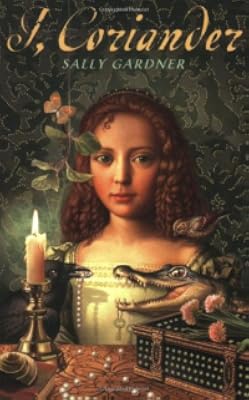
I, Coriander
by Sally Gardner 
On This Page
Description
In 17th century London, Coriander, a girl who has inherited magic from her mother, must find a way to use this magic in order to save both herself and an inhabitant of the fairy world where her mother was born.Tags
Recommendations




Member Recommendations
Member Reviews
A strange and beautifully written tale of Cromwellian London and fairy-tales come to life. After the death of her mother and the flight of her father, Coriander is left to the tender mercies of her Puritan step-mother and a fiendish preacher. Her mother was not of this world, however, and has left something precious and powerful behind, something coveted by a malicious witch who is manipulating Coriander's misfortunes and plotting her murder. Can Coriander travel between the two worlds, defeat the witch, rescue the prince and be reunited with her father? It's a classic fairy-tale with a wonderfully evocative setting, packed with danger and wonder.
Born in 1643 to a wealthy London merchant and his beautiful wife, Coriander Hobbie was raised in a loving and affectionate home, knowing only happiness until the day a mysteriously alluring pair of silver shoes was delivered to her house beside the Thames. This strange gift, which her mother refused to allow her to wear, introduced the first note of disquiet into Coriander's life, and was the beginning of a series of strange events that would bring her great heartache, and involve her in dangerous adventures in both the mortal world and in the fairy world existing alongside it. Having lost her mother early in the book, Coriander moves back and forth between the two worlds, contending with an abusive and scheming Puritan stepmother - the show more horrible Maude Leggs, ugly, ignorant, and shrill, is seen as a wise choice for her father, whose Royalist sympathies had put him at risk from the repressive forces of the Commonwealth - her stepmother's maniacal preacher friend, Arise Fell; and the evil Fairy Queen Rosmore, whose cunning schemes are all aimed at stealing the powerful shadow that once belonged to Coriander's mother...
This work of historical fantasy, which alternates between Commonwealth and Restoration England, and a magical fairy world existing alongside our own, was chosen as the October selection for The Children's Fiction Book-Club to which I belong, and I am very happy to have finally read it, as I have owned a copy since it was first published in 2005. That said, while I found I, Coriander an enjoyable read in many ways - I thought the writing itself was lovely, and that Coriander made for an engaging heroine - it had some significant problems. From a storytelling perspective, I thought the sections of the book that occurred in the mortal world were far more convincing than those that occurred in the fairy world. Rosmore, for all that she is the true author of Coriander's misery, is never as fully realized a character as Maud, while Coriander's romance withTycho had a distinctly tacked-on feeling to it, when compared to the relationship between Hester and Gabriel Appleby.
Unfortunately, while Maud Leggs and Arise Fell were marvelously realized villains, from the storytelling perspective - just the sort of repulsive characters one loves to hate! - their depiction raises troubling questions of historical inaccuracy and bias. I have no quarrel with a critical depiction of the Puritans - they were often zealots, bringing persecution to bear upon those with whom they disagreed, and their notion of culture (what was and wasn't 'godly') was appalling - but Gardner's aim is more than a little off here, potentially leaving young readers with some mistaken ideas. Like many other Reform-based Protestant sects (as opposed to both Catholics and Anglicans of this period), the Puritans placed great emphasis on the individual's relationship with the divine, unmediated by the clergy. To encourage this, they promoted education - the idea being that everyone should be able to read the Bible for themselves - and female literacy rose under their aegis. The exact opposite impression is created in the story, however, through the depiction of Maud and Arise, and their hostility toward women learning. Similarly, although the Puritans arose in response to a worldview every bit as repressive as their own, this is not the impression created by the story at all, which leaves readers with the impression that the monarchy (jubilantly welcomed back at the end of the book) was somehow benevolent.
I don't know that these glaring errors really ruined the book for me - although I did laugh out loud, when reading the historical afterword, to see Quakers described as a 'radical sect' and classified with the Puritans! - but then, I feel equipped to perceive them. It troubles me that young readers, perhaps not as informed about this period, might not be. For this reason, I really wavered in my rating. Three stars represents my enjoyment of the writing. If I were rating for historical accuracy, on the other hand, I might give the book only one. show less
This work of historical fantasy, which alternates between Commonwealth and Restoration England, and a magical fairy world existing alongside our own, was chosen as the October selection for The Children's Fiction Book-Club to which I belong, and I am very happy to have finally read it, as I have owned a copy since it was first published in 2005. That said, while I found I, Coriander an enjoyable read in many ways - I thought the writing itself was lovely, and that Coriander made for an engaging heroine - it had some significant problems. From a storytelling perspective, I thought the sections of the book that occurred in the mortal world were far more convincing than those that occurred in the fairy world. Rosmore, for all that she is the true author of Coriander's misery, is never as fully realized a character as Maud, while Coriander's romance with
Unfortunately, while Maud Leggs and Arise Fell were marvelously realized villains, from the storytelling perspective - just the sort of repulsive characters one loves to hate! - their depiction raises troubling questions of historical inaccuracy and bias. I have no quarrel with a critical depiction of the Puritans - they were often zealots, bringing persecution to bear upon those with whom they disagreed, and their notion of culture (what was and wasn't 'godly') was appalling - but Gardner's aim is more than a little off here, potentially leaving young readers with some mistaken ideas. Like many other Reform-based Protestant sects (as opposed to both Catholics and Anglicans of this period), the Puritans placed great emphasis on the individual's relationship with the divine, unmediated by the clergy. To encourage this, they promoted education - the idea being that everyone should be able to read the Bible for themselves - and female literacy rose under their aegis. The exact opposite impression is created in the story, however, through the depiction of Maud and Arise, and their hostility toward women learning. Similarly, although the Puritans arose in response to a worldview every bit as repressive as their own, this is not the impression created by the story at all, which leaves readers with the impression that the monarchy (jubilantly welcomed back at the end of the book) was somehow benevolent.
I don't know that these glaring errors really ruined the book for me - although I did laugh out loud, when reading the historical afterword, to see Quakers described as a 'radical sect' and classified with the Puritans! - but then, I feel equipped to perceive them. It troubles me that young readers, perhaps not as informed about this period, might not be. For this reason, I really wavered in my rating. Three stars represents my enjoyment of the writing. If I were rating for historical accuracy, on the other hand, I might give the book only one. show less
This was a lovely little fairy-tale story. I can just imagine reading this to little girls, who will inevitably beg for just one more chapter before having to go to bed. It's so easy to imagine said little girls dreaming of being a fairy princess, even though this isn't your typical fairy princess story.
From the very start, this story reminded me strongly of Jonathan Strange & Mr Norrell by Susanna Clarke. Except, this story was much more entertaining, and fun, and concise. And not a single footnote!
There was a lot of stuff to love in this story. It catered to my love of historical fiction. I always enjoy well-written stories that are set back in time a ways. Generally, the further back the better. I love immersing myself in a show more different time with different mentalities and ideas and concepts, and I especially love it when there is a strong character I can identify with that's going with me.
Coriander was absolutely strong, and I loved her. She never let anyone take her dignity and identity away from her, even in a time when women were considered property and were thought to be nothing more than feeble-minded breeding house-keepers. Coriander refused to let herself be put into that particular box, and I loved her spunk for it.
This book also placed a lot of emphasis on religious and political persecution. This always interests me, because I'm a "Live and Let Live" kind of girl. I don't care what you believe, as long as you don't try to foist that belief on me against my will. I guess this makes me a little morbidly curious to read about people who just have to "cleanse", "convert", "fix" the "unbelievers" around them. I was really kind of fascinated with Maud Leggs and Arise Fell in this story because of that. Of course, they couldn't care less whether you believed. They just derived a sick pleasure out of the conversion process.
I definitely enjoyed reading this story. It was interesting and fun, and was a well-blended mix of history and fairy-tale. I think it would have been 5 star quality if it had wrapped just a few things up a little better, like who Medlar was, and how the time system worked, etc, but I think this is a solid 4 star book, even lacking those things. I would definitely recommend it for anyone looking for a light, fun read. show less
From the very start, this story reminded me strongly of Jonathan Strange & Mr Norrell by Susanna Clarke. Except, this story was much more entertaining, and fun, and concise. And not a single footnote!
There was a lot of stuff to love in this story. It catered to my love of historical fiction. I always enjoy well-written stories that are set back in time a ways. Generally, the further back the better. I love immersing myself in a show more different time with different mentalities and ideas and concepts, and I especially love it when there is a strong character I can identify with that's going with me.
Coriander was absolutely strong, and I loved her. She never let anyone take her dignity and identity away from her, even in a time when women were considered property and were thought to be nothing more than feeble-minded breeding house-keepers. Coriander refused to let herself be put into that particular box, and I loved her spunk for it.
This book also placed a lot of emphasis on religious and political persecution. This always interests me, because I'm a "Live and Let Live" kind of girl. I don't care what you believe, as long as you don't try to foist that belief on me against my will. I guess this makes me a little morbidly curious to read about people who just have to "cleanse", "convert", "fix" the "unbelievers" around them. I was really kind of fascinated with Maud Leggs and Arise Fell in this story because of that. Of course, they couldn't care less whether you believed. They just derived a sick pleasure out of the conversion process.
I definitely enjoyed reading this story. It was interesting and fun, and was a well-blended mix of history and fairy-tale. I think it would have been 5 star quality if it had wrapped just a few things up a little better, like who Medlar was, and how the time system worked, etc, but I think this is a solid 4 star book, even lacking those things. I would definitely recommend it for anyone looking for a light, fun read. show less
Sally Gardner pulled no punches in I, Coriander. Her Cromwell-era England is harsh and full and the perfect backdrop to the very dark - and very darkly human - tale she tells. No one's life is simple or all that pretty in the book, but Coriander's is made even less so upon the arrival of her strictly religious stepmother, Maug Leggs, and Maud's...'preacher' Arise Fell. Maud is pretty damn bad, but Arise Fell is one of the most disturbing characters I've ever read in a kids book, maybe in any book. He is completely repugnant and utterly fascinating. Together, they are so throroughly creepy and villainous that your skin kinda crawls when they enter a scene, adding this great sense of threat and malice and tension to the story. But the show more best thing (or the worst)? They are believable. These are not over the top and unrealistic villains that yeah, may be scary, but are also utterly ridiculous. No, Gardner created two people who could easily be found on the front page of the news, or in a segment on 20/20. They are creepy and awful and utterly human in it. It's scary. And it can make for a very dark read, so if you don't like that or are sensitive to some things...be warned.
But the beauty of the story? Coriander. She never gives up or loses who she is. When Arise Fell arrives and introduces her to his hands of "Wrath" and "Salvation" things get decidedly dark for Coriander -- and yet, she refuses to give up who she is. She fights to keep her self and her identity, and she actively seeks out ways to make things right. That's so powerful for a young girl to be doing in any time, but especially in Coriander's time, and that's what makes it such a potentially powerful story for young girls. Yes, it is dark, but the fact is, there are plenty of girls who go through similar things, and seeing someone triumph can only be good.
I think, too, that Gardner's use of history is genius. The tale is perfectly suited to the narrow, suspicious, dangerous times it's set in. The setting just really works for the tale, and Garnder uses enough of the history to make it come alive and give it a sense of place, but not so much that it ever start to feel like a history lesson. Her Cromwellian England is almost tangible; I could have wished for a little more of the faerie world, but in the end, I think it kind of works as is on that score.
The only thing I really had a problem with was the ending, and some of the plot-device-y-ness of some aspects. The resolution was far too quick for my liking, and I definitely needed more of the prince and that whole story line. A big part of the reason I felt this was rushed, though, is that Coriander takes great leaps in age through the story, and I needed more from that. Every time she enters the faerie world, no matter how brief it may seem to her, she finds herself aged a few years upon her return to England. This is in keeping with mythology, and I am fine with it in its way - and even as a plot device - except it left me with questions. Like, if Coriander has aged from say 8 to 16 over a few successive trips that have only equaled say 2years at the utmost in England...setting aside the problems that would cause back in Cromwell times, it left me with questions about Coriander, mentally. Does her mind age too? Does her maturity level increase along with her growth? Is she essentially a different Coriander over night, without knowing how it happened, or who she has become? Because if so, yes, it's a little strange, and would have some serious ramifications - but if not, then the WHOLE BIT with the prince suddenly becomes hella creepy. Just saying, if Cinderella featured an 8 year old girl who just looks like a pretty teen about to marry a prince, I don't think it would be nearly the popular story that it is...
And whether her mind did age or not, the age jumps happen so suddenly that it's hard for the reader to shift their mind to the new Coriander, and it left me feeling like an 8 year old was being wooed by a prince... Uncomfortable-making, to say the least.
That being said, I don't think it is meant to be creepy, or even that it reads creepy. It's more one of those things you notice on reflection and are like, WTF? But I did thoroughly enjoy myself reading this, and think Gardner has a pretty good talent for crafting a world and a story, and not being afraid of darker elements, which I always appreciate. I, Coriander has elements of the Cinderella tale, and a definite fairy tale-esque feel throughout, but it is certainly its own story, and suitable to those who don't like fairy tales just as much as those who do, and in the end, I would recommend it with only slight caveats.
Here's an excerpt from one of my favorite/most disturbing parts of the book: the arrival of Arise Fell:
http://www.youtube.com/watch?v=_C55jFA4rOQ show less
But the beauty of the story? Coriander. She never gives up or loses who she is. When Arise Fell arrives and introduces her to his hands of "Wrath" and "Salvation" things get decidedly dark for Coriander -- and yet, she refuses to give up who she is. She fights to keep her self and her identity, and she actively seeks out ways to make things right. That's so powerful for a young girl to be doing in any time, but especially in Coriander's time, and that's what makes it such a potentially powerful story for young girls. Yes, it is dark, but the fact is, there are plenty of girls who go through similar things, and seeing someone triumph can only be good.
I think, too, that Gardner's use of history is genius. The tale is perfectly suited to the narrow, suspicious, dangerous times it's set in. The setting just really works for the tale, and Garnder uses enough of the history to make it come alive and give it a sense of place, but not so much that it ever start to feel like a history lesson. Her Cromwellian England is almost tangible; I could have wished for a little more of the faerie world, but in the end, I think it kind of works as is on that score.
The only thing I really had a problem with was the ending, and some of the plot-device-y-ness of some aspects. The resolution was far too quick for my liking, and I definitely needed more of the prince and that whole story line. A big part of the reason I felt this was rushed, though, is that Coriander takes great leaps in age through the story, and I needed more from that. Every time she enters the faerie world, no matter how brief it may seem to her, she finds herself aged a few years upon her return to England. This is in keeping with mythology, and I am fine with it in its way - and even as a plot device - except it left me with questions. Like, if Coriander has aged from say 8 to 16 over a few successive trips that have only equaled say 2years at the utmost in England...setting aside the problems that would cause back in Cromwell times, it left me with questions about Coriander, mentally. Does her mind age too? Does her maturity level increase along with her growth? Is she essentially a different Coriander over night, without knowing how it happened, or who she has become? Because if so, yes, it's a little strange, and would have some serious ramifications - but if not, then the WHOLE BIT with the prince suddenly becomes hella creepy. Just saying, if Cinderella featured an 8 year old girl who just looks like a pretty teen about to marry a prince, I don't think it would be nearly the popular story that it is...
And whether her mind did age or not, the age jumps happen so suddenly that it's hard for the reader to shift their mind to the new Coriander, and it left me feeling like an 8 year old was being wooed by a prince... Uncomfortable-making, to say the least.
That being said, I don't think it is meant to be creepy, or even that it reads creepy. It's more one of those things you notice on reflection and are like, WTF? But I did thoroughly enjoy myself reading this, and think Gardner has a pretty good talent for crafting a world and a story, and not being afraid of darker elements, which I always appreciate. I, Coriander has elements of the Cinderella tale, and a definite fairy tale-esque feel throughout, but it is certainly its own story, and suitable to those who don't like fairy tales just as much as those who do, and in the end, I would recommend it with only slight caveats.
Here's an excerpt from one of my favorite/most disturbing parts of the book: the arrival of Arise Fell:
http://www.youtube.com/watch?v=_C55jFA4rOQ show less
Spellbinding. All the attention to sensory detail made the experience of reading it so immersive I finished the book in one late night. Dramatic & atmospheric, full of allusions and symbolism. Good vs. evil - the only truly complex character is Coriander's father who is a good man who makes some bad decisions. I especially loved how painlessly I actually learned a bit more about English history, both political and cultural. I'm excited to discuss this in the Children's Books group - come join us all through Oct. 2012.
ETA - turns out I wasn't actually learning very good history. See msg 13 from Abigail in this thread: http://www.goodreads.com/topic/show/1047720?utm_content=A&utm_medium=email&a.... In fact the whole discussion is good - show more and I've taken a star off my rating. show less
ETA - turns out I wasn't actually learning very good history. See msg 13 from Abigail in this thread: http://www.goodreads.com/topic/show/1047720?utm_content=A&utm_medium=email&a.... In fact the whole discussion is good - show more and I've taken a star off my rating. show less
I was pleasantly surprised by this book. It was darker then I expected but more interesting as well. The historical setting in London during the time of Cromwell added extra interest for me.
After her mother dies and her father, a Royalist, flees to escape punishment from Cromwell's regime, Coriander is left in the hands of her cruel, greedy stepmother and her partner in crime, Puritan minister Arise Fell. When the two lock Coriander in a trunk and leave her to die, she travels to her mother's fairy world, finds her love Prince Tycho, and realizes that things will only worsen in both worlds unless she prevents the evil fairy Queen Rosmore from finding her mother's shadow. The story is well-written and the characters are, for the most part, rich and interesting. The Tycho love plot feels more functional (every fairy tale needs a prince) than believable, however, and the ending feels forced. Still, Gardner's London comes to show more life, as does the fairy world. The audio version is well-executed, though Maud's voice is so shrill and horrible (true to her character) that you will hope she dies early on, and be disappointed when she doesn't. show less
Members
- Recently Added By
Lists

Cinderella Stories
111 works; 15 members

KayStJ's to-read list
1,616 works; 11 members

infjsarah's wishlist
408 works; 2 members

Reading history in Children's Books
78 works; 3 members
Talk Discussions
Past Discussions
Fantasy girl locked in closet travels to magic land in Name that Book (January 2018)
Author Information

76+ Works 5,380 Members
Sally Gardner is a LibraryThing Author, an author who lists their personal library on LibraryThing.
Some Editions
Awards and Honors
Awards
Common Knowledge
- Canonical title
- I, Coriander
- Original title
- I, Coriander
- Original publication date
- 2005
- People/Characters
- Coriander Hobie
- Important places
- London, England, UK
- Important events
- Restoration of the Monarchy
- Dedication
- In loving memory of an irreplaceable friend, Maria Bjornson. The world we live in is nothing more than a mirror that reflects another world below its silvery surface, a land where time is but a small and unimportant thing, s... (show all)tripped of all its power. I hope to find you there.
- First words
- It is night, and our old house by the river is finally quiet.
- Quotations
- If we shadows have offended, think but this and all is mended: that you have but slumbered here, while these visions did appear.
William Shakespeare, A Midsummer Night's Dream - Last words
- (Click to show. Warning: May contain spoilers.)With this I blow out the last candle.
Classifications
- Genres
- Fiction and Literature, Tween, Kids, Fantasy
- DDC/MDS
- 823.914 — Literature & rhetoric English & Old English literatures English fiction 1900- 1901-1999 1945-1999
- LCC
- PZ7 .G179335 .I — Language and Literature Fiction and juvenile belles lettres Fiction and juvenile belles lettres Juvenile belles lettres
- BISAC
Statistics
- Members
- 1,316
- Popularity
- 18,453
- Reviews
- 44
- Rating
- (3.87)
- Languages
- 9 — Danish, Dutch, English, Estonian, German, Italian, Latvian, Portuguese, Spanish
- Media
- Paper, Audiobook, Ebook
- ISBNs
- 35
- ASINs
- 6