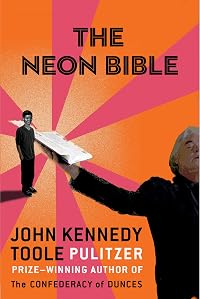
The Neon Bible
by John Kennedy Toole
On This Page
Description
The first novel by the Pulizer Prize-winning author of A Confederacy Of Dunces. David is a young boy growing up in a small Southern town in the 1940s. From his porch, David can see the whole valley, including the neon Bible that lights up the sky, emblem of the God-fearing folk who snub his family because Poppa can't afford the church dues.Tags
Recommendations









Member Reviews
Da pena pensar dónde podría haber llegado John Kennedy Toole de no haberse suicidado a tan temprana edad. Sin lugar a dudas era un genio. 'La Biblia de neón' fue la primera novela que escribió, siendo apenas un adolescente, y sólo puedo decir que es una obra con fuerza, con imágenes indelebles que permanecen a fuego en la memoria tras varias horas después de su lectura.
Toole nos cuenta la historia de David y de su familia en un pueblo sureño de Estados Unidos, cuya población, o la mayor parte de ella, se deja influenciar fácilmente por su predicador. La novela está narrada en primera persona por David, un adolescente que viaja en tren no sabemos hacia adónde. A través de David, conoceremos a sus padres, y sobre todo su show more relación con la tía Mae, una mujer algo llamativa y con un gran corazón, que escandaliza a todo el pueblo con sus actitudes.
Las impresiones que deja la lectura de 'La Biblia de neón' son de soledad, compasión y tristeza, pero también de una enorme rabia, por la mezquindad e hipocresía de la gente.
En definitiva, una gran novela. show less
Toole nos cuenta la historia de David y de su familia en un pueblo sureño de Estados Unidos, cuya población, o la mayor parte de ella, se deja influenciar fácilmente por su predicador. La novela está narrada en primera persona por David, un adolescente que viaja en tren no sabemos hacia adónde. A través de David, conoceremos a sus padres, y sobre todo su show more relación con la tía Mae, una mujer algo llamativa y con un gran corazón, que escandaliza a todo el pueblo con sus actitudes.
Las impresiones que deja la lectura de 'La Biblia de neón' son de soledad, compasión y tristeza, pero también de una enorme rabia, por la mezquindad e hipocresía de la gente.
En definitiva, una gran novela. show less
It’s stunning to me that this was written by Toole at the age of 16. The prose is simple and spare, and I suppose occasionally a little awkward, but his observations on life and people are fantastic. The violence of childhood from other kids and adults, the hypocrisy of religion, the pathos and transience of life – it’s all here. Toole reminds me of fellow Southerner Carson McCullers in style, at least in this book, and remarkable talent at an early age. I loved his masterpiece, ‘A Confederacy of Dunces’, but had put off reading this one because I wondered how good could it be, from a teenager, and published posthumously by his family, who were litigating over it. I’m certainly glad I read it, and considered tacking on an show more extra 1/2 star. It also reminds me of just how tragic his suicide at the age of 31, then unpublished, really was. show less
Toole's Confederacy of Dunces has long been one of my favourite books; this, his only other work (published posthumously in 1989 but actually written at the age of sixteen) is a totally different style, but very readable.
Narrator David is a quiet only child in a small town of the American South. Father is violent and abusive, Mother increasingly strange; and Aunt Mae, who lodges with them, an erstwhile performer and good time girl. As the story opens, David is on a train...but he takes us back through his1940s childhood. Violence, brutality and poverty seem frequent features; teachers, good and bad; a first date; the War. And the local society, deeply entrenched in Christian revivals and conformity.
The unfortunate events build to a show more sudden crescendo, and we find out what David's doing on that train...
A book that portends a great writer in the making. show less
Narrator David is a quiet only child in a small town of the American South. Father is violent and abusive, Mother increasingly strange; and Aunt Mae, who lodges with them, an erstwhile performer and good time girl. As the story opens, David is on a train...but he takes us back through his1940s childhood. Violence, brutality and poverty seem frequent features; teachers, good and bad; a first date; the War. And the local society, deeply entrenched in Christian revivals and conformity.
The unfortunate events build to a show more sudden crescendo, and we find out what David's doing on that train...
A book that portends a great writer in the making. show less
Aquesta novel·la m'ha colpit com una mala cosa. La va escriure un al·lot de 15 anys, i encara no entenc com algú d'aquesta edat pot escriure amb aquesta qualitat i aquesta força. Jo ja no me'n record del que feia quan jo tenia 15 anys. Per no fer, crec que ni tan sols pensava en el sexe. I aquí arriba un al·lot d'aquesta edat i escriu una novel·la que molts escriptors voldrien per a ells. Em fa molta (i no necessàriament sana) enveja.
Pel que fa a la traducció de Carles Llorach, hauria pogut ser molt bona si no fos perquè tradueix un munt de locucions angleses d'una forma totalment mecànica, paraula per paraula. Una llàstima, perquè per culpa d'això, i de pleonasmes innecessaris aquí i allà, una traducció excel·lent es show more converteix en poca cosa més que passable. Si hi va haver un corrector d'estil, no va fer bé la feina. show less
Pel que fa a la traducció de Carles Llorach, hauria pogut ser molt bona si no fos perquè tradueix un munt de locucions angleses d'una forma totalment mecànica, paraula per paraula. Una llàstima, perquè per culpa d'això, i de pleonasmes innecessaris aquí i allà, una traducció excel·lent es show more converteix en poca cosa més que passable. Si hi va haver un corrector d'estil, no va fer bé la feina. show less
Beautiful little story about a young man's growing up years in an Appalachain-type community where you either fit in or get out, without much in between. David narrates the story of his family's fall from fortune, the church rolls, and thus the good graces of most people in town. His suffering, and the suffering of his mother and aunt at the hands of the various people of trust in town is a sad little tale, culminating in a life changing day for the 14 year old boy. Touching, sad, and gorgeous in its simplicity.
The Neon Bible opens with seventeen-year-old David two or three hours into his very first train ride—begun just as the sun is beginning to set—and ending the next morning as the sun's "up full." In between, David tells his life story, beginning when he was three and got a toy train for Christmas, before his father lost his job and they had to move into the rickety old house at the top of the hill outside town.
David lives one of those lives that just slowly moves from bad to worse, too slowly for him to lose hope or even notice that things are as bad as they are. As things turn out, the best thing that ever happened to any of them was when Aunt Mae came to live with them, though no one thought so at the time.
John Kennedy Toole's A show more Confederacy of Dunces is in my Top Ten Favorite Books. The Neon Bible isn't quite that good, but it's one of those books that gets better as you think about it. It has qualities of Salinger's Catcher in the Rye, probably because they both are narrated in the first-person by a teenage boy. And it has qualities of To Kill a Mockingbird, mainly, I think, because Toole's teenage boy often sounds about the same age as Harper Lee's Scout.
Toole was sixteen years old when he wrote The Neon Bible. At thirty-one, about the age that Salinger was when he published Catcher in the Rye, Toole committed suicide. Though he suffered depression, his devoted mother was convinced that it was the failure of A Confederacy of Dunces to find a publisher that was responsible for his death. It was her persistence, and the help of celebrated novelist Walker Percy, that finally resulted in the book's publication by Louisiana State University Press eleven years after his death. And in 1981, Toole's master work received the Pulitzer Prize for fiction.
The Neon Bible and A Confederacy of Dunces are two very different books, each quite brilliant in its own way. Toole dismissed his early work as "immature," which it is . . . and also why it is so good. As the fruit of an immature mind, it is incredibly honest. show less
David lives one of those lives that just slowly moves from bad to worse, too slowly for him to lose hope or even notice that things are as bad as they are. As things turn out, the best thing that ever happened to any of them was when Aunt Mae came to live with them, though no one thought so at the time.
John Kennedy Toole's A show more Confederacy of Dunces is in my Top Ten Favorite Books. The Neon Bible isn't quite that good, but it's one of those books that gets better as you think about it. It has qualities of Salinger's Catcher in the Rye, probably because they both are narrated in the first-person by a teenage boy. And it has qualities of To Kill a Mockingbird, mainly, I think, because Toole's teenage boy often sounds about the same age as Harper Lee's Scout.
Toole was sixteen years old when he wrote The Neon Bible. At thirty-one, about the age that Salinger was when he published Catcher in the Rye, Toole committed suicide. Though he suffered depression, his devoted mother was convinced that it was the failure of A Confederacy of Dunces to find a publisher that was responsible for his death. It was her persistence, and the help of celebrated novelist Walker Percy, that finally resulted in the book's publication by Louisiana State University Press eleven years after his death. And in 1981, Toole's master work received the Pulitzer Prize for fiction.
The Neon Bible and A Confederacy of Dunces are two very different books, each quite brilliant in its own way. Toole dismissed his early work as "immature," which it is . . . and also why it is so good. As the fruit of an immature mind, it is incredibly honest. show less
I read Confederacy of Dunces four or five years ago - it's one of my wife's favorite books. I wasn't really into it. But since The Neon Bible promised to be a quick read, I gave Toole another go. Judging from the ratings, most people don't agree with me but I thought The Neon Bible was the better work. Sure, there were a few sticky areas with the writing, but this was his first work and written when he was 15. I have to wonder if he made revisions later in life, because if he didn't, he definitely had a level of brilliance and talent very rarely seen.
Members
- Recently Added By
Author Information

3 Works 24,830 Members
John Kennedy Toole was born in New Orleans, Louisiana on December 17, 1937. He received an undergraduate degree in English from Tulane University in 1958 and a master's degree in English literature from Columbia University in 1959. He started to pursue a doctorate at Columbia, but he was drafted into the U.S. Army in 1961 before he was able to show more finish. He served for two years at Fort Buchanan in Puerto Rico, teaching English to Spanish-speaking recruits. He taught at the University of Southwestern Louisiana, Hunter College in Manhattan, and St. Mary's Dominican College. He wrote A Confederacy of Dunces and sent a copy to Simon and Schuster for publication, but it was rejected. His failure to get his novel published and his increasing frustration at living with and supporting his parents brought on a breakdown. He committed suicide on March 26, 1969 at the age of 31. A Confederacy of Dunces was finally published in 1980 and won the 1981 Pulitzer Prize for Fiction. The Neon Bible, which he wrote when he was sixteen years old, was published in 1989. (Bowker Author Biography) show less
Work Relationships
Has the adaptation
Common Knowledge
- Canonical title*
- Neonraamattu
- Original title
- The Neon Bible
- Original publication date
- 1989
- People/Characters
- David; Aunt Mae; Frank; Bobbie Lee Thompson; Jo Lynne; Clyde
- Important places
- USA; Louisiana, USA; Mississippi, USA
- Related movies
- The Neon Bible (1995 | IMDb)
- First words
- This is the first time I've been on a train.
- Last words
- (Click to show. Warning: May contain spoilers.)The sun's up full now over the short trees, and I can see the sky's the same clear blue that it was yesterday in the valley.
- Blurbers
- McKeen, William; King, Florence; Luft, Kerry
- Original language*
- englanti
*Some information comes from Common Knowledge in other languages. Click "Edit" for more information.
Classifications
Statistics
- Members
- 1,278
- Popularity
- 19,038
- Reviews
- 23
- Rating
- (3.53)
- Languages
- 11 — Catalan, Czech, Dutch, English, Finnish, French, German, Italian, Romanian, Spanish, Swedish
- Media
- Paper, Audiobook, Ebook
- ISBNs
- 35
- ASINs
- 15