On This Page
Description
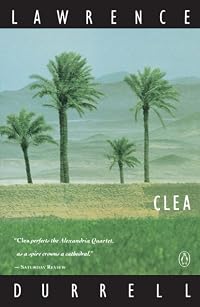
'I knew that Clea would share everything with me, withholding nothing - not even the look of complicity which women reserve only for their mirrors.' In Clea, the concluding part of The Alexandria Quartet, Darley returns to Alexandria now caught by war-fever. The conflagration has its effect on his circle - on Nessim and Justine, Balthazar and Clea, Mountolive and Pombal - a clarity of purpose emerges as the story moves towards its cadence.Tags
Recommendations





















Member Reviews
And, finally, The Alexandria Quartet draws to an end. This book is the first one to move forward chronologically in a substantive way-- while the other occur before World War II, in this one the war is underway (not, as the back cover claims, yet over). We get to revisit all the characters we came to meet in the first three books and see how they have grown and changed as a result of those events, plus those of the war. It's interesting: Durrell says the quartet was his study of love, and each book has had a different thing to say about it. Justine has a very romantic notion of it, full of grand affairs and mad passions and overblown ideas. In Balthazar, we seem to learn that love is mostly based upon lies, but it can still exist, just show more not in the way we thought we knew. And then in Mountolive, all love is a sham on every level: most of the relationships here are for political or social reasons, not romantic ones. But Clea takes us right back where we began, as the narrator (now allowed to use his name) is able to come to terms with the events of the series thanks to his love affair with Clea, the bisexual artist. This and many other plot threads of the series are tied up in fine form, as all of the characters ultimately come to a fitting end, and the truths (maybe) are finally revealed. Durrell's prose is as fantastic, his descriptions as evocative, and his insights as keen as ever. A strong end to a strong series, whose only fault was the honestly somewhat superfluous metafictional aspects. show less
World War II has begun and Darley returns to Alexandria in wartime. He resumes the narrative, but this time he adopts the lighter chronological approach of the third book. It's a happy marriage of the two styles as he reunites with friends and the city, and most especially with Clea. She has been an interesting peripheral figure up to now, liable to be someone's love interest but stubbornly resistant to the role. A confidante mostly, a sounding board but never really a source of advice, remaining aloof and devoted to her art. She would have received less of my attention to now if her name wasn't attached to this fourth novel of the quartet. Here she becomes catalyst, as Darley works through relinquishing the scars that Alexandria and show more his experiences there left etched on his memory.
Pursewarden's journal interrupts the flow of the story, but it is a brilliant metatextual piece where it seems like Durrell rather than the character who is speaking to the value and place of art and the artist. He positions it next to religion as a partner in healing the psyche, and explains the oblique, slanted messages that it delivers as a gateway for providing the reader a means to discover universal truths. The reader should not become too caught up in the vessel's quality but try to see through it as through a telescope to the great beyond that the author is working to forge passage to. Ultimately this quartet was Pursewarden's story, its central figure, and the realization of art its central theme. There is a price to be paid for achieving it, now or later, but a sweetness in the prize. show less
Pursewarden's journal interrupts the flow of the story, but it is a brilliant metatextual piece where it seems like Durrell rather than the character who is speaking to the value and place of art and the artist. He positions it next to religion as a partner in healing the psyche, and explains the oblique, slanted messages that it delivers as a gateway for providing the reader a means to discover universal truths. The reader should not become too caught up in the vessel's quality but try to see through it as through a telescope to the great beyond that the author is working to forge passage to. Ultimately this quartet was Pursewarden's story, its central figure, and the realization of art its central theme. There is a price to be paid for achieving it, now or later, but a sweetness in the prize. show less
“Clea,” the fourth volume of Lawrence Durrell’s “Alexandria Quartet,” opens with several years having passed since the events of the first three volumes. Darley, the narrator, is living on a Greek island with the six-year-old illegitimate daughter Nessim fathered with Melissa. After running into Balthazar and his Inter-Linear, he eventually heads off for Alexandria again with the child, full of both trepidation and anticipation about the past and the people he knew there.
When Darley arrives in Alexandria, almost immediately he runs into his old artist friend Clea, and consummates a formerly Plutonic relationship, now that their circle of friends is unencumbered by the presence of Melissa, who has died, and Justine, who is show more under house arrest for the duration of the novel. More than in any of the others, this novel has several meta-fictional aspects: meditations on art, creativity, and the novel (especially as revealed with Pursewarden’s letters), and some of Clea’s ideas about painting. All of this is, as always in this tetralogy, tied in beautifully with Balthazar’s earlier analyses shot throughout the Inter-Linear.
Reading these four novels has been one of the more powerful set of experiences that I have recently had. Most readers will probably not enjoy this; it’s not action-packed and full of adventure. But if you admire writing that tries to capture the uniqueness of inner coruscating experience, the complexities of passion and romantic relationships, and realizes the inability to tell “the whole story,” even after nearly one thousand pages of trying, I hope you will appreciate this as much as I did. As I said in my review of “Mountolive,” I have simply run out of things to say about how much I loved this. Sometimes admiration must finish itself off in silence. show less
When Darley arrives in Alexandria, almost immediately he runs into his old artist friend Clea, and consummates a formerly Plutonic relationship, now that their circle of friends is unencumbered by the presence of Melissa, who has died, and Justine, who is show more under house arrest for the duration of the novel. More than in any of the others, this novel has several meta-fictional aspects: meditations on art, creativity, and the novel (especially as revealed with Pursewarden’s letters), and some of Clea’s ideas about painting. All of this is, as always in this tetralogy, tied in beautifully with Balthazar’s earlier analyses shot throughout the Inter-Linear.
Reading these four novels has been one of the more powerful set of experiences that I have recently had. Most readers will probably not enjoy this; it’s not action-packed and full of adventure. But if you admire writing that tries to capture the uniqueness of inner coruscating experience, the complexities of passion and romantic relationships, and realizes the inability to tell “the whole story,” even after nearly one thousand pages of trying, I hope you will appreciate this as much as I did. As I said in my review of “Mountolive,” I have simply run out of things to say about how much I loved this. Sometimes admiration must finish itself off in silence. show less
I can't do it. I can't finish. This Quartet is ending in a total mess. The phrase that came to me that best describes this volume is "a soap opera for the literati". In an author's note at the onset of this volume, Durrell even admits he could expand the story line almost indefinitely. Of course he could have. It degenerated into a sad soap opera.
He seemed to insert every absurd device and event he could locate in attempt to keep the reader's interest. I won't attempt to list them but one sample should give a person the flavor. A character uses a telescope to observe and then lip read another character. The absurdities abound and multiply.
A sad end to a Quartet that began with the wonderful volume "Justine".
He seemed to insert every absurd device and event he could locate in attempt to keep the reader's interest. I won't attempt to list them but one sample should give a person the flavor. A character uses a telescope to observe and then lip read another character. The absurdities abound and multiply.
A sad end to a Quartet that began with the wonderful volume "Justine".
In Clea (1960) we finally gain a true sequel to the story thus far. Darley narrates again, but a wiser Darley than when last heard from. With the passing of years he has had ample time to reflect; he’s a hermit still, raising the child in comfortable solitude. War is upon the world and it is only with a summons from Nessim that he returns to a much different Alexandria (thought still unchanged in the essentials), hoping to at last exorcise its hold over him.
Clea’s function in the narrative is as a clearing of the board, an attempt to set in order all the lives flung about by the earlier events. The triumph is not of truth (as Henry James said, “the whole of anything can never be told”) but of pragmatism. It functions as a show more book-length epilogue – the “story” and its finale have already been told and retold. This is 200 pages of who gets hitched, who dies and who moves away. With Justine and Mountolive as two impeccable dramatic narratives, Clea pairs off with Balthazar as a series of disconnected sketches meant to fill in the blanks with further guesswork. There are snatches of plots centered on Liza Pursewarden, on Keats’ coming of age, on Pombal’s first genuine love affair and on Scobie’s final resting place but they are just the loose ends of Alexandria. Clea is a meandering stream after the tidal flood of the previous volumes. Perhaps it is inevitable that I am disappointed.
On the other hand, the sketches are usually beautifully rendered. Liza’s fight to whitewash her brother’s reputation causes her to briefly interact with Darley and the others, all of whom view Liza with a fascinated unease, imbuing her with all the characteristics of a seer, a specter, a witch. Nevertheless her story is a pitiful one. Scobie’s posthumous legacy, on the other hand, makes for a heartwarming and surprisingly believable final twist in his story. And the claim Darley originally made that the city was responsible for his and others actions finally begins to convince, for here Alexandria comes across as the eminence grise, malevolent and diabolical, leading those within its sphere to tragedy and chaos (the death toll is truly staggering in this series).
But the worst part of The Alexandria Quartet is also featured in this volume. Pursewarden, alas, falls back into the hands of those who see him as an artiste, leading back into the tedious and now redundant throes of “artistic philosophy.” The biggest problem with inventing an artist for one’s novel is the threat of their invisible work. So much fuss is made over Pursewarden’s art that one wants nothing more than to read it and pass judgment but that is of course impossible. Thence an uncharitable view springs up every time his blasted books are mentioned; he IS all hat and no cattle. As a character he’s as interesting as the others but as an artist I have to view him as a waste of space, especially as Durrell loses no opportunity to insert his doggerel verse into the book. The 30 pages of his journal are borderline unreadable and enormously frustrating – a few interesting thoughts stuck in a load of codswallop.
That’s the worst it gets, thankfully. It’s certainly interesting to see how Durrell chose to wrap things up. Depending on your perspective, the conclusion will appear either cleansing and life-embracing or a further stultification, a giving in to decadence in a world gone to war. I’m for the latter. Darley and Clea hook up and the first thing they do is "ignore the loutish reality of the world" by refusing to depart from bed to air-raid shelter. The new love is as troubled in its way as all the old loves were, and though stronger, built upon the debris of old experiences, it is up for debate whether it’ll last long. People have wised up, though only in a guarded and limpid sort of way and one has to laugh when, for instance, Clea announces that she was the only one who really “got” Pursewarden, who was on his wavelength. Or when she claims “Paracelsus says that thoughts are acts. Of them all, I suppose, the sex act is the most important, the one in which our spirits most divulge themselves” going on to claim that it actually is the base root of knowledge. This contradicts everything that’s gone before, with virtually the entire cast sleeping around and nevertheless evincing total ignorance of one another’s true motivations. Clea, always appearing so sensible while on the sidelines, steps into the limelight and reveals she hasn’t been listening to any but her own desires after all.
In a way, that’s the biggest part of the problem and what kept raising my eyebrows during the read - not the lack of drama (there’s plenty) but the lack of maturity. The cast began as depressed, self-absorbed chronic liars using erotic episodes and obsessive analytics to try to order their world and dammit if they don’t end up about the same way (with Darley being the sole exception). As Clea says towards the end: “Oh, isn’t it disgusting? When will we all grow up?”
On the other hand, it’s not so very much to complain of. Clea is consistent with volumes I-III in all the major ways, good and bad. It is still a moving work, it is uncertain of answers, still walks the knife-edge of melodrama, reads exquisitely, glitches over pretentious pseudo-philosophical babble and contains multitudes. The main focus is upon Darley’s relationship with Clea, of course, and it is the first time a couple in Alexandria have really been depicted enjoying one another’s company – boating, swimming, chatting and so on. "With Clea also the new relationship offered no problems, perhaps because deliberately we avoided defining it too sharply, and allowed it to follow the curves of its own nature, to fulfill its own design." Darley is the one who has changed the most, no longer dogged in pursuit of answers, willing instead to allow life to progress at its own pace and to offer solitude to those who need it. "This parting was… well, it was only like changing the bandages until a wound should heal."
And so I would conclude that, though somewhat less enjoyable than the first three, Clea is a worthwhile conclusion. Endings are hard to do well and in my opinion this one is reasonable, not excellent – four stars to the trio’s five. I would have preferred it more focused. But then I’m going to miss the language, now it’s over: "It is strange, too, to remember what a curious sea-engendered rapport we shared during that memorable summer. A delight almost as deep as the bondage of kisses – to enter the rhythm of the waters together, responding to each other and the play of the long tides. Clea had always been a fine swimmer, I a poor one. But thanks to my period spent in Greece I too was now expert, more than a match for her. Underwater we played and explored the submarine world of the pool, as thoughtlessly as fishes on the fifth day of the Creation. Eloquent and silent water-ballets which allowed us to correspond only by smile and gesture. The water-silences captured and transformed everything human in movement, so that we were like the coloured projections of undines painted upon these brilliant screens of rock and weed, echoing and copying the water-rhythms. Here thought itself perished, was converted into a fathomless content in physical action."
That can speak for itself. It’s been a strange reading experience and I’m exhausted but I’m glad I made the time for it.
http://pseudointellectualreviews.wordpress.com/2013/06/22/clea-lawrence-durrell/ show less
Clea’s function in the narrative is as a clearing of the board, an attempt to set in order all the lives flung about by the earlier events. The triumph is not of truth (as Henry James said, “the whole of anything can never be told”) but of pragmatism. It functions as a show more book-length epilogue – the “story” and its finale have already been told and retold. This is 200 pages of who gets hitched, who dies and who moves away. With Justine and Mountolive as two impeccable dramatic narratives, Clea pairs off with Balthazar as a series of disconnected sketches meant to fill in the blanks with further guesswork. There are snatches of plots centered on Liza Pursewarden, on Keats’ coming of age, on Pombal’s first genuine love affair and on Scobie’s final resting place but they are just the loose ends of Alexandria. Clea is a meandering stream after the tidal flood of the previous volumes. Perhaps it is inevitable that I am disappointed.
On the other hand, the sketches are usually beautifully rendered. Liza’s fight to whitewash her brother’s reputation causes her to briefly interact with Darley and the others, all of whom view Liza with a fascinated unease, imbuing her with all the characteristics of a seer, a specter, a witch. Nevertheless her story is a pitiful one. Scobie’s posthumous legacy, on the other hand, makes for a heartwarming and surprisingly believable final twist in his story. And the claim Darley originally made that the city was responsible for his and others actions finally begins to convince, for here Alexandria comes across as the eminence grise, malevolent and diabolical, leading those within its sphere to tragedy and chaos (the death toll is truly staggering in this series).
But the worst part of The Alexandria Quartet is also featured in this volume. Pursewarden, alas, falls back into the hands of those who see him as an artiste, leading back into the tedious and now redundant throes of “artistic philosophy.” The biggest problem with inventing an artist for one’s novel is the threat of their invisible work. So much fuss is made over Pursewarden’s art that one wants nothing more than to read it and pass judgment but that is of course impossible. Thence an uncharitable view springs up every time his blasted books are mentioned; he IS all hat and no cattle. As a character he’s as interesting as the others but as an artist I have to view him as a waste of space, especially as Durrell loses no opportunity to insert his doggerel verse into the book. The 30 pages of his journal are borderline unreadable and enormously frustrating – a few interesting thoughts stuck in a load of codswallop.
That’s the worst it gets, thankfully. It’s certainly interesting to see how Durrell chose to wrap things up. Depending on your perspective, the conclusion will appear either cleansing and life-embracing or a further stultification, a giving in to decadence in a world gone to war. I’m for the latter. Darley and Clea hook up and the first thing they do is "ignore the loutish reality of the world" by refusing to depart from bed to air-raid shelter. The new love is as troubled in its way as all the old loves were, and though stronger, built upon the debris of old experiences, it is up for debate whether it’ll last long. People have wised up, though only in a guarded and limpid sort of way and one has to laugh when, for instance, Clea announces that she was the only one who really “got” Pursewarden, who was on his wavelength. Or when she claims “Paracelsus says that thoughts are acts. Of them all, I suppose, the sex act is the most important, the one in which our spirits most divulge themselves” going on to claim that it actually is the base root of knowledge. This contradicts everything that’s gone before, with virtually the entire cast sleeping around and nevertheless evincing total ignorance of one another’s true motivations. Clea, always appearing so sensible while on the sidelines, steps into the limelight and reveals she hasn’t been listening to any but her own desires after all.
In a way, that’s the biggest part of the problem and what kept raising my eyebrows during the read - not the lack of drama (there’s plenty) but the lack of maturity. The cast began as depressed, self-absorbed chronic liars using erotic episodes and obsessive analytics to try to order their world and dammit if they don’t end up about the same way (with Darley being the sole exception). As Clea says towards the end: “Oh, isn’t it disgusting? When will we all grow up?”
On the other hand, it’s not so very much to complain of. Clea is consistent with volumes I-III in all the major ways, good and bad. It is still a moving work, it is uncertain of answers, still walks the knife-edge of melodrama, reads exquisitely, glitches over pretentious pseudo-philosophical babble and contains multitudes. The main focus is upon Darley’s relationship with Clea, of course, and it is the first time a couple in Alexandria have really been depicted enjoying one another’s company – boating, swimming, chatting and so on. "With Clea also the new relationship offered no problems, perhaps because deliberately we avoided defining it too sharply, and allowed it to follow the curves of its own nature, to fulfill its own design." Darley is the one who has changed the most, no longer dogged in pursuit of answers, willing instead to allow life to progress at its own pace and to offer solitude to those who need it. "This parting was… well, it was only like changing the bandages until a wound should heal."
And so I would conclude that, though somewhat less enjoyable than the first three, Clea is a worthwhile conclusion. Endings are hard to do well and in my opinion this one is reasonable, not excellent – four stars to the trio’s five. I would have preferred it more focused. But then I’m going to miss the language, now it’s over: "It is strange, too, to remember what a curious sea-engendered rapport we shared during that memorable summer. A delight almost as deep as the bondage of kisses – to enter the rhythm of the waters together, responding to each other and the play of the long tides. Clea had always been a fine swimmer, I a poor one. But thanks to my period spent in Greece I too was now expert, more than a match for her. Underwater we played and explored the submarine world of the pool, as thoughtlessly as fishes on the fifth day of the Creation. Eloquent and silent water-ballets which allowed us to correspond only by smile and gesture. The water-silences captured and transformed everything human in movement, so that we were like the coloured projections of undines painted upon these brilliant screens of rock and weed, echoing and copying the water-rhythms. Here thought itself perished, was converted into a fathomless content in physical action."
That can speak for itself. It’s been a strange reading experience and I’m exhausted but I’m glad I made the time for it.
http://pseudointellectualreviews.wordpress.com/2013/06/22/clea-lawrence-durrell/ show less
In [Clea], Lawrence Durrell completes his [Alexandria Quartet] with a sequel, a more linear narrative to finally move Darley, [Justine]’s narrator, along in time, and show the effects of his earlier misunderstandings.
Alexandria is transformed in World War II when Darley finally returns to the city to confront the mistakes of his earlier life there. He reunites with Clea, an artist who hovered on the edges of all of his relationships during his earlier stay, and finds a deeper and more complete love than he experienced in any of his other affairs. Continuing to reminisce, Darley sees his previous relationships and life more clearly in the context of a stable and reciprocated love.
Durrell layers in much of his own vision for the show more [Alexandria Quartet] in sections of [Clea] where he is discussing the writing life with another author. In one passage, he definitively announces his thesis:
“I mean about the mutability of all truth. Each fact can have a thousand motivations, all equally valid, and each fact a thousand faces. So many truths have little to do with fact. Your duty is to hunt them down. At each moment of time all multiplicity waits at your elbow. Why, Darley, this should thrill you and give your writing the curves of a pregnant woman.”
This vision sets Durrell in a class by himself – the anti-Dickens. Rather than creating whole universes of characters, Durrell finds a handful and continually re-writes their existences, each new facet of their lives as true and credible as the last.
Bottom Line: Finally a sequel to the earlier stories in the series, but still full of improvisation and twisting perception, again changing the face of the story and the characters.
4 bones!!!! show less
Alexandria is transformed in World War II when Darley finally returns to the city to confront the mistakes of his earlier life there. He reunites with Clea, an artist who hovered on the edges of all of his relationships during his earlier stay, and finds a deeper and more complete love than he experienced in any of his other affairs. Continuing to reminisce, Darley sees his previous relationships and life more clearly in the context of a stable and reciprocated love.
Durrell layers in much of his own vision for the show more [Alexandria Quartet] in sections of [Clea] where he is discussing the writing life with another author. In one passage, he definitively announces his thesis:
“I mean about the mutability of all truth. Each fact can have a thousand motivations, all equally valid, and each fact a thousand faces. So many truths have little to do with fact. Your duty is to hunt them down. At each moment of time all multiplicity waits at your elbow. Why, Darley, this should thrill you and give your writing the curves of a pregnant woman.”
This vision sets Durrell in a class by himself – the anti-Dickens. Rather than creating whole universes of characters, Durrell finds a handful and continually re-writes their existences, each new facet of their lives as true and credible as the last.
Bottom Line: Finally a sequel to the earlier stories in the series, but still full of improvisation and twisting perception, again changing the face of the story and the characters.
4 bones!!!! show less
More conventional and more enjoyable than the other three members of the quartet: there is something like a narrative here, that is tied up at the end of the book, and there's a lot of straightforward pleasure along the way. The mood, despite the war, is rather lighter than before. Darley has at last grown up and stopped whingeing; Nessim and Justine are shunted off to glower off-stage. Scobie and Pursewarden, the two most amusing characters in the series, have a lot of posthumous input. Scobie bizarrely talks through the mouths of other characters who recite his monologues from memory; Pursewarden more conventionally through his letters and notebooks.
I think it was a mistake to pause for a couple of years between reading Mountolive and show more Clea: it took me a while to get back into the relationships between the characters and remember what we had been told before. There's probably a lot to be said for re-reading the whole quartet quickly once you've read it once. If it ever gets back to the front of my queue...
Assessment of the Quartet as a whole: Hard to say. When I started, I noted that I'm not a fan of Henry Miller, Durrell's most obvious influence. I'm much more comfortable with realist fiction. Evelyn Waugh — to name just one example — managed to capture the idea of Alexandria just as effectively and with far less fuss in a much more accessible form. All the same, I did find Durrell's exercise of digging and redigging through a story to unearth different levels of "truth" interesting and amusing (it's always fun watching someone else working) even if the conclusion that "it's all subjective" seems a bit trite after all that effort. It's undeniable that there's some very witty and beautiful writing there, and some extremely memorable minor characters. So, while it's perhaps a literary cul de sac, it does have quite a bit to offer. show less
I think it was a mistake to pause for a couple of years between reading Mountolive and show more Clea: it took me a while to get back into the relationships between the characters and remember what we had been told before. There's probably a lot to be said for re-reading the whole quartet quickly once you've read it once. If it ever gets back to the front of my queue...
Assessment of the Quartet as a whole: Hard to say. When I started, I noted that I'm not a fan of Henry Miller, Durrell's most obvious influence. I'm much more comfortable with realist fiction. Evelyn Waugh — to name just one example — managed to capture the idea of Alexandria just as effectively and with far less fuss in a much more accessible form. All the same, I did find Durrell's exercise of digging and redigging through a story to unearth different levels of "truth" interesting and amusing (it's always fun watching someone else working) even if the conclusion that "it's all subjective" seems a bit trite after all that effort. It's undeniable that there's some very witty and beautiful writing there, and some extremely memorable minor characters. So, while it's perhaps a literary cul de sac, it does have quite a bit to offer. show less
Members
- Recently Added By
Lists

20th Century Literature
1,161 works; 55 members

1960s, Best books published therein
254 works; 22 members

Recommended Reading : 600 Classics Reviewed, Editors of Salem Press, 2015
634 works; 6 members
Author Information

152+ Works 18,674 Members
Lawrence Durrell was born on February 27, 1912 in Jullundur, India to British parents. During World War II, he served as a British press officer. His first novel, Pied Piper of Lovers, was published in 1935, but was considered a failure. Some of his other works include The Black Book, The Alexandria Quartet, The Avignon Quintet, and Caesar's Vast show more Ghost: A Portrait of Provence. Bitter Lemons won the Duff Cooper Prize in 1959. He died on November 7, 1990 at the age of 78. (Bowker Author Biography) show less

Lawrence Durrell has a Legacy Library. Legacy libraries are the personal libraries of famous readers, entered by LibraryThing members from the Legacy Libraries group.
Some Editions
Awards and Honors
Distinctions
Notable Lists
Series

Belongs to Publisher Series
Work Relationships
Is contained in
Common Knowledge
- Canonical title
- Clea
- Original title
- Clea
- Original publication date
- 1960
- People/Characters
- Darley; Melissa; Pursewarden; Scobie; David Mountolive; Justine (show all 8); Balthazar; Clea
- Important places
- Alexandria, Egypt; Egypt
- Important events
- World War II (1939 | 1945)
- Epigraph
- The Primary and most beautiful of Nature's qualities is motion, which agitates her at all times, but this motion is simply the perpetual consequence of crimes, it is conserved by means of crimes alone.
D.A.F. de Sade - Dedication
- To
MY FATHER - First words
- The oranges were more plentiful than usual that year.
- Quotations
- The most tender, the most tragic of illusions is perhaps to believe that our actions can add or subtract from the total quantity of good and evil in the world.
- Original language
- English
Classifications
Statistics
- Members
- 1,624
- Popularity
- 13,920
- Reviews
- 26
- Rating
- (3.94)
- Languages
- 15 — Catalan, Danish, English, Finnish, French, German, Greek, Hungarian, Italian, Japanese, Polish, Portuguese, Russian, Spanish, Turkish
- Media
- Paper, Audiobook, Ebook
- ISBNs
- 60
- UPCs
- 1
- ASINs
- 54