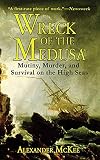
Wreck of the Medusa
by Alexander McKee
On This Page
Description
In 1816, a fleet of ships left France to accept the British hand-over of the port of Saint-Louis in Senegal. Among them was the frigate Medusa. A month after it set sail, she shank miles off of Africa's west coast, leaving the passengers to flee on lifeboats and a raft cobbled together from parts of the sinking ship. After a failed attempt by those in the lifeboats to tow the raft, it and the more than 150 people aboard were abandoned. This is the horrific tale, filled with suicide, murder, show more and cannibalism, of those left behind. show lessTags
Recommendations










































Member Recommendations


Member Reviews
On June 12, 1816, the Medusa set sail in a convoy to Senegal. Among Medusa's 240 crew and passengers are the Picard family, commander de Chaumareys, newly appointed Gov. Schmaltz, and would-be explorer M. Richefort. Against strict instructions, de Chaumareys indulges the Schmaltzes to tour along the way, creating greater delays. Due to rough seas and overconfident leadership, the Medusa strikes the Arguin sandbar. Unnecessarily, de Chaumareys is quick to abandon ship, refusing to toss the cannon and 3 barrels of gold francs to lighten the load. 150 people cram onto a large raft, sinking waist deep in water! Others board 5 smaller boats, with Schmaltz in a spacious barge, and 15 left behind. After the raft proves too cumbersome to tow, show more the lack of humanity and the events that unfold will shock you. Whether out at sea or forced to trek across the desert, those not among the privileged few suffered hunger, thirst and violence on an unprecedented scale.
"Harrowing" does not even begin to describe what these people went through. With every page turn the situation kept getting worse and I couldn't look away. Without debate McKee accuses de Chaumareys and Gov. Schmaltz of incompetence and unfeeling neglect: "...half-measures had been employed half-heartedly" and innocent lives were gambled. First published in 1975, this book holds up better than expected. McKee relies heavily on the survivors accounts for a heightened dramatic effect. It reads like a thriller novel! I appreciated the seamless transitions between the different parties as well. My only quibble is that, by quoting directly, the terms "Arab" "Muselman" and "Moors"are used interchangeably, without further modern clarification and there needs to be a better format for citation. show less
"Harrowing" does not even begin to describe what these people went through. With every page turn the situation kept getting worse and I couldn't look away. Without debate McKee accuses de Chaumareys and Gov. Schmaltz of incompetence and unfeeling neglect: "...half-measures had been employed half-heartedly" and innocent lives were gambled. First published in 1975, this book holds up better than expected. McKee relies heavily on the survivors accounts for a heightened dramatic effect. It reads like a thriller novel! I appreciated the seamless transitions between the different parties as well. My only quibble is that, by quoting directly, the terms "Arab" "Muselman" and "Moors"are used interchangeably, without further modern clarification and there needs to be a better format for citation. show less
In 1816, an envoy of ships sailed from Rochelle, france headed for St Louis, Senegal, to replace the English government there with a French one. Command of the lead ship was given to an incompetent aristocrat, because of political policy at the time. Like much incompetent management world-over, this buffoon, because of stupidity in a relatively unchallenging situation, managed to run his ship into a sandbar. Worse, he cowardly saved his life and those of VIPs aboard, while abandoning more than half of his ship's inhabitants to horrid travails, cannibalism, and death. Politicians tried to quash the truth, when the few survivors told the story of the Captain's cowardice, but it would eventually out.
If you despise humans who sell their show more souls for money and/or power, this book will add to your despising. Or, you can try to pity them, because really, though they strive so heartily to do so, and give up so much, they can never be happy, and end badly. show less
If you despise humans who sell their show more souls for money and/or power, this book will add to your despising. Or, you can try to pity them, because really, though they strive so heartily to do so, and give up so much, they can never be happy, and end badly. show less
A chilling tale of political favours, incompetence and a ship wrecked on a sandbank 70 miles of a desert shore and the dire consequences that transpired for the ordinary people aboard, many of whom were left standing deep in water on a raft with sharks circling; while the boats that could have been used to rescue them and get them ashore where kept ready to be used by the more distinguished passengers and crew. This is followed by the story of a daring land based rescue expedition to bring those who did make it ashore back out of the desert to safety.
This was a bit disappointing. I had expected it to be more interesting considering that, the incident of the Medusa is mentioned in so many works as a basis of comparison. Perhaps I found it disappointing because it was so vague in places. However, I suppose that it would be difficult to write a highly detailed work about something that happened so long ago.
It did have interesting end chapters, however. One chapter told of modern day examples of survival, such as the ordeal of the Andes survivors. Another chapter told of an experience in the 1940's of the rafts of Rio Azul, which had been torpedoed. These men, however, shared some type fraternity, & were therefore able to keep up morale until being rescued.
Another chapter told of the show more artist Gericault & his creation of the disturbing portrayal of the struggles aboard the raft of the Medusa. It told of his deep depression he suffered afterward because, that he could never surpass his own masterpiece. show less
It did have interesting end chapters, however. One chapter told of modern day examples of survival, such as the ordeal of the Andes survivors. Another chapter told of an experience in the 1940's of the rafts of Rio Azul, which had been torpedoed. These men, however, shared some type fraternity, & were therefore able to keep up morale until being rescued.
Another chapter told of the show more artist Gericault & his creation of the disturbing portrayal of the struggles aboard the raft of the Medusa. It told of his deep depression he suffered afterward because, that he could never surpass his own masterpiece. show less
Ratings
Members
- Recently Added By
Author Information

36 Works 1,028 Members
Common Knowledge
- Canonical title
- Wreck of the Medusa
- People/Characters
- Captain Hugues Duroy de Chaumareys; Colonel Julien-Désiré Schmaltz; Reine Schmaltz; Joseph Jean-Baptiste Alexandre Griffon du Bellay; M. Richefort; M. Picard (show all 16); Charlotte-Adelaide Picard; Alphonse Fleury; Lieutenant Joseph Pierre Andre Reynaud; Lieutenant Jean Espiaux; J.B. Henry Savigny; Laura Picard; Alexander Correard; Jean Daniel Coudein; Sub-Lieutenant Lapeyrere; Lietenant Leon Henry de Parnajon
- Important places
- St. Louis, Saint-Louis Region, Senegal; Arguin Sandbar, Bay of Arguin, Africa; Funchal, Madeira, Portugal; Teneriffe, Canary Islands
- Important events
- Wreck of the Medusa (1816)
- First words
- The girl who ran impulsively into the fields to gather blooms was saying goodbye to France.
- Quotations
- The castaways were divided by nationality, by color, by caste, by age, by occupation, by experience, and most dangerously of all by the marks of the branding iron which indicated from whence many of the soldiers had been recr... (show all)uited - the jails of France. They were divided also into the strong and the weak, but as events were to show it was not physical strength or weakness which would determine who would live and who would die, but more inward qualities.
About a dozen corpses lolled grotesquely in the water, their legs caught in the gaps between the timbres of the raft. - Last words
- (Click to show. Warning: May contain spoilers.)They decline to give the story of the Medusa the status of a tragedy because, they conclude, the victims were largely responsible for what happened to them. I wonder how true that is?
Classifications
Statistics
- Members
- 191
- Popularity
- 170,827
- Reviews
- 4
- Rating
- (3.88)
- Languages
- Dutch, English
- Media
- Paper, Ebook
- ISBNs
- 10
- ASINs
- 7