On This Page
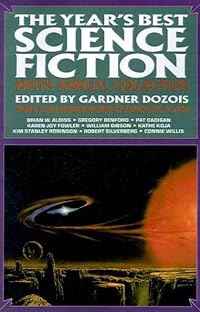
Description
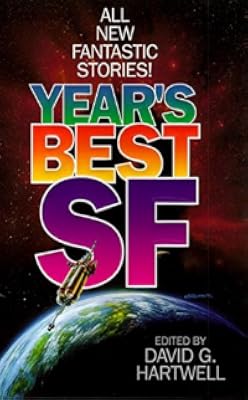
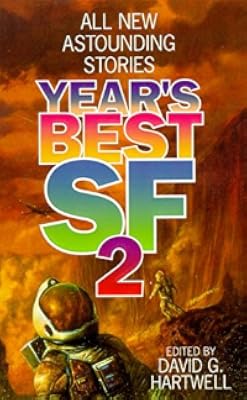
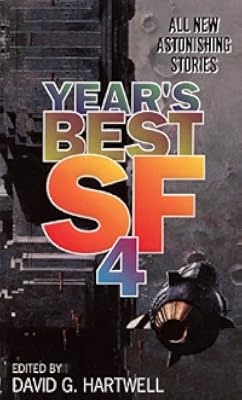
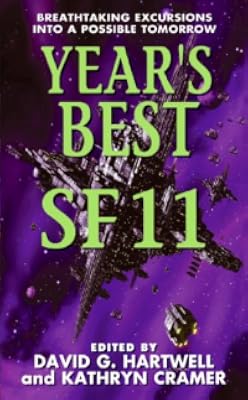
WORLD-ALTERING SCIENCE FICTION Tales of wonder and adventure, set on distant planets or in the future of our own Stories that go beyond the limits of Space and Time David G. Hartwell has brought together only the best of this year's new SF from established pros and audacious newcomers, selecting only those that share the universal quality of great science fiction. Our familiar world will look a little less familiar after you read one. Includes storiesby: Joe Haldeman Ursula K. Le Guin Robert show more Silverberg Roper Zelazny show lessTags
Recommendations

















Member Reviews
My reactions to reading this collection in 2001. Spoilers follow.
"Think Like a Dinosaur", James Patrick Kelly -- Hartwell, in his introductory notes, says this story is part of a dialogue about Tom Godwin's "The Cold Equations". That's true. It does involve the killing of an innocent to balance some equations, here the obscure equations involved in quantum teleportation of humans to an alien world. However, the story, in its plot of birth and death via teleportation, has echoes of Algis Budry's Rogue Moon. This story is more emotional than Godwin's tale. The narrator, a person counseling skittish people on how to handle the teleportation process, kills, rather gleefully, one of his charges. He learns to "think like a dinosaur", like the show more alien Gendians who are the ones who insist on the equations being balanced in their teleportation process.
"Wonders of the Invisible World", Patricia A. McKillip -- I'm not really sure what the point of this story was. Most of it concerns the narrator's interaction, as a time traveling researcher, with Cotton Mather (the story's title is an allusion to a work of Mather's) as part of a project to investigate the imagery of primitive, "Pre-Real" (presumably as in "virtual reality") peoples' mind. At first, the narrator seems appalled by both the poisonous uses that Mather puts his rather impoverished imagination to yet sad by the lack of imagination by most adults in her world. Yet, she's appalled by the atavistic imagination of her boss. The narrator seems to reach the conclusion, at story's end, that the powerful computer tools of her age enable a much healthier imagination for her son -- though that imagination may be lost when he gets older. Why a library of pre-conceived icons and notions should necessarily mean greater imagination among the youth is not really explored -- though it probably would. And McKillip definitely doesn't explain why this imagination should suddenly be lost in the narrator's society when people reach adulthood. It seemed like more of an excuse to comment and criticize Mather than anything else.
"Hot Times in Magma City", Robert Silverberg -- Once again Silverberg proves why he's a master. He takes a rather hackneyed idea, Los Angeles threatened by volcanic eruptions, and breaths new life into by sheer technical skill and a little technological extrapolation. (To show what a hackneyed idea this is, about two years after this story was published, the movie Volcano came about -- about Los Angeles threatened by an eruption.) Silverberg has the great metropolis threatened by a whole series of magma eruptions. The technical skill of the story comes in telling it in a chatty, present-tense style and, perhaps even more importantly, who he selects as the heroes: a bunch of drug addicts sentenced to mandatory community service. They fight the magma upwellings in special suits. Silverberg handles those action details well. But it's the addition of their interactions, the flaws and quirks that made them addicts, and their attempts at self-rehabilitation through their work fighting magma, that make the story special.
"Gossamer", Stephen Baxter -- While this story is ingenious and conforms to the aesthetics of hard sf, I only found it somewhat interesting (though, of course, I haven't read all the hard sf published in 1995 so I don't know if Hartwell omitted better examples to include it). I'm usually not all that interested in the description of planetscapes -- here Pluto and Charon -- or the creation of exotic life -- here a rather spider-like lifeform that uses the resources of both those worlds.
"A Worm in the Well", Gregory Benford -- Hartwell mentions Poul Anderson in his introductory notes about the tradition Benford is working in. The description is accurate here as a hard-bitten owner/operator of a spaceship not only confronts the dangers and technical challenges of grabbing a near invisible wormhole near the sun (with the aid of her onboard artificial Intelligence, Erma) but also engages in some hard negotiations in selling it in order to clear her debts. I found the story entertaining but nothing special.
"Downloading Midnight", William Browning Spencer -- A story that combines the fantasy-like adventures of AI avatars in the cyberverse with the manipulation and analysis of images taken from human mind as in Roger Zelazny's "The Dream Master" or Greg Bear's Queen of Angels. It wasn't particularly interesting except for the background which cryptically makes reference to the Decadence and the details of the Big R as the citizens of this world called reality. I like the details of its sexual repression with the sexual age of consent as 25 with sexual unions proceeding through a legally defined series of injunctions and waivers and contracts and monitored meetings and mathematical measurements of personality traits like evasiveness. The story ends with the virtual entertainment world starting to see the dawn of something to replace the ubiquitous sex shows: true innocence.
"For White Hill" Joe Haldeman -- Having read some of Joe Haldeman's diary entries (obviously the ones he chooses to publish) on his website, I sense a lot of Haldeman in the sculptor-narrator of this tale. Both are well-traveled artists with an interest in sex, food, and the tools and techniques of their art. This was a pleasantly mournful tale of the narrator going to a devastated Earth of the far future (all life has been sterilized off it due to nanophages planted by an alien race humans are at war with). The narrator, like Haldeman, is also a war veteran. He is ther for a contest to produce a work of art honoring man's past on his homeworld. A new alien attack, which causes Earth's sun to age at an accelerated rate, traps the artists gathered for the competition on a threatened planet. The narrator falls in love with White Hill, another artist who also works as an empathetic therapist (she comes from a culture which has the interesting notion that all parts of life, work and art, are necessary). She leaves to help, at the price of her life, a group of artists in coldsleep on a ship. The narrator does not go with her, unable to immerse himself in the unquiet groupmind network of the sleepers, and writes the story to commemorate White Hill before he dies. The story will be engraved on platinum plates and put on a ship to be discovered thousands of years in the future, an attempt to give White Hill some sort of immortality.
"In Saturn Time", William Barton -- Something different from Barton, an alternate history. This is an alternate history of the US space program from 1974 to 2001 when a US ship goes to Jupiter (and tv commentator Arthur C. Clarke -- clearly present if not explicitly named -- plays "Thus Sprach Zarathustra"). The turning point seems to have been the nomination, in the 1972 Democratic presidential primary, of Morris Udall who took the party away from the more leftist George McGovern wing which didn't support the space program. (Even Jesse Jackson is onboard in his support.) I support the space program but am not all that interested in stories about it so, even if this was from Barton, I was not all that thrilled with it.
"Coming of Age in Karhide: Sov Thade Tage Em Ereb, of Rer in Karhide, on Gethen", Ursula K. Le Guin -- Having never read more than an excerpt of her famous The Left Hand of Darkness, I can't say how much Le Guin expands the background and depiction of its planet Winter inhabited by human-like aliens who are genderless most of the time except when they are in "kemmer" and not only have sex but can choose their gender. The story is, as the title indicates, a coming of age tale about a young alien coming to terms with the new presence of sex, desire, and love in her life -- mostly involving a cousin of hers (not scandalous in this culture). It was a moderately engaging tale, and Le Guin does often write, as many have noted, as an anthropologist and historian of alien worlds.
"The Three Descents of Jeremy Baker", Roger Zelazny -- This story was chatty, occasionally funny, and bubbly -- as you would expect from Zelazny though that's only one of his styles, but its plot of a human meeting aliens around a black hole who enable him to inhabit the core of information at its center (where he has to stay until the passing of another cycle of the universe) didn't do much for me.
"Evolution", Nancy Kress -- Second time I've read this tale about a mother's trials during a plague caused by antibiotic resistant bacteria, and I liked it just as much.
"The Day the Aliens Came", Robert Sheckley -- As to be expected from Sheckley, this is a humorous tale. The plot involves how the presence of various aliens on Earth change things like apartment living, childbirth, eating, money, and even individuality. Sheckley isn't making some grand point here, no satirical point about humanity by juxtaposing it with the alien race or races, just a good, funny story taking off on an old sf idea.
"Microbe", Joan Slonczewski -- An ok puzzle story about trying to survive on a planet filled with lifeforms that threaten advanced nanotech spacesuits and that are prokaryotes in the shape of a torus and with triple-helix DNA. Slonczewski (and this is the first thing I've read by her) is, I believe, a biologist so I assume the scientific details are reasonably accurate.
"The Ziggurat", Gene Wolfe -- I'm not a big fan of Wolfe's sf, but, then, I haven't read a lot of it, and Wolfe seems to be a writer of many styles. I did like this creepy little story a lot though. It's about the war of the sexes. At first, it's a cold war of sorts as protagonist Emery Bainbridge awaits, in his isolated cabin, the appearance of his soon to be ex-wife, his step-daughters, and his son. He is willing to agree to just about anything to save his interest in and money derived from the company he founded, a company he already lost control of in his first divorce. But the war between the sexes turns hot with some mysterious female intruders who break in to his cabin, kidnap one of his step-daughters (who have been talked by their mother into making false accusations of child molestation against him if he doesn't agree to her terms), take a shot at him, and, eventually, kill his son. Besides being a commentary (with Bainbridge's comments on the difference between male and female love) on the relationship between the sexes, it's a vengeance tale as Bainbridge avenges his son's death and comes to learn, in a typically elliptic Wolfe way, that they are stranded visitors from a future where men are feared. The story's end is rather creepy even though it sort of wraps things up. Bainbridge retrieves tech from the women's crashed space station (crashed in a lake) to start a new company and has managed to capture one of the "Brownies" from the future and plans to make her his new wife and mother to future children. As unreasonable and unrealistic and immoral as his wife comes across, Bainbridge comes across as the representative of certain male obsessions about career and family no matter how strangely or unreasonable a man expects others to cater to those obsessions. It was also somewhat amusing to hear the detailed, dispassionate way engineer Bainbridge addresses certain technical issues in the midst of a divorce and avenging his son. As his wife warns her daughters, "Never marry an engineer, girls." show less
"Think Like a Dinosaur", James Patrick Kelly -- Hartwell, in his introductory notes, says this story is part of a dialogue about Tom Godwin's "The Cold Equations". That's true. It does involve the killing of an innocent to balance some equations, here the obscure equations involved in quantum teleportation of humans to an alien world. However, the story, in its plot of birth and death via teleportation, has echoes of Algis Budry's Rogue Moon. This story is more emotional than Godwin's tale. The narrator, a person counseling skittish people on how to handle the teleportation process, kills, rather gleefully, one of his charges. He learns to "think like a dinosaur", like the show more alien Gendians who are the ones who insist on the equations being balanced in their teleportation process.
"Wonders of the Invisible World", Patricia A. McKillip -- I'm not really sure what the point of this story was. Most of it concerns the narrator's interaction, as a time traveling researcher, with Cotton Mather (the story's title is an allusion to a work of Mather's) as part of a project to investigate the imagery of primitive, "Pre-Real" (presumably as in "virtual reality") peoples' mind. At first, the narrator seems appalled by both the poisonous uses that Mather puts his rather impoverished imagination to yet sad by the lack of imagination by most adults in her world. Yet, she's appalled by the atavistic imagination of her boss. The narrator seems to reach the conclusion, at story's end, that the powerful computer tools of her age enable a much healthier imagination for her son -- though that imagination may be lost when he gets older. Why a library of pre-conceived icons and notions should necessarily mean greater imagination among the youth is not really explored -- though it probably would. And McKillip definitely doesn't explain why this imagination should suddenly be lost in the narrator's society when people reach adulthood. It seemed like more of an excuse to comment and criticize Mather than anything else.
"Hot Times in Magma City", Robert Silverberg -- Once again Silverberg proves why he's a master. He takes a rather hackneyed idea, Los Angeles threatened by volcanic eruptions, and breaths new life into by sheer technical skill and a little technological extrapolation. (To show what a hackneyed idea this is, about two years after this story was published, the movie Volcano came about -- about Los Angeles threatened by an eruption.) Silverberg has the great metropolis threatened by a whole series of magma eruptions. The technical skill of the story comes in telling it in a chatty, present-tense style and, perhaps even more importantly, who he selects as the heroes: a bunch of drug addicts sentenced to mandatory community service. They fight the magma upwellings in special suits. Silverberg handles those action details well. But it's the addition of their interactions, the flaws and quirks that made them addicts, and their attempts at self-rehabilitation through their work fighting magma, that make the story special.
"Gossamer", Stephen Baxter -- While this story is ingenious and conforms to the aesthetics of hard sf, I only found it somewhat interesting (though, of course, I haven't read all the hard sf published in 1995 so I don't know if Hartwell omitted better examples to include it). I'm usually not all that interested in the description of planetscapes -- here Pluto and Charon -- or the creation of exotic life -- here a rather spider-like lifeform that uses the resources of both those worlds.
"A Worm in the Well", Gregory Benford -- Hartwell mentions Poul Anderson in his introductory notes about the tradition Benford is working in. The description is accurate here as a hard-bitten owner/operator of a spaceship not only confronts the dangers and technical challenges of grabbing a near invisible wormhole near the sun (with the aid of her onboard artificial Intelligence, Erma) but also engages in some hard negotiations in selling it in order to clear her debts. I found the story entertaining but nothing special.
"Downloading Midnight", William Browning Spencer -- A story that combines the fantasy-like adventures of AI avatars in the cyberverse with the manipulation and analysis of images taken from human mind as in Roger Zelazny's "The Dream Master" or Greg Bear's Queen of Angels. It wasn't particularly interesting except for the background which cryptically makes reference to the Decadence and the details of the Big R as the citizens of this world called reality. I like the details of its sexual repression with the sexual age of consent as 25 with sexual unions proceeding through a legally defined series of injunctions and waivers and contracts and monitored meetings and mathematical measurements of personality traits like evasiveness. The story ends with the virtual entertainment world starting to see the dawn of something to replace the ubiquitous sex shows: true innocence.
"For White Hill" Joe Haldeman -- Having read some of Joe Haldeman's diary entries (obviously the ones he chooses to publish) on his website, I sense a lot of Haldeman in the sculptor-narrator of this tale. Both are well-traveled artists with an interest in sex, food, and the tools and techniques of their art. This was a pleasantly mournful tale of the narrator going to a devastated Earth of the far future (all life has been sterilized off it due to nanophages planted by an alien race humans are at war with). The narrator, like Haldeman, is also a war veteran. He is ther for a contest to produce a work of art honoring man's past on his homeworld. A new alien attack, which causes Earth's sun to age at an accelerated rate, traps the artists gathered for the competition on a threatened planet. The narrator falls in love with White Hill, another artist who also works as an empathetic therapist (she comes from a culture which has the interesting notion that all parts of life, work and art, are necessary). She leaves to help, at the price of her life, a group of artists in coldsleep on a ship. The narrator does not go with her, unable to immerse himself in the unquiet groupmind network of the sleepers, and writes the story to commemorate White Hill before he dies. The story will be engraved on platinum plates and put on a ship to be discovered thousands of years in the future, an attempt to give White Hill some sort of immortality.
"In Saturn Time", William Barton -- Something different from Barton, an alternate history. This is an alternate history of the US space program from 1974 to 2001 when a US ship goes to Jupiter (and tv commentator Arthur C. Clarke -- clearly present if not explicitly named -- plays "Thus Sprach Zarathustra"). The turning point seems to have been the nomination, in the 1972 Democratic presidential primary, of Morris Udall who took the party away from the more leftist George McGovern wing which didn't support the space program. (Even Jesse Jackson is onboard in his support.) I support the space program but am not all that interested in stories about it so, even if this was from Barton, I was not all that thrilled with it.
"Coming of Age in Karhide: Sov Thade Tage Em Ereb, of Rer in Karhide, on Gethen", Ursula K. Le Guin -- Having never read more than an excerpt of her famous The Left Hand of Darkness, I can't say how much Le Guin expands the background and depiction of its planet Winter inhabited by human-like aliens who are genderless most of the time except when they are in "kemmer" and not only have sex but can choose their gender. The story is, as the title indicates, a coming of age tale about a young alien coming to terms with the new presence of sex, desire, and love in her life -- mostly involving a cousin of hers (not scandalous in this culture). It was a moderately engaging tale, and Le Guin does often write, as many have noted, as an anthropologist and historian of alien worlds.
"The Three Descents of Jeremy Baker", Roger Zelazny -- This story was chatty, occasionally funny, and bubbly -- as you would expect from Zelazny though that's only one of his styles, but its plot of a human meeting aliens around a black hole who enable him to inhabit the core of information at its center (where he has to stay until the passing of another cycle of the universe) didn't do much for me.
"Evolution", Nancy Kress -- Second time I've read this tale about a mother's trials during a plague caused by antibiotic resistant bacteria, and I liked it just as much.
"The Day the Aliens Came", Robert Sheckley -- As to be expected from Sheckley, this is a humorous tale. The plot involves how the presence of various aliens on Earth change things like apartment living, childbirth, eating, money, and even individuality. Sheckley isn't making some grand point here, no satirical point about humanity by juxtaposing it with the alien race or races, just a good, funny story taking off on an old sf idea.
"Microbe", Joan Slonczewski -- An ok puzzle story about trying to survive on a planet filled with lifeforms that threaten advanced nanotech spacesuits and that are prokaryotes in the shape of a torus and with triple-helix DNA. Slonczewski (and this is the first thing I've read by her) is, I believe, a biologist so I assume the scientific details are reasonably accurate.
"The Ziggurat", Gene Wolfe -- I'm not a big fan of Wolfe's sf, but, then, I haven't read a lot of it, and Wolfe seems to be a writer of many styles. I did like this creepy little story a lot though. It's about the war of the sexes. At first, it's a cold war of sorts as protagonist Emery Bainbridge awaits, in his isolated cabin, the appearance of his soon to be ex-wife, his step-daughters, and his son. He is willing to agree to just about anything to save his interest in and money derived from the company he founded, a company he already lost control of in his first divorce. But the war between the sexes turns hot with some mysterious female intruders who break in to his cabin, kidnap one of his step-daughters (who have been talked by their mother into making false accusations of child molestation against him if he doesn't agree to her terms), take a shot at him, and, eventually, kill his son. Besides being a commentary (with Bainbridge's comments on the difference between male and female love) on the relationship between the sexes, it's a vengeance tale as Bainbridge avenges his son's death and comes to learn, in a typically elliptic Wolfe way, that they are stranded visitors from a future where men are feared. The story's end is rather creepy even though it sort of wraps things up. Bainbridge retrieves tech from the women's crashed space station (crashed in a lake) to start a new company and has managed to capture one of the "Brownies" from the future and plans to make her his new wife and mother to future children. As unreasonable and unrealistic and immoral as his wife comes across, Bainbridge comes across as the representative of certain male obsessions about career and family no matter how strangely or unreasonable a man expects others to cater to those obsessions. It was also somewhat amusing to hear the detailed, dispassionate way engineer Bainbridge addresses certain technical issues in the midst of a divorce and avenging his son. As his wife warns her daughters, "Never marry an engineer, girls." show less
Some terrific stories, including one from Robert Silverberg about LA becoming a volcanic zone and one from Ursula K. LeGuin exploring the sexuality of the Gethenians. Unfortunately, also contains a story by Gene Wolfe that is so sexist and creepy it made me completely reevaluate my feelings toward him.
I took a guess on the date. However, when this anthology first came out, I bought it. I have been getting the other ones every year since. It is one of the best annual science fiction collections.
• James Patrick Kelly: "Think Like a Dinosaur" (Originally in Asimov's, 1995) A clever and chilling story that plays with the concept of self. Must remember to explore more of his works if possible.
• Patricia A. McKillip: "Wonders of the Invisible World" (Originally in Full Spectrum 5, 1995) The Woman who brought us Riddlemaster of Hed brings us this postmodern religious tale. I am not sure what happens in this story that name checks Cotton Mather and references brain scans and not sure I care to find out with a reread.
• Robert Silverberg: "Hot Times in Magma City" (Originally in Omni Online, 1995) Hartwell in his intro writes :” one which represents Silverberg at the height of his talent: this is essentially a compressed novel, show more conforming to the limitations of classical drama. Additionally, there is the air of classic Theodore Sturgeon about this story in the choice and treatment of the central character. In a year of impressive novellas from major talents in the SF field, few are as impressive as this piece first presented by Omni Online.” And it’s a tight little tale that is saying something deeper than the surface premise of this day in the life of a first responder.
• Stephen Baxter: "Gossamer" (Originally in Science Fiction Age, 1995) Hartwell takes care to point out this as representative “Hard SF” that relies on an adherence to the minutiae of what’s scientifically possible and expanding it forward into speculation. Personally, I find the boundary between hard and soft to simply be: is ther ‘an’ explanation and some internal truths in the story universe. Star Trek has an internal logic that is by our standards impossible, the Expanse is merely highly unlikely. Trek explains away inertia and the speed of light barrier, the Expanse uses detailed calculations to truthfully describe in system travel but then has a Deus Ex Machina moments of ‘magical’ travel. Are they both soft? Both hard? It’s like obscenity, you know it when you see it? Because I can say for sure that much of Zelazny’s (for instance) works are definitely ‘soft’ in that his science is primarily psychology. Anyway, this piece is an entertaining ‘explorers in trouble’ story that is quite satisfying.
• Gregory Benford: "A Worm in the Well" (Originally in Analog, 1995) I liked this short piece about a scavenger ship pilot taking a dangerous but lucrative job. Great AI interaction makes this especially timely as I write this years later in 2023.
• William Browning Spencer: "Downloading Midnight" (Originally in Tomorrow, 1995) a relatively obscure writer working out of his normal metier gives a complex view into a future of entertainment that bears close scrutiny. Like the previous entry, may be asking questions more relevant now than when written.
• Joe Haldeman: "For White Hill" (Originally in Far Futures, 1995) As the title says, a far future best described as post-apocalyptic, post exodus. It deals in art on a very large scale. Art that mourns and remembers a time before. I love the idea of this and imagine I’ll come back to it again.
• William Barton: "In Saturn Time" (Originally in Amazing Stories: The Anthology, 1995) Hartwell calls this an alternate history story that uses time and premise similarly to Bellay’s “Looking Backward” which as a side note, is totally worth your time if you’ve never read it.
• Ursula K. Le Guin: "Coming of Age in Karhide" (Originally in New Legends, 1995) What do I need to say about Ursula? Nothing. You either know and love her or you have her on your TBR. Maybe the selling point of this story is it revisits Winter, the setting of “Left Hand of Darkness”.
• Roger Zelazny: "The Three Descents of Jeremy Baker" (Originally in F&SF, 1995) Zelazny said in his notes for this story that it is an attempt to combine 3 interesting hard SF ideas into one piece. It has the typical breezy dialogue in the face of deadly peril that marks much of Roger’s work and is a definite must read in my book.
• Nancy Kress: "Evolution" (Originally in Asimov's, 1995) A sort of medical drama that also feels very current in it’s examination of mass hysteria in an endemic atmosphere.
• Robert Sheckley: "The Day the Aliens Came" (Originally in New Legends, 1995) Sheckley was well into the latter part of his career at this point and so the slightly cynical writer self insert plays well and authentically as anything can in this bizarre short story.
• Joan Slonczewski: "Microbe" (Originally in Analog, 1995) A story of exploration and seeking of strange life forms.
• Gene Wolfe: "The Ziggurat" (Originally in Full Spectrum 5, 1995) I’ve read this story several times over the years. A simple story that takes place in a remote mountain cabin. It has a sadness that wasn’t apparent to me the first read. show less
• Patricia A. McKillip: "Wonders of the Invisible World" (Originally in Full Spectrum 5, 1995) The Woman who brought us Riddlemaster of Hed brings us this postmodern religious tale. I am not sure what happens in this story that name checks Cotton Mather and references brain scans and not sure I care to find out with a reread.
• Robert Silverberg: "Hot Times in Magma City" (Originally in Omni Online, 1995) Hartwell in his intro writes :” one which represents Silverberg at the height of his talent: this is essentially a compressed novel, show more conforming to the limitations of classical drama. Additionally, there is the air of classic Theodore Sturgeon about this story in the choice and treatment of the central character. In a year of impressive novellas from major talents in the SF field, few are as impressive as this piece first presented by Omni Online.” And it’s a tight little tale that is saying something deeper than the surface premise of this day in the life of a first responder.
• Stephen Baxter: "Gossamer" (Originally in Science Fiction Age, 1995) Hartwell takes care to point out this as representative “Hard SF” that relies on an adherence to the minutiae of what’s scientifically possible and expanding it forward into speculation. Personally, I find the boundary between hard and soft to simply be: is ther ‘an’ explanation and some internal truths in the story universe. Star Trek has an internal logic that is by our standards impossible, the Expanse is merely highly unlikely. Trek explains away inertia and the speed of light barrier, the Expanse uses detailed calculations to truthfully describe in system travel but then has a Deus Ex Machina moments of ‘magical’ travel. Are they both soft? Both hard? It’s like obscenity, you know it when you see it? Because I can say for sure that much of Zelazny’s (for instance) works are definitely ‘soft’ in that his science is primarily psychology. Anyway, this piece is an entertaining ‘explorers in trouble’ story that is quite satisfying.
• Gregory Benford: "A Worm in the Well" (Originally in Analog, 1995) I liked this short piece about a scavenger ship pilot taking a dangerous but lucrative job. Great AI interaction makes this especially timely as I write this years later in 2023.
• William Browning Spencer: "Downloading Midnight" (Originally in Tomorrow, 1995) a relatively obscure writer working out of his normal metier gives a complex view into a future of entertainment that bears close scrutiny. Like the previous entry, may be asking questions more relevant now than when written.
• Joe Haldeman: "For White Hill" (Originally in Far Futures, 1995) As the title says, a far future best described as post-apocalyptic, post exodus. It deals in art on a very large scale. Art that mourns and remembers a time before. I love the idea of this and imagine I’ll come back to it again.
• William Barton: "In Saturn Time" (Originally in Amazing Stories: The Anthology, 1995) Hartwell calls this an alternate history story that uses time and premise similarly to Bellay’s “Looking Backward” which as a side note, is totally worth your time if you’ve never read it.
• Ursula K. Le Guin: "Coming of Age in Karhide" (Originally in New Legends, 1995) What do I need to say about Ursula? Nothing. You either know and love her or you have her on your TBR. Maybe the selling point of this story is it revisits Winter, the setting of “Left Hand of Darkness”.
• Roger Zelazny: "The Three Descents of Jeremy Baker" (Originally in F&SF, 1995) Zelazny said in his notes for this story that it is an attempt to combine 3 interesting hard SF ideas into one piece. It has the typical breezy dialogue in the face of deadly peril that marks much of Roger’s work and is a definite must read in my book.
• Nancy Kress: "Evolution" (Originally in Asimov's, 1995) A sort of medical drama that also feels very current in it’s examination of mass hysteria in an endemic atmosphere.
• Robert Sheckley: "The Day the Aliens Came" (Originally in New Legends, 1995) Sheckley was well into the latter part of his career at this point and so the slightly cynical writer self insert plays well and authentically as anything can in this bizarre short story.
• Joan Slonczewski: "Microbe" (Originally in Analog, 1995) A story of exploration and seeking of strange life forms.
• Gene Wolfe: "The Ziggurat" (Originally in Full Spectrum 5, 1995) I’ve read this story several times over the years. A simple story that takes place in a remote mountain cabin. It has a sadness that wasn’t apparent to me the first read. show less
1999 must have been a bad year for SF short stories because the pickings in this volume are quit slim.
Top reads are as follows:
Visit the Sins by Cory Doctorow - rich exploration with intergenerational communication and isolation 4/5
Written in Blood by Chris Lawson - Islamic Scifi, original and intriguing 4/5
Rosetta Stone by Fred Lerner - the first and only SF story in which the science is library science, original and well written 5/5
Top reads are as follows:
Visit the Sins by Cory Doctorow - rich exploration with intergenerational communication and isolation 4/5
Written in Blood by Chris Lawson - Islamic Scifi, original and intriguing 4/5
Rosetta Stone by Fred Lerner - the first and only SF story in which the science is library science, original and well written 5/5
Think Like a Dinosaur
Wonders of the Inviable World
Hot Times in Magma City
Gossamer
Woman in the Well
Downloading Midnight
For White Hill
Saturn Time
Coming of Age in Kashide
3 Descents pf Jeremy Baker
Evolution
Microlee
Ziggart
Wonders of the Inviable World
Hot Times in Magma City
Gossamer
Woman in the Well
Downloading Midnight
For White Hill
Saturn Time
Coming of Age in Kashide
3 Descents pf Jeremy Baker
Evolution
Microlee
Ziggart
De beste hard core science fiction verhalen uit 1995 volgens David G. Hartwell. Geen fantasy, geen science fantasy maar alleen pure science fiction. Dit was wat mij trok bij het vinden van deze pocket in een stapel tweedehandsboeken op de Deventer boekenmarkt jaren geleden.
Nu heb ik vaak bij verhalen en novelle dat het zo kort is dat ik moeite heb om in het verhaal te kruipen en ik er uiteindelijk alleen maar langs schuur waarna het snel weer vergeten is. En met snel bedoel ik zodra ik een ander verhaal ter hand heb genomen.
In deze verzameling verhalen zijn er drie van de veertien die er voor mij uitspringen en wel degelijk een indruk bij me hebben achtergelaten. Dit zijn Hot Times in Magma City van Robert Silverberg, Coming of Age in show more Karhide van Ursula K. Le Guin en The Ziggurat van Gene Wolfe.
De andere elf werken niet voor mij omdat ik vooral lees dat de auteur een idee heeft gehad en dat geforceerd in een verhaal heeft gedrukt. De ideeën zijn niet sterk genoeg op zichzelf om boeiend te zijn.
Wat bij de bovengenoemde drie het doet is dat de personages een werkelijke geschiedenis hebben meegekregen. Zij zijn voor mij gaan leven en ik heb met hen meegeleefd. Hierdoor is de science fiction geloofwaardig en wordt het interessant.
Drie uit veertien is voor mij een hoge score dus ik vind dit boek wel een aanrader voor als je weer even je wil laven aan science fiction ideeën. show less
Nu heb ik vaak bij verhalen en novelle dat het zo kort is dat ik moeite heb om in het verhaal te kruipen en ik er uiteindelijk alleen maar langs schuur waarna het snel weer vergeten is. En met snel bedoel ik zodra ik een ander verhaal ter hand heb genomen.
In deze verzameling verhalen zijn er drie van de veertien die er voor mij uitspringen en wel degelijk een indruk bij me hebben achtergelaten. Dit zijn Hot Times in Magma City van Robert Silverberg, Coming of Age in show more Karhide van Ursula K. Le Guin en The Ziggurat van Gene Wolfe.
De andere elf werken niet voor mij omdat ik vooral lees dat de auteur een idee heeft gehad en dat geforceerd in een verhaal heeft gedrukt. De ideeën zijn niet sterk genoeg op zichzelf om boeiend te zijn.
Wat bij de bovengenoemde drie het doet is dat de personages een werkelijke geschiedenis hebben meegekregen. Zij zijn voor mij gaan leven en ik heb met hen meegeleefd. Hierdoor is de science fiction geloofwaardig en wordt het interessant.
Drie uit veertien is voor mij een hoge score dus ik vind dit boek wel een aanrader voor als je weer even je wil laven aan science fiction ideeën. show less
Nov 15, 2014Dutch
Members
- Recently Added By
Author Information

All Editions
Some Editions
Series

Work Relationships
Contains
Common Knowledge
- Canonical title
- Year's Best SF
- Original publication date
- 1996-05
- Dedication
- To Geoffrey and to Kathryn
- First words
- This is the first volume of an annual year's best science fiction anthology, to be published each spring in a widely available mass market edition.
- Last words
- (Click to show. Warning: May contain spoilers.)Very gently, her fingers tightened around his.
Classifications
- Genres
- Fiction and Literature, Science Fiction
- DDC/MDS
- 813.087608 — Literature & rhetoric American literature in English American fiction in English By type Genre fiction Adventure fiction Speculative fiction Collections
- LCC
- PN6120.95 .S33 .Y43 — Language and Literature Literature (General) Literature (General) Collections of general literature Fiction
- BISAC
Statistics
- Members
- 367
- Popularity
- 85,509
- Reviews
- 7
- Rating
- (3.44)
- Languages
- English, Hungarian, Polish
- Media
- Paper, Ebook
- ISBNs
- 7
- ASINs
- 5