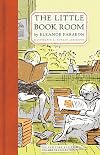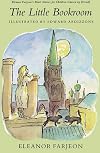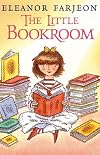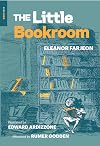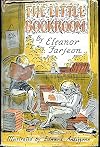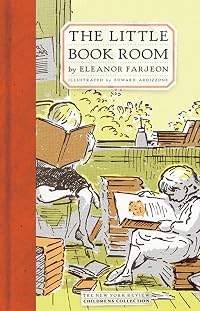
The Little Bookroom
by Eleanor Farjeon
On This Page
Description
Classic Literature. Juvenile Fiction. Juvenile Literature. Short Stories. HTML:In The Little Bookroom, Eleanor Farjeon mischievously tilts our workaday world to reveal its wonders and follies. Her selection of her favorite stories describes powerful—and sometimes exceedingly silly—monarchs, and commoners who are every bit their match; musicians and dancers who live for aft rather than earthly reward; and a goldfish who wishes to “marry the Moon, surpass the Sun, and possess the show more World.”. show lessTags
Recommendations



















Member Reviews
"Of all the rooms in the house, the Little Bookroom was yielded up to books as an untended garden is left to its flowers and weeds. There was no selection or sense of order here. In dining-room, study, and nursery there was choice and arrangement; but the Little Bookroom gathered to itself a motley crew of strays and vagabonds, outcasts from the ordered shelves below, the overflow of parcels bought wholesale by my father in the sales-rooms. Much trash, and more treasure. Riff-raff and gentlefolk and noblemen. A lottery, a lucky dip for a child who had never been forbidden to handle anything between covers."
From the very start of the Author’s Note we are drawn into the world of the bookroom. I could easily quote the whole of show more Farjeon’s introduction, so exquisitely does it conjure up a storeroom of reading matter, and so perfectly does it fulfil the maxim that a piece can be more than the sum of its parts. The whole — twenty-seven stories succeeding the author’s note — is delightfully complemented by Edward Ardizzone’s line illustrations, a fact the author acknowledged in a 1956 poem “To Ted” included as a introduction: ‘what the child’s eye saw, through you | The ageing eye remembers.’
Twenty-seven stories, some longer, some shorter, grace this collection. Some of the titles deliberately evoke the fairytale tradition, such as ‘The Giant and the Mite’, ‘The Seventh Princess’ or ‘The King’s Daughter Cries for the Moon’. Other tales can be viewed as parables (such as ‘The Lady’s Room’), fables (‘The Goldfish’), or simply enjoyed for their quiet humour (for instance ‘The Clumber Pup’ and ‘Pennyworth’). A couple or so hark back to traditional rhymes or literary pieces, riffing on phrases and names to seemingly ‘explain’ their obscurities (‘Leaving Paradise’ and ‘Pannychis’, for example).
Whatever their form many have a bittersweet melancholy that reminds me of Hans Christian Anderson’s offerings or a Wilde fairytale, though a little gentler perhaps. Several pieces stick in my mind. ‘The Connemara Donkey’ though set in an early 20th-century England speaks of the traditional belief that made-up stories can overcome any antagonism by becoming true, all seen through the eyes and ears of little Danny O’Toole. ‘The Girl Who Kissed the Peach-tree’ feels like a traditional Sicilian tale, one of a handful of tales in this collection that evince a genuine love for growing beautiful things despite a knowledge that life can be hard. Pre-echoes of this appear in the author’s own introduction to The Little Bookroom:
"No servant ever came with duster and broom to polish the dim panes through which the sunlight danced, or sweep from the floor the dust of long-ago. The room would not have been the same without its dust: star-dust, gold-dust, fern-dust, the dust that returns to dust under the earth, and comes up from her lap in the shape of a hyacinth."
The best tales, in my opinion, come towards the end, and somehow evoke a deep-seated yearning for things that stretch back into time. ‘San Fairy Ann’ is a beautiful tale about the love poured into a doll and how it is paralleled in the connections that we make with other humans. ‘The Glass Peacock’ with its themes of compassion and generosity is a perfect Christmas tale, a beautiful little drama contained within a forgotten urban courtyard. And what can I say about ‘And I Dance Mine Own Child’ that does it justice? This treatment of the Patient Griselda tale-type is a worthy descendant all the way from Boccaccio via Chaucer and Thomas Dekker, muting any inherent cruelty but dwelling on a basic humanity that should never go out of fashion. I’m not ashamed to say that I shed a little tear at the end of this, and that it wasn’t because dust had got into my eyes.
"When I crept out of the Little Bookroom with smarting eyes, no wonder that its mottled gold-dust still danced in my brain. its silver cobwebs still clung to the corners of my mind. No wonder that many years later, when I came to write books myself, they were a muddle of fiction and fact and fantasy and truth."
Fiction and fact and fantasy and truth, yes there is that aplenty in these tales. I challenge anybody not to feel better after reading this collection, or not to resolve to act better. These are stories to remember, and reread, and cherish, so that — as with Farjeon’s own little bookroom — we will all be able to truthfully declare that “Seven maids with seven brooms, sweeping for half-a-hundred years, have never managed to clear my mind of its dust …”
https://wp.me/s2oNj1-bookroom show less
From the very start of the Author’s Note we are drawn into the world of the bookroom. I could easily quote the whole of show more Farjeon’s introduction, so exquisitely does it conjure up a storeroom of reading matter, and so perfectly does it fulfil the maxim that a piece can be more than the sum of its parts. The whole — twenty-seven stories succeeding the author’s note — is delightfully complemented by Edward Ardizzone’s line illustrations, a fact the author acknowledged in a 1956 poem “To Ted” included as a introduction: ‘what the child’s eye saw, through you | The ageing eye remembers.’
Twenty-seven stories, some longer, some shorter, grace this collection. Some of the titles deliberately evoke the fairytale tradition, such as ‘The Giant and the Mite’, ‘The Seventh Princess’ or ‘The King’s Daughter Cries for the Moon’. Other tales can be viewed as parables (such as ‘The Lady’s Room’), fables (‘The Goldfish’), or simply enjoyed for their quiet humour (for instance ‘The Clumber Pup’ and ‘Pennyworth’). A couple or so hark back to traditional rhymes or literary pieces, riffing on phrases and names to seemingly ‘explain’ their obscurities (‘Leaving Paradise’ and ‘Pannychis’, for example).
Whatever their form many have a bittersweet melancholy that reminds me of Hans Christian Anderson’s offerings or a Wilde fairytale, though a little gentler perhaps. Several pieces stick in my mind. ‘The Connemara Donkey’ though set in an early 20th-century England speaks of the traditional belief that made-up stories can overcome any antagonism by becoming true, all seen through the eyes and ears of little Danny O’Toole. ‘The Girl Who Kissed the Peach-tree’ feels like a traditional Sicilian tale, one of a handful of tales in this collection that evince a genuine love for growing beautiful things despite a knowledge that life can be hard. Pre-echoes of this appear in the author’s own introduction to The Little Bookroom:
"No servant ever came with duster and broom to polish the dim panes through which the sunlight danced, or sweep from the floor the dust of long-ago. The room would not have been the same without its dust: star-dust, gold-dust, fern-dust, the dust that returns to dust under the earth, and comes up from her lap in the shape of a hyacinth."
The best tales, in my opinion, come towards the end, and somehow evoke a deep-seated yearning for things that stretch back into time. ‘San Fairy Ann’ is a beautiful tale about the love poured into a doll and how it is paralleled in the connections that we make with other humans. ‘The Glass Peacock’ with its themes of compassion and generosity is a perfect Christmas tale, a beautiful little drama contained within a forgotten urban courtyard. And what can I say about ‘And I Dance Mine Own Child’ that does it justice? This treatment of the Patient Griselda tale-type is a worthy descendant all the way from Boccaccio via Chaucer and Thomas Dekker, muting any inherent cruelty but dwelling on a basic humanity that should never go out of fashion. I’m not ashamed to say that I shed a little tear at the end of this, and that it wasn’t because dust had got into my eyes.
"When I crept out of the Little Bookroom with smarting eyes, no wonder that its mottled gold-dust still danced in my brain. its silver cobwebs still clung to the corners of my mind. No wonder that many years later, when I came to write books myself, they were a muddle of fiction and fact and fantasy and truth."
Fiction and fact and fantasy and truth, yes there is that aplenty in these tales. I challenge anybody not to feel better after reading this collection, or not to resolve to act better. These are stories to remember, and reread, and cherish, so that — as with Farjeon’s own little bookroom — we will all be able to truthfully declare that “Seven maids with seven brooms, sweeping for half-a-hundred years, have never managed to clear my mind of its dust …”
https://wp.me/s2oNj1-bookroom show less
I was reminded lately of Eleanor Farjeon. I had enjoyed a couple of her books years ago--not as a child. I think I might have learned of her when my own children attended a Waldorf school. In any event, I requested this, the only book of hers available from interlibrary loan.
These short stories reflect a long past English era, but not the kind which are blatant morality tales. These tales are designed to evoke a sense of wonder in the reader. While my grandkids now are very free and imaginative, and have an idea of nature spirits and good deeds, I'm not sure if they wouldn't find these stories a bit too quaint and irrelevant. I did read them "Young Kate", which I thought was one of the best (tho I neglected to read the part about her show more only escaping her fate by getting married-I felt she needed more control of her own life. Wasn't that the point?). And I think next I'll try "And I Dance My Own Child" since their great-grandma lived with them until her death.
Actually, I think the Author's Note was the best part of the book. And I know my grandkids have the same over-flowing-with-books in their whole house. And, who knows, when they visit they may come across by copy of 'Martin Pippin in the Apple Orchard' in my own Little Bookroom. show less
These short stories reflect a long past English era, but not the kind which are blatant morality tales. These tales are designed to evoke a sense of wonder in the reader. While my grandkids now are very free and imaginative, and have an idea of nature spirits and good deeds, I'm not sure if they wouldn't find these stories a bit too quaint and irrelevant. I did read them "Young Kate", which I thought was one of the best (tho I neglected to read the part about her show more only escaping her fate by getting married-I felt she needed more control of her own life. Wasn't that the point?). And I think next I'll try "And I Dance My Own Child" since their great-grandma lived with them until her death.
Actually, I think the Author's Note was the best part of the book. And I know my grandkids have the same over-flowing-with-books in their whole house. And, who knows, when they visit they may come across by copy of 'Martin Pippin in the Apple Orchard' in my own Little Bookroom. show less
In the Author's Note at the beginning of this book there is a sentence that jumped out at me and made me smile - "It would have been more natural to live without clothes than without books." Short Stories for children and what a lovely selection they are too. As I read I mentally heard myself reading them aloud to children and having fun doing it, they are so well written. My favourite was the story - And I Dance Mine Own Child. One of the longest in the book it told about a 10 year old girl and her 110 year old Gramma. They both had the name Griselda and there is a an old book involved with '....funny print, and wrong spelling.' It's been a long time since I've read a children's book for personal reading and I was unsure whether it show more would hold my interest enough to read to the end, actually for children, it's quite long at 302 pages. First published in 1955, the year I was born, it's dated for children today being nothing like a Harry Potter novel but I can see the attraction it would have held back in the day. Even today, read with animation to children I could see it still being enjoyed. show less
A lovely selection of the author's own colourful fairy tales, where the power of goodness defeats all manner of selfishness and curmudgeonry, without ever becoming cloying. Complemented by Edward Ardizzone's perfect, scratchy drawings.
A wonderful mix of stories - fairy tales, realism, fables, humor. All of them remind you that there is good in the world. Eleanor Farjeon could really write, and the illustrations are charming. I especially liked her version of a Cinderella story, in which the heroine rejects the prince and marries the footman instead.
The world would be a better place if more ppl loved Farjeon, and [a:George MacDonald|2413|George MacDonald|https://images.gr-assets.com/authors/1201019294p2/2413.jpg] ([b:The Princess and the Goblin|444381|The Princess and the Goblin (Princess Irene and Curdie, #1)|George MacDonald|https://i.gr-assets.com/images/S/compressed.photo.goodreads.com/books/1348689290l/444381._SY75_.jpg|3193161]), and [a:Frances Hodgson Burnett|2041|Frances Hodgson Burnett|https://images.gr-assets.com/authors/1197934848p2/2041.jpg] ([b:The Secret Garden|231815|The Secret Garden|Frances Hodgson Burnett|https://i.gr-assets.com/images/S/compressed.photo.goodreads.com/books/1442934240l/231815._SX50_.jpg|3186437]). Sweet but not syrupy, joyful, spiritual but not at show more all preachy, tender. Comfort reads all when I'm tired of the prophets of doom, the cynics, snarky reviewers, and trolls.... show less
The Little Bookroom is a collection of Eleanor Farjeon children's stories picked out by the author herself. Although you've probably never heard of her, you probably know at least one of her works, the poem "Morning has Broken" made famous by Cat Stevens. The stories here are a mix of the fantastic and the mundane, the short and the rather long. They all have a sweet, nostalgic feel to them that hints at the fact that they were all published before 1955 when the book was first published. In short, there's something here for everyone.
Besides the lovely pen-and-ink illustrations, my copy also has a nice afterword by Rumor Godden.
Besides the lovely pen-and-ink illustrations, my copy also has a nice afterword by Rumor Godden.
Members
- Recently Added By
Lists

1001 Children's Books You Must Read Before You Grow Up
774 works; 100 members

Hayao Miyazaki's 50 Recommended Children's Books
48 works; 6 members

CCE 1000 Good Books List
1,033 works; 12 members

Carnegie Medal Winners In Order
85 works; 1 member

Carnegie Medal books I've read (shortlist and winners)
86 works; 17 members

Books Read in 2024
4,727 works; 128 members

HMS: Make Your Child a Lover of Books, Ages 7-9
52 works; 2 members
Author Information

115+ Works 2,882 Members
All Editions
Some Editions
Awards and Honors
Series
Belongs to Publisher Series
Common Knowledge
- Original publication date
- 1955
- Dedication
- These stories are dedicated with love to Denys Blakelock who began to share my childhood in the Little Bookroom sixty years after
- First words
- There was in the village a simpleton who was not the ordinary type of village idiot, by any means.
Author's Note: In the home of my childhood there was a room we called 'The Little Bookroom'. - Last words
- (Click to show. Warning: May contain spoilers.)But he never told even his wife and children that often, when life seemed too heavy to be borne, as life so often does, the beauty of things rushed in upon him unawares, from the sky and the grass, the trees and the rocks, the fresh water and the salt, the light and the dark, and he heard as clear as in the moment when she broke from him the lovely laugh of Pannychis, and heard her call to him from heaven and hearth, 'Look happy! Look happy!'
- Blurbers
- Stein, Sadie
Classifications
- Genres
- Children's Books, Fiction and Literature, Kids
- DDC/MDS
- 823.912 — Literature & rhetoric English & Old English literatures English fiction 1900- 1901-1999 1901-1945
- LCC
- PZ7 .F229 .L — Language and Literature Fiction and juvenile belles lettres Fiction and juvenile belles lettres Juvenile belles lettres
- BISAC
Statistics
- Members
- 661
- Popularity
- 43,461
- Reviews
- 13
- Rating
- (4.20)
- Languages
- 6 — English, Estonian, Korean, Norwegian (Bokmål), Polish, Spanish
- Media
- Paper, Ebook
- ISBNs
- 15
- ASINs
- 16