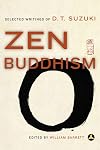
Zen Buddhism: Selected Writings of D. T. Suzuki
by Daisetz Teitaro Suzuki
On This Page
Description
No other figure in history has played a bigger part in opening the West to Buddhism than the eminent Zen author, D.T. Suzuki, and in this reissue of his best work readers are given the very heart of Zen teaching. Zen Buddhism, which sold more than 125,000 as an Anchor paperback after its publication in 1956, includes a basic historical background as well as a thorough overview of the techniques for Zen practice. Concepts and terminology such as satori, zazen, and koans, as well as the show more various elements of this philosophy are all given clear explanations. But while Suzuki takes nothing for granted in the reader's understanding of the fundamentals, he does not give a merely rudimentary overview. Each of the essays included here, particularly those on the unconscious mind and the relation of Zen to Western philosophy, go far beyond other sources for their penetrating insights and timeless wisdom. What is most important about D.T. Suzuki's work, however--and what comes across so powerfully in these selections--is his unparalleled ability to communicate the experiential aspect of Zen. The intensity here with which Zen philosophy comes to life is without parallel in the canon of Buddhist literature. Suzuki stands apart from all teachers before or since because of his exceptional ability to eloquently capture in words the seemingly inexpressible essence of Zen. show lessTags
Recommendations




















Member Reviews
I own a couple of dozen books about Buddhism. I enjoy reading about the four noble truths [Life means suffering; the origin of suffering is attachment; the cessation of suffering is attainable; and the path to the cessation of suffering], the teachings of Buddha and Zen Masters, and the many riddles used in instruction; however, I have not read anything by Suzuki. But when I read that this book by him was challenged at the Plymouth-Canton school system in Canton, Michigan in 1987, I decided to purchase it. The book-banners explained their decision by stating, "this book details the teachings of the religion of Buddhism in such a way that the reader could very likely embrace its teachings and choose this as his religion." I agree it is a show more thorough and well-written survey of the history and philosophy of Buddhism, but I completely disagree that this – or any book – could turn someone away from sincere and deeply held beliefs. If this book turned anyone any which way, it was because the reader had some doubts about those beliefs.
Zen Buddhism has not convinced me to embrace Buddhism as a life style. Still, many of the ideas are appealing. Introspection, respect for all sentient life, non-violence, and moderation – among other ideas – are things practitioners of any religion can easily embrace.
According to the author’s note, Suzuki, who lived from 1869 to 1966, was born and educated in Japan. He lectured extensively throughout the world and taught at Columbia University. He influenced many of the great thinkers of the 20th century, including C. G. Jung, Aldous Huxley, and the Trappist Monk, Thomas Merton.”
Suzuki begins with a discussion of the “sense of Zen,” and notes that “Hebraic and Greek traditions are profoundly dualistic in spirit. That is, they divide reality into two parts and set one part off against the other. The Hebrew tradition divides God and creature, the Law and erring members, spirit and flesh. The Greek, on the other hand, divides reality along intellectual lines,” … [making] “reason the highest and most valued function” (x). The bedrock of Buddhism, however, lay in the idea of “favoring intuition over reason” (x).
Suzuki then outlines a detailed history of Buddhism from its origins in India through China, and to Japan. He then focuses on several varieties of Zen whose adherents practice meditation in an attempt to develop “a new viewpoint on life and things generally” (98). According to Suzuki, “Zen is a matter of character and not of the intellect” (114). Furthermore, he writes, requires something inwardly propelling, energizing, and capable of doing work” (111). I see this “inward force” as faith.
Zen, on the other hand, “gives life to the intellect … by giving one a new point of view on things, a new way of approaching the truth and beauty of life and the world, by discovering a new source of energy in the inmost recesses of consciousness, and by bestowing on one a feeling of completeness and sufficiency” (132).
Suzuki then gives a guide to practical instruction in Zen, Zen and the unconscious, lessons in the koans, or riddles, used in instruction, the role of nature, a survey of existentialism, pragmatism, and Zen, and finally, notes on painting, poetry, and the tea ceremony.
I highly recommend this book to any reader who has ever had any curiosity about Zen Buddhism. I tried, but failed to find anything that cannot fit within the confines of most organized religions. The only drawbacks are the Chinese and Japanese names, which can be confusing. I am moving this book to my desert island shelf. 5 stars
--Jim, 4/14/12 show less
Zen Buddhism has not convinced me to embrace Buddhism as a life style. Still, many of the ideas are appealing. Introspection, respect for all sentient life, non-violence, and moderation – among other ideas – are things practitioners of any religion can easily embrace.
According to the author’s note, Suzuki, who lived from 1869 to 1966, was born and educated in Japan. He lectured extensively throughout the world and taught at Columbia University. He influenced many of the great thinkers of the 20th century, including C. G. Jung, Aldous Huxley, and the Trappist Monk, Thomas Merton.”
Suzuki begins with a discussion of the “sense of Zen,” and notes that “Hebraic and Greek traditions are profoundly dualistic in spirit. That is, they divide reality into two parts and set one part off against the other. The Hebrew tradition divides God and creature, the Law and erring members, spirit and flesh. The Greek, on the other hand, divides reality along intellectual lines,” … [making] “reason the highest and most valued function” (x). The bedrock of Buddhism, however, lay in the idea of “favoring intuition over reason” (x).
Suzuki then outlines a detailed history of Buddhism from its origins in India through China, and to Japan. He then focuses on several varieties of Zen whose adherents practice meditation in an attempt to develop “a new viewpoint on life and things generally” (98). According to Suzuki, “Zen is a matter of character and not of the intellect” (114). Furthermore, he writes, requires something inwardly propelling, energizing, and capable of doing work” (111). I see this “inward force” as faith.
Zen, on the other hand, “gives life to the intellect … by giving one a new point of view on things, a new way of approaching the truth and beauty of life and the world, by discovering a new source of energy in the inmost recesses of consciousness, and by bestowing on one a feeling of completeness and sufficiency” (132).
Suzuki then gives a guide to practical instruction in Zen, Zen and the unconscious, lessons in the koans, or riddles, used in instruction, the role of nature, a survey of existentialism, pragmatism, and Zen, and finally, notes on painting, poetry, and the tea ceremony.
I highly recommend this book to any reader who has ever had any curiosity about Zen Buddhism. I tried, but failed to find anything that cannot fit within the confines of most organized religions. The only drawbacks are the Chinese and Japanese names, which can be confusing. I am moving this book to my desert island shelf. 5 stars
--Jim, 4/14/12 show less
No other figure in history has played a bigger part in opening the West to Buddhism than the eminent Zen author, D.T. Suzuki, and in this reissue of his best work readers are given the very heart of Zen teaching. ZEN BUDDHISM, which sold more than 125,000 as an Anchor paperback after its publication in 1956, includes a basic historical background as well as a thorough overview of the techniques for Zen practice. Concepts and terminology such as satori, zazen, and koans, as well as the various elements of this philosophy are all given clear explanations. But while Suzuki takes nothing for granted in the reader's understanding of the fundamentals, he does not give a merely rudimentary overview. Each of the essays included here, show more particularly those on the unconscious mind and the relation of Zen to Western philosophy, go far beyond other sources for their penetrating insights and timeless wisdom.What is most important about D.T. Suzuki's work, however - and what comes across so powerfully in these selections - is his unparalleled ability to communicate the experiential aspect of Zen. show less
No other figure in history has played a bigger part in opening the West to Buddhism than the eminent Zen author D.T. Suzuki. In the reissue of his best work, readers are given the very heart of Zen teaching. These writings are brought together to form the most accessible & definitive overview of Zen philosophy available.
The sense of Zen
Zen in relation to Buddhism generally
The history of Zen
Satori, or, Enlightenment
Practical methods of Zen instruction
The reason of unreason: the koan exercise
The Zen doctrine of no-mind
The role of nature in Zen Buddhism
Existentialism, pragmatism & Zen
Painting, swordsmanship, tea ceremony
The sense of Zen
Zen in relation to Buddhism generally
The history of Zen
Satori, or, Enlightenment
Practical methods of Zen instruction
The reason of unreason: the koan exercise
The Zen doctrine of no-mind
The role of nature in Zen Buddhism
Existentialism, pragmatism & Zen
Painting, swordsmanship, tea ceremony
note books #840, 841
1.25 old paperback but very good
1.25 old paperback but very good
Ratings
Members
- Recently Added By
Lists

Blue Pyramid 1,276 Best Books of All Time
1,248 works; 32 members
Author Information

152+ Works 7,007 Members
A student of the Zen master Shaku Soen, who addressed the 1893 World's Parliament of Religions held in Chicago, D. T. Suzuki did more to introduce Zen to Westerners than any other representative of that tradition. Shaku Soen sent the young Suzuki to America in 1897 to help Paul Carus translate the Chinese text the Dao De Jing. Suzuki remained in show more America for about a decade, working at Carus' Open Court Publishing Company outside Chicago. After Suzuki returned to Japan, he married an American woman, Beatrice Lane, in 1911, and they began publishing an English journal, The Eastern Buddhist, in 1921. During this time in Japan, Suzuki translated into Japanese a number of Swedenborgian texts. He traveled to China in 1934, and he went to London in 1936 to attend the World Congress of Faiths. Suzuki recognized that the West had much to offer the East, but like Swami Vivekananda, he was convinced that the East had much to offer the West in its religion and philosophy. On this basis he was motivated to write about Zen in English. Suzuki wrote about 30 books in English and many more in Japanese. Suzuki's first books in English were a translation of Ashvaghosha's Discourse on the Awakening of Faith in the Mahayana (1900) and Outlines of Mahayana Buddhism (1907). A practitioner of Rinzai Zen Buddhism, Suzuki, in his writings about the ultimate experience of satori and the meditative use of koans, made Zen terms almost household words in the United States. In the early part of the twentieth century, Suzuki devoted himself to the propagation of Zen via his writings. After World War II he became a noted lecturer on Zen at American and European universities. That Suzuki's work was effective can be seen in the fact that Zen was picked up in the 1950s by California beatniks, producing what was termed Beat Zen. From that time on, Americans increasingly began to go to Japan to study Zen, and more Zen masters began to come to the United States to teach. The earliest institutions devoted to the practice of Zen in America were established in San Francisco in 1928, in Los Angeles in 1929, and in New York City in 1931. Zen centers remain an important part of the American urban scene, and several of them have established rural Zen retreat centers. (Bowker Author Biography) show less
All Editions
Some Editions
Series
Belongs to Publisher Series
Anchor Books (A90)
Common Knowledge
- Original publication date
- 1956
- People/Characters
- Bodhi-Daruma; Ignatius of Loyola; William James; Confucius
- Important places
- Japan; China
- First words
- Zen Buddhism presents a surface so bizarre and irrational, yet so colorful and striking,
- Last words
- (Click to show. Warning: May contain spoilers.)where one can rise above the limits of relativity and even have a glimpse of eternity?
Classifications
- Genres
- Religion & Spirituality, Nonfiction, Philosophy, General Nonfiction
- DDC/MDS
- 294.32 — Religion Other religions Dharmic religions Buddhism Buddhism of the north
- LCC
- BL1430 .S848 — Philosophy, Psychology and Religion Religions. Mythology. Rationalism Religions. Mythology. Rationalism History and principles of religions Asian. Oriental By religion
- BISAC
Statistics
- Members
- 768
- Popularity
- 36,676
- Reviews
- 5
- Rating
- (3.90)
- Languages
- English
- Media
- Paper
- ISBNs
- 5
- ASINs
- 10