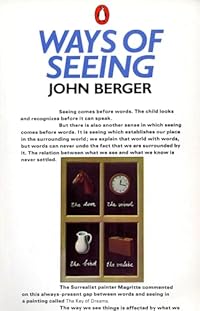
Ways of Seeing
by John Berger
On This Page
Description
Contains seven essays. Three of them use only pictures. Examines the relationship between what we see and what we know.Tags
Recommendations






























Member Recommendations

Member Reviews
Great read, and highly recommendable. From the first essay, which is a riff on/exegesis of Walter Benjamin's essay on the work of art in the age of mechanical reproductibility, this book is consistently on-point. Yes, the theses have been questioned in subsequent decades. But, on the other hand, I find myself continuing to agree with its strident, polemical critique of art in capitalist societies. Besides the first essay, which provides some compelling, concrete examples of the sorts of issues that Benjamin's work brings to the surface, the third essay (on gender, and how women are constituted as objects in painting, while men are subjects), and the last essay (on advertising) were my favorites.
I must admit that I have a great show more admiration for this era of radical leftist (Marxist) thought. I don't think it matters what your political persuasion is: it seems important to keep taking the theses presented here seriously. Yes, they are pessimistic (culture is essentially a function of the ruling class's imposition of its values), and yes, I could easily think of ways to problematize many of their stongest theses. The idea that when we are naked we are most authentically our own selves, for example. I'm committed enough to Jacques Derrida's philosophical project to immediately question that idea. But nonetheless, if you take a moment to situate this book in its historical moment (the early 1970s, a time when some of the great Western Marxist texts were really being seriously studied in Britain and in the USA, and a time when Althusserian structuralist Marxism was also a powerful influence), I think this book is both powerful and capable of speaking to our present.
Finally, as someone whose primary interest is in literature (texts, versus images), I thought this book's reproduction of more than 100 paintings, photographs, and advertisements was extremely helpful. Even in the mass-market/pocket paperback edition, the small black-and-white images were comprehensible and helpful. show less
I must admit that I have a great show more admiration for this era of radical leftist (Marxist) thought. I don't think it matters what your political persuasion is: it seems important to keep taking the theses presented here seriously. Yes, they are pessimistic (culture is essentially a function of the ruling class's imposition of its values), and yes, I could easily think of ways to problematize many of their stongest theses. The idea that when we are naked we are most authentically our own selves, for example. I'm committed enough to Jacques Derrida's philosophical project to immediately question that idea. But nonetheless, if you take a moment to situate this book in its historical moment (the early 1970s, a time when some of the great Western Marxist texts were really being seriously studied in Britain and in the USA, and a time when Althusserian structuralist Marxism was also a powerful influence), I think this book is both powerful and capable of speaking to our present.
Finally, as someone whose primary interest is in literature (texts, versus images), I thought this book's reproduction of more than 100 paintings, photographs, and advertisements was extremely helpful. Even in the mass-market/pocket paperback edition, the small black-and-white images were comprehensible and helpful. show less
Stuff that I feel would be largely too obvious to mention in a modern day, 'enlightened' society where feminist discourse is making its way into the mainstream, but I'm pretty sure this was the first concrete and articulated exposure I had to ideas of the 'male gaze' when I was 17. In that sense it's a bit like the Beatles: might seem tame now, but it's contextual position in history is what gives it weight.
I admit I’m not well-versed in art history and theory, so that may be a reason this book affected me so deeply, but I was really struck by these essays. They’re incisive. They’re structured well. And they truly made me think. They made me think about art as a sign, a symbol, an argument, a brag, a promise, a prison.
Berger is very clear about his purview here, which I appreciate. Though he mentions photography and advertising and film, and he draws contrasts to sculpture and Eastern art, the real subject of analysis is European oil paintings and, by extension, the rise of capitalism. There are both visual and written essays, and while I was initially wary about how well an essay told only through images would work, I was quickly show more won over. My favourite written essays were about representations of women and nudity—touching on appearance, agency, sight, maleness as the norm—and the final essay on advertising, which Berger refers to as “publicity”—touching upon classism, envy, glamour, desire, materialism, and commodification.
Comparatively, my problems are rather slight. The book is set entirely in bold, which is weird. The cover is hideous; whose idea was it to just paste the first few paragraphs of the essay right onto the cover?! The images are in tiny and black and white and in some of the visual essays they run across the crease of the spine, rendering them nearly indiscernible. But I think my only criticism of the content itself is that Berger has a tendency to make some pretty definitive declarations, especially about what is and is not “exceptional.” Take this statement from p. 103: “Adriaen Brouwer was the only exceptional ‘genre’ painter.” Hmmm. Berger backs this statement up, of course, and explains why Brouwer was different from his contemporaries, but that doesn’t make it any more than an opinion presented as a fact, which rubs me the wrong way.
The best thing I can say about a collection of essays is that it changed my way of thinking—my way of seeing!—and that is undoubtedly true with this book. There are layers to art criticism that never crossed my mind, layers far beyond and beneath the purely aesthetic, and I’ll be thinking about these things next time I visit an art museum. I’ll be asking questions like: who was this painted for? Who and what are the subjects? How are the people looking at me, the observer, and how are they arranged to appeal to or challenge my point of view? What sort of place would this have been hung in before it was brought to this museum? And who would have been looking at it there? And what would they have hoped to show to people who visited their home or abbey or office, to make them feel? More often than not, according to Berger, the answer to the last question is envy. show less
Berger is very clear about his purview here, which I appreciate. Though he mentions photography and advertising and film, and he draws contrasts to sculpture and Eastern art, the real subject of analysis is European oil paintings and, by extension, the rise of capitalism. There are both visual and written essays, and while I was initially wary about how well an essay told only through images would work, I was quickly show more won over. My favourite written essays were about representations of women and nudity—touching on appearance, agency, sight, maleness as the norm—and the final essay on advertising, which Berger refers to as “publicity”—touching upon classism, envy, glamour, desire, materialism, and commodification.
Comparatively, my problems are rather slight. The book is set entirely in bold, which is weird. The cover is hideous; whose idea was it to just paste the first few paragraphs of the essay right onto the cover?! The images are in tiny and black and white and in some of the visual essays they run across the crease of the spine, rendering them nearly indiscernible. But I think my only criticism of the content itself is that Berger has a tendency to make some pretty definitive declarations, especially about what is and is not “exceptional.” Take this statement from p. 103: “Adriaen Brouwer was the only exceptional ‘genre’ painter.” Hmmm. Berger backs this statement up, of course, and explains why Brouwer was different from his contemporaries, but that doesn’t make it any more than an opinion presented as a fact, which rubs me the wrong way.
The best thing I can say about a collection of essays is that it changed my way of thinking—my way of seeing!—and that is undoubtedly true with this book. There are layers to art criticism that never crossed my mind, layers far beyond and beneath the purely aesthetic, and I’ll be thinking about these things next time I visit an art museum. I’ll be asking questions like: who was this painted for? Who and what are the subjects? How are the people looking at me, the observer, and how are they arranged to appeal to or challenge my point of view? What sort of place would this have been hung in before it was brought to this museum? And who would have been looking at it there? And what would they have hoped to show to people who visited their home or abbey or office, to make them feel? More often than not, according to Berger, the answer to the last question is envy. show less
This is a work of genius. Only a pretentious 1970s Marxist, aided and abetted by the BBC’s ‘Telling You What To Think’ Department, could cram this amount of fatuous tosh into 155 short pages. A single example, about one of my favourite painters Rembrandt van Rijn:
"In the later painting he has turned the tradition against itself. He has wrested its language away from it. He is an old man. All has gone except a sense of the question of existence, of existence as a question. And the painter in him—who is both more and less than the old man—has found the means to express just that, using a medium which had been traditionally developed to exclude any such question."
Ghastly.
"In the later painting he has turned the tradition against itself. He has wrested its language away from it. He is an old man. All has gone except a sense of the question of existence, of existence as a question. And the painter in him—who is both more and less than the old man—has found the means to express just that, using a medium which had been traditionally developed to exclude any such question."
Ghastly.
I am not the audience for this book, mainly because I've already read and more or less digested the handful of essays and ideas on which it is based. The seven chapters break down fairly simply.
1: Benjamin's 'Work of Art'--the ability to reproduce images alters the way we encounter works of art. This seems reasonable. Nobody gets to see a Giotto without having seen a reproduction first, except someone who has no interest in the Giotto in the first place. But Berger et al* go a step further: we need to use the fact that we encounter works of art differently to undermine the ruling class's privilege and the "specialized experts who are the clerks of the nostalgia of a ruling class in decline." That's on page 32. Part of me, a large part, show more laments the fact that you'd never get that published today, not even on a website. Another part of me laments the stupidity of intellectuals who put their faith in the inherent goodness of The People. The People does not have a good track record when it comes to art appreciation. That's not to say that people can't learn to appreciate art, only that We are no better and no worse than the ruling class was. We need to learn, we need to be taught, you can't do that if you assume that We are inherently able to do the right thing.
2 & 3: Women are depicted differently from men, and, frankly, not in ways that are healthy for anyone, but particularly not for women. I agree. Which makes it breathtaking to see the authors get so many things wrong, either intentionally (cutting short the bible verse in which God punishes Eve *and Adam*); stupidly (non-Western art forms show women as active participants in sex, so that are isn't morally dubious); or in ways that are, ahem, temporally bound ("Hair is associated with sexual power, with passion." Seventies!).
5: Oil paintings are bourgeois and generally not morally okay. Holbein's 'Ambassadors' is read as an example of this; the incredible distorted skull in the painting is the exception which proves the rule of oil paintings rather than, you know, showing that oil paintings can be self-critical, as are most good artworks of any kind. In general, the lesson of this book is that all art is bad for you, except the pieces that the authors of this book like. They like pieces by artists who can plausibly be turned into radicals, because only radicals can be interesting (Franz Hals; William Blake). They don't discuss the 20th century at all (I know they know that twentieth century art exists; perhaps, as good Benjaminian Marxists, they don't like abstraction or difficulty). They're also very uncomfortable with religious art, and want to group, e.g., Ambrosius Benson's Mary Magdalene with the absurd and/or pornographic Magdalene of later times, rather than admitting the rather obvious differences (Benson's is rich, but not, how can I put this... naked and disheveled.) Since the authors have a hard time saying what they actually like (vs. what they suspect is oppressive), you get idiocies like this: Rembrandt's famous late portrait shows a man for whom "all has gone except a sense of the question of existence, of existence as a question." A little thought would show that this is the sort of conservative pablum Great Artists have been serving up for generations.
6 & 7: Advertizing uses art to make you think you want things you don't want and that you can get them, so you don't need to think about what you really want, e.g., more time away from the office. This is true.
In sum: I was sucked in by the idea that this was a book about understanding art. It is not. It is critical theory for high-school readers. Good for what it is, but extremely narrow in scope, and quite harmful for anyone who swallows it whole rather than taking a few minutes to worry away at its assumptions. Harmful because those who accept it will say silly things, and because those who read it and reject it out of hand (due to the rhetoric, bad arguments, or conceptual confusion) won't be challenged to, you know, care about other people.
* Humorous aspect of this book: it makes a big deal about how it was written by a group of people, because, you know, individuals are bad, and groups are good. You'll note that the book is sold as a book by John Berger. You can draw the conclusion. show less
1: Benjamin's 'Work of Art'--the ability to reproduce images alters the way we encounter works of art. This seems reasonable. Nobody gets to see a Giotto without having seen a reproduction first, except someone who has no interest in the Giotto in the first place. But Berger et al* go a step further: we need to use the fact that we encounter works of art differently to undermine the ruling class's privilege and the "specialized experts who are the clerks of the nostalgia of a ruling class in decline." That's on page 32. Part of me, a large part, show more laments the fact that you'd never get that published today, not even on a website. Another part of me laments the stupidity of intellectuals who put their faith in the inherent goodness of The People. The People does not have a good track record when it comes to art appreciation. That's not to say that people can't learn to appreciate art, only that We are no better and no worse than the ruling class was. We need to learn, we need to be taught, you can't do that if you assume that We are inherently able to do the right thing.
2 & 3: Women are depicted differently from men, and, frankly, not in ways that are healthy for anyone, but particularly not for women. I agree. Which makes it breathtaking to see the authors get so many things wrong, either intentionally (cutting short the bible verse in which God punishes Eve *and Adam*); stupidly (non-Western art forms show women as active participants in sex, so that are isn't morally dubious); or in ways that are, ahem, temporally bound ("Hair is associated with sexual power, with passion." Seventies!).
5: Oil paintings are bourgeois and generally not morally okay. Holbein's 'Ambassadors' is read as an example of this; the incredible distorted skull in the painting is the exception which proves the rule of oil paintings rather than, you know, showing that oil paintings can be self-critical, as are most good artworks of any kind. In general, the lesson of this book is that all art is bad for you, except the pieces that the authors of this book like. They like pieces by artists who can plausibly be turned into radicals, because only radicals can be interesting (Franz Hals; William Blake). They don't discuss the 20th century at all (I know they know that twentieth century art exists; perhaps, as good Benjaminian Marxists, they don't like abstraction or difficulty). They're also very uncomfortable with religious art, and want to group, e.g., Ambrosius Benson's Mary Magdalene with the absurd and/or pornographic Magdalene of later times, rather than admitting the rather obvious differences (Benson's is rich, but not, how can I put this... naked and disheveled.) Since the authors have a hard time saying what they actually like (vs. what they suspect is oppressive), you get idiocies like this: Rembrandt's famous late portrait shows a man for whom "all has gone except a sense of the question of existence, of existence as a question." A little thought would show that this is the sort of conservative pablum Great Artists have been serving up for generations.
6 & 7: Advertizing uses art to make you think you want things you don't want and that you can get them, so you don't need to think about what you really want, e.g., more time away from the office. This is true.
In sum: I was sucked in by the idea that this was a book about understanding art. It is not. It is critical theory for high-school readers. Good for what it is, but extremely narrow in scope, and quite harmful for anyone who swallows it whole rather than taking a few minutes to worry away at its assumptions. Harmful because those who accept it will say silly things, and because those who read it and reject it out of hand (due to the rhetoric, bad arguments, or conceptual confusion) won't be challenged to, you know, care about other people.
* Humorous aspect of this book: it makes a big deal about how it was written by a group of people, because, you know, individuals are bad, and groups are good. You'll note that the book is sold as a book by John Berger. You can draw the conclusion. show less
This is the book I recommend when people tell me they don't know much about art and want to learn about it. I like this better than general art and art history books because those tend to be bogged down with dry facts and too many historical details, whereas Ways of Seeing is very short, easy to understand, and demystifies art to the general public without having the reader struggle to remember names and dates. Berger explores the ways in which images (both fine art images and commercial images) create meaning and are used, as well as offering insight on the relationships between art, the artist, and the viewer. Although this book was written in the early 70s, it is still very much relevant, and the chapter on advertising seems to apply show more even more so now. My only criticism is that the pictures are not in colour! To someone with a basic background in art history or culture theory, this book may seem overly simplistic but I think it's a great one to start off with for anyone who wants to examine and question the visual world in which we live. show less
Having been recently diagnosed with adhd (also autism, if you must know) I finally have a better undedtanding of why I've always struggled to read non-fiction. I've sort of assumed it's because it bores me, and that this makes me a bad person. Now I think it's because the tendency of non-fiction to be so interesting keeps sending my brain off in different direction. Two consecutive sentences can contain at least two different things that are interesting in different ways, maning it can tale ten minutes to get past those sentences, and I'll still feel like I haven't actually absorbed them. Fiction is easier, because it's the story I'm interested in. Obviously the writing and the characters have to be good, or else I won't care about the show more story, but they're in service to the story, and that's what I want to follow.
John Berger's little book is, obviously, packed with interesting things to say about art - so my brain kept wandering off in odd directions and tangents - a lot of which I seem to have absorbed from other sources down the years, clearly it's a hugely influential book, but here they are all together, a foundation for looking at and thinking about art that culminates in an analysis of publicity and advertising that rings true still today, though I wonder if he wrote about the image and art and advertising in the digital age. Also, though he makes wry references to the subject, the relationship of artists to, y'know, money, which keeps them from starving. show less
John Berger's little book is, obviously, packed with interesting things to say about art - so my brain kept wandering off in odd directions and tangents - a lot of which I seem to have absorbed from other sources down the years, clearly it's a hugely influential book, but here they are all together, a foundation for looking at and thinking about art that culminates in an analysis of publicity and advertising that rings true still today, though I wonder if he wrote about the image and art and advertising in the digital age. Also, though he makes wry references to the subject, the relationship of artists to, y'know, money, which keeps them from starving. show less
Members
- Recently Added By
Lists

Best non-science books for scientists
11 works; 7 members

Will Durant's 100 Books: An Update
46 works; 4 members

Non-Fiction Worth Reading
1,015 works; 260 members

Fake Top 100 Nonfiction
79 works; 3 members

TED 2013 Summer Reading List
190 works; 13 members

culture
320 works; 1 member

The Great Courses: Visual Literacy Skills
53 works; 1 member

Blackwell's Five Foot Bookshelf
72 works; 4 members

Five star books
1,755 works; 107 members

Art History and Appreciation
36 works; 1 member

Art Books
16 works; 1 member

Books Read in 2025
4,090 works; 97 members
Author Information

149+ Works 17,077 Members
John Peter Berger was born in London, England on November 5, 1926. After serving in the British Army from 1944 to 1946, he enrolled in the Chelsea School of Art. He began his career as a painter and exhibited work at a number of London galleries in the late 1940s. He then worked as an art critic for The New Statesman for a decade. He wrote fiction show more and nonfiction including several volumes of art criticism. His novels include A Painter of Our Time, From A to X, and G., which won both the James Tait Black Memorial Prize and the Booker Prize in 1972. His other works include an essay collection entitled Permanent Red, Into Their Labors, and a book and television series entitled Ways of Seeing. In the 1970s, he collaborated with the director Alain Tanner on three films. He wrote or co-wrote La Salamandre, The Middle of the World, and Jonah Who Will Be 25 in the Year 2000. He died on January 1, 2017 at the age of 90. (Bowker Author Biography) show less
Some Editions
Awards and Honors
Notable Lists
Series
Belongs to Publisher Series
Work Relationships
Is an adaptation of
Has as a student's study guide
Common Knowledge
- Canonical title
- Ways of Seeing
- Original publication date
- 1972
- Related movies
- Ways of Seeing (1972 | IMDb)
- First words
- Seeing comes before words. The child looks and recognizes before it can speak.
- Last words
- (Click to show. Warning: May contain spoilers.)To be continued by the reader...
- Blurbers
- Dyer, Geoff; Fuller, Peter
- Original language
- English
Classifications
Statistics
- Members
- 5,914
- Popularity
- 2,166
- Reviews
- 68
- Rating
- (4.01)
- Languages
- 17 — Catalan, Chinese, Czech, Danish, Dutch, English, Estonian, Finnish, French, German, Hungarian, Italian, Polish, Portuguese, Spanish, Swedish, Turkish
- Media
- Paper, Ebook
- ISBNs
- 53
- ASINs
- 31