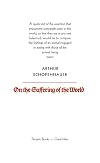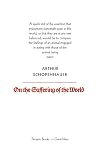
On The Suffering of the World
by Arthur Schopenhauer
On This Page
Description
On the Suffering of the World is a collection of the later aphoristic writings of Arthur Schopenhauer, known for their incisive, aphoristic style and dark, pessimistic view of human existence. Edited and with an introduction by Eugene Thacker, On the Suffering of the World comprises a core selection of Schopenhauer's later writings, gathered together for the first time in print. These texts, produced during the last decades of Schopenhauer's long life, reveal a unique kind of philosophy, show more expressed in a singular style. Eschewing the tradition of dry, totalizing, academic philosophy prevalent during the time, Schopenhauer's later writings mark a shift towards a philosophy of aphorisms, fragments, anecdotes and observations, written in a literary style that is by turns antagonistic, resigned, confessional, and filled with all the fragile contours of an intellectual memoir. Here Schopenhauer allows himself to pose challenging questions regarding the fate of the human species, the role of suffering in the world, and the rift between self and world that increasingly has come to define human existence, to this day. It is these writings of Schopenhauer that later generations of artists, poets, musicians, and philosophers would identify as exemplifying the pessimism of their era, and perhaps of our own as well. On the Suffering of the World is presented with an introduction that places Schopenhauer's thought in its intellectual context, while also connecting it to contemporary concerns over climate change, the anthropocene, and the spectre of human extinction. The book also includes a bibliography and chronology of Schopenhauer's life. show lessTags
Recommendations














































Member Reviews
Where he's good, Schopenhauer is very good (On the Suffering of the World, On Thinking for Yourself, On Philosophy and the Intellect), but where he's bad he's execrable (On Women).
Dour and pessimistic, he's the Morrissey of philosophy. All is vanity, life is short and joy is fleeting. I have to wonder if today he would be diagnosed with clinical depression, rather than the romantic melancholia of genius. So, that said, I found much in common with him, in a mordantly humourous way, as I'm inclined to a glass-half-empty view of life (much as I seek to amend that). Where I think he goes wrong, particularly so in his views upon women, is in not challenging the assumptions and cultural perspectives of his time and place. He takes these views show more as given and does not seem to be conscious of the possibility that the qualities he berates in woman may be roles forced upon them by society, nor that his own perspective may be skewed by the privileged position he holds in that society as a man.
Worth reading, though I'm sure he would not have said the same about this review, laden as it is with plebian affectations to style, parentheses and deviod of original thought, relying instead upon a disection of the thoughts of another. show less
Dour and pessimistic, he's the Morrissey of philosophy. All is vanity, life is short and joy is fleeting. I have to wonder if today he would be diagnosed with clinical depression, rather than the romantic melancholia of genius. So, that said, I found much in common with him, in a mordantly humourous way, as I'm inclined to a glass-half-empty view of life (much as I seek to amend that). Where I think he goes wrong, particularly so in his views upon women, is in not challenging the assumptions and cultural perspectives of his time and place. He takes these views show more as given and does not seem to be conscious of the possibility that the qualities he berates in woman may be roles forced upon them by society, nor that his own perspective may be skewed by the privileged position he holds in that society as a man.
Worth reading, though I'm sure he would not have said the same about this review, laden as it is with plebian affectations to style, parentheses and deviod of original thought, relying instead upon a disection of the thoughts of another. show less
Schopenhauer has some pretty great ideas although to me, he didn't express them very eloquently and clearly which made me re-read several passages. His first few essays were brilliant, although it was hard to take him seriously after his misogynistic essay On Women where he contradicts the philosophy he espouses in previous essays. (The need for objectivity, being aware of the phenomenal nature of the logical system etc) I was able to detach myself from that though and admit that his last essay on writing redeemed him if only a little.
Marvellous work, cold and direct on the subject of humanity and what makes it tick. To be read in your twenties or after your first heartbroken.
Ratings
Members
- Recently Added By
Lists

Books Read in 2016
4,666 works; 199 members
Author Information

730+ Works 14,923 Members
Arthur Schopenhauer traveled in childhood throughout Europe and lived for a time in Goethe's Weimar, where his mother had established a salon that attracted many of Europe's leading intellectuals. As a young man, Schopenhauer studied at the University of Gottingen and in Berlin, where he attended the lectures of Fichte and Schleiermacher. show more Schopenhauer's first work was The Fourfold Root of the Principle of Sufficient Reason (1813), followed by a treatise on the physiology of perception, On Vision and Colors (1816). When Schopenhauer wrote his principal work, The World as Will and Idea (1819), he was confident that it was a work of great importance that would soon win him fame, but in this he was badly disappointed. In 1819 he arranged to hold a series of philosophical lectures at the same time as those of the newly arrived professor Hegel, whom Schopenhauer despised (calling him, among other creative epithets, an "intellectual Caliban"). This move resulted only in further humiliation for Schopenhauer, since no one showed up to hear him. Schopenhauer continued to be frustrated in repeated attempts to achieve recognition. In 1839 and 1840 he submitted essays on freedom of the will and the foundation of morality to competitions sponsored by the Royal Danish Academy but he won no prize, even when his essay was the only entry in the competition. In 1844 he published a second volume of The World as Will and Idea, containing developments and commentaries on the first. Around 1850, toward the end of his life, Schopenhauer's philosophy began to receive belated recognition, and he died in the confidence that his long-awaited and deserved fame had finally come. Schopenhauer's philosophy exercised considerable influence in the late nineteenth and early twentieth centuries, not only among academic philosophers but even more among artists and literati. This may be in part because, unlike his German idealist contemporaries, Schopenhauer is a lucid and even witty writer, whose style consciously owes more to Hume than to Kant. Schopenhauer's philosophy is founded on the idea that reality is Will--a single, insatiable, objectless striving that manifests itself in the world of appearance as a vast multiplicity of phenomena, engaged in an endless and painful struggle with one another. He saw the same vision in the texts of Indian religions---Vedanta and Buddhism---which he regarded as vastly superior to Western monotheism. Schopenhauer's theory of the empirical world is an idealism, in which the doctrines of Kant are identified with those of Berkeley. In aesthetic enjoyment Schopenhauer saw a form of knowledge that is higher than ordinary empirical knowledge because it is a disinterested contemplation of the forms or essences of things, rather than a cognition of causal connections between particulars driven by the will's interest in control and domination. True salvation, however, lies in an intuitive insight into the evil of willing, which in its highest manifestations is capable of completely extinguishing the will in a state of nirvana. In his perceptive development of the psychological consequences of his theory, Schopenhauer gives particular emphasis to the way in which our knowledge and behavior are insidiously manipulated by our unconscious volition; this stress, plus the central role he gives to sexuality in his theory of the will, contains much that is found later in Freud (who acknowledged that Schopenhauer had anticipated his theory of repression). Schopenhauer's main influence on twentieth-century philosophy, however, was mediated by Nietzsche, whose theory of the will to power added a poignant twist by committing itself to the affirmation of the will while still conceiving it in essentially the same way---insatiable, painful, predatory, deceptive, and subversive of rational thought---which it had been in Schopenhauer's metaphysical pessimism. (Bowker Author Biography) show less
Some Editions
Series
Belongs to Publisher Series
Penguin Great Ideas (14)
Work Relationships
Is contained in
Common Knowledge
- Canonical title
- On The Suffering of the World
- Original publication date
- 2004 (this collection) (this collection)
- Original language
- German
Classifications
Statistics
- Members
- 583
- Popularity
- 50,403
- Reviews
- 3
- Rating
- (3.63)
- Languages
- 6 — English, French, Greek, Japanese, Portuguese, Spanish
- Media
- Paper, Audiobook, Ebook
- ISBNs
- 16
- UPCs
- 1
- ASINs
- 12