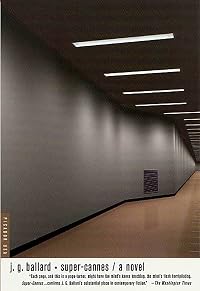
Super-Cannes
by J. G. Ballard
On This Page
Description
Long-regarded as one of the true visionary writers of the twentieth century, J.G. Ballard was one of the first British writers of the post-war period to begin to see, and to map out in his fiction, the future course of our civilization. For forty years his unflinching eye has turned to the point where the advancing edge of our technological progress has worn away our inner humanity.Eden-Olympia is more than just a multinational business park, it is a virtual city-state in itself, with the show more latest in services and facilities for the most elite high-tech industries. Isolated and secure, overlooking the luxurious French Riviera, the residents lack nothing. Yet one day Dr. Greenwood from Eden-Olympia's clinic goes on a suicidal shooting spree. Dr. Jane Sinclair is hired as his replacement, and she and her husband, Paul, are given Dr. Greenwood's house as a residence.Unable to work while recovering from an accident, Paul spends his days taking aclose look at the house where Dr. Greenwood shot himself and three hostages. He discovers clues in the house lead him to question Eden-Olympia's official account of the killings. Drawn into investigating the activities of the park's leading citizens, while Jane is lured deeper into Eden-Olympia's inner workings, Paul uncovers the dangerous psychological vents that maintain Eden-Olympia's smoothly running surface. An experiment is underway at Eden-Olympia, an experiment in power and brutality. Soon Paul finds himself in race to save himself and his wife before they are crushed by forces that may be beyond anyone's control. show lessTags
Recommendations












Member Recommendations


Member Reviews
This is a book about business and psychopathy. Anyone who has worked in a large multi-national should recognise the inherent truth in Ballard's novel, that the competitive drive of individuals in very large corporations drives not the most competent to the top, but the most psychopathic. In this imagined massive business park in the South of France Ballard's characters are orchestrated by a rouge psychiatrist, Wilder Penrose, into organised violence, sexual indulgence and ultimately random killing. Paul Sinclair the protagonist arrives at Super Cannes as a semi-retired partner of an executive transferred to the site and we follow his story as he tries to unravel the bizarre happenings.
Ballard is a genius and this work is a genuine show more thriller with a brilliant twist at the end. show less
Ballard is a genius and this work is a genuine show more thriller with a brilliant twist at the end. show less
“Representative democracy had been replaced by the surveillance camera and the private police force.”
This novel revolves around a gated capitalist paradise, Eden-Olympia. Eden-Olympia, with its ornamental ponds, sports centres and cafes, is a hi-tech business park nestling in the hills above the French Riviera, home to the new elites of major multi-national companies like Siemens and Mitsui etc. Its inhabitants, monitored by surveillance cameras and guarded by the complex's own security force, have no need or time to interact with the larger community. All that matters is the accumulation of wealth, work and company profits have eclipsed the need for play.
Into this capitalist paradise arrives an ex-RAF pilot and his wife. Paul show more Sinclair is recovering from injuries to his knees sustained in a botched aeroplane take-off where he was the pilot whilst his wife Jane is a youthful paediatrician with a taste for the occasional recreational drug. Jane is to replace David Greenwood, a doctor who some months earlier had rampaged Eden-Olympia with a rifle killing 10 people before dying himself himself. Because of his injuries, Paul finds himself with plenty of free time on his hands which he increasingly spends alone due to Jane's burgeoning work schedule. Smelling a conspiracy Paul, an prompted by resident psychiatrist Wilder Penrose, turns sleuth trying to uncover why David Greenwood, whom his wife knew back in Britain as a mild mannered doctor, turned mass murderer.
As Paul delves under the skin of Eden-Olympia he discovers a serious programme of violence, designed and promoted by Penrose, to counteract executive stress in which Arab pimps and Senegalese trinket merchants are left bleeding in the gutters and robberies committed. Sinclair is appalled by the criminality he uncovers but also feels a grudging admiration of the rationale behind it and finds himself unable to inform the Police or tear himself away.
This is a well crafted novel and the action progresses at a good clip meaning that the reader ends up caring for Paul and willing as he sinks further into this murky other world that he will not only wake up and come to his senses but also actively do something to halt it it's expansion. Twisted Penrose is a well written villain, an "amiable Prospero", the anti-hero of this insular little world, viewing the encouragement of baser instincts as an engine to drive the arts, sciences and industries of the world who treats those around him almost as clockwork toys, to wind-up then sit back and revel in the havoc that they cause. On the whole I really enjoyed it yet it also missed that little something that would have made this a really good read. show less
This novel revolves around a gated capitalist paradise, Eden-Olympia. Eden-Olympia, with its ornamental ponds, sports centres and cafes, is a hi-tech business park nestling in the hills above the French Riviera, home to the new elites of major multi-national companies like Siemens and Mitsui etc. Its inhabitants, monitored by surveillance cameras and guarded by the complex's own security force, have no need or time to interact with the larger community. All that matters is the accumulation of wealth, work and company profits have eclipsed the need for play.
Into this capitalist paradise arrives an ex-RAF pilot and his wife. Paul show more Sinclair is recovering from injuries to his knees sustained in a botched aeroplane take-off where he was the pilot whilst his wife Jane is a youthful paediatrician with a taste for the occasional recreational drug. Jane is to replace David Greenwood, a doctor who some months earlier had rampaged Eden-Olympia with a rifle killing 10 people before dying himself himself. Because of his injuries, Paul finds himself with plenty of free time on his hands which he increasingly spends alone due to Jane's burgeoning work schedule. Smelling a conspiracy Paul, an prompted by resident psychiatrist Wilder Penrose, turns sleuth trying to uncover why David Greenwood, whom his wife knew back in Britain as a mild mannered doctor, turned mass murderer.
As Paul delves under the skin of Eden-Olympia he discovers a serious programme of violence, designed and promoted by Penrose, to counteract executive stress in which Arab pimps and Senegalese trinket merchants are left bleeding in the gutters and robberies committed. Sinclair is appalled by the criminality he uncovers but also feels a grudging admiration of the rationale behind it and finds himself unable to inform the Police or tear himself away.
This is a well crafted novel and the action progresses at a good clip meaning that the reader ends up caring for Paul and willing as he sinks further into this murky other world that he will not only wake up and come to his senses but also actively do something to halt it it's expansion. Twisted Penrose is a well written villain, an "amiable Prospero", the anti-hero of this insular little world, viewing the encouragement of baser instincts as an engine to drive the arts, sciences and industries of the world who treats those around him almost as clockwork toys, to wind-up then sit back and revel in the havoc that they cause. On the whole I really enjoyed it yet it also missed that little something that would have made this a really good read. show less
Gritty and gruesome, this book is a look at the underbelly of the modern industrial elite. It makes a compelling argument against an over-intellectualism and hypocritical society where human emotion has no outlet and can, therefore, only be expressed in deviant ways. The construction is careful: it neither insults the reader nor progresses too cryptically so that the reader can follow the logic of this world, its crippling hold and its unique morality. A harsh critique of modern capitalism with a wonderful rebellious ending.
Anyone who's read say, half a dozen Ballard novels could probably identify this as such from the first paragraph. A first paragraph that stayed with me through-out the book. Indeed I re-read it twice, once at about the 1/3 mark and once right after finishing the book.
One is rapidly led to believe that this novel deals with all of Ballard's normal tropes; medical doctor characters, nutters, aviation, social microcosms, veneer of civilisation which is easily ripped away. In the case of one of these, though, one is being mis-led, which makes the book more interesting. Instead of pulling a Lord of the Flies re-set (see High Rise, Concrete Island, Rushing to Paradise) here the characters, despite all working in a giant science park on the show more French Riviera, do not lose their connections to the outside world completely - at least not physically, making the book more realistic than say, High Rise, where everybody inexplicably chooses to give up work and never leave their middle-class tower apartment block home. Most of the characters still behave like a-moral aliens or depraved loonies, however. This seems to have been one of Ballard's core beliefs; we're all just pretending to be sane until we can get to a situation where we don't have to pretend anymore. I don't really buy it.
There's a murder mystery at the core of the book, which provides a narrative drive sometimes absent with Ballard. Who did what and why seems to be pretty much wrapped up by about half way and then the book meanders for about 100p before further revelations wind things up again for a denouement that is quite satisfying, particularly the very end.
If there's a real antagonist in this book, it's the psychiatrist, Wilder, who's views are disturbing. I immediately reacted against them; this must be wrong! But I had to stop and seriously think things through to see where the error was hidden. A novel hasn't made me do that since Starship Troopers. It's one of those scary philosophies all the more dangerous and superficially plausible because there is just enough truth mixed with the insanity.
Ballard is such a hit-and-miss writer. High Rise was an unmitigated disaster, Rushing to Paradise is a bull's eye, this is somewhere between. More interesting for being a believable setting, more readable for its use and subversion of murder-mystery trappings, clever in the character arc of the protagonist, but suffering still from being too much of a re-tread of Ballard's basic themes, never-the-less worthwhile. show less
One is rapidly led to believe that this novel deals with all of Ballard's normal tropes; medical doctor characters, nutters, aviation, social microcosms, veneer of civilisation which is easily ripped away. In the case of one of these, though, one is being mis-led, which makes the book more interesting. Instead of pulling a Lord of the Flies re-set (see High Rise, Concrete Island, Rushing to Paradise) here the characters, despite all working in a giant science park on the show more French Riviera, do not lose their connections to the outside world completely - at least not physically, making the book more realistic than say, High Rise, where everybody inexplicably chooses to give up work and never leave their middle-class tower apartment block home. Most of the characters still behave like a-moral aliens or depraved loonies, however. This seems to have been one of Ballard's core beliefs; we're all just pretending to be sane until we can get to a situation where we don't have to pretend anymore. I don't really buy it.
There's a murder mystery at the core of the book, which provides a narrative drive sometimes absent with Ballard. Who did what and why seems to be pretty much wrapped up by about half way and then the book meanders for about 100p before further revelations wind things up again for a denouement that is quite satisfying, particularly the very end.
If there's a real antagonist in this book, it's the psychiatrist, Wilder, who's views are disturbing. I immediately reacted against them; this must be wrong! But I had to stop and seriously think things through to see where the error was hidden. A novel hasn't made me do that since Starship Troopers. It's one of those scary philosophies all the more dangerous and superficially plausible because there is just enough truth mixed with the insanity.
Ballard is such a hit-and-miss writer. High Rise was an unmitigated disaster, Rushing to Paradise is a bull's eye, this is somewhere between. More interesting for being a believable setting, more readable for its use and subversion of murder-mystery trappings, clever in the character arc of the protagonist, but suffering still from being too much of a re-tread of Ballard's basic themes, never-the-less worthwhile. show less
A wonderful novel, oozing with millenarian angst and chock-full of Ballard’s favourite icons, played from his deck like tarot cards – the Grounded Pilot, the Closed Community, the Unhinged Doctor, the Sexy Car-Crash – with the theme, as always, having to do with the dark poles of eros and thanatos lurking just beneath the veneer of human society.
The plot involves Paul Sinclair, a former airman recovering from a plane crash, who accompanies his young wife Jane to an ultramodern business park on the French Riviera, where she is to work as an on-site physician. Paul gets drawn into uncovering the mystery surrounding Jane’s predecessor, who went on a killing spree and murdered ten people before being killed himself.
At first the show more place seems paradisiacal, full of rich happy people like something from the 30s – ‘a vanished world of Cole Porter and beach pyjamas, morphine lesbians and the swagger portraits of Tamara de Lempicka’. But something is very wrong at the Eden-Olympia complex: in each tiny, everyday detail there is an undercurrent of cheap sex, casual violence, sickness. (It is very Lynchian in that sense: god I wish Lynch would film this.) ‘Over the swimming pools and manicured lawns seemed to hover a dream of violence,’ we are told at one point; but often the hints are more subtle and unnerving. Innocuous body parts become creepy and upsetting as Ballard describes them:
My exposed big toes unsettled her, flexing priapically among the unswept leaves.
I love this sentence so much. It makes me laugh at how ridiculous it is, while also making me shudder because it works. There is more lurking menace when Paul and Jane arrive at their new home:
The house was silent, but somewhere in the garden was a swimming pool filled with unsettled water.
—Actually let me just stop there for a second so we can appreciate that admirable sentence. Doing a lot of work, isn’t it! Direct but efficient. Ballard goes on:
Reflections from its disturbed surface seemed to bruise the smooth walls of the house. The light drummed against Jane’s sunglasses, giving her the edgy and vulnerable look of a studio visitor who had strayed into the wrong film set.
The reference to the movie business is an example of Ballard’s tendency to choose his similes and metaphors from the realms of modern technology and celebrity culture. The world of Super-Cannes is not natural but rather scientific, medical: a flag flutters ‘like the trace of a fibrillating heart’, the sea is ‘smooth enough to xerox’, every hair on a fur stole is ‘as vibrant as an electron track in a cloud chamber’, crowds of tourists clump around the shop-fronts ‘like platelets blocking an artery’.
This is only the third or fourth Ballard novel I’ve read, but I’ve never enjoyed his cold, efficient prose style more than I did here. Some writers explore themes; Ballard dissects them, using a scalpel. Like his main influence, William Burroughs, and his main disciple, Will Self, Ballard sees social problems as a matter of pathology: sexual perversion for him is about psychosexual dysfuction; casual violence is about clinical psychopathy. This medicalisation can make for an eerie worldview, but it gives you some descriptive passages you wouldn’t get from any other writer. And for once, I genuinely cared about the characters here – I was really rooting for Paul and Jane to get out in one piece.
As well as being a mystery story, this is a stonking novel-of-ideas, and the main idea is this: if the modern world is making us all less sociable and more atomised, what might the psychological consequences be? Because the madness and violence at Eden-Olympia are intimately tied to the erosion of community that Ballard sees around him:
People find all the togetherness they need in the airport boarding lounge and the department-store lift. They pay lip service to community values but prefer to be alone.
Or again:
The Adolf Hitlers and Pol Pots of the future won’t walk out of the desert. They’ll emerge from shopping malls and corporate business parks.
I’m not sure I entirely accept Ballard’s thesis, or his speculation that ‘meaningless violence may be the true poetry of the new millennium’; but then I don’t think he does either – it’s thrown out there as a way of working with the issues. Watching him at work, scalpel in hand, is disturbing, thought-provoking, and enormously enjoyable. show less
The plot involves Paul Sinclair, a former airman recovering from a plane crash, who accompanies his young wife Jane to an ultramodern business park on the French Riviera, where she is to work as an on-site physician. Paul gets drawn into uncovering the mystery surrounding Jane’s predecessor, who went on a killing spree and murdered ten people before being killed himself.
At first the show more place seems paradisiacal, full of rich happy people like something from the 30s – ‘a vanished world of Cole Porter and beach pyjamas, morphine lesbians and the swagger portraits of Tamara de Lempicka’. But something is very wrong at the Eden-Olympia complex: in each tiny, everyday detail there is an undercurrent of cheap sex, casual violence, sickness. (It is very Lynchian in that sense: god I wish Lynch would film this.) ‘Over the swimming pools and manicured lawns seemed to hover a dream of violence,’ we are told at one point; but often the hints are more subtle and unnerving. Innocuous body parts become creepy and upsetting as Ballard describes them:
My exposed big toes unsettled her, flexing priapically among the unswept leaves.
I love this sentence so much. It makes me laugh at how ridiculous it is, while also making me shudder because it works. There is more lurking menace when Paul and Jane arrive at their new home:
The house was silent, but somewhere in the garden was a swimming pool filled with unsettled water.
—Actually let me just stop there for a second so we can appreciate that admirable sentence. Doing a lot of work, isn’t it! Direct but efficient. Ballard goes on:
Reflections from its disturbed surface seemed to bruise the smooth walls of the house. The light drummed against Jane’s sunglasses, giving her the edgy and vulnerable look of a studio visitor who had strayed into the wrong film set.
The reference to the movie business is an example of Ballard’s tendency to choose his similes and metaphors from the realms of modern technology and celebrity culture. The world of Super-Cannes is not natural but rather scientific, medical: a flag flutters ‘like the trace of a fibrillating heart’, the sea is ‘smooth enough to xerox’, every hair on a fur stole is ‘as vibrant as an electron track in a cloud chamber’, crowds of tourists clump around the shop-fronts ‘like platelets blocking an artery’.
This is only the third or fourth Ballard novel I’ve read, but I’ve never enjoyed his cold, efficient prose style more than I did here. Some writers explore themes; Ballard dissects them, using a scalpel. Like his main influence, William Burroughs, and his main disciple, Will Self, Ballard sees social problems as a matter of pathology: sexual perversion for him is about psychosexual dysfuction; casual violence is about clinical psychopathy. This medicalisation can make for an eerie worldview, but it gives you some descriptive passages you wouldn’t get from any other writer. And for once, I genuinely cared about the characters here – I was really rooting for Paul and Jane to get out in one piece.
As well as being a mystery story, this is a stonking novel-of-ideas, and the main idea is this: if the modern world is making us all less sociable and more atomised, what might the psychological consequences be? Because the madness and violence at Eden-Olympia are intimately tied to the erosion of community that Ballard sees around him:
People find all the togetherness they need in the airport boarding lounge and the department-store lift. They pay lip service to community values but prefer to be alone.
Or again:
The Adolf Hitlers and Pol Pots of the future won’t walk out of the desert. They’ll emerge from shopping malls and corporate business parks.
I’m not sure I entirely accept Ballard’s thesis, or his speculation that ‘meaningless violence may be the true poetry of the new millennium’; but then I don’t think he does either – it’s thrown out there as a way of working with the issues. Watching him at work, scalpel in hand, is disturbing, thought-provoking, and enormously enjoyable. show less
This was quite a strange chilling one. Ballard has seized the fever that gripped (some of) us back in the 1990s as the millennium approached, asked himself some questions about where society was heading at the time and then produced this novel. In it, he constructs an artificial community which the great corporations of the day have founded as an ideal working environment. The trouble is, it’s too ideal.
As the staff work longer and longer hours, eschewing all sense of sociability, they gradually lose their minds. There is a remedy but it’s more horrific than our protagonist can grasp. For the most part, this reads more like a detective thriller as Paul tries to dig deeper into the mystery of why Dr David Greenwood, a fellow Brit, show more had murdered a number of colleagues in a shooting frenzy one day shortly before Paul arrives on the scene.
The novel’s strength lies in the way the author develops the surreal facade of perfection that is the community of Eden-Olympia. You know it’s not right even though the descriptions are of paradise. There’s something very clever about this writing and I think it must be in the way he describes the people. It just goes to show his skill in creating flawed characters against a flawless backdrop. And it works to create a jarring juxtaposition right through the novel. In fact, as the people become more flawed the close you get to them, the worse this becomes until the whole thing shatters.
I enjoyed it but it wasn’t as good a read as I expected. It asks questions of us as a society but, really also asks questions of us as individuals? What drives us and what keeps us sane? What do we need to keep a balance in our lives? To what extent can you artificially create a lifestyle without causing some monstrous cancer to develop inside the soul? Good questions. show less
As the staff work longer and longer hours, eschewing all sense of sociability, they gradually lose their minds. There is a remedy but it’s more horrific than our protagonist can grasp. For the most part, this reads more like a detective thriller as Paul tries to dig deeper into the mystery of why Dr David Greenwood, a fellow Brit, show more had murdered a number of colleagues in a shooting frenzy one day shortly before Paul arrives on the scene.
The novel’s strength lies in the way the author develops the surreal facade of perfection that is the community of Eden-Olympia. You know it’s not right even though the descriptions are of paradise. There’s something very clever about this writing and I think it must be in the way he describes the people. It just goes to show his skill in creating flawed characters against a flawless backdrop. And it works to create a jarring juxtaposition right through the novel. In fact, as the people become more flawed the close you get to them, the worse this becomes until the whole thing shatters.
I enjoyed it but it wasn’t as good a read as I expected. It asks questions of us as a society but, really also asks questions of us as individuals? What drives us and what keeps us sane? What do we need to keep a balance in our lives? To what extent can you artificially create a lifestyle without causing some monstrous cancer to develop inside the soul? Good questions. show less
Eden-Olympia is a secure and crime-free gated community for the rich and work obsessed. A silicon valley for France and a place with an ethic of all work and no play. A young doctor and her husband, an injured pilot, move there to take over from a doctor who went on a murderous rampage. It's Ballard at his cold and clinical best, illuminating the darker sides of human nature and giving something of a prophetic warning. It's not new territory for Ballard, a slightly more laid back version of High Rise, but as usual he finds new angles to shine light on his literary obsessions.
Members
- Recently Added By
Lists

Must read
10 works; 1 member

Broderick and Di Filippo's Science Fiction: The 101 Best Novels 1985-2010
103 works; 7 members

Books Read in 2021
5,361 works; 114 members

1001 Books You Must Read Before You Die
1,448 works; 1,137 members
Author Information

290+ Works 37,812 Members
J. G. Ballard was born to British parents in Shanghai, China on November 15, 1930. While a child during World War II, he spent four years in a Japanese POW camp. This experience was the basis for the emotionally moving novel Empire of the Sun, which he adapted into a successful movie, directed by Steven Spielberg. Before becoming a full-time show more writer, he studied medicine at Cambridge University and served as a pilot in the British Royal Air Force. Ballard is best known for his science fiction writings. His early works were heavily influenced by surrealism. Most of his novels deal with death and destruction of the human spirit. Novels such as Crash, Concrete Island, and High Rise portray a society that is devolving into barbaric chaos. Crash was made into a movie by David Cronenberg in 1996. The Drowned World describes an apocalyptic society, with a hero that ushers in the destruction of the world. His novel Empire of the Sun was shortlisted for the Booker Prize and awarded the Guardian Fiction Prize and James Tait Black Memorial Prize for fiction. Empire of the Sun was filmed by Steven Spielberg in 1987, starring a young Christian Bale as Jim (Ballard). Ballard moved away from science fiction, but he is still considered one of the leading authors of the genre. He died on April 19, 2009 at the age of 78. (Bowker Author Biography) show less
Some Editions
Awards and Honors
Common Knowledge
- Original title
- Super-Cannes
- Original publication date
- 2000
- People/Characters
- Paul Sinclair; Wilder Penrose; Frank Halder; Senora Morales
- Important places*
- Eden-Olympia, Provence-Alpes-Côte d'Azur, France
- First words
- The first person I met at Eden-Olympia was a psychiatrist, and in many ways it seems only too apt that my guide to this 'intelligent' city in the hills above Cannes should have been a specialist in mental disorders.
- Quotations
- Meaningless violence may be the true poetry of the new millennium.
- Last words*
- (Click to show. Warning: May contain spoilers.)I drove on thinking of Jane and Frances Baring and Wilder Penrose, ready to finish the task that David Greenwood had begun.
- Publisher's editor*
- Flamingo
- Canonical DDC/MDS
- 823.914
- Canonical LCC
- PR6052.A46
*Some information comes from Common Knowledge in other languages. Click "Edit" for more information.
Classifications
Statistics
- Members
- 1,430
- Popularity
- 16,565
- Reviews
- 24
- Rating
- (3.56)
- Languages
- 9 — Czech, Dutch, English, Finnish, French, Italian, Japanese, Russian, Spanish
- Media
- Paper, Audiobook, Ebook
- ISBNs
- 26
- ASINs
- 8